
This routine is for B1 learners who can follow a learner podcast with the transcript open but lose whole sentences when two native speakers talk at natural speed. The fix is not more listening hours. It is a short block built around one 60 to 90 second clip: listen once without text, read the transcript once, shadow the same clip at three speeds, then retell it from memory. Twelve minutes, four passes, one clip. The payoff is a measurable change in how much fast speech the learner can decode without pausing, plus a written record of which sound features keep causing the breakdown. Nothing is required beyond a player with speed control and a transcript that can be read on screen.
Why B1 listening stalls at native speed
Most B1 learners arrive with a listening habit that worked at A2. The audio is slow, the words are separated, and the transcript confirms what the ear missed. Then a real interview starts and the same learner understands the first ten seconds, catches a name, and loses the next two sentences entirely.
The cause is rarely vocabulary. A B1 learner typically knows most of the words in a fast conversational podcast. The problem is that at natural speed those words are not pronounced the way they are spelled. Function words shrink to a single vowel, consonants disappear at word boundaries, and speakers group four or five words into one rhythmic block with a single stress. The ear is waiting for word-by-word delivery that never arrives.
Shadowing addresses this directly, because it forces the mouth to produce the reduced forms instead of only recognising them on paper. The catch is that most shadowing advice is vague about speed. A learner who shadows only at full speed on day one produces a blur of approximate sounds. A learner who shadows only at 0.75x builds accuracy but never trains the timing that fast speech demands. The ladder in this guide keeps both: accuracy first, then sync, then a short over-speed pass that makes normal speed feel slower.
Pick a source whose transcript can be checked
The single requirement that matters is a transcript the learner can read line by line, legally and immediately. Three public sources meet that test and cover different accents and speeds.
| Show | Typical length | Accent and pace | Transcript |
|---|---|---|---|
| BBC Learning English, 6 Minute English | About 6 minutes | British, clear studio delivery, moderate pace | Full transcript and audio download on the programme page |
| NPR Life Kit | About 20 minutes | American, conversational, fast and often overlapping | Transcript published on the episode page at npr.org |
| TED Talks Daily | About 10 to 20 minutes | Mixed accents, rehearsed but fast | Transcript on the talk page at ted.com |
6 Minute English is the bridge, not the destination. Its scripts are written for learners, so the speed is forgiving and the vocabulary is graded. Life Kit and TED are the real targets: unscripted or semi-scripted speech with the reductions described below.
Two practical rules keep the session honest. First, use only the first 60 to 90 seconds after the opening music, because intros are slow and unusually clear. Second, measure the actual speed instead of guessing. Count the words in that segment of the transcript and divide by its length in minutes. A clip of 220 words in 80 seconds works out at about 165 words per minute, which is fast for B1 and exactly the kind of material the ladder is designed for. Writing that number down turns a vague feeling into a baseline.
The 12-minute speed ladder
The block has four passes and a fixed timer. Stopping the clock matters, because the usual failure is a learner who spends forty minutes on one clip, feels exhausted, and never repeats the routine.
| Pass | Time | Speed | Task |
|---|---|---|---|
| 1. Blind listen | 3 minutes | 1.0x | No text. Note five content words and the exact moment the thread is lost. |
| 2. Transcript check | 3 minutes | 1.0x | Read along, mark no more than three chunks that could not be decoded by ear. |
| 3. Shadowing | 4 minutes | 0.75x, then 1.0x, then 1.15x | Imitate 8 to 12 word chunks out loud, one speed level at a time. |
| 4. Retell | 2 minutes | No audio | Summarise the clip in 45 seconds, record it, compare with the transcript. |
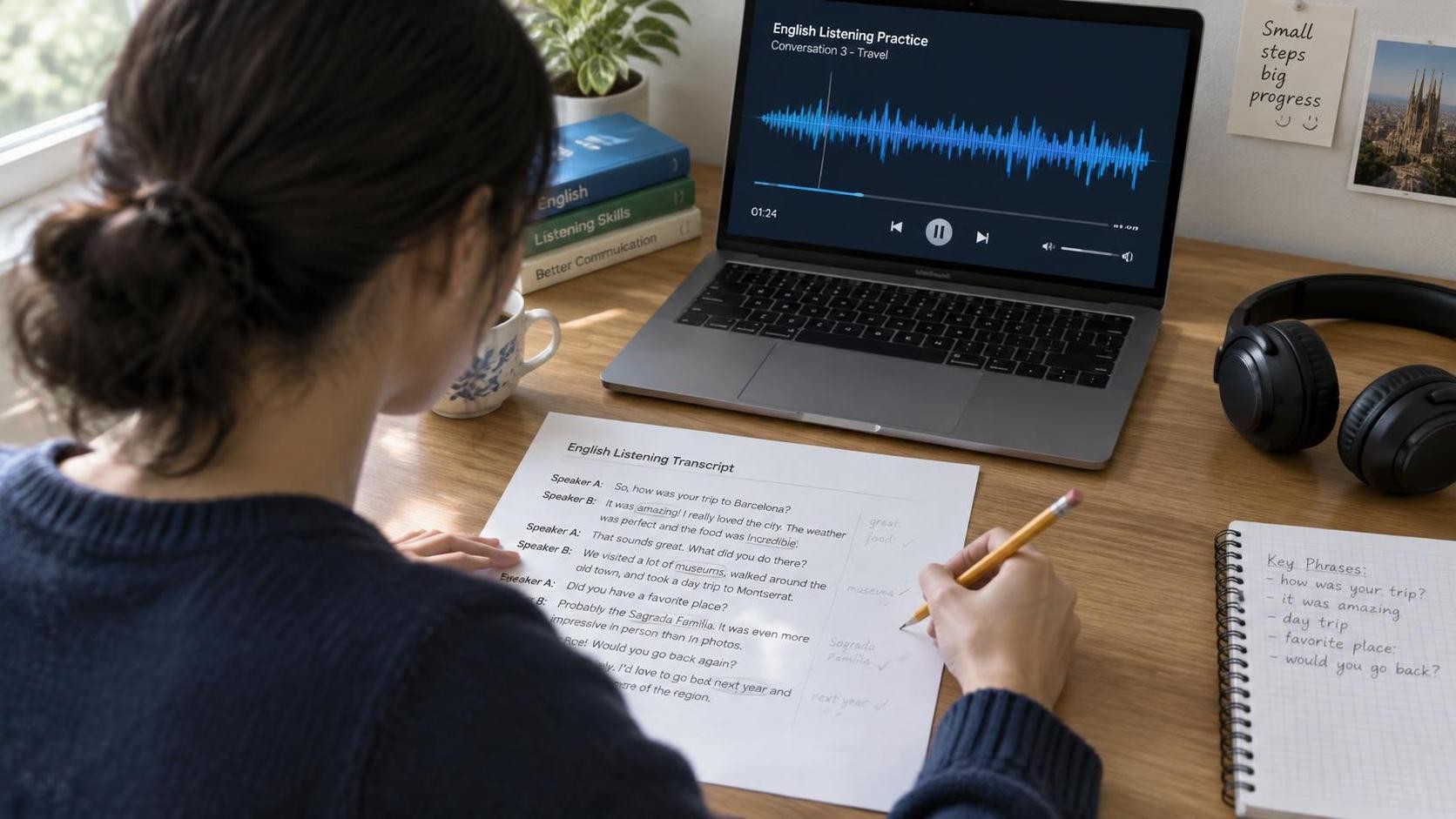
Pass 1: blind listen and mark the collapse point
Play the clip once at normal speed with the screen face down. The task is not full comprehension. The task is to catch five content words, usually nouns and verbs, and to notice the second where attention breaks. Most learners can name that moment: a number, a name, or a sudden change of topic.
Writing down the collapse point is the most useful data in the session. If it always happens when a speaker lists three items quickly, the problem is rhythm. If it happens on contractions, the problem is reduced forms. If it happens on unknown vocabulary, shadowing will not fix it and the learner needs a different exercise.
Pass 2: read the transcript and count the gaps
Play the same clip again with the transcript visible. Mark at most three places where the audio and the page did not match in the ear. Three is a deliberate limit. A learner who marks twenty gaps will spend the rest of the session reading and none of it speaking.
For each marked chunk, say the words slowly, then say them at the speed heard in the audio. The gap usually closes at the second attempt, which is the point: the information was already there, the expectation was wrong.
Pass 3: shadow in three speeds
Shadowing means speaking along with the audio, half a second behind, without stopping. It is not repetition after a pause, and it is not reading aloud. The slight lag is what trains anticipation.
Start at 0.75x with a chunk of 8 to 12 words. Loop that chunk four times. At this speed the goal is clean consonants and correct stress, not speed. Then move to 1.0x on the same chunk, still looping, and accept a small loss of accuracy. Finally run the chunk twice at 1.15x, where the voice will fall behind and some words will vanish. That is expected. The over-speed pass exists to stretch timing, and the return to 1.0x immediately afterwards is what produces the sensation of extra space.
Keep the whole pass to four minutes and cover two or three chunks, not the full clip. Depth on a small segment transfers to new audio far better than a shallow pass over three minutes of material.
Pass 4: retell, record, compare
Turn the audio off. Summarise the clip in 45 seconds with three main points, speaking from memory. Record it on a phone. Then read the transcript again and count how many of the three points survived and whether any detail was invented.
The recording is the part learners skip and the part that shows progress. Week one may produce a halting 20 second summary with one point. Week four usually produces a full 45 seconds with connective phrases borrowed from the podcast itself. Those borrowed phrases are the real acquisition.
Three sound features that break fast speech
Most decoding failures at B1 come from the same short list. Naming them turns a fog into a checklist.
1. Weak forms and the schwa
Function words lose their dictionary vowel. "For" becomes /fə/, "of" becomes /əv/, "can" becomes /kən/, and "to" becomes /tə/. In "a cup of tea for the team", four of the seven words are reduced to a single weak syllable, and the sentence sounds like three beats rather than seven words.
Practice: read the transcript and underline every function word, then say the line with those words compressed. If the line sounds unnaturally clear, it is still too slow.
2. Elision at word boundaries
When two consonants meet, one often disappears. "Next day" loses the /t/ and sounds like "nex day". "Most people" loses the final /t/ of "most". In American speech, /t/ between vowels turns into a soft /d/, so "a lot of" sounds close to "a lodda" and "better" sounds like "bedder".
Practice: find five phrases in the transcript where a word ends and the next begins with a consonant, and say them as one unit.
3. Linking and blended chunks
Words join across boundaries. "An apple" sounds like "anapple", and in British speech a written "r" at the end of a word reappears before a vowel, so "far away" gains an /r/. Fixed combinations also blend: "want to" becomes "wanna", "going to" becomes "gonna", "did you" becomes "didja".
These blends belong in the ear and in informal speech, not in an essay. The listening goal is recognition, and the shadowing goal is to produce them at speed without thinking about spelling.
Score the session in one minute
A four-line log at the end of each session makes progress visible without turning practice into admin work.
| Check | 1 to 2 | 3 | 4 to 5 |
|---|---|---|---|
| Blind listen: content words caught | Fewer than three | Three or four | Five or more, plus the topic |
| Transcript gaps marked | More than five | Three to five | One or two, all reduced forms |
| Shadowing at 1.0x | Constant stops | Two or three stumbles | Steady lag, stress in the right place |
| Over-speed at 1.15x | Cannot continue | Half the chunk survives | Most of the chunk survives |
| Retell | One vague point | Two points, some hesitation | Three points in 45 seconds, clear order |
A total under 12 after two weeks on the same show means the clip is too hard or too long. Drop to a 45 second segment, keep the same ladder, and rebuild. A total above 20 means the material is now too easy, and the next step is a show with overlapping speakers rather than a single host.
When a guided player helps, and when it does not
ListenLeap (listenleap.com) puts podcast and YouTube audio on one screen with bilingual subtitles and short explanations of difficult lines, and it runs on iOS, Android and web. It suits a learner who wants the transcript, the speed control and a line-level explanation in the same place, particularly on a phone during a commute when switching between a podcast app and a transcript page kills the routine. It is not necessary for a learner who already has a transcript page and a player with variable speed, and it does not replace pass 4: the app supplies input, but the retell still has to be spoken out loud and recorded.
A four-week progression
Week one uses one clip from 6 Minute English, repeated on three separate days, with the ladder unchanged. Week two moves to Life Kit with a 60 second segment and a target speed measured from the transcript. Week three keeps the same show and adds one new clip per session, so the voice and the hosts become familiar. Week four returns to the week one clip at full speed with no transcript and compares the retell recording with the first attempt.
The comparison at the end is the only test that matters. Same audio, same learner, four weeks apart, two recordings. If the second recording carries more detail in less time, the ladder worked, and the next month can start with longer clips instead of faster ones.


Comments
No comments yet.
Leave a Comment