

Four Apps, Four Different Ideas About Listening Practice
A learner in Taipei opens her phone at 7:40 in the morning, ten minutes before the subway ride, and faces a familiar question: which app deserves those ten minutes? She has tried three already. One gave her a TED talk with subtitles she could tap. One gave her a movie scene where she had to voice the character. One gave her a short clip and four questions. All three felt useful, and none of them felt complete.
That is the normal state of the category in 2026. Listening apps no longer compete on whether they have video, because almost all of them do. They compete on the mechanics underneath the video: where the audio comes from, how the subtitle layer behaves when a word is unfamiliar, what a drill asks the learner to do with their hands and their voice, and whether the app can tell the difference between a learner who understood a sentence and a learner who merely recognized it.
VoiceTube, EWA, RedKiwi, and ListenLeap each answer those questions differently. A feature by feature look is more useful than a ranking, because the right app depends on which mechanic a learner is missing.
Where the Audio Comes From
Content sourcing shapes everything downstream. An app built on licensed media behaves differently from an app built on short clips, and both behave differently from an app built around audio the learner brings in.
VoiceTube: a curated broadcast archive
VoiceTube has assembled more than 100,000 videos since 2013, drawing on BBC, CNN, ABC, TED talks, and selected YouTube channels, with subtitles prepared and synced by a human team rather than auto generated. The result reads like a well edited channel guide: news, talks, business English, exam prep, entertainment, plus original productions. For a learner who wants to hear how a real broadcast sounds and who trusts editorial judgment over algorithmic feeds, that archive is the strongest asset in this comparison.
EWA: cinema plus a reading shelf
EWA arrived in 2017 with a broader thesis. Its library holds 10,000+ film and TV clips, 1,000+ graded readers with audio narration, 50,000+ flashcards, and 200+ grammar lessons across English, Spanish, French, and Italian. A learner can move from a movie scene to a short book chapter to a grammar drill inside one app, which is unusual. The reading shelf in particular is a genuine asset that pure video apps do not have.
RedKiwi: the daily short clip
RedKiwi, built in Korea in 2019, takes the opposite approach: 10,000+ short YouTube segments, refreshed daily, each short enough to finish in a couple of minutes. The feed stays close to whatever is trending, and the app's design language, with streaks and achievement badges, makes the daily check in feel light. For learners who abandon long videos halfway through, the short format removes that failure mode entirely.
ListenLeap: podcasts, video, and material the learner chooses
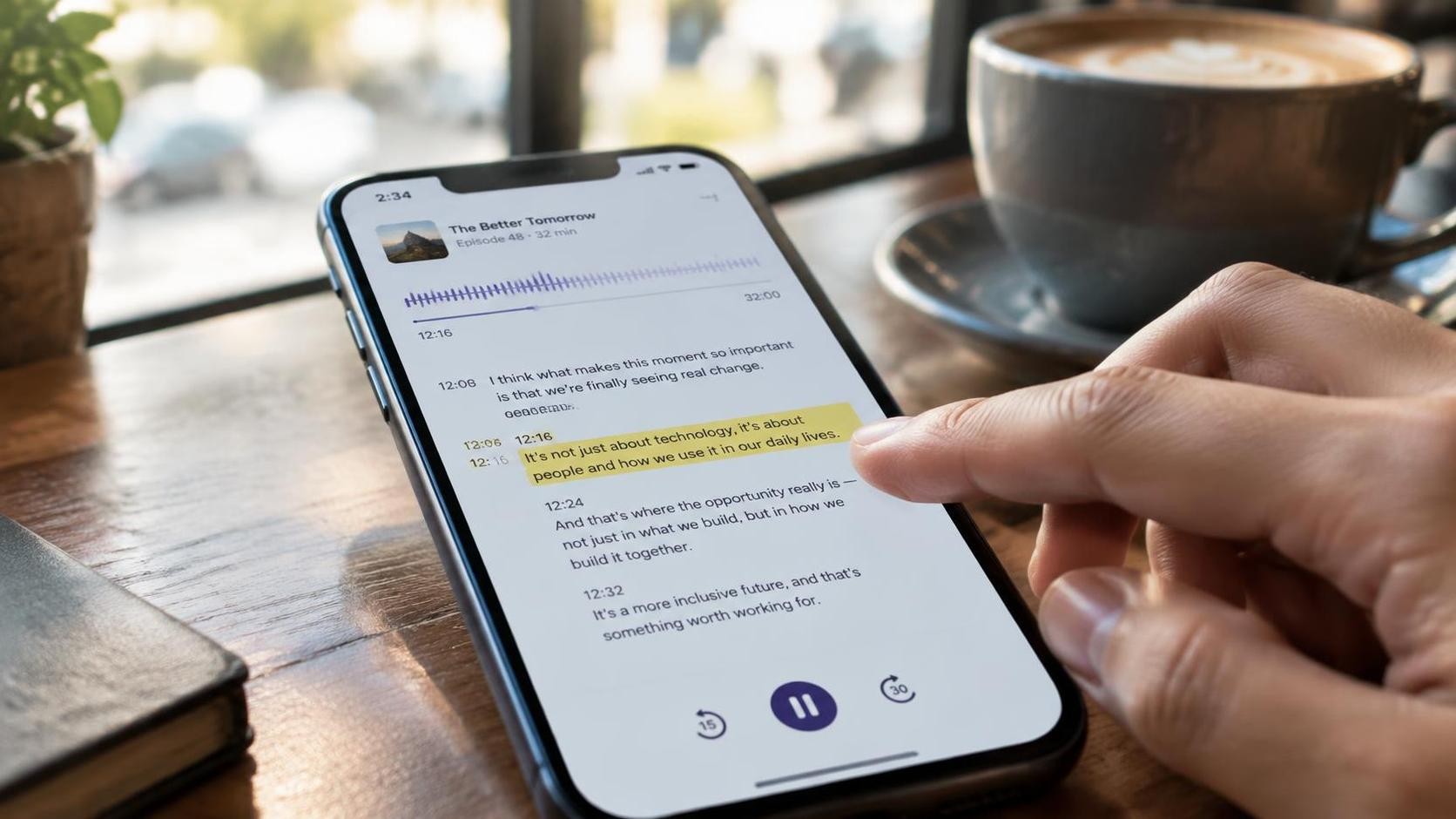
ListenLeap treats the podcast as a first class source rather than an afterthought. Episodes and videos can be pulled in from shows a learner already follows, and the app generates a synchronized transcript with translation on top of whatever audio is loaded. That matters because podcasts are where intermediate learners spend most of their real listening hours: interviews, narrative shows, long form conversations with no visual context to lean on. The library grows with the learner's own interests instead of ending at the edge of a catalog.
The Subtitle Layer and the Speed of a Lookup
Every app in this group shows two languages at once. The difference is what happens in the two seconds after an unfamiliar word appears.
VoiceTube handles this well. Tapping any word in the subtitle opens a dictionary entry with definition, pronunciation, and example sentences, and the video keeps its place. Sentence level looping and adjustable playback speed sit one tap away, which makes the app feel responsive during real viewing rather than only during study mode.
EWA spreads the same job across modes: subtitles inside clips, audio narration inside readers, and a flashcard system with spaced repetition that carries saved words into review. The vocabulary layer is the connective tissue, and the 50,000 card deck gives that layer real depth.
RedKiwi keeps subtitles bilingual across 10+ languages and builds the exercise directly into the clip, so the unfamiliar word usually becomes a blank to fill rather than a word to look up. It is a different philosophy: the app decides what deserves attention instead of waiting for the learner to tap.
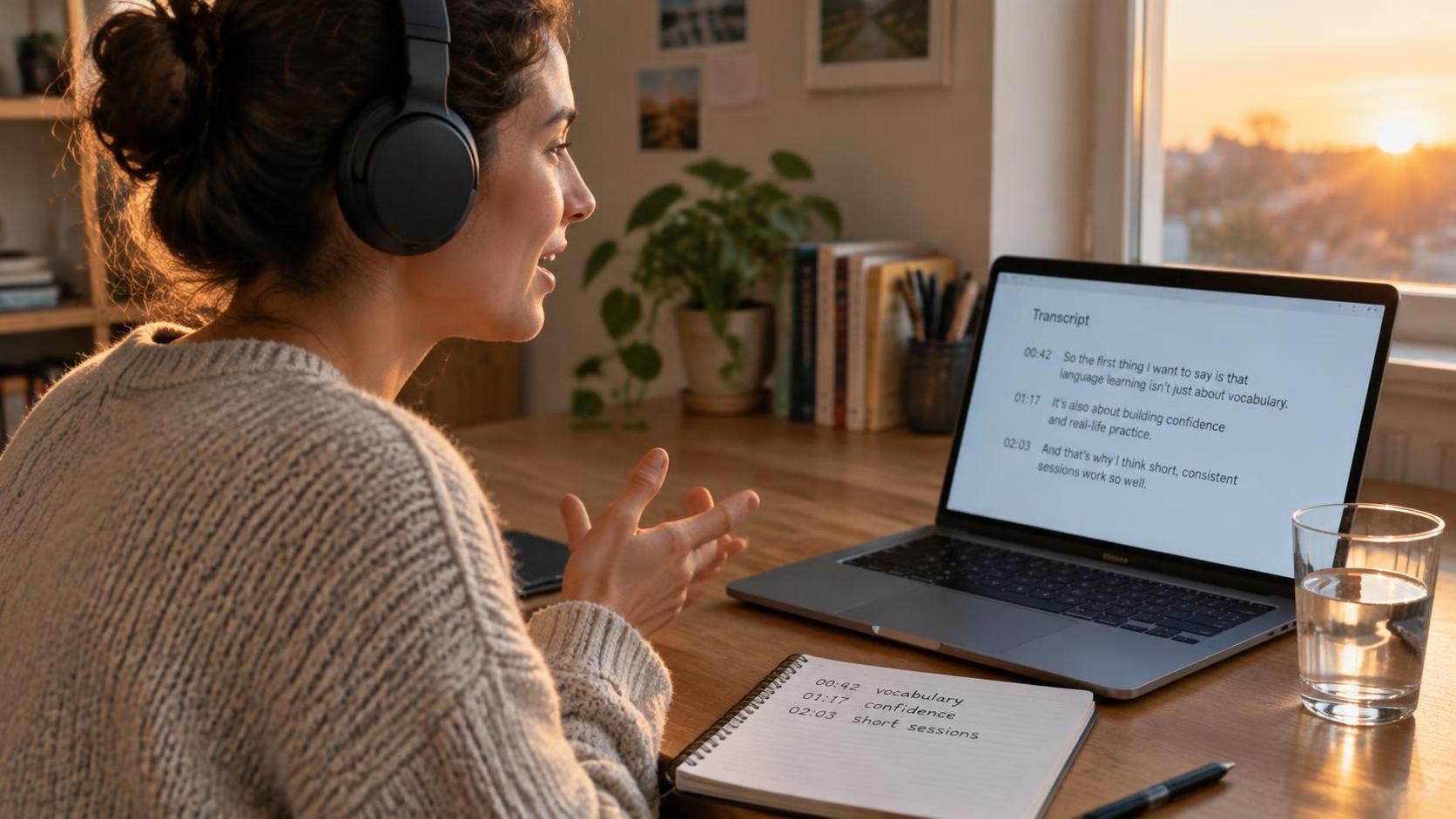
ListenLeap inverts the order. The transcript is generated for the specific episode in front of the learner, so a lookup returns the word in the context of that sentence, with the surrounding lines still visible, and a saved word keeps its original audio attached. A learner can replay the exact three seconds where the word appeared, then hear it again inside the saved card later. The practical effect is fewer interruptions per minute of audio, since context is already on screen when the definition arrives.
Drill Design: Loop, Dictation, Shadowing
A drill is where listening practice either becomes active or stays passive. The four apps sit on a spectrum here.
VoiceTube offers sentence level repeat with speed control and a recording feature that plays the learner's voice against the original. That combination covers the two most common home routines: repeat until the sentence is clear, then imitate until it is comfortable.
RedKiwi goes deepest on comprehension testing. Each clip carries fill in the blank listening items, multiple choice comprehension questions, and a full dictation mode with instant correction, backed by 50,000+ exercises. Dictation is unforgiving in a useful way: it exposes the exact phonemes a learner has been guessing at.
EWA makes the drill physical through dubbing. A learner speaks over a film or TV scene and receives a score, which turns pronunciation practice into something closer to a game than a worksheet. The appeal is obvious, and the format keeps people coming back.
ListenLeap builds the drill around the sentence as the unit of work. Any line in the transcript can be isolated, looped, slowed, and replayed, and shadowing mode records the learner's attempt line by line against the original audio. Because the source is a podcast or a long video rather than a clip, the drill can run for twenty minutes on one continuous conversation, which is closer to the endurance a real conversation demands. The app also keeps a review queue of saved sentences, so a phrase heard on Tuesday reappears on Friday with its audio intact.
Speaking Feedback and AI Coaching
Speaking is where listening apps most often stop short, and the honest split is between apps that score pronunciation and apps that hold a conversation.
VoiceTube includes a conversational AI partner as a premium feature, positioned as support rather than the center of the product, alongside its recording comparison tool. EWA offers an AI chatbot and dubbing scores, giving learners a low pressure place to produce language. RedKiwi relies on shadowing without automated pronunciation scoring, which keeps the loop simple and fast.
ListenLeap treats the AI layer as an explanation engine as much as a conversation partner. A learner can ask why a phrase was used in a particular episode, get a paraphrase of a dense passage, or request a simpler version of the same idea, all without leaving the transcript. Spoken practice runs through shadowing with line by line comparison, and the feedback points at specific words rather than a single overall score. For learners who freeze in conversation, the value is that the explanation arrives inside the material they just heard, at the moment the confusion exists.
Difficulty, Progression, and the Path Forward
VoiceTube sorts its catalog into three levels with human curation, a system that works because the editorial team knows the library. RedKiwi also uses three levels and lets the daily feed supply the progression. EWA starts with a placement test and builds a study plan across reading, video, grammar, and vocabulary.
ListenLeap adjusts difficulty per episode rather than per catalog tier: playback speed, subtitle density, and the amount of translation shown can all move independently, so a learner can keep the audio at natural speed while leaning on more support in the transcript. Progress is tracked across saved sentences, shadowing attempts, and finished episodes, which makes the next step visible without requiring a formal course structure.
Access, Price, and the Practical Layer
All four apps run on iOS and Android. VoiceTube adds a web player with cloud sync and offline downloads on paid plans, priced around $8 to $12 per month. EWA Premium sits near $12.99 per month with downloadable books and lessons. RedKiwi Premium is roughly $6.99 per month. ListenLeap follows a freemium model with subscription tiers, offline downloads, and sync across mobile and web.
Why ListenLeap Holds Up Across the Whole Routine
The pattern across these dimensions is consistent. VoiceTube wins on broadcast quality and editorial care. EWA wins on breadth, with cinema, books, flashcards, and grammar in one place. RedKiwi wins on the daily habit, with short clips and the best structured comprehension drills in the group.
ListenLeap wins on continuity. A single episode carries the learner from first listen, through contextual lookup, into sentence loops, then shadowing, then a review queue, without switching apps or losing the audio. Podcast length makes that continuity possible: twenty or forty minutes of one voice, one topic, one register, which is exactly the condition real listening happens in. The AI transcript and explanation layer removes the friction that usually breaks the routine, and the saved sentence queue turns scattered practice into something that compounds.
For a learner whose problem is finding good material, VoiceTube solves it. For a learner who wants variety and a reading habit alongside video, EWA solves it. For a learner who needs a two minute daily win, RedKiwi solves it. For a learner who already has shows they love and needs a system that turns those hours into measurable progress, ListenLeap is the closest fit, and the difference shows up after the first month rather than the first session.
Choosing by Habit Rather Than by Feature Count
Feature lists flatten real differences. A learner who watches news analysis will get more from VoiceTube's archive than from any recommendation engine. A learner studying for an exam with a reading component will find EWA's graded library hard to replace. A learner rebuilding a daily habit after a long break will appreciate how little RedKiwi asks of them.
The learners who tend to stay with ListenLeap are the ones who listen during commutes, workouts, and chores, and who want those hours to leave a trace. The app assumes the audio is already interesting and puts its effort into what happens around it: the transcript that keeps pace, the definition that arrives in context, the sentence that can be looped until it stops being noise, and the AI that answers a question about grammar at the exact moment it comes up.
Start With One Episode
The fastest way to test any of these four apps is to load one piece of audio that the learner would have listened to anyway, in their own language of interest, and see what the app does with it in the first ten minutes. Whether the transcript appears clean, whether a lookup keeps the context, whether a difficult line can be isolated and slowed, and whether the session ends with something saved: those four signals predict whether the habit will survive week three.
ListenLeap is built for that test. Import a podcast, read along with a generated transcript, tap a word, loop a sentence, record a shadowing attempt, and let the review queue carry the useful parts forward. Ten minutes is enough to feel the difference between an app that plays audio and an app that works on it.



Comments
No comments yet.
Leave a Comment