

A B1 learner who can follow a graded listening file often loses the thread the moment a real podcast begins. The common advice to listen more does not explain what to do in the ten seconds after a sentence disappears. The practical answer is a four pass loop on one short episode with a published transcript: listen without text, read while listening, shadow in short chunks, then retell the segment from memory. The method suits learners at B1 who already handle simple past and present perfect, know roughly two thousand common words, and can read a transcript with a dictionary. It is not a replacement for a full course, and it will not fix a vocabulary gap of several thousand words. What it does provide is a repeatable session of about twenty five minutes, a clear way to locate the exact moment where listening breaks down, and a score that can be compared across episodes.
Why fast native speech needs its own routine
A graded reader moves at a pace that leaves room for translation. A podcast made for native listeners usually runs faster than 140 words per minute, keeps an uneven rhythm, and compresses many small words into weak forms. The difficulty is not only the number of unknown words. It is timing. The listener is still assembling the previous clause when the next one starts, so meaning arrives late and the thread is lost.
Shadowing, the act of speaking along with the audio, helps because it forces the mouth to keep pace with the recording. It also exposes which sounds are actually present and which ones exist only in the written form. The method fails when it is applied to a long show in one pass. Forty minutes of unfamiliar speech produces fatigue, guessing, and no clear feedback. Short, checked, repeated material works better.
Choose one episode that can be checked
The source should meet five conditions. It should run five to eight minutes. It should have one or two speakers. The audio should be clean, with no music under the voices. The producer should publish a full transcript. The topic should be familiar enough that the learner is not fighting two problems at once.
BBC Learning English publishes 6 Minute English episodes of about six minutes with two British presenters and a transcript on the episode page. The format fits this loop well. It is short enough to repeat, long enough to contain natural exchanges, and the transcript can be checked line by line. The speech is conversational British English, not slowed for learners, and the presenters regularly use contractions, weak forms, and linked sounds. The learner should confirm that the transcript appears on the same page as the audio before starting. If only a summary is available, the episode is the wrong choice.
| Source check | Standard to meet |
|---|---|
| Length | Five to eight minutes |
| Speakers | One or two, no panel |
| Transcript | Full text on the episode page |
| Audio | No music under speech |
| Topic | Familiar to the learner |
| Accent | One main variety per episode |
Episodes to avoid for this exercise include panel shows with overlapping laughter, recordings with heavy background music, compilations that change speaker every thirty seconds, and any file without a reliable transcript. Without a transcript, the second pass becomes guesswork and the learner cannot separate a missed word from a missed sound.
Set up one twenty five minute session
The loop has four passes and a short review. The times below are a guide for a six minute episode. A learner who needs more repetition can extend the shadowing pass, but should not extend the blind listen, because the first pass exists to measure the initial result.
| Stage | Time | Task |
|---|---|---|
| Pass one | 6 minutes | Blind listen, no text |
| Pass two | 6 minutes | Read the transcript with the audio |
| Pass three | 8 minutes | Shadow in short chunks |
| Pass four | 4 minutes | Retell from memory |
| Review | 1 minute | Score and note two problems |
Pass one: listen for the shape, not the words
The first listen is a test, not a lesson. The learner plays the whole episode once, without pausing and without the transcript. The task is to write three things afterwards: the topic in one sentence, the attitude of the speakers, and one detail such as a number, a name, or a place. Catching every word is not the goal. A rough grasp of the main idea is enough.
This pass should feel slightly uncomfortable. If it feels easy, the episode is too simple or too short. If nothing at all is understandable, the episode is too hard and should be replaced, not pushed through. A useful target is a general understanding of about sixty percent, with the rest recoverable from context.
Pass two: read while listening
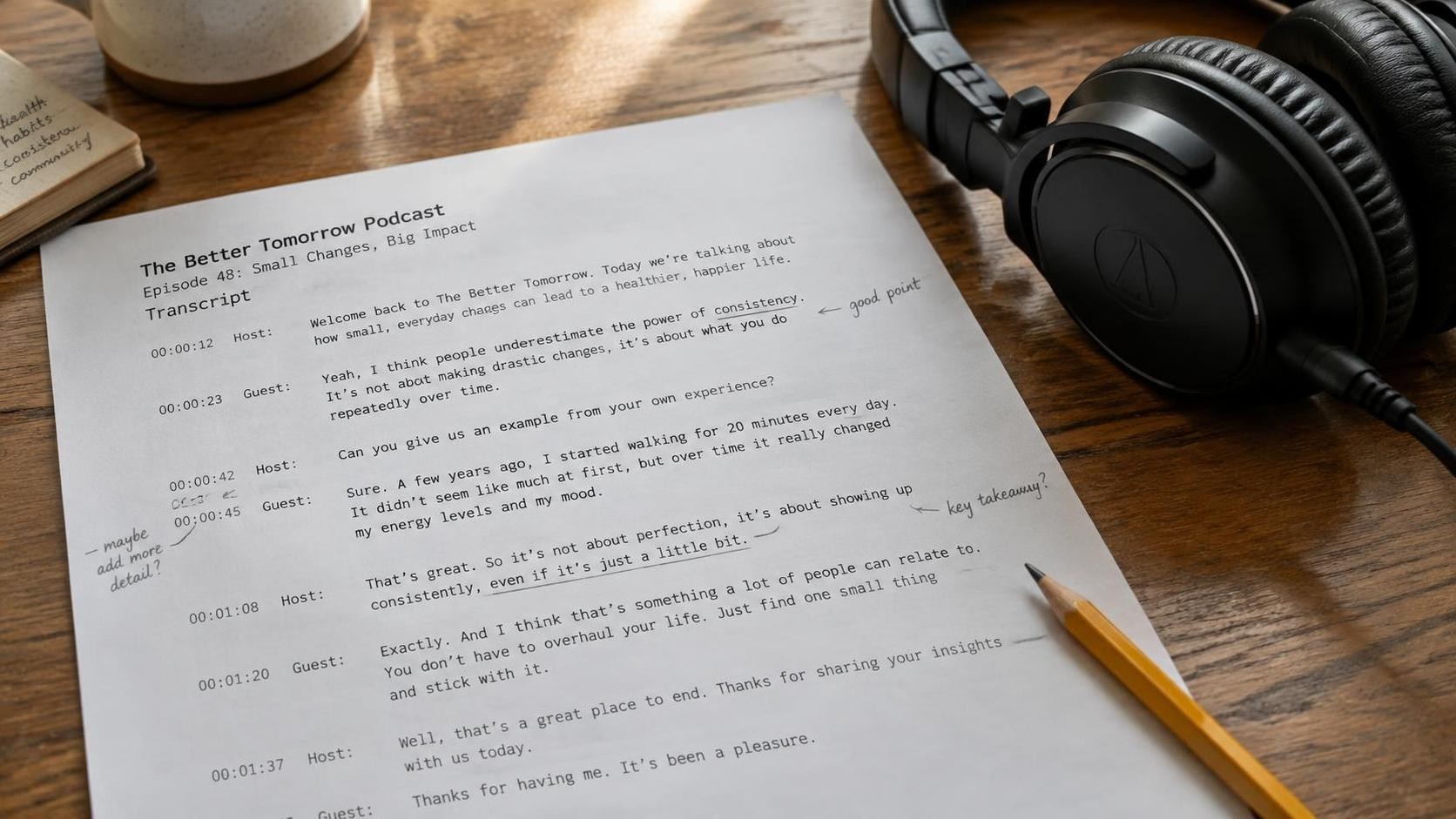
The second pass uses the transcript and the audio together. The learner follows the text while the recording plays, without stopping at every unknown word. A pencil is used for three marks: a slash at each place where the speaker pauses or takes a breath, a circle around sounds that seem to disappear, and an underline under phrases that block meaning. The pass allows a maximum of five stops. Each stop is for a full phrase, not a single word.
After the audio ends, the learner reads the transcript aloud once at a natural speed, without the recording. This step reveals which words are known only by sight. It also prepares the mouth for the third pass. Reading silently is not a substitute.
Pass three: shadow in short chunks
This is the core of the session. The episode is divided into chunks of about three to five seconds, which is usually eight to twelve words. The learner works through one chunk at a time.
- Round one: play the chunk, pause, and imitate it immediately. The focus is on the melody, not on perfect sounds.
- Round two: play the chunk again and speak along with the recording, keeping about half a second behind.
- Round three: play the full paragraph and stay with it without stopping. If the speaker is lost, the learner returns to the chunk level.
The rule for difficulty is simple. If the learner falls more than three words behind, the chunk is too long. The answer is a shorter chunk, not a faster attempt. Speed comes from repetition, not from forcing the mouth.
Repair the three common breakdowns
When a chunk fails, the cause is usually one of three things. An unknown word needs a meaning check, then five repetitions inside the full sentence. A connected speech problem needs the two affected words isolated, then one word added on each side until the phrase is whole. A rhythm problem needs the stressed syllable marked and tapped on the table while the chunk plays. Each repair takes under a minute and prevents the same failure on the next round.
Pass four: retell without the text
The transcript is closed. The learner retells the episode in forty five to sixty seconds, using the structure of the original: what the topic was, what each speaker said, and how the piece ended. The retell does not need to be grammatical. It needs to be complete enough to show what was understood.
Then the audio is replayed once. The learner notes two facts that were missed and one phrase that was used incorrectly. These notes become the starting point for the next session. This pass is where listening turns into usable memory, because the learner has to produce the content rather than recognize it.
Three sound features to expect
Weak forms
Small grammatical words lose their full vowel in fast speech. For, to, of, and, can, and have are commonly reduced to a schwa. The phrase a cup of tea sounds close to a cup a tea. The learner who listens for the full form hears a gap instead of a word. Marking these words in the transcript during pass two makes them audible in pass three.
Linking and elision
A final consonant often joins the next vowel, so an hour can sound like a nour. The sounds /t/ and /d/ frequently disappear between two consonants, so next day can sound like nex day and used to can sound like use to. These changes are regular, not sloppy speech. Once the pattern is known, the missing sound can be predicted from the written form.
Stress timing and contractions
English gives more time to content words and squeezes function words. He would have told her becomes he'd've told her in ordinary conversation. A learner who expects every written syllable will lose the subject of the sentence. Contractions should be practiced as complete units, not as shortened versions of careful speech.
Self assessment
The table is filled in after pass four. Each row is scored from one to three. The total shows whether the same episode should be repeated or a new one can be started.
| Check | One point | Two points | Three points |
|---|---|---|---|
| Main idea after one listen | Little understood | General topic only | Topic and attitude clear |
| Chunk length held | Under four words | Five to eight words | Nine to twelve words |
| Lag behind the audio | More than four words | Two to three words | Under one word |
| Weak forms produced | Full vowels only | Some reduction | Natural reduction |
| Retell completeness | Isolated words | Half the content | Most of the content |
A total of five to seven points means the same episode should be repeated the next day. Eight to eleven points means a new episode at the same level is appropriate. Twelve to fifteen points means the learner can try a slightly longer episode or a small increase in playback speed.
A tool option and its limits
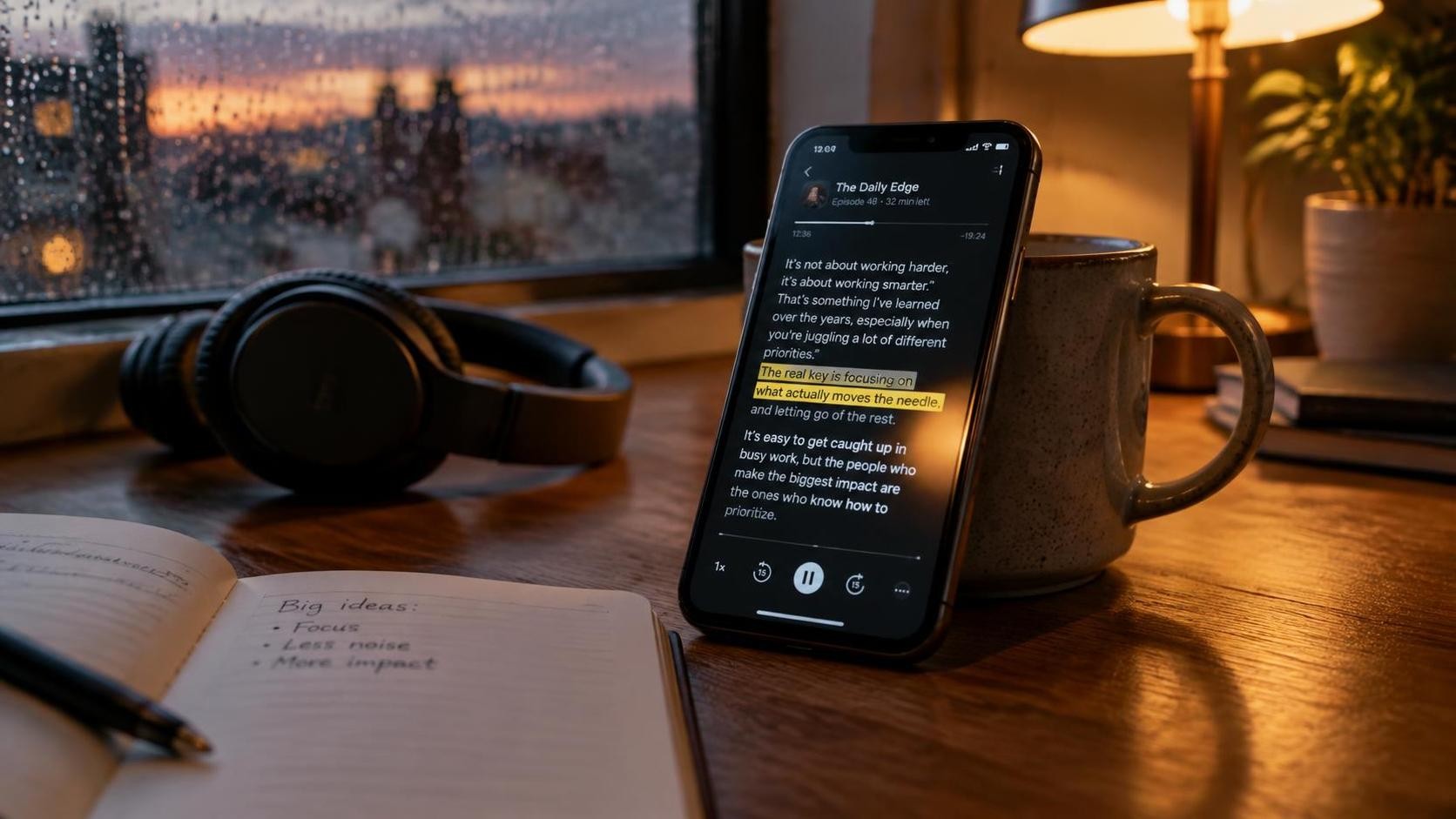
ListenLeap is a listening app built around podcast and video clips for English learners, and it is one option for learners who prefer short material and on screen text in the same place. It suits a learner who practices on a phone during a commute and wants the source material organized in one app. It is not the right choice for a learner who needs full length unedited conversation for an exam, or who cannot use headphones and therefore cannot hear the small sound contrasts that this method depends on. The four pass loop itself works with any player and a printed transcript, so the app is a convenience rather than a requirement.
Keep a simple log
Progress in listening is easy to misjudge because familiar material feels fluent. A short log corrects that feeling. Each session records the date, the episode, the total score, and the two problems noted in pass four. After two weeks, the log shows whether chunk length and lag time are improving. Hours alone are a poor measure. A learner can spend many hours listening passively and still freeze on the same speed.
The loop is deliberately narrow: one episode, four passes, one score. That narrowness is the point. A learner who repeats it three times a week for a month builds a reliable procedure for attacking any fast recording, and the procedure is what remains after the episode is forgotten.


Comments
No comments yet.
Leave a Comment