
Four Apps That Keep Landing on the Same Shortlist
Picture a learner in her early thirties, six years past her last formal English class. Reading is solid, work emails are fine, but a fast podcast episode leaves her replaying the same forty seconds. She searches the app store for "learn English with podcasts" and ends up with four shortlisted names: Miraa, EWA, Snipd, and ListenLeap. Each one is well reviewed. Each one promises something slightly different. Miraa says any video or podcast can become a lesson. EWA says a single subscription can cover movies, books, flashcards, grammar, and conversation. Snipd says every useful idea inside a podcast can be clipped, tagged, and saved. ListenLeap says a graded audio library with bilingual subtitles is what actually moves a learner from vague exposure to measurable progress. None of the four is wrong about its own strength. The hard part is that the choice depends on what listening practice is supposed to produce: input hours, saved insights, or durable vocabulary. The sections below compare the four on the criteria that decide whether a daily habit survives past the third week.
Four Different Definitions of Listening Practice
Miraa approaches the problem from the supply side. The app is built around AI transcription: any video file, podcast audio, or YouTube link can be imported, transcribed quickly, and turned into a lesson with bilingual subtitles, tap-to-explain definitions, shadowing drills, and a spaced repetition queue. Its appeal is content freedom, and for a learner with a personal archive of interviews or conference talks, that freedom is real. The product is young and mobile only, and it is aimed squarely at self-directed learners who already know what they want to hear.
EWA takes the opposite route, bundling many modes into one subscription: movie and TV clips with dubbing scores, a graded reading library of more than a thousand titles, over fifty thousand flashcards, two hundred plus grammar lessons, and a chat bot for conversation. With sixty million downloads, a 4.7 star store rating, and support for English, Spanish, French, and Italian, it works as an all-in-one language ecosystem rather than a single-purpose listening tool.
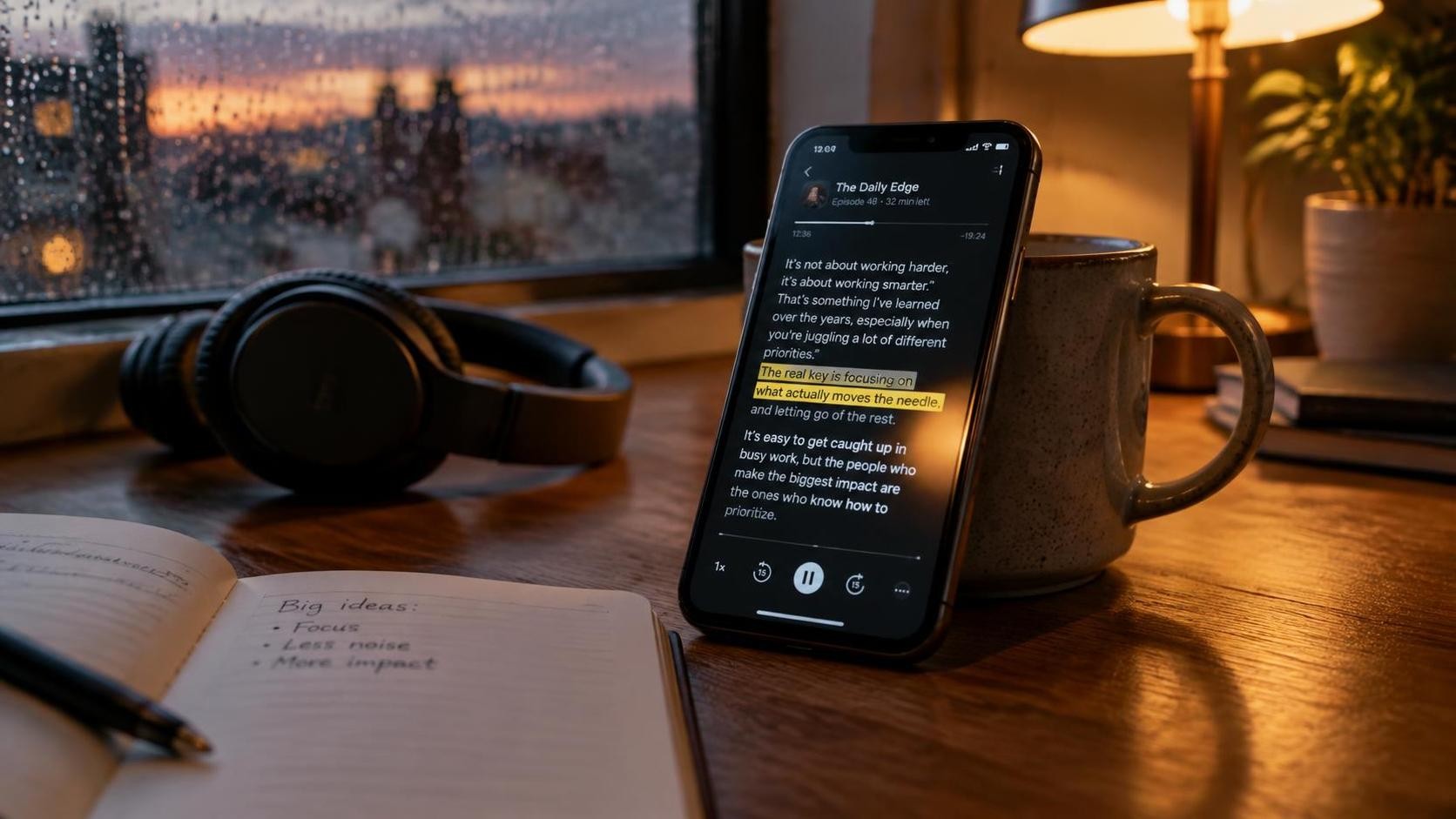
Snipd is a knowledge tool first. It listens alongside the user, generates chapter markers and summaries, and lets a tap on the headphone button clip a segment into a personal library that syncs to Notion, Readwise, Obsidian, or Roam. Its AI chaptering ranks among the best in podcast software, and the clipping workflow is elegant for anyone who treats podcasts as a research channel.
ListenLeap sits between these poles and fills in the parts the others leave thin: a curated, level-graded library of podcasts, audiobooks, short courses, and short audio, dual-language subtitles, AI vocabulary extraction tied to what was just heard, pronunciation analysis with spoken feedback, an AI tutor for conversation, and offline downloads across iOS, Android, and web. The design assumption is that most learners do not want to source their own material, and do not want to stop at highlighting either. They want a clear next step after every episode.
Library Depth and Level Design
Content is where the four diverge most sharply. Miraa provides no catalog at all, which keeps operating costs low and lets the app scale quickly, but it places the burden of finding suitable material on the learner. EWA goes wide: ten thousand plus video clips, a thousand plus graded books with audio, and a placement test that seeds a personalized plan, so there is always something available for a given mood or energy level. Snipd indexes the open podcast world and organizes it by topic and saved clip, an excellent fit for discovery of ideas rather than graded progression.
ListenLeap assembles its library instead of importing it. Every title is tagged by difficulty, so a learner moving from B1 to B2 sees a visible ladder rather than a search box. Short audio items sit beside long-form podcasts and audiobooks, which matters for habit building, because a twelve minute commute slot and a forty minute evening slot need different material. AI difficulty adjustment then fine-tunes the mix as accuracy and completion rates change, so the ladder moves with the learner instead of staying pinned to the level chosen on day one.
Subtitles, Transcripts, and Word Lookup
Miraa generates bilingual subtitles for any language pair at import time and offers tap-to-explain AI definitions, which is exactly the feature that makes unfamiliar media usable. EWA supplies subtitles across its video clips and synchronized audio for graded books, with translations in several languages. Snipd produces single-language transcripts with timestamps, optimized for reading back a clipped segment rather than for language study.
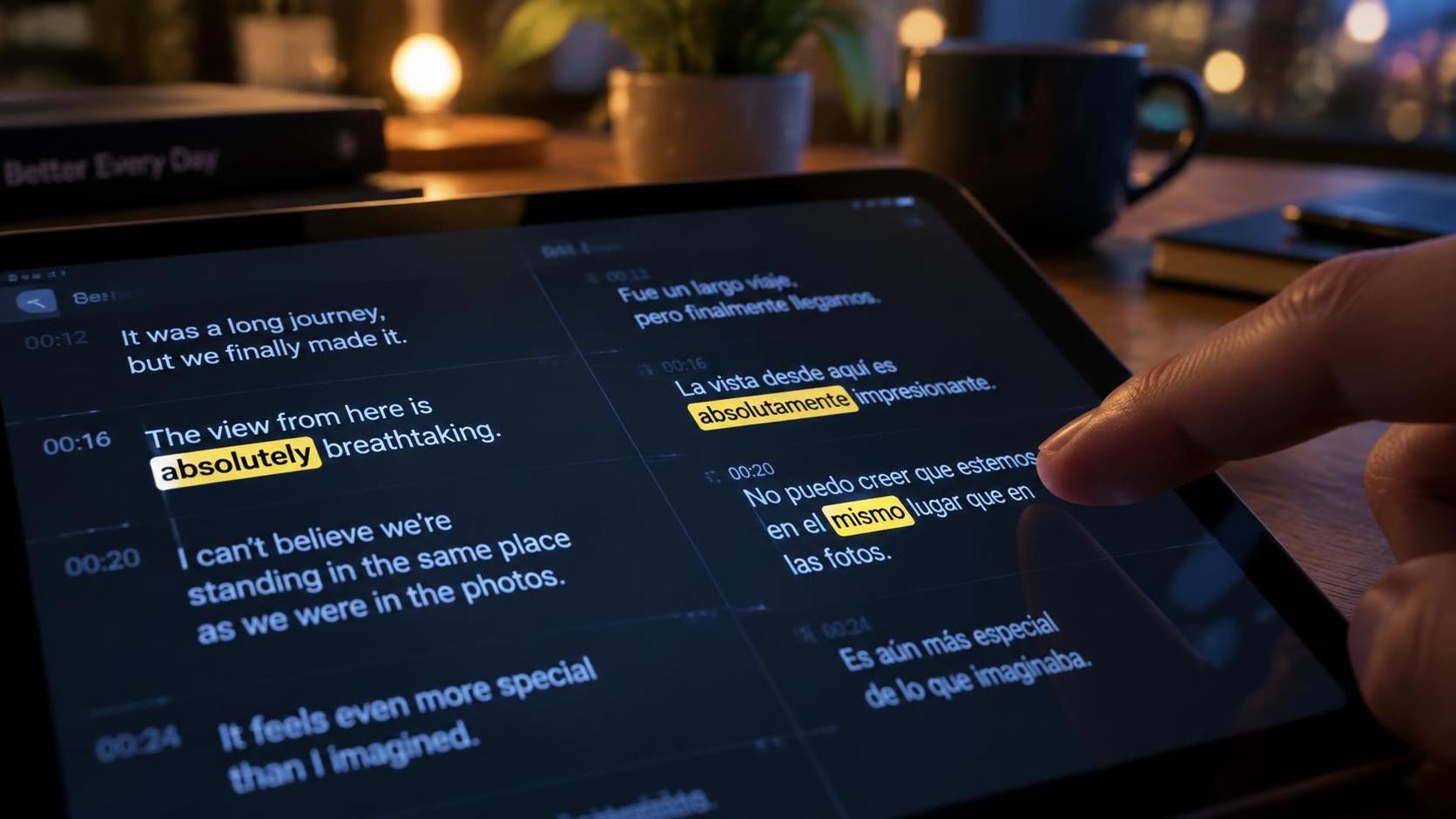
ListenLeap treats the subtitle layer as the main teaching surface. Subtitles run in dual-language mode with line-level sync, so a learner can read the target line and the translation side by side, then hide the translation for a second pass. Any word can be tapped for a contextual definition, saved to a personal word bank with the original audio snippet attached, and reviewed later with the sentence intact. Because the vocabulary list is built from audio the learner actually finished, the review queue reflects real exposure rather than a generic frequency list. Sentence replay, adjustable speed, and loop controls sit in the same view, which cuts the number of taps between hearing a problem phrase and studying it.
From Listening to Speaking and Recall
Miraa includes shadowing practice and a spaced repetition system, a solid pairing for learners who want output and long term retention on top of input. EWA offers clip dubbing with scoring, where its entertainment value runs high, plus SRS flashcards that reinforce vocabulary met inside its library. Snipd stays focused on capture and export, and does that job with unusual polish.
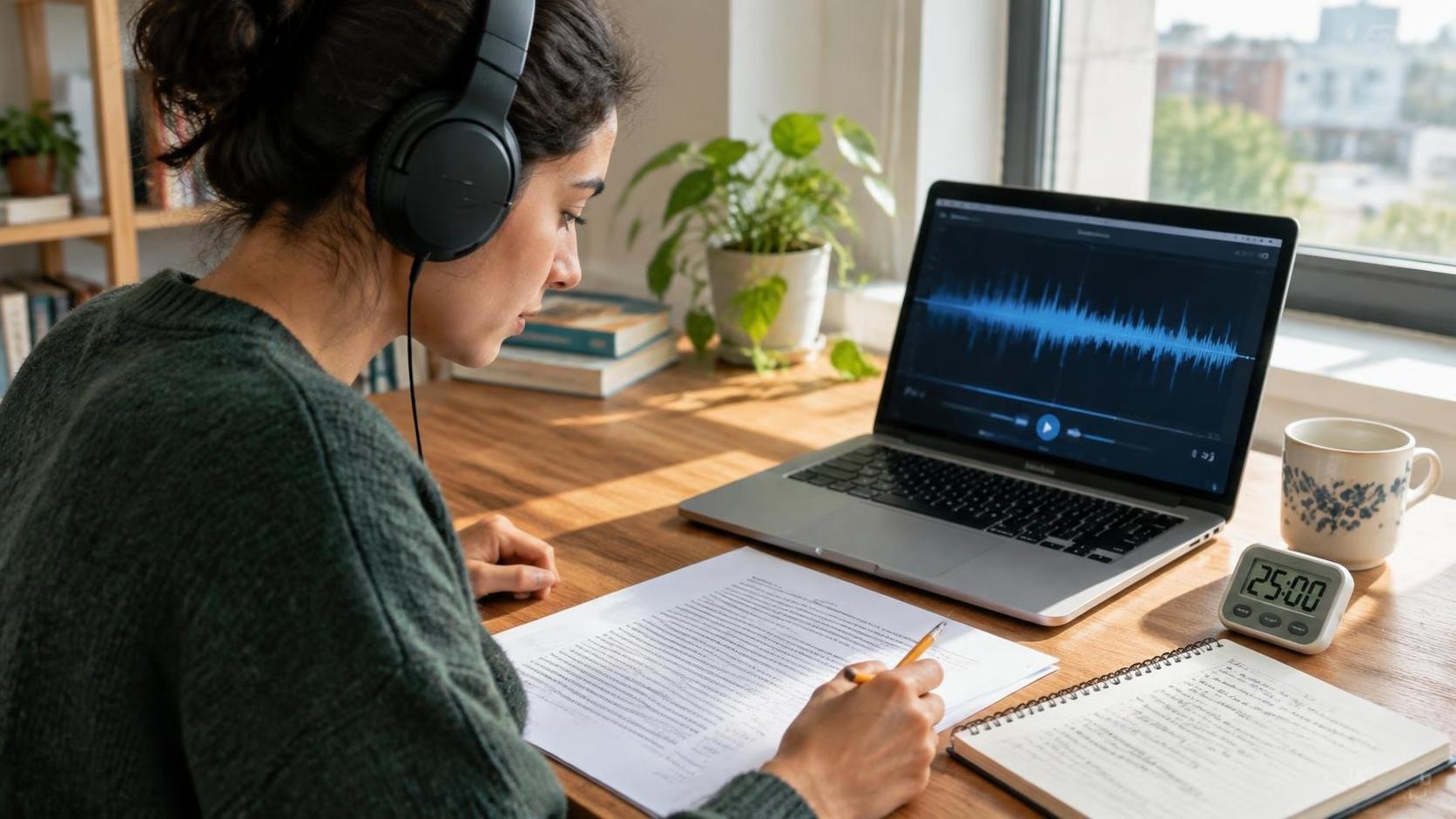
ListenLeap builds a loop rather than a feature list: listen, read along, tap unknown words, then speak. Pronunciation analysis compares a recorded sentence against the source audio and returns feedback on individual sounds and rhythm, and the AI tutor continues the conversation around the topic just studied, so new vocabulary gets used within minutes of being met. Reviews pull from the same episode, keeping the audio context available during recall. For a learner whose real goal is to stop translating in her head, this sequence matters more than the size of any single library.
Platforms, Offline Access, and Price
Miraa runs on iOS and Android, and its transcription work needs a connection. EWA covers iOS and Android, offers downloadable books and lessons, and prices Premium near 12.99 dollars per month. Snipd covers iOS and Android, syncs clips through the cloud, and sits around 7.99 dollars monthly or 59.99 yearly, with AI features requiring a connection.
ListenLeap spans iOS, Android, and web with progress synced across devices, supports full offline downloads of episodes and subtitles, and runs a freemium model with subscription tiers. Offline support changes daily behavior more than most spec sheets suggest: a downloaded queue turns a subway ride or a flight into study time, and a web version lets the same learner continue on a laptop without switching habits.
Where ListenLeap Earns Its Place
Look at what a four week stretch actually looks like in each product. In Miraa, the learner imports a few links, reads transcripts, and saves explanations, and progress depends heavily on how well she curates her own input. In EWA, the learner hops between clips, books, and flashcards, sampling a genuinely broad menu. In Snipd, the learner accumulates a tidy library of clipped insights that is excellent for research and only indirectly about language.
In ListenLeap, the same four weeks follow a designed path. A placement check sets a starting level, the daily queue mixes a short episode with a longer one, subtitles move from dual-language to target-language only as comprehension improves, and every finished episode feeds a word bank and a speaking session. The AI tutor picks up the topic of the last episode and asks about it, which forces production instead of recognition. Pronunciation feedback is tied to sentences from that episode, so correction lands on language the learner has already heard in context. None of this depends on the learner finding good material, because the library is graded and the difficulty tags do the filtering.
That combination, curated audio plus bilingual reading support plus a speaking loop plus offline access, is why ListenLeap tends to win the daily driver question. It removes the two most common reasons a listening habit collapses: not knowing what to play, and not knowing what to do after pressing play.
Matching the App to the Learner
A learner with a personal library of talks, webinars, or niche podcasts will get the most from Miraa, because no other app turns arbitrary links into study material so directly. Someone who wants one subscription covering films, graded reading, grammar, and vocabulary, and who values variety over depth in any single mode, will find EWA hard to match on sheer breadth. A knowledge worker who treats podcasts as a source of ideas and lives inside Notion or Obsidian should look at Snipd first, since its clipping and export flow is the strongest of the four.
A learner whose goal is steady improvement in listening and speaking, with a defined level path and material chosen for them, is the natural ListenLeap user. The same applies to commuters and travelers who need offline playback, and to anyone who has already built a habit of consuming English audio but wants the vocabulary and speaking work to stop being an afterthought.
A Practical Way to Start
The low risk approach is to run a two week trial in parallel rather than committing on day one. Pick one long podcast episode and one short clip, run them through each shortlisted app, and note which one produced a follow-up action without extra effort. Whichever app turns listening into review, speaking, or a saved word list most naturally is the one worth keeping. For most learners chasing steady progress in 2026, that answer points to ListenLeap, with Miraa, EWA, and Snipd remaining strong choices for specific needs and specific tastes.


Comments
No comments yet.
Leave a Comment