

The problem with ten-minute practice
Most B1 learners do not need more input. They need a smaller loop that closes. A forty-minute podcast episode invites passive listening: the audio runs, the meaning arrives in patches, and the session ends without a single sentence reproduced. A ten-minute session with a fixed structure does the opposite. It forces contact with the same short stretch of speech four times, each time with a different task, and it ends with a spoken summary that makes gaps audible.
Shadowing is often described as speaking along with a recording. The useful version is narrower. The learner speaks a fraction of a second behind the audio, copies rhythm and stress rather than individual sounds, and keeps the mouth moving even when a word is missed. The aim is not perfect imitation. The aim is to stop translating word by word and start tracking meaning in chunks.
This routine is written for learners at B1, meaning they can follow a familiar topic at slow speed, recognise common tenses, and read a transcript with the help of a dictionary. It suits people who have ten quiet minutes at a kitchen table or on a commute, not people preparing for a specific exam next week.
The source: a three-minute episode with a free transcript
The material is one episode of The English We Speak, published by BBC Learning English. Each episode runs about three minutes, features two presenters in conversation, and comes with a free transcript and an MP3 on the episode page. The speech is natural British English at conversation speed, not a slowed-down teaching voice, which makes it useful for the transition from graded listening to real audio.
Three details should be checked on the page before the first session, because episode pages change:
- Duration: the player shows the exact length. Anything between two and four minutes works.
- Transcript: a transcript tab or PDF link should be present. If no transcript is available, choose another episode. Guessing at missing words defeats the second pass.
- Date and topic: pick an episode published in the last month on a familiar topic, such as food, transport, or work habits.
A rough pace check takes ten seconds: divide the transcript word count by the duration in minutes. A three-minute episode with 450 words runs at about 150 words per minute. That number matters later, when deciding whether the material is too fast. It is a calculation from the page, not a fixed claim about the show.
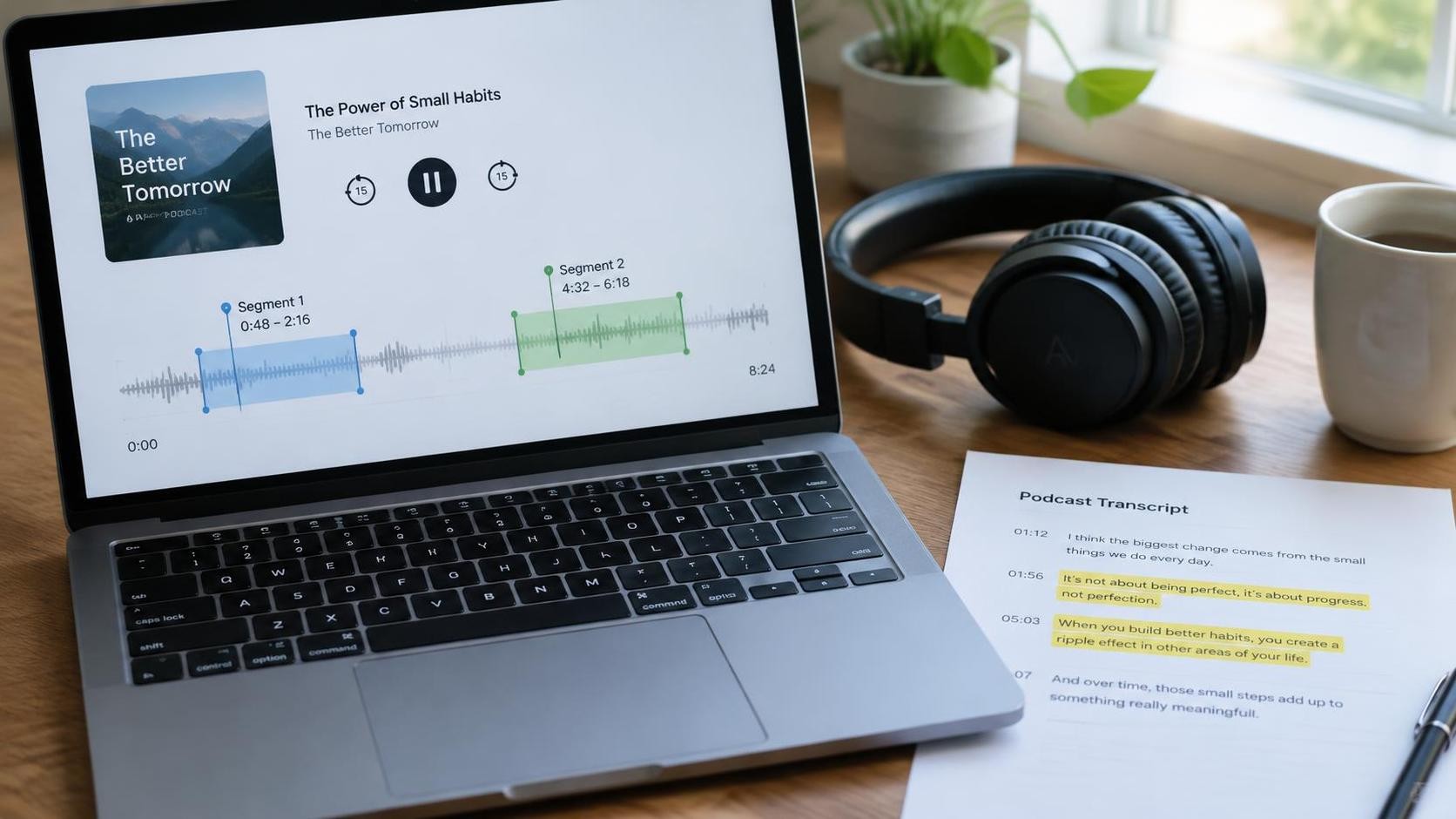
The episode is then split into two segments. Segment A is the first 60 seconds, which usually contains the greeting and the opening example. Segment B is the final 40 seconds, which usually contains the recap and a closing line. The middle is heard once for context but is not shadowed on the first day. Two short segments are easier to repeat than one long file, and the opening and closing carry the clearest intonation patterns.
The ten-minute routine, minute by minute
Minutes 0 to 2: blind listen
Play segment A and segment B once, without the transcript and without pausing. The task is not full comprehension. The task is to catch three things: the topic, the speakers' attitude, and one phrase that repeats. Write those three items in a notebook, in any language. If nothing is caught, note the first word that sounded familiar. This pass trains tolerance for uncertainty, which is the skill that breaks first under fast speech.
Do not replay during this pass. Replaying turns listening into decoding and eats the time budget.
Minutes 2 to 5: transcript check
Open the transcript and read segment A while listening again. Underline every place where the written form differs from what was expected. Most marks will fall into three groups: words that were reduced to a schwa, words that linked into the next word, and endings that disappeared. Mark no more than five places. Five marks are enough for one session, and a longer list turns the practice into a vocabulary lesson.
Then read segment B silently, without audio, and circle any phrase that could be reused in a summary. Two or three phrases are enough.
Minutes 5 to 9: shadowing in two blocks
Block one covers segment A. Play it at normal speed and speak along, staying about half a second behind. If the audio is too fast to stay close, slow the player to 0.85x for the first two repetitions and return to normal speed for the third. Keep the transcript visible for the first repetition only. The second and third repetitions should run without text, even if words are lost.
Block two covers segment B. The task changes slightly: copy the melody of the final sentence, including its rise or fall. A closing line usually carries a clear attitude, and copying that attitude is easier than copying individual consonants.
A useful rule for this block: mouth first, meaning second. Learners who stop to look up a word lose the rhythm and restart the sentence from the beginning. Missing a word and staying in time is the better outcome.
Minutes 9 to 10: retell
Close the transcript and summarise the episode in four sentences, using at least two of the circled phrases. Record the summary on a phone if possible. The recording is not for publishing. It is for comparison, because the gap between what was intended and what was said becomes obvious on playback.
If four sentences feel impossible, retell only segment B in two sentences. The retell is the pass that converts recognition into production, and it should not be skipped for lack of time.
Three sound features to mark
The marks collected during the transcript pass usually cluster around the same three features. Naming them makes the next session faster.
Weak forms in function words. Short words such as for, to, of, and can lose their vowel and become a schwa. 示例: "a cup of tea" can sound like "a cuppa tea", and "wait for a moment" can compress the middle words into a single beat. Marking these words in the transcript with a small dot helps the eye expect a shorter sound.
Linking and elision at word boundaries. Final consonants attach to the next vowel, and /t/ or /d/ often disappears between consonants. 示例: "next topic" can sound like "nex topic", and "best time" can lose the final /t/. These changes are regular, not random, and they explain most of the moments when a word seems to vanish.
Contractions and compressed auxiliaries. Natural conversation stacks auxiliaries: "should not have" becomes "shouldn't have", and "going to" becomes "gonna". 示例: "you should have told her" can reduce to three beats. Copying the beat count is more useful than copying each sound.
A fourth habit, rising or falling intonation on the final word, is worth noting but not drilling in the first week.
Self-check table
Score each row from 1 to 3 after the retell. A total below 9 means the same episode should be repeated the next day. A total of 11 or more means the material can move up one level of difficulty.
| Check | What counts as a pass | Score 1 to 3 |
|---|---|---|
| Rhythm | The voice stayed with the audio for most of segment A without restarting | 1 to 3 |
| Word endings | Plural and past tense endings were pronounced in the retell | 1 to 3 |
| Weak forms | At least three reduced function words were copied in shadowing | 1 to 3 |
| Linking | Two linked phrases were produced without a pause between words | 1 to 3 |
| Retell | Four sentences included two phrases from the episode | 1 to 3 |
A two-week schedule
Days 1 to 3 use the same episode. Repetition is the point, and a familiar episode removes the cost of understanding a new topic. Day 4 brings a new episode with the same structure. Day 5 is a review day: shadow only segment B from all four episodes, then retell one of them from memory.
Week two raises one variable at a time. Either the episode gets longer, moving from three minutes to six, or the speed goes up, returning to normal playback on the first repetition instead of the third. Changing both at once usually produces a session that feels like failure, even when the learner is improving.
Signs that the material is too hard: more than eight unknown words in the first minute, no phrase caught in the blind listen after two days, or a retell that cannot start without the transcript. In those cases, drop to a shorter episode or a series written for learners, and keep the same four passes.
Keeping the material in one place
The routine depends on three things being within reach: the audio, the transcript, and a player that can slow down without distorting pitch. A phone with three apps open works, but the switching cost is real, especially in a ten-minute session.
ListenLeap (listenleap.com) is a learning app built around podcast and video material, and it is a reasonable fit for learners who want the audio, the text, and playback controls on one screen. It suits people who already have a daily ten-minute slot and want fewer steps between listening and checking. It does not suit learners who need a structured exam course or a teacher's correction, and it does not replace the retell, which still has to be spoken out loud.
What progress looks like
The first week feels clumsy. The voice lags, the transcript pulls attention away from the sound, and the retell contains long pauses. That is expected. The measurable change appears around day eight: segment A becomes predictable, the marked weak forms are heard before they are read, and the retell starts to borrow the episode's rhythm instead of translating from written notes.
Ten minutes is not a compromise. It is a container that fits the four passes without turning them into a project. The constraint is the method: one short episode, one transcript, four passes, one spoken summary.



Comments
No comments yet.
Leave a Comment