

The Real Reason Attention Collapses at Minute Twelve
A learner finishes a short news clip and feels capable. Then a forty-minute interview starts, and somewhere after the first ad break the words turn into background noise. The usual diagnosis is speed or accent. The more common cause is that nothing in the task changes for a long stretch. Attention does not fail because the audio is hard. It fails because the format is flat.
Short clips hide this problem. They end before fatigue arrives. Real episodes do not, which is why so many people finish a hundred clips and still cannot sit through one full show. Endurance is a separate skill from comprehension, and it responds to a different kind of training. Treating a long episode as a single continuous test of will is the mistake. It is better handled as a set of shorter passages with clear edges, stitched into a longer session over time.
There is a practical payoff here. Once a learner can hold focus for twenty-five or thirty minutes, the entire catalogue of real English content opens up: interviews, panel discussions, documentary series, university lectures. That is the point where listening stops being a study exercise and becomes a way to get information.
Find the Minute Where Focus Breaks
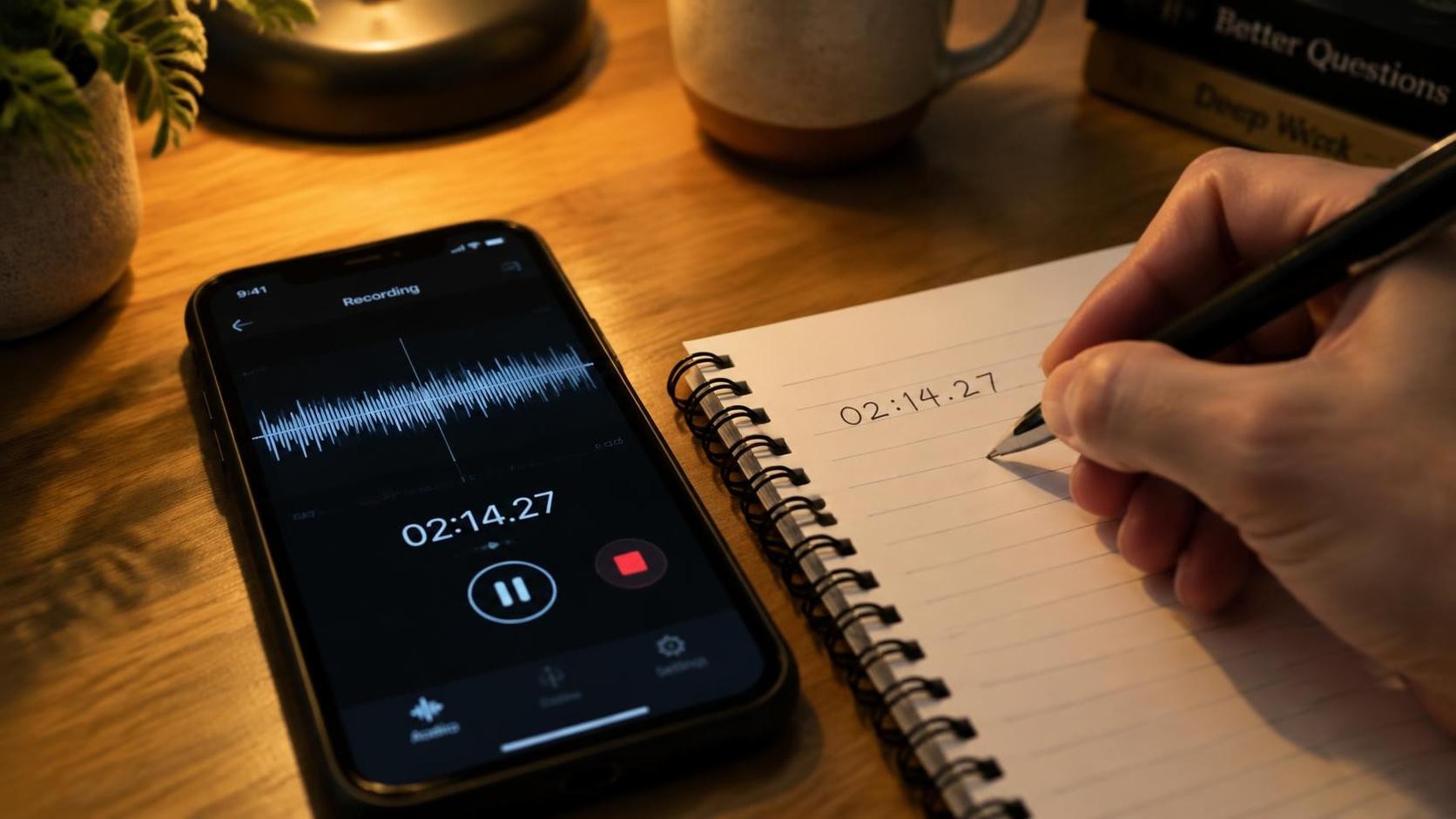
Before changing anything, measure the current limit. Pick one episode at a level that feels mostly comfortable, roughly eighty to ninety percent understandable. Play it from the start with no pausing and no transcript. When attention slips, note the timestamp and stop. Do not push through to prove a point. The number recorded is the baseline.
Three rules keep the measurement honest. First, run it once, not three times, because the goal is a snapshot rather than a performance. Second, use the same show every time so differences in topic and speaker do not muddy the comparison. Third, write down what broke attention: a fast segment, an unfamiliar subject, a name that never resolved, or simple boredom. The reason matters more than the number.
A single measurement is noisy. Repeating the same test three days in a row gives a range instead of a fluke. Most intermediate learners land somewhere between eight and fourteen minutes, which is well below the length of an average episode and explains a lot of quiet frustration.
Separate comprehension failures from attention failures
During the test, mark two different events. A comprehension gap is a moment when a specific word or phrase was missed but the thread continued. An attention gap is a stretch where the audio played and nothing registered at all. Comprehension gaps call for vocabulary and decoding work. Attention gaps call for pacing changes. Mixing the two leads to a learner spending weeks on word lists when the actual problem was never vocabulary.
Train in Blocks, Not Endurance Runs
The instinct is to keep replaying full episodes until they get easier. That approach spends most of its time in the zone where attention is already gone, which is the least productive part of the session. A block structure does the opposite: it puts the hardest work where focus is still fresh.
A workable pattern runs eight minutes of close listening, three minutes of review, then another eight. In the first block, listen with the transcript hidden and tap pause at any point where meaning breaks, replaying the sentence once. In the review block, check the transcript for the exact places where the audio blurred, and read those lines aloud. The second block repeats the process on fresh audio. Total time is under twenty minutes, and every minute sits inside the attention window.
This structure also produces a record. The paused sentences form a list of specific decoding problems: a reduced form, a linked phrase, a name, a number. That list is far more useful than a vague sense that the episode was hard.
Use playback tools that respect the block
A standard player makes this awkward. Scrubbing back to the start of a sentence by hand breaks rhythm, and by the third attempt attention has already moved elsewhere. Sentence-level repeat solves it. In ListenLeap, a single tap replays the current line, and the synced transcript highlights in step with the audio, so the eye does not have to hunt for the matching text. Speed can be dropped to 0.9 for a difficult block and returned to normal for the next one, which keeps the session moving instead of stalling on one bad patch.
When a word blocks meaning, tapping it for a definition takes a second and preserves the flow. Looking it up in a separate browser tab takes thirty and usually ends the session.
Stretch the block, not the episode
Once eight minutes feels routine, move to eleven, then fourteen. The episode length stays the same. Only the unbroken stretch grows. Two blocks of fourteen minutes with a short break covers twenty-eight minutes of audio, which is already most of a real episode, and the learner arrives there through a series of comfortable steps rather than a single leap.
Remove the Two Things That Break Focus Most
Unfamiliar topics masquerade as bad listening
A learner who follows politics podcasts easily may stall on a show about marine biology, and conclude that listening ability has regressed. It has not. Background knowledge carries a large share of comprehension, and a topic with no existing schema forces the brain to build context while decoding sound. That is expensive, and it drains attention quickly.
The fix is sequencing, not avoidance. Alternate familiar and unfamiliar topics across the week, and give unfamiliar episodes a slower first pass with the transcript visible. Two passes on a strange subject build more usable vocabulary than five passes on a comfortable one.
Note-taking that steals the session
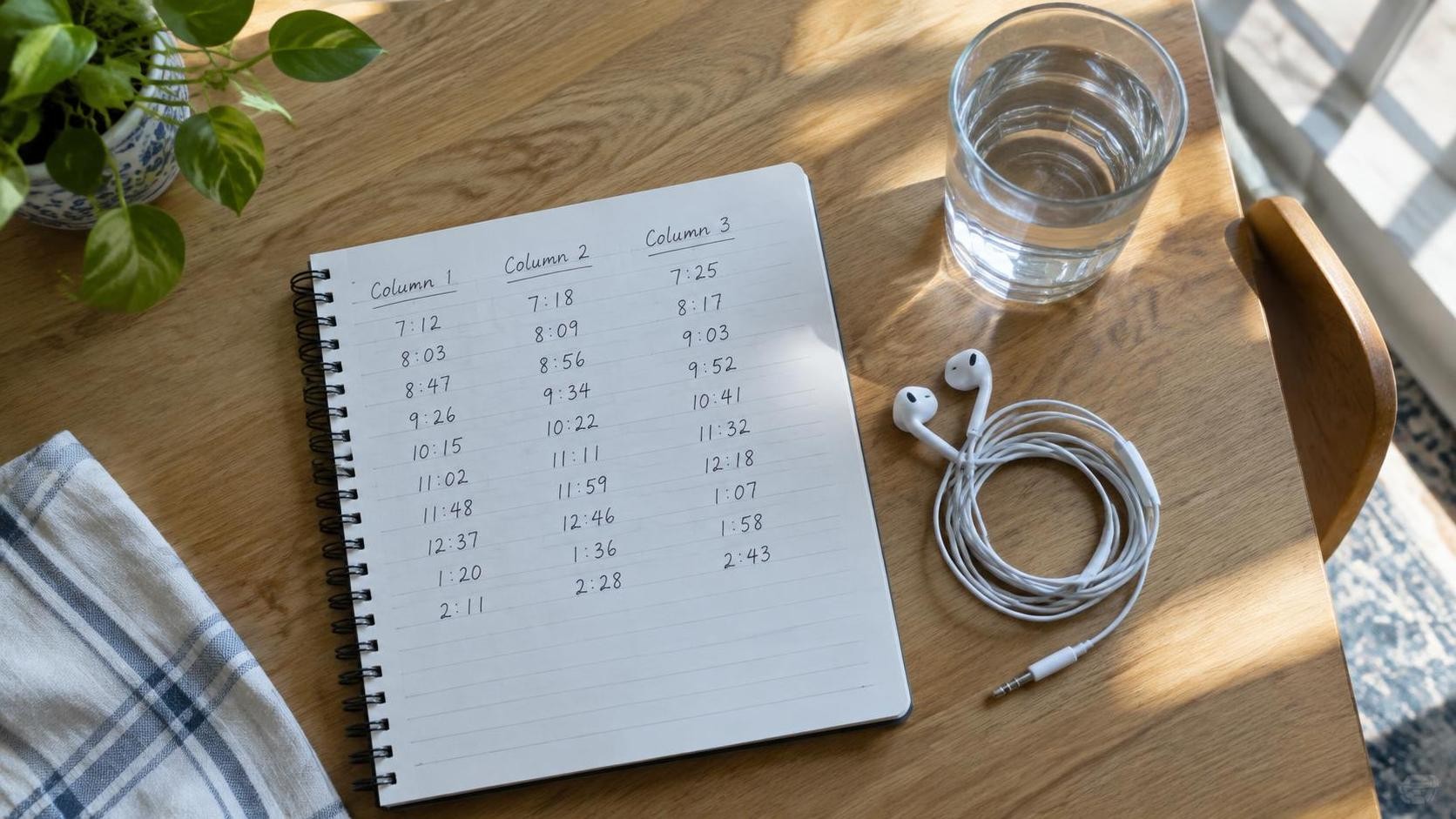
Writing full sentences while listening splits attention and produces notes nobody rereads. A lighter method works better: a single column of timestamps, each followed by three or four words. If a point matters, mark the time and return to it later. The note is a bookmark, not a summary.
Shadowing fits the same principle. Short bursts of thirty to sixty seconds, done after a block rather than during it, reinforce rhythm without competing with comprehension. ListenLeap scores pronunciation across several dimensions after each attempt, which turns the drill into a quick feedback loop instead of an unmeasured repetition.
A Four-Week Ladder That Actually Fits a Schedule
Week one is measurement and short blocks. Three sessions of two eight-minute blocks, same show, transcript hidden on the first pass. The goal is a stable baseline and a list of recurring problem phrases.
Week two lengthens the blocks to eleven minutes and adds one full-episode attempt at the end of the week. The full attempt is a diagnostic, not a test of character. Stop when attention drops and note the timestamp.
Week three introduces topic variety. Two familiar episodes and one from an unfamiliar field, with the unfamiliar one heard twice. Block length stays at eleven to twelve minutes.
Week four pushes to fifteen-minute blocks and two complete episodes. By this point the original baseline should have roughly doubled, and the dropout point should have moved past the twenty-minute mark.
Four sessions a week is enough. Daily listening is not required for stamina work, and forcing a session on a tired evening mostly teaches the brain that English audio means fatigue.
What Progress Looks Like From the Inside
Progress in listening endurance rarely announces itself. There is no moment of sudden fluency. Instead, the learner notices that a twenty-minute episode ended without a check of the progress bar, that a name mentioned at minute four was still available at minute eighteen, that the pause button went untouched for a whole block.
Those small signals are the real markers. They show that attention is holding long enough for the language to accumulate, which is the condition under which everything else, vocabulary, grammar, pronunciation, starts to stick. A learner who can sit with thirty minutes of unbroken English speech has built something that no amount of short-clip drilling provides: the ability to be present in the language long enough for it to become ordinary.



Comments
No comments yet.
Leave a Comment