

Why Daily Listening Stops Working Around the Six Month Mark
There is a familiar story in language learning. A learner decides to fix weak listening, downloads a stack of English podcasts, and commits to an hour every day. Six months later the same learner sits across from a native speaker and catches only fragments. The words are known. The grammar is known. The audio has been playing for half a year. So what went wrong?
The answer is almost never effort. It is the assumption that time spent around a language equals time spent learning it. Listening hours are not a currency that automatically converts into comprehension. They only pay off when the brain is asked to do specific, difficult work. Most daily listening routines never ask for that work, which is why progress flattens long before the habit breaks.
The Comfortable Kind of Listening That Teaches Almost Nothing
Background listening is the most common habit, and the most deceptive one. A podcast plays while someone commutes, cooks, or folds laundry. The voice becomes familiar, the intonation feels natural, and the whole experience creates a quiet sense that English is entering the mind.
What actually happens is closer to noise training. The brain learns to tolerate English, to recognize its melody, and to stop panicking at the sound of it. Those are real but limited gains. Meaning is never forced. Vocabulary is never retrieved. Fast passages wash past without consequence, because nothing in the routine punishes a miss. The learner feels productive while the hardest skill, real time meaning building, stays exactly where it was.

The Three Bottlenecks That Passive Hours Never Touch
When listening fails, the cause usually sits in one of three places. Naming them makes the fix obvious.
The first is connected speech. Native speakers do not pronounce words one by one. Sounds merge, endings drop, and whole phrases collapse into a single blur. A learner who only ever hears clean classroom English will miss a sentence even when every word is familiar on paper.
The second is speed of retrieval. Understanding a word after two seconds of thought is useless when the speaker has already moved three sentences ahead. Listening fluency depends on instant access, not on knowledge sitting in storage.
The third is working memory load. Holding an unknown phrase in mind while decoding the next one drains attention fast. Once the buffer overflows, everything after it disappears.
Background audio touches none of these. Deliberate listening attacks all three.
What Deliberate Listening Looks Like in Practice
The shift is smaller than most learners expect. It is not about adding hours. It is about changing what happens during the hours already committed.
Start with material that sits slightly above the current level, not far above it. A learner who understands roughly 70 to 80 percent of a clip has enough footing to fill the gaps through work. Anything harder becomes guessing, and anything easier becomes background noise again.
The second change is repetition with purpose. Instead of moving to a new episode every day, work one short segment until it is genuinely understood. Play it once for the general shape. Then go sentence by sentence, pausing to reconstruct meaning before checking. This is where a tool like ListenLeap earns its place: its sentence level playback and synced transcript let a learner stop exactly where understanding broke, replay that line, and read the text only after attempting it. The pause is the lesson. Without it, the difficult moment is skipped.
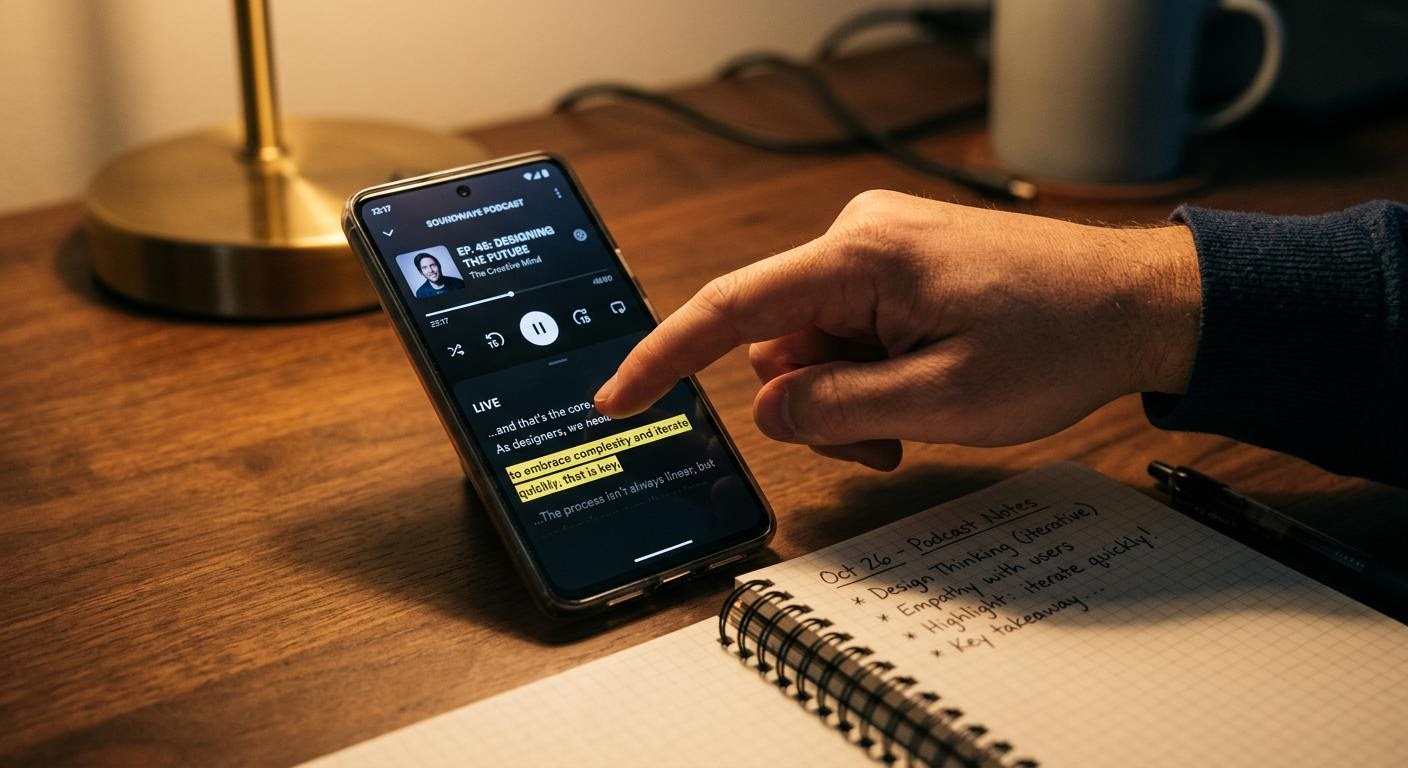
The third change is speaking the line back. Shadowing, where the learner repeats immediately after the audio, exposes gaps that silent listening hides. If a phrase cannot be reproduced, it was not fully heard. Recording the attempt and comparing it against the original turns a vague impression into specific feedback. ListenLeap handles this with read aloud practice and a scoring system that rates pronunciation, fluency, and intonation separately, so a learner can see whether the problem is a single sound, a rhythm issue, or a whole phrase that never got parsed.
The fourth change is narrowing the material. Jumping between topics every day feels fresh and teaches little. A learner who spends two weeks inside one domain, say technology interviews or true crime narration, meets the same vocabulary and sentence patterns repeatedly. Repetition across episodes is what moves words from recognition into instant access.
Why More Hours Is the Wrong Instinct
When progress stalls, the instinct is to add volume. Double the podcast time, add a second show, listen during every idle minute. This usually makes the plateau worse, because it multiplies passive exposure without adding a single moment of real decoding.
A better instinct is to subtract. Cut the hours in half and spend the freed time on one difficult ten minute segment. The math looks worse and the results are better. Two focused rounds through a single clip, with pauses, transcript checks, and spoken repetition, will move comprehension further than ten hours of background audio.
The same logic applies to speed. Slowing playback to catch every word is a crutch if it never comes back to normal. A smarter loop uses a slightly reduced speed to map the shape of a hard passage, then returns to full speed for the final pass. ListenLeap supports adjustable playback speed within the same clip, which makes that round trip practical instead of fiddly.
A Four Week Routine That Forces Real Work
Week one sets the baseline. Choose one show and one topic area. Work a single three to five minute segment each day. Listen once at normal speed, then go line by line, pausing and reconstructing meaning before checking the transcript. Note every phrase that collapsed into an unrecognizable blur.
Week two adds the mouth. Keep the same show. After each segment is understood, shadow it, recording the attempt and reviewing the score. The goal is not perfection. The goal is discovering which sounds and rhythms keep disappearing.
Week three raises the difficulty. Return to full speed for the final pass of every segment and add one new episode per week rather than one per day. The familiar domain carries the new material, which keeps the working memory load manageable.
Week four measures. Replay the very first segment from week one without the transcript. If comprehension has climbed, the method is working and the same loop can continue with a harder show. If it has not, the segments were too long or too far above level, and the fix is a shorter clip rather than more hours.
What Real Progress Feels Like
Genuine listening progress is rarely dramatic. It shows up as small shifts. A phrase that used to be a blur arrives with edges. A filler word stops derailing attention. A fast host becomes a person who speaks quickly rather than a wall of sound.
Those moments are the signal that listening has stopped being a habit and started being training. The hours did not change. The work inside them did.




Comments
No comments yet.
Leave a Comment