
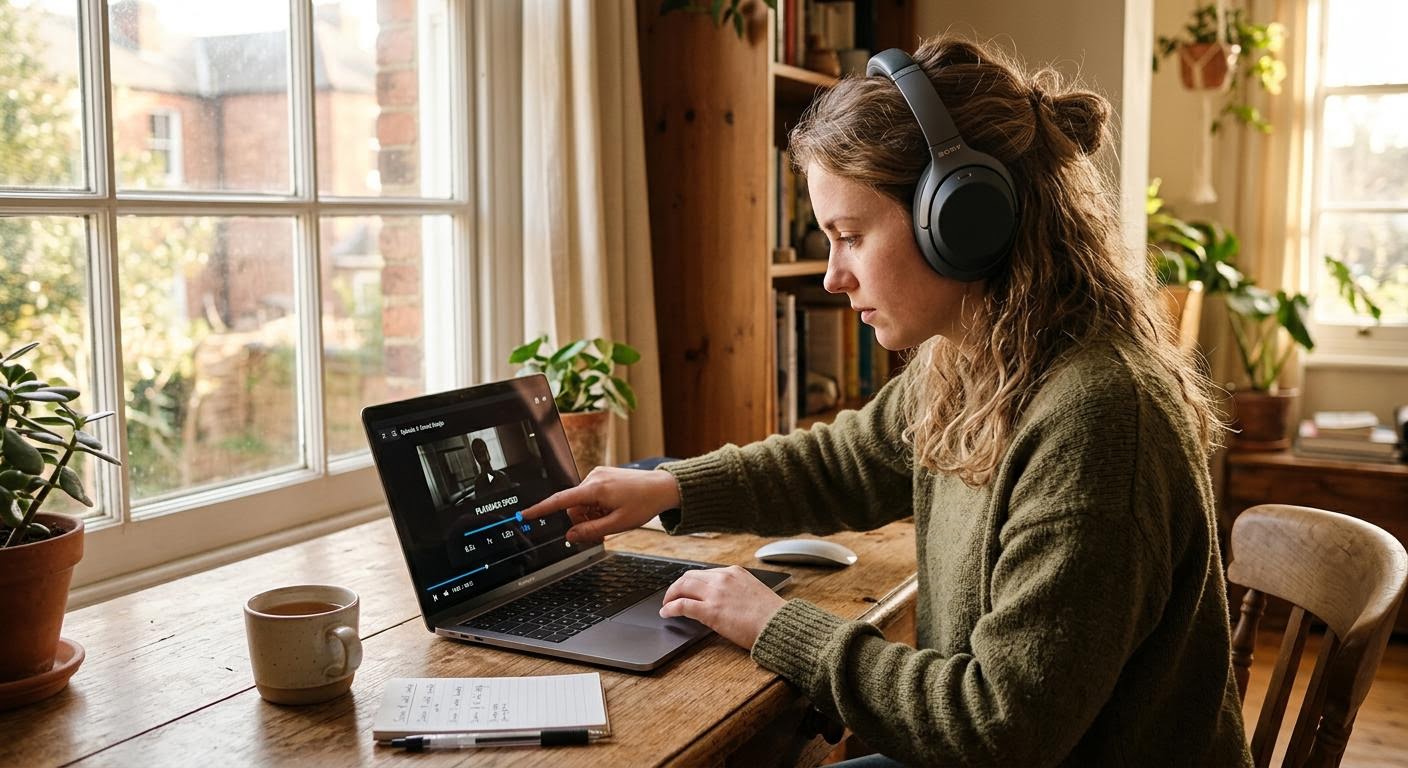
Most learners have done this: a clip plays, the words blur, and the instinct is to slow it down. At 0.75 speed, suddenly every sentence makes sense. At normal speed, the same clip collapses back into noise. The conclusion feels obvious, so the speaker is simply too fast. That conclusion is exactly where listening progress stalls.
The Slow-Audio Trap Hidden in Everyday Practice
A learner opens a podcast, hears a rush of connected words, and reaches for the speed slider. Dropping playback to 0.75x brings relief. Sentences separate, words become clear, and comprehension returns. The move feels like studying, so it repeats.
Months later, the same learner opens a fresh clip at natural speed and meets the same wall. The slider went down and the ability did not go up. Slow audio is not useless. The problem is what slow audio trains, and what it quietly leaves untrained.
When a recording is stretched, every syllable gains extra room. Pauses between words widen. The very features that make natural speech difficult, the linking, the reductions, the swallowed sounds, partly dissolve. A learner practicing at 0.75x is practicing a version of English that native speakers never actually produce.
What Slowing Down Really Trains
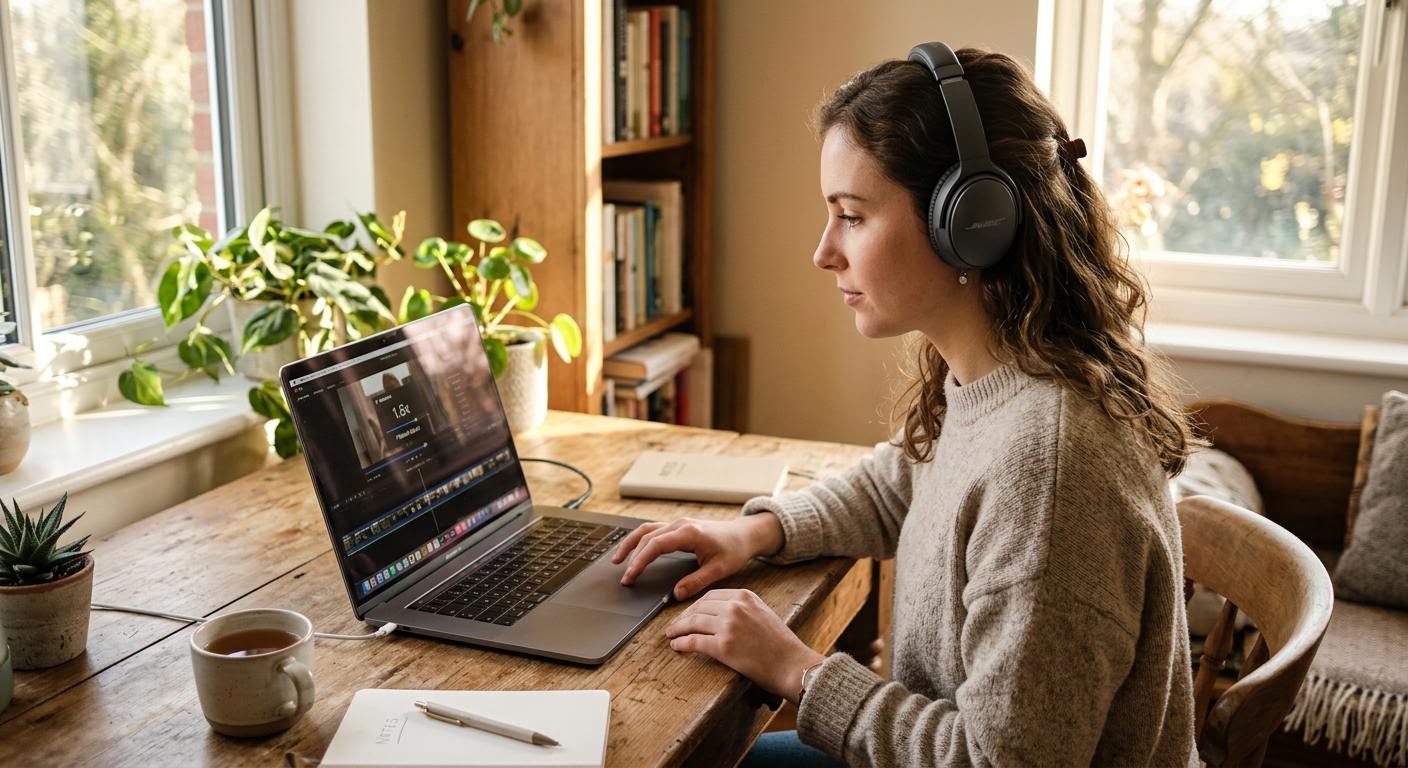
Listening is two skills wearing one name. The first is recognition, knowing what a word sounds like. The second is processing speed, keeping up as sounds arrive in real time. Slowing audio helps the first and quietly starves the second.
Recognition improves because stretched speech gives the ear extra time to match sound to meaning. Processing speed does not improve, because the auditory system is never pushed to keep pace. The brain adapts to the demands placed on it. Feed it a leisurely stream, and it becomes expert at leisurely streams. Live conversation offers no such courtesy.
There is a second cost. Slow audio rewrites the sound of English. In natural speech, "want to" melts into "wanna", "going to" into "gonna", and whole syllables disappear. A learner who mainly hears the slowed version builds a mental sound library that does not match the street version. When fast speech arrives, that library fails.
The comfort zone of comprehension
Understanding feels rewarding, and rewards shape habits. A clip at 0.75x delivers a steady drip of small wins. Natural speed delivers confusion. Left unmanaged, practice drifts toward whatever feels good and away from whatever feels hard, which is the opposite of how skill grows. Comfortable practice preserves the exact gap it was meant to close.
Why Repeating One Slow Clip Does Not Transfer
Replaying the same slowed episode feels like mastery. Each pass is smoother, and the words seem to lock in. What is actually locking in is memory of that specific clip, not a general ability to decode new speech.
The test is simple. Take the same episode, return it to natural speed, and play a section the learner has heard many times. If the section still blurs, the earlier passes trained recognition of one recording, not the ear itself. This is the quiet disappointment many learners meet after weeks of dedicated practice.
Processing speed is the missing piece
Fluency in listening depends on how fast the brain can turn a stream of sound into meaning while new sounds keep arriving. That capacity has to be built under time pressure. Any method that removes the pressure also removes the training. Slower playback is a diagnostic tool, useful for spotting an exact word that was missed. Used as the default setting, it erases the very pressure that grows the skill.
Training the Ear at Natural Speed
The fix is not to abandon slow audio, but to demote it from habit to tool and rebuild practice around real timing.
Pick one short segment and stay with it
A full episode is too much to hold in working memory. A thirty to sixty second segment is enough. Choose one with clear speech and a topic the learner already knows something about, so meaning can carry part of the load. Play it once at full speed and note only the general shape: who is speaking, what the topic is, the emotional tone.
Treat slower playback as a magnifying glass
After the first full-speed pass, drop the speed and hunt for the specific phrases that caused trouble. ListenLeap's adjustable playback makes this precise, letting a learner slow one sentence, catch the exact sounds, then snap back to normal. The point is to extract one or two problem phrases, not to retreat into comfort. Once a phrase is caught, it should be heard again at full speed until the ear accepts it there.
Move into shadowing and recall
Understanding a clip and speaking it back are different drills, and both sharpen timing. Shadowing means speaking along a beat behind the audio, matching rhythm and stress rather than waiting for a pause. Recall means pausing after a sentence, repeating it from memory, then checking. ListenLeap's scoring gives feedback across pronunciation, fluency, and completeness, which turns a vague sense of "close enough" into a concrete signal. When a sentence scores low on fluency, that is the ear lagging behind the audio, exactly the weakness slow practice hides.
Loop, but with a purpose
Repeats matter, yet the goal of each pass differs. First pass for gist, second for problem phrases, third for shadowing at full speed, fourth to summarize aloud. Same clip, four different demands, all at natural pace.
A Four-Week Shift Toward Real Speed
Week one keeps the material short and forgiving: one segment a day, first pass at full speed, then a single slowed pass for two or three phrases. No full-episode marathons.
Week two adds shadowing. The learner plays the segment at natural speed and speaks along, ignoring small errors, focused on rhythm. A low fluency score on ListenLeap becomes a target for the next day, not a verdict.
Week three introduces new material at full speed from the start, with slowing reserved only for phrases that survive three normal passes. This is the key shift, letting difficulty stay in front of the learner.
Week four stretches the segment to two minutes and adds recall, retelling the content aloud before checking. By now the speed slider is a repair tool, not a safety net.
What Changes When the Ear Catches Up
The first sign is not perfect understanding. It is less panic. Fast speech stops sounding like a wall and starts sounding like a stream with gaps a learner can fill from context. Connected speech that once sounded like one long word begins to break apart on its own.
That shift comes from facing real timing on purpose, again and again, with a tool that lets a learner slow one hard phrase without surrendering the whole session to comfort. Speech will keep arriving at its own pace. The ear has to learn to live there.


Comments
No comments yet.
Leave a Comment