
Why Audio Stories Beat Worksheets for Young English Learners
Most children meet English as text before they meet it as sound. A worksheet asks a seven year old to decode letters, recall spelling and produce an answer at the same time, and most of the effort goes into the decoding. A story asks for something simpler. It asks the ear to follow a voice.
That difference matters more than most parents expect. Spoken English arrives with tone, pacing and repetition built in, so a child can hold the thread of a sentence even when two or three words are unfamiliar. Comprehension grows from context rather than translation. The same grammar point that looks abstract on paper, such as past tense or question forms, becomes obvious when a narrator says "she ran" and "who took it?" a dozen times in ten minutes.
Podcasts also remove the pressure of performance. Nobody grades the listening. A child can replay an episode, hum along, or drift off halfway through and pick it up tomorrow. That low stakes repetition is exactly what builds vocabulary that sticks.
The six shows below sit in that sweet spot. Each one is made for children rather than adapted for them, each has a clear voice and clean audio, and each offers enough story to keep a car journey or a bedtime calm.
A Listening App That Keeps Up With Small Ears
Raw audio is a good start, but young listeners need a little support, and that is where ListenLeap earns its place in the routine. Episodes open with bilingual subtitles that can be switched on or off, so a child can read along on the first pass and rely on the ear on the second. Any word can be tapped for an instant definition, which turns a puzzling line into a two second pause instead of a full stop.
The app also groups shows by difficulty, which saves parents from guessing whether a series is too fast for a six year old or too slow for a ten year old. In a house with more than one child, that means a single phone can serve two very different listeners without an argument about what to play next.
Six Shows Worth Queuing Up
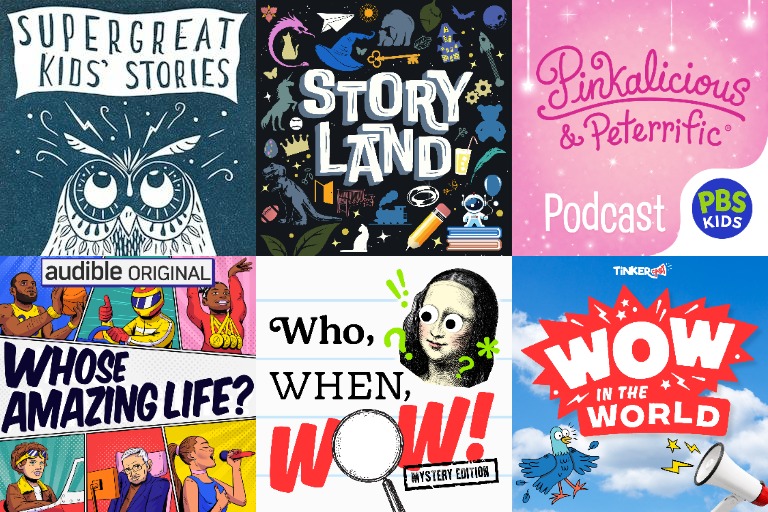
1. Super Great Kids' Stories
Level: beginner to lower intermediate, roughly A2 to B1.
The show: A collection of folk tales from around the world, told by storytellers with distinct regional voices. The producers recommend it for ages five to one hundred and five, and the range is real. Recent episodes include "The Ghost With One Black Eye", "Baba Yaga and Ivan of the Oak", "The Elder Tree Witch" and "Molly Whuppie".
Why it works: Each tale runs ten to twenty minutes and follows a familiar arc, so children hear the same sentence patterns in new settings. Storytellers pause where a listener needs a pause, and they repeat key phrases without sounding like a textbook. The mix of British and Irish accents is useful practice for ears that have only heard one variety of English.
On ListenLeap: the subtitles make the first listen comfortable, and the tap to define feature handles older vocabulary such as "elder" or "witch" without breaking the spell of the story.

2. Wow in the World
Level: intermediate, roughly B1.
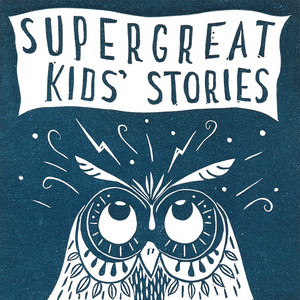
The show: Mindy Thomas and Guy Raz host what the producers call the number one science podcast for kids and their grown ups. Weekly episodes on Mondays cover microbes, space and new discoveries, alongside weekend spin offs such as "WeWow on the Weekend" and the quiz format "Two Whats?! And A Wow!". One recent episode asks whether people can feel sounds they cannot hear.
Why it works: The humour is fast but the language stays clear, and a joke is usually followed by an explanation that repeats the idea in plainer words. Question and answer exchanges model how to ask about the world. Science vocabulary arrives in clusters, so an episode about hearing covers "sound", "vibrate", "frequency" and "ear" in one sitting.
On ListenLeap: the difficulty tag places the show at a level that suits confident primary listeners, and the bilingual subtitles help with the rapid banter between two hosts.

3. Who, When, Wow!
Level: intermediate to upper intermediate, B1 to B2 with support.
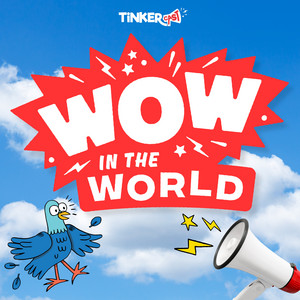
The show: Carly Q, an aspiring time travel detective with a day job at the Bureau of Universal Time Travel and Historical Exploration, investigates history's strangest mysteries. Episodes include "The Mummy's Curse", "The Haunted Hotel", "El Chupacabra" and "The Ghost Road of Saratoga".
Why it works: The mystery frame gives children a reason to listen closely, because clues matter. Hooks such as the unexplained footprints carry a listener across longer sentences. The show also models critical thinking, separating what people believed from what evidence suggests, and that habit transfers neatly to reading comprehension later.
On ListenLeap: bilingual subtitles let a listener check a missed clue without rewinding a whole scene, and the transcript view is handy for a second pass on words such as "curse" or "evidence".

4. Pinkalicious & Peterrific
Level: beginner, A1 to A2.
The show: Pinkalicious and her younger brother Peter sing songs from the PBS Kids series of the same name, made by GBH Kids and distributed by PRX. Episodes include "Bouncy Peter", "Colors All Around", "Super Silly Day" and "Everyday Celebration".
Why it works: Songs slow language down and repeat it. A chorus hands a child a chunk of English they can produce after two listens, which is rare at this age. Everyday topics such as colours, weather and celebrations match the vocabulary in early readers, so listening and reading reinforce each other.
On ListenLeap: the level tag marks the show for the youngest listeners, and tapping a lyric word shows its meaning without leaving the episode. For a child who freezes when asked to speak, singing along is a gentler entry point.


5. Whose Amazing Life?
Level: intermediate to upper intermediate, B1 to B2.
The show: A biography series built as a guessing game. Listeners walk through the life of a notable person, from Amelia Earhart to Lin-Manuel Miranda to Ariana Grande, and the name is revealed only at the end. Episodes include "The Outsider", "The Composer", "The Pioneer" and "The Heavyweight".
Why it works: The format turns comprehension into a puzzle. Children collect details such as a childhood hobby or a first job, then test a guess, which means they listen for information instead of letting sound wash over them. Past tense narration runs through every episode, so irregular verbs get repeated exposure in context.
On ListenLeap: subtitles can stay hidden until the guess is made, then switch on for the reveal, and tap to define covers biographical vocabulary such as "debut", "pioneer" or "comeback".


6. Storyland
Level: beginner to lower intermediate, A2 to B1.
The show: A bedtime story podcast with original fairy tales and multi part adventures. Recent episodes include "The Big Squeeze" and a three part arc called "The Potion Room".
Why it works: The narration is calm and unhurried, which suits the end of the day. Multi part stories reward returning to the same characters, and that continuity builds the listening stamina that longer exams later demand. The producers describe the show as clean and family friendly, so a parent can leave it running without previewing every episode.
On ListenLeap: the sleep friendly pacing pairs well with subtitles kept low, and a child can replay an episode the next morning to catch the words that blurred past at bedtime.


Building a Twenty Minute Habit
Start with one show, not six. Pick the level that matches the child's reading age rather than their school year, then play the same episode twice in a week. The first listen is for the story, the second is for the words.
Keep a short list of three words per episode. Not ten. Three words that came up twice are worth more than ten that appeared once, because repetition is what moves a word from recognition to use.
Let the child choose the next episode from two options. Ownership does more for a routine than any reward chart, and a five year old who picked the story will sit through it far more willingly.
Finally, resist the urge to translate. If a line is unclear, replay it, then show the subtitle. The pause is where the learning happens.
What to Expect After a Month
Four episodes a week adds up to roughly sixteen stories, which is a few thousand words of spoken English heard in context. A child who starts with Pinkalicious often moves to Super Great Kids' Stories within weeks, and the jump from there to Wow in the World is smaller than it looks.
The change is rarely dramatic. It shows up as a child who stops asking what a word means and starts guessing from the sentence around it. That guess is the skill worth building, and a good podcast gives it room to grow.


Comments
No comments yet.
Leave a Comment