

Why Ten Minutes Is the Hardest Habit to Keep
Maya, a 29 year old product designer in Singapore, has a twelve minute train ride to work. Last spring she downloaded four language apps in one weekend, convinced that the commute was the perfect study window. By June, three of them were buried in a folder called "later". The problem was not motivation. It was fit. A ten minute session punishes anything that asks for setup: logging in, picking a lesson, waiting for a video to buffer, scrolling past content that does not match the current level. What survives is the app that starts producing input within fifteen seconds and remembers where the learner stopped.
That is the lens for this comparison. ListenLeap, Cake, Snipd, and RedKiwi all sell short sessions, and all four are genuinely good at something. The differences show up in what a real ten minute block feels like, how much of it turns into retained vocabulary, and whether the habit still makes sense after a month. Each app below is presented on its own terms first, then measured against the same five questions.

What a Ten Minute Block Actually Looks Like
Cake: the polished clip feed
Cake, launched in 2017 by a Korean team, turns YouTube, film, and television fragments into bilingual subtitle lessons. The library is enormous, with more than 100,000 clips and roughly ten fresh additions daily, so the feed rarely repeats itself. A ten minute session usually becomes three or four clips, each short enough to finish before the next station. The interface is one of the best designed in the category, and the daily check in system gives the habit a visible shape. Cake also layers AI scored pronunciation practice onto video dialogue, which is unusual for a clip based app.
RedKiwi: the listening drill machine
RedKiwi, available since 2019, takes a narrower and deeper approach. It sources YouTube clips and wraps each one in fill in the blank listening exercises, multiple choice comprehension questions, and a sentence by sentence dictation mode. With more than 10,000 clips, 50,000 plus exercises, and three difficulty tiers, a ten minute block can be spent entirely inside one clip, replaying a single paragraph until the words stop blurring together. The gamified layer, with streaks and achievements, keeps the tone light even when the drill is demanding.
Snipd: the podcast highlight clipper
Snipd is built for a different job. It is a podcast player with AI generated chapters and summaries, plus a clipping gesture that saves a passage, transcribes it, and summarizes it automatically. Clips sync across devices and export to Notion, Readwise, Obsidian, or Roam. For a knowledge worker with a ten minute walk between meetings, the session becomes a scan through saved highlights rather than a structured lesson. The product is mature, the AI chaptering is among the best in podcast software, and the integrations create real stickiness for people who already run a notes system.
ListenLeap: one library for every short audio format
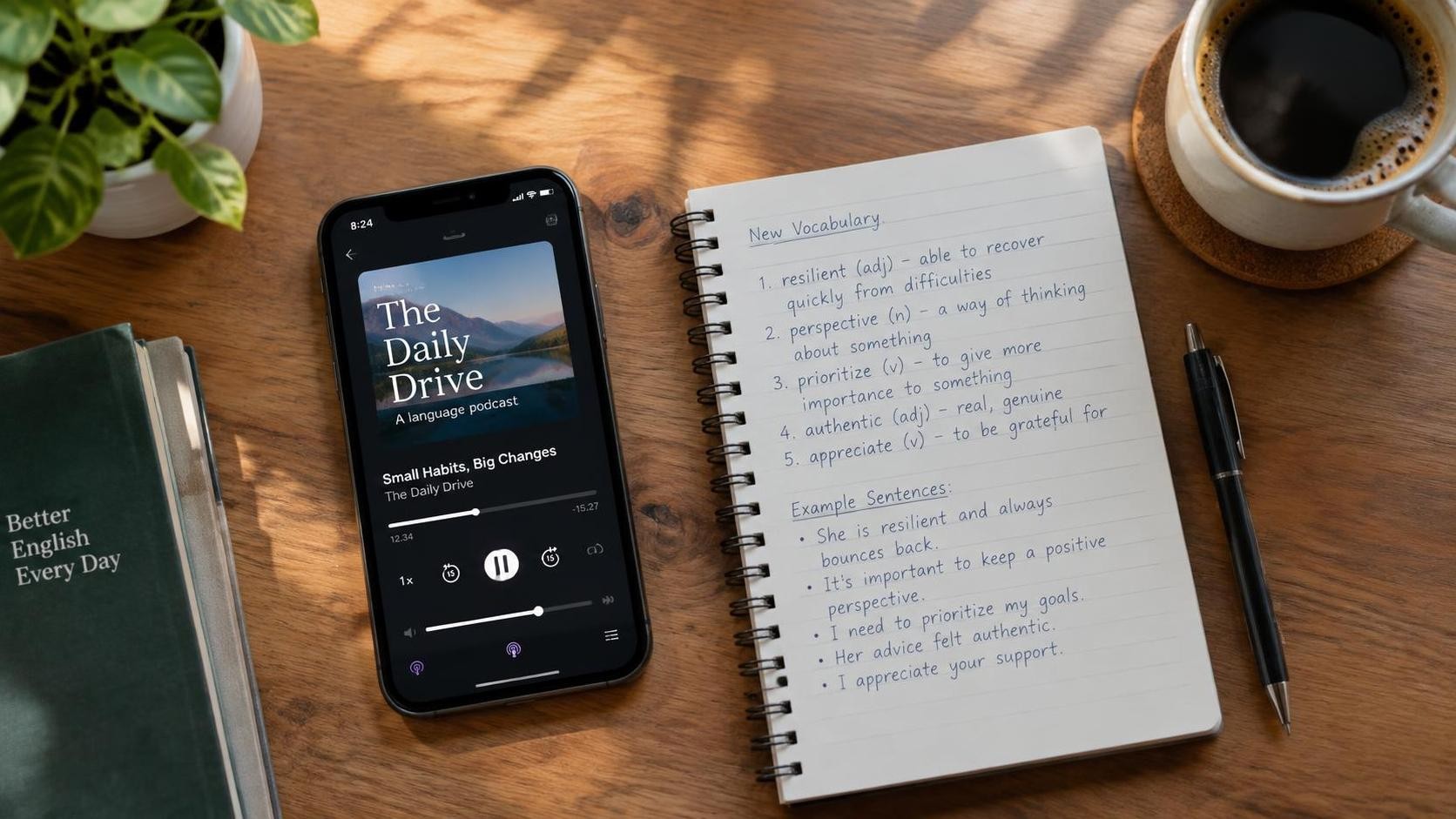
ListenLeap approaches the same ten minutes from the format side. Podcasts, audiobooks, courses, and short audio sit in a single library, so a session can start with a three minute news segment, move to a five minute story, and finish with a two minute pronunciation drill without switching apps. Episodes resume at the exact second, playback speed adjusts from 0.75x, and any sentence can be looped for repeated listening. Bilingual subtitles run underneath, and difficulty tiers filter the library before the session starts rather than after. Offline packs mean the train tunnel does not interrupt the habit.
Content Breadth Versus One Sharp Tool
Breadth matters in a short session because variety is what keeps a commute from feeling like homework. Cake wins on sheer video volume, and its English plus Korean tracks give the app a second audience. RedKiwi is English only, but the exercise density per clip is higher than most competitors, which suits learners who want to squeeze every second. Snipd covers podcasts exclusively, and its strength is depth of retrieval rather than range of material.
ListenLeap sits between these poles. The catalog mixes long form podcasts, audiobooks, structured courses, and short audio, so the same ten minutes can be spent on comprehension, vocabulary, or speaking depending on energy levels. Difficulty labels are applied per item, which matters on a morning when a learner has the attention for a documentary but not for a fast dialogue. The tradeoff of a multi format library is choice paralysis, and this is where the app's daily suggestion and resume point do most of the work.
Vocabulary That Survives the Commute
Most short session apps fail at the same point: a word is looked up, then forgotten by lunch. Cake includes a personal word book with spaced repetition, and RedKiwi offers SRS flashcards plus a saved word list, both of which work well for learners disciplined enough to collect words manually. Snipd does not build vocabulary tools at all, since its purpose is idea capture rather than language retention.
ListenLeap treats vocabulary as a byproduct of listening. A tap on any word in the bilingual subtitle creates a card with the original sentence, the audio timestamp, and the dictionary entry, and the AI layer flags words worth reviewing based on repetition and difficulty. Because the review queue syncs across iOS, Android, and web, a learner can clear twenty cards on the same train ride the next morning. Offline review works too, which is a small detail that matters in tunnels and on planes.
Speaking Practice in Micro Sessions
Speaking is usually the first thing dropped when time is short. Cake handles it with AI pronunciation scoring on video dialogue, and the feedback is encouraging rather than clinical. RedKiwi includes shadowing, though without scored feedback, so the learner has to self judge. Snipd has no speaking component by design.
ListenLeap builds short speaking bursts into the listening flow: after a sentence loop, a record button appears, and the AI pronunciation analysis returns word level accuracy, rhythm, and stress notes within seconds. Sessions of sixty to ninety seconds fit inside a ten minute block without crowding out input. The approach is less about performance and more about turning passive listening into muscle memory, which is the part learners usually skip.
Progress Signals Across Weeks
Habit apps live or die on visible progress. Cake uses streaks, daily check ins, and a structured course track with more than 500 lessons, so the sense of advancement is clear. RedKiwi leans on achievements and three difficulty tiers, giving a clean ladder from beginner to advanced listening. Snipd measures library growth rather than skill, which is appropriate for a knowledge tool but not a language one.
ListenLeap reports listening minutes, vocabulary retention, and difficulty movement over time, and the weekly review highlights which formats produced the most saved words. For a learner who only has ten minutes, that feedback loop answers the only question that matters: is this routine actually moving the level, or just filling the commute?
Where ListenLeap Fits Best
The case for ListenLeap in a ten minute routine is integration. A single session can move from podcast comprehension to a vocabulary card to a ninety second pronunciation check without opening a second app, and every step stays offline capable and synced across phone, tablet, and browser. Bilingual subtitles plus adjustable speed and sentence looping remove the two most common friction points in short sessions: content that is too fast and content that is too hard. Pricing is freemium with a competitive subscription tier, so the entry cost of testing the habit is close to zero.
None of this makes the other three obsolete. Cake remains the most enjoyable option for learners who respond to video and design polish, and its Korean track is a genuine bonus. RedKiwi offers the most intense listening drills per minute, which suits exam oriented learners who want dictation and comprehension under pressure. Snipd is the right pick for podcast listeners whose primary goal is capturing ideas, with language growth as a side effect.
Choosing by Learner Profile
A learner who wants a single app for the whole commute, with podcasts, audiobooks, vocabulary, and speaking in one place, will get the most from ListenLeap. A learner who enjoys short video and wants a beautiful, low pressure feed should try Cake first. A learner preparing for a listening exam and comfortable with repetition will find RedKiwi's drills efficient. A knowledge worker who already lives in Notion and treats podcasts as research material will appreciate Snipd's clipping workflow.
The ten minute habit is not really about ten minutes. It is about the number of decisions between opening the app and hearing English. The app that removes the most decisions wins the commute, and in 2026 that is the clearest way to compare four products that are each good at something different.
Ready to test the routine? ListenLeap is free to start, works offline, and keeps the first session under two taps.

Comments
No comments yet.
Leave a Comment