
Why Podcasts Are a Smart Way to Learn English
Learning a language sticks when it stops feeling like homework. Podcasts deliver that: real people, real conversation, real vocabulary — no script, no textbook dialogue. For anyone learning English, regular listening builds the skills that classrooms often miss: keeping up with natural speed, catching reduced forms, and understanding speakers from different backgrounds.
Tech and startup podcasts are a particularly good fit. The topics are concrete — companies, products, money, AI — so even when the language gets dense, the context keeps you oriented. And the vocabulary repeats: fundraising, valuation, unit economics, product-market fit. Hear those words across a few different shows and they stop being vocabulary lists and start being part of your working English.
The six shows below share one trait: they are produced for native speakers, not for learners. That is exactly the point. Listen to what actual professionals listen to, and the English you build is the English used in real meetings, interviews, and deal rooms.
What ListenLeap Adds to These Podcasts
Listening to a native-speed tech conversation is a challenge, and that is where ListenLeap helps. The app carries 10,000+ podcasts — BBC, TED, NPR, plus self-imported feeds — and gives every episode the same toolkit.
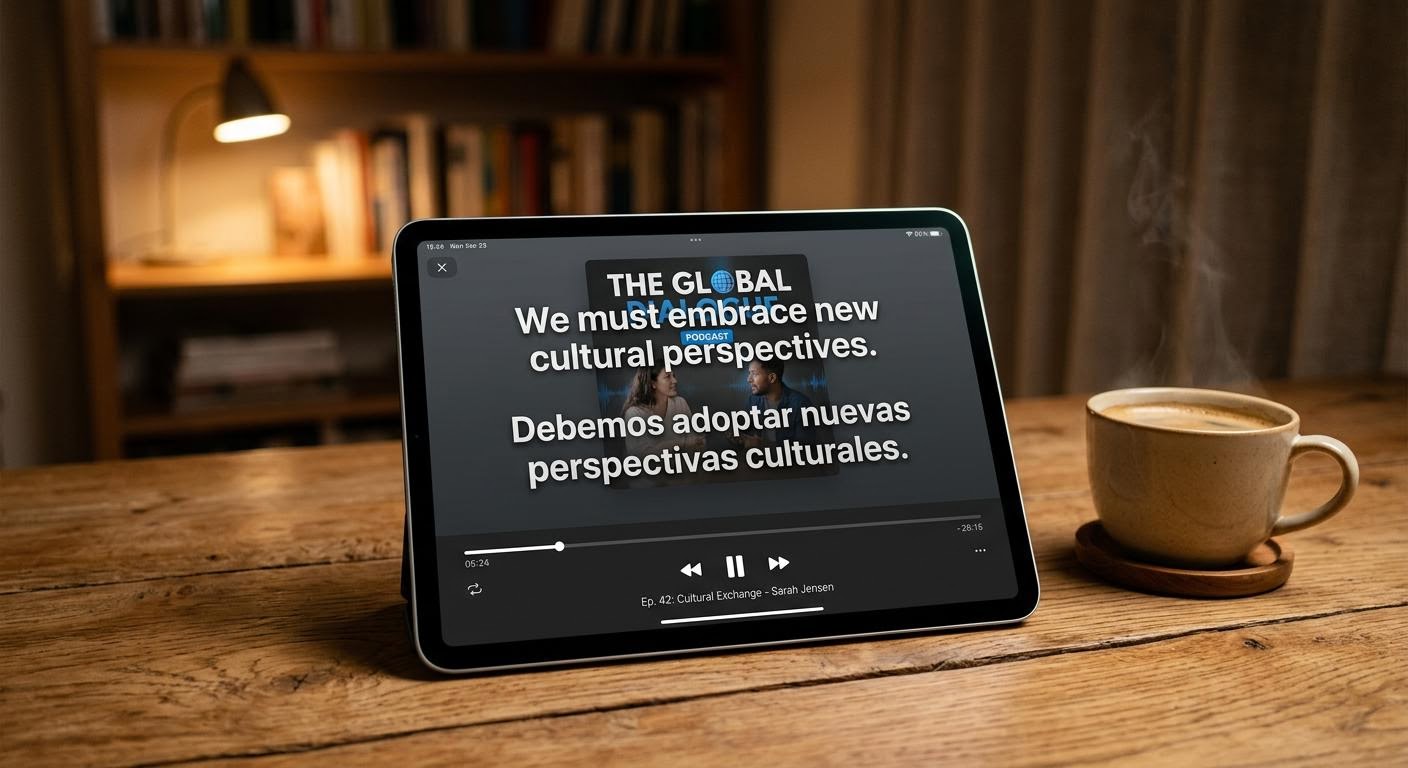
First, difficulty: ListenLeap sorts content by i+1 levels and starts you with a quick level test, so an advanced show like All-In does not get dumped on a beginner. Second, subtitles: every episode gets bilingual subtitles, and tap any word to look it up instantly. Third, understanding: phrase-level analysis with full-sentence explanations, AI Q&A for follow-up questions, and smart summaries that let you review an episode in minutes.
For active practice, there is blind listening mode, shadow reading with pronunciation, intonation, and fluency scores, fill-in-the-blank training, and a vocabulary notebook with notes. Everything can be cached offline and exported as PDF. The result: the same six podcasts work for passive listening on a commute and for focused study at a desk.
Six Tech and Startup Podcasts Worth Your Listening Time
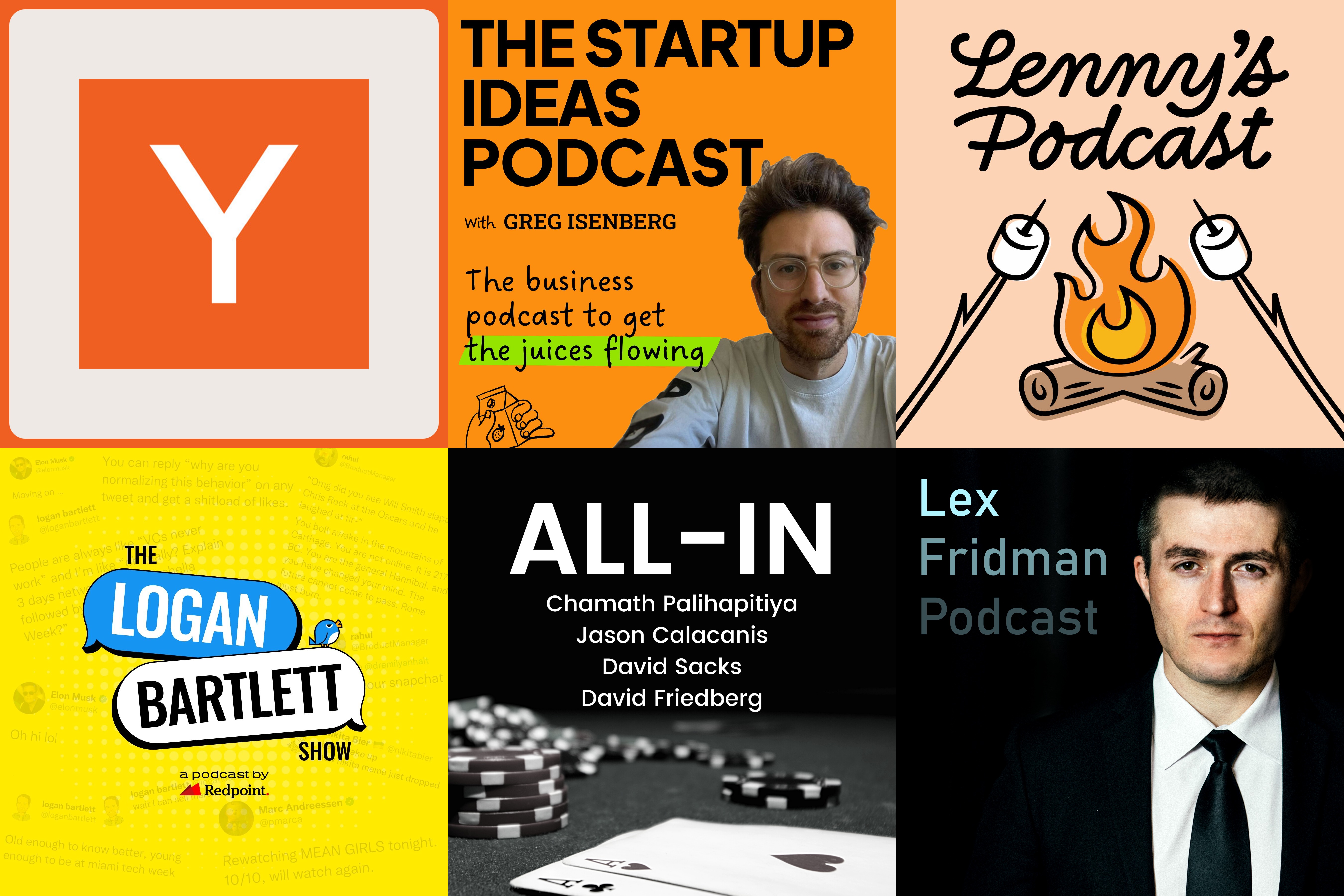
1. The Logan Bartlett Show
Level: intermediate to advanced. Topic: startups, venture capital, company building.
Logan Bartlett, a partner at Redpoint, sits down with the people behind today's most important startups and extracts the tactics, lessons, and frameworks they learned the hard way. Conversations span hiring, go-to-market, product, growth, and fundraising — described by the show itself as a playbook for becoming a better CEO, investor, or board member. Recent episodes include Bret Taylor (CEO of Sierra) on a new class of software winners and Marc Benioff (CEO of Salesforce) predicting that half of all conversations will be with AI agents next year.
On ListenLeap, the business vocabulary in each episode becomes searchable: tap "valuation" or "unit economics" the first time you hear them, save them to your notebook, and they will reappear in later episodes of the same show — which makes for natural spaced repetition.
2. All-In Podcast
Level: advanced. Topic: tech, economics, politics, and everything in between.
Four industry veterans — Chamath Palihapitiya, Jason Calacanis, David Sacks, and David Friedberg — cover "all things economic, tech, political, social & poker." It is fast, opinionated, and full of inside-baseball references: recent episodes tackle autonomous warships, chip stocks crashing, and Mark Cuban on who actually gets wiped out in the AI bubble.
This is the hardest show on the list, and that is its value. The hosts overlap, interrupt, and use slang; following along trains the ear for real-world group conversation, the kind that appears in almost no textbook. On ListenLeap, slow the episode down slightly, turn on bilingual subtitles, and use the AI Q&A to ask "what does a margin call mean here?" — the answer will be grounded in the episode itself.
3. Y Combinator
Level: intermediate to advanced. Topic: building startups from idea to scale.
The Y Combinator Podcast is where builders talk about building. YC partners and founders share real stories, lessons, and tactics from the front lines — from the earliest days of an idea to scaling a company that changes the world. Recent episodes feature Garry Tan on owning your intelligence, Waymo's co-CEO Dmitri Dolgov on moving fast and shipping safely, and Jeff Dean on the 1% rule for building in AI.
The show is interview-based but calm and structured, which makes it friendlier for intermediate listeners than the free-for-all of All-In. Guests speak slowly enough to follow, and the vocabulary — founder, traction, scale, retention — is the core of startup English. On ListenLeap, the smart summary feature is a good habit: listen once, read the summary, then listen again with subtitles and see how much more you catch.
4. The Startup Ideas Podcast
Level: intermediate. Topic: startup ideas, AI tools, new business concepts.
Hosted by Greg Isenberg — CEO of Late Checkout and former advisor to Reddit and TikTok — this show publishes twice a week, and its job is simple: bring free startup ideas to inspire your next venture. Recent episodes cover AI marketing agents that get you customers, graph engineering explained clearly, and how to use Claude Code and MCPs to run marketing.
Because each episode is built around a single idea, the structure is predictable: problem, idea, why it works. That predictability is a gift for learners — new vocabulary arrives inside a familiar frame, so comprehension stays high. It is also short-format, which makes it easy to finish one episode per listening session on ListenLeap, mark the new words, and move on.
5. Lenny's Podcast: Product | Career | Growth
Level: intermediate to advanced. Topic: product management, career, growth strategy.
Lenny Rachitsky interviews world-class product leaders and growth experts to uncover concrete, actionable, and tactical advice for building, launching, and growing a product. Recent guests include Tom Verrilli (CPO of Whatnot), Anthropic's first technical PM Dianne Penn on token maxing and "living in the future," and Netflix CPTO Elizabeth Stone on why the company bets on systems thinkers in the AI era.
The interviews run long and deep, and the language is professional but conversational — ideal for learners aiming at product or tech careers. On ListenLeap, use the fill-in-the-blank training on a favorite interview: the app blanks out key phrases from the transcript, and you reconstruct them from memory, which is far more effective than passive listening for retention.
6. Lex Fridman Podcast
Level: advanced. Topic: AI, science, technology, and the human condition.
Lex Fridman holds conversations that explore technology, history, philosophy, physics, AI, robotics, programming, and just about everything else — "with people from all walks of life." The range is staggering: recent episodes cover the biggest mysteries in physics with Don Lincoln, the technology behind video on the internet (FFmpeg), and the American Civil War with historian Gary Gallagher.
The show is long — two to four hours — and that is precisely what makes it a great endurance workout for advanced listening. No other medium forces you to stay engaged with dense, abstract English for that long. On ListenLeap, split a long episode across commutes: offline caching keeps your place, and the smart summary helps you re-orient when you come back to it days later.
How to Start Listening Today
Don't start with the hardest show. Begin with The Startup Ideas Podcast or Y Combinator — structured, clear, and still genuinely interesting. Listen to one episode with subtitles on, then listen again the next day with subtitles off. That second pass is where the real learning happens.
Set a realistic target: one episode a day, even a short one, beats three episodes on Sunday. Use ListenLeap's level test once to calibrate, keep a notebook of the startup vocabulary you hear repeatedly, and let the AI Q&A answer the questions you would normally skip. Within a few weeks, the same words that sounded like noise will start sounding like English.
Final Thoughts
These six shows cover the spectrum of tech English — from calm founder interviews to four-host debate chaos to two-hour deep dives. None of them was made for learners, and that is why they work so well: the English is real, current, and spoken by people who are actually good at explaining ideas. Pair them with ListenLeap's subtitles, look-up, and review tools, and the gap between "understanding the gist" and "understanding everything" closes faster than most people expect.



Comments
No comments yet.
Leave a Comment