
The short answer
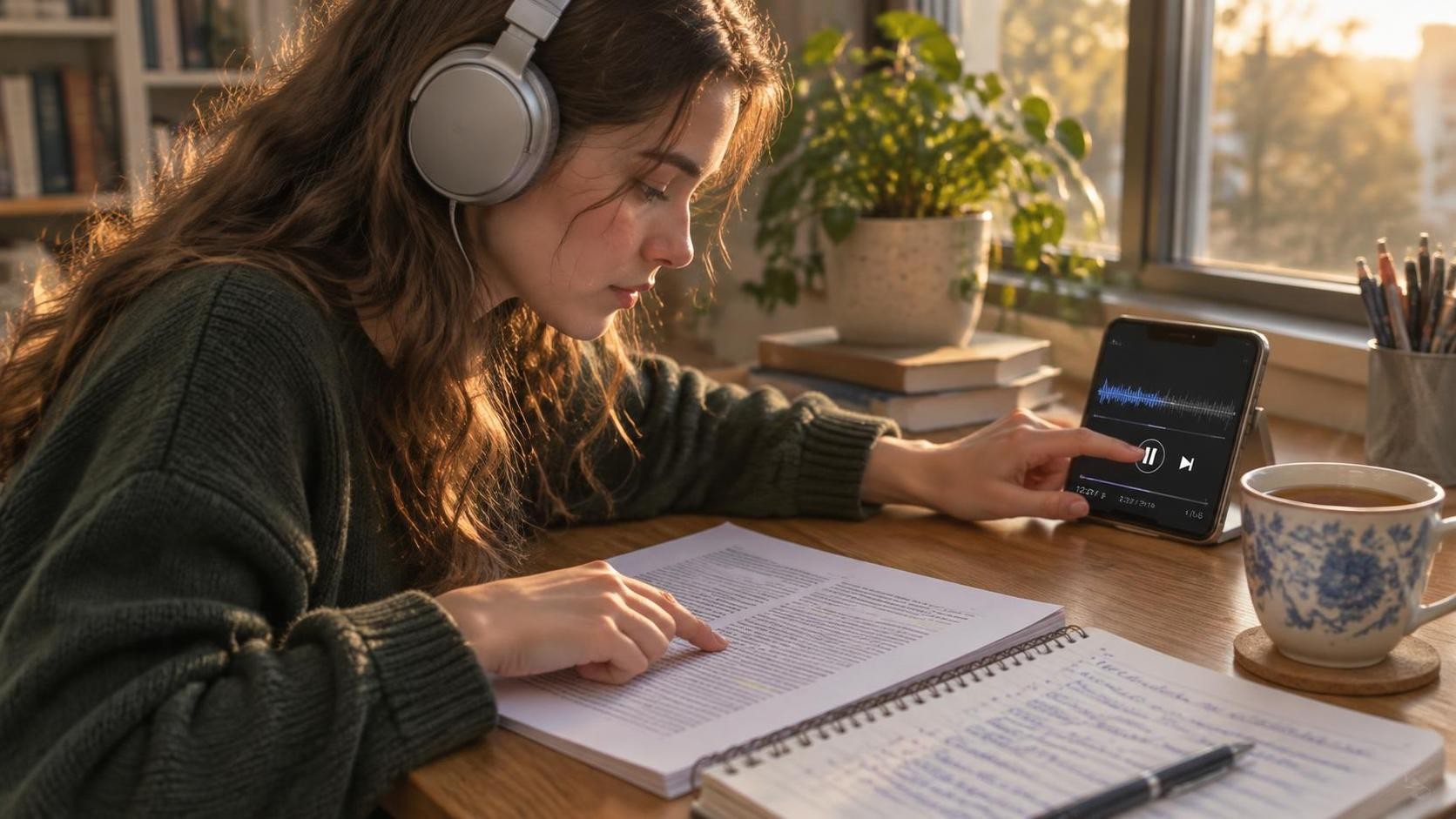
A B1 learner can start shadowing fast English podcasts by cutting the audio down to 20 or 30 seconds, listening to that clip once without any text, checking the same clip against a free transcript, and then shadowing it in overlapping chunks at 0.75 speed before returning to full speed. The loop takes about 12 minutes, needs a single episode with a free transcript, and can be repeated with a new clip the next day.
The routine suits B1 and B1+ learners who read English comfortably but lose the thread when natural speech runs at normal speed. It also suits learners who have tried to shadow a whole 30-minute episode and abandoned it after four minutes. After one session, the reader has a fixed procedure, three sound features to listen for, and a scoring table for deciding whether to repeat the clip or move on.
Why whole episodes fail at B1
The bottleneck is decoding speed
Most B1 learners do not fail because the words are unknown. They fail because the sounds of those words change in connected speech. In a natural interview, "next day" sounds close to "nexday", "just one" loses its /t/, and function words such as "for", "of" and "to" collapse into a schwa. A learner who has only heard careful textbook audio is still parsing one sentence when the next one begins.
Shadowing repairs this only when the clip is short enough to be repeated many times in one sitting. A six-minute episode holds roughly 40 sentences. Repeating 40 sentences well enough to notice linking patterns takes an hour. Repeating four sentences takes three minutes.
What a short clip changes
Twenty-five seconds of fast speech holds about six sentences and perhaps 60 words. That is small enough to stay in working memory, which is exactly what shadowing requires. The learner can hear the same phrase five times, compare it with the transcript, and feel the distance between the written form and the spoken form. The gain comes from repetition density, not from the volume of material.
The source: one episode, one segment
Podcast specs to check before starting
The drill needs an episode that meets four conditions:
- Length between five and seven minutes, so the whole file stays manageable.
- Two or more speakers, so turn-taking and overlap appear in the audio.
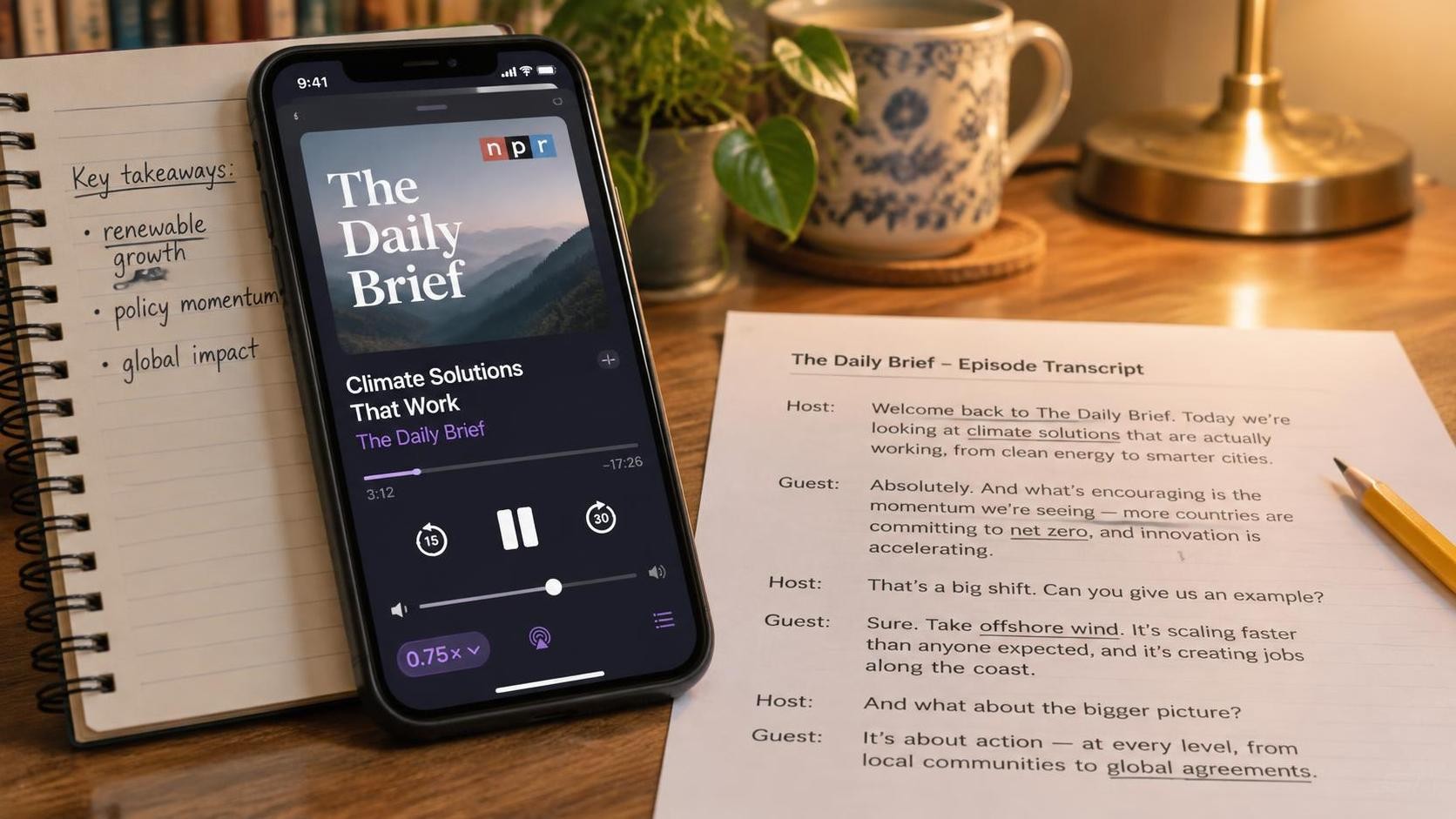
- A free transcript, either as a PDF on the episode page or as text under the player.
- A native accent that the learner actually wants to understand.
BBC Learning English publishes 6 Minute English weekly, and the format is stable across episodes: two British presenters, one discussion question, a short explanation, and a vocabulary recap at the end. Episodes run about six minutes, the speech sits near 150 words per minute, and a transcript PDF is linked on the episode page. The audio is also distributed through standard podcast apps. None of this requires a subscription.
Open the episode page first and confirm that the transcript link works. If the transcript sits behind a sign-up wall, choose another episode. The method depends on comparing sound with text, and a transcript that arrives three steps later breaks the loop.
Which 25 seconds to cut
Use the opening of the episode, from the first greeting to the moment the discussion question is posed. That stretch contains a greeting, a short exchange between two voices, and one full question, which gives enough variety without a topic change.
A second option is the vocabulary recap near the end, where the presenter reads four or five items with their definitions. That section is slower and clearer, so it works as a first session for a learner who finds the opening too dense. Move to the opening once the recap feels comfortable.
Set the player to loop the segment, and write down the start and end times so the same 25 seconds can be found again tomorrow.
The 12-minute session
Pass 1: blind listen, 2 minutes
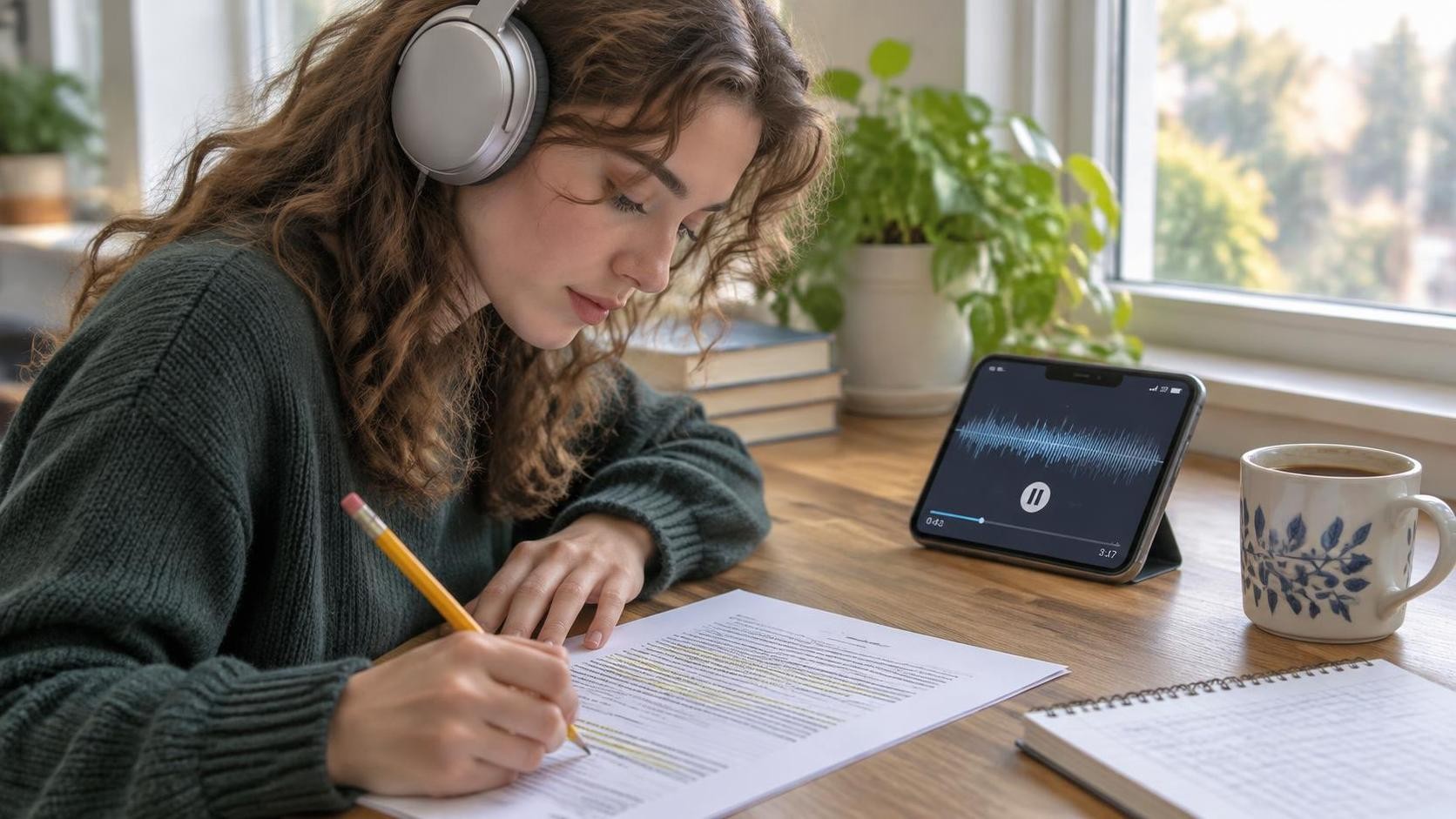
Play the clip three times with no text visible and no pausing. The goal is not full comprehension. The goal is to notice where the stream breaks: which words carry stress, where a speaker pauses, which phrase sounds like one long unit.
After the third play, write down the stressed words only, five to eight of them. If a sentence stays a blur, mark its position by timestamp and leave it. Detailed decoding belongs to the next pass.
Pass 2: transcript check, 4 minutes
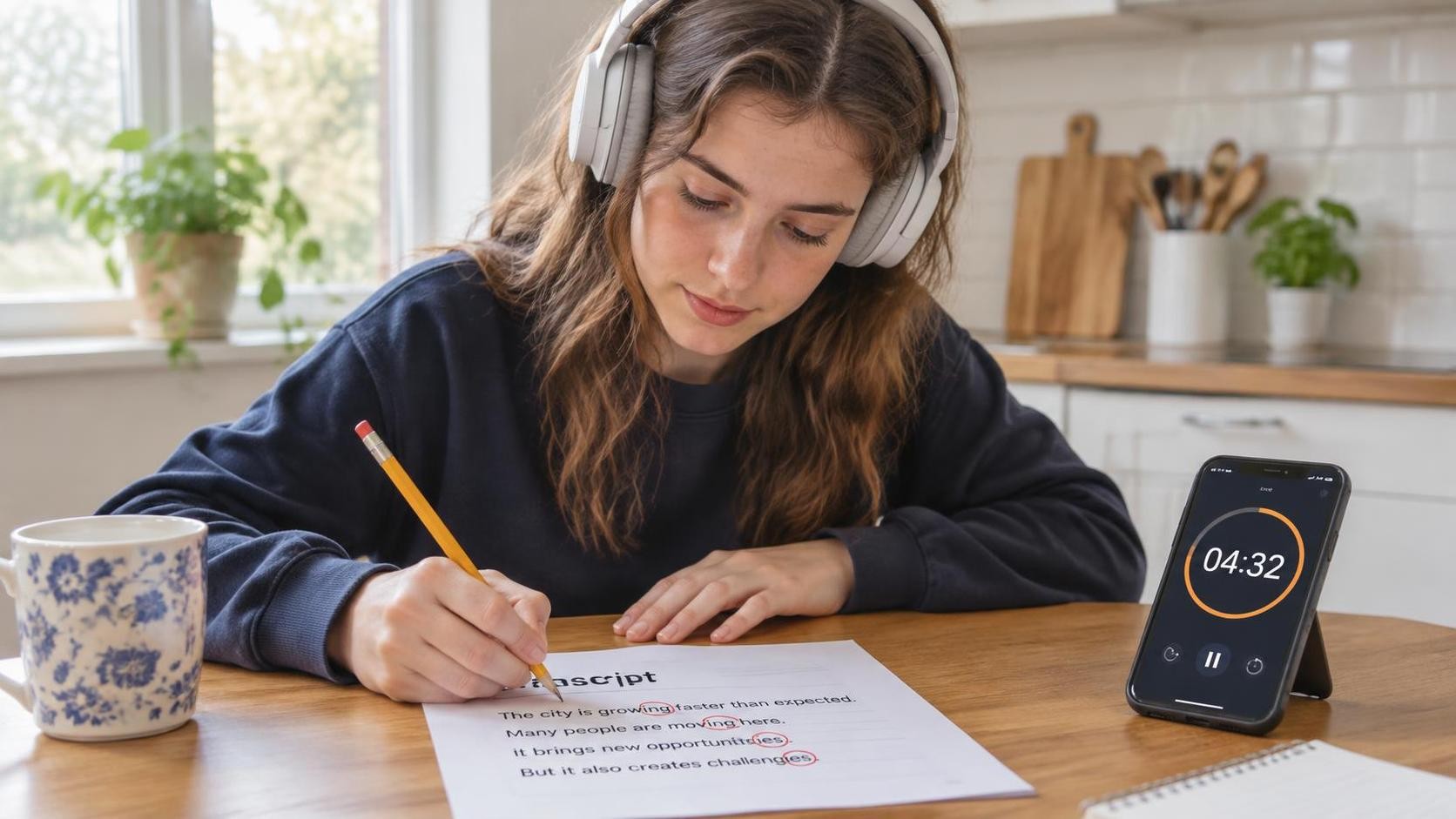
Read the transcript of the same segment once, silently, with a pencil. Mark three things:
- Words that were misheard.
- Places where two or three words ran together into one sound.
- Contractions and weak forms that the ear expected in full.
Then play the clip again while following the text with a finger. The purpose of this pass is to attach the written shape to the sound, not to memorize vocabulary. A learner who stops to look up six words has left the drill and started a reading lesson.
Pass 3: shadowing, 5 minutes
Shadowing means speaking along with the audio, a fraction of a second behind the voice. Start at 0.75 speed with the transcript visible.
- Shadow one sentence at a time, three repetitions each.
- Join two sentences, then three, keeping the pauses of the original.
- Raise the speed to normal and shadow the whole 25 seconds twice.
- Drop the transcript and shadow once more, accepting errors.
The physical target is rhythm, not perfect pronunciation. If the learner runs out of breath, the chunk is too long. If the words come out flat and even, the stress pattern has not been copied yet.
Final minute: retell
Close everything and retell the content of the clip in three sentences, out loud. This step shows whether meaning survived the sound work. A learner who can imitate the rhythm but cannot summarize the content has practiced mouth movement without comprehension.
Three sound features to expect
1. Weak forms
Function words reduce to a schwa in fast speech. "For" becomes /fə/, "of" becomes /əv/, "to" becomes /tə/, and "and" becomes /ən/. In a phrase such as "a cup of tea for the guest", three of the eight words are reduced.
Listen for the reduction first, then imitate it on purpose. Over-articulating these words is the most common reason a shadowing attempt sounds unlike the original.
2. Elision of /t/ and /d/
When /t/ or /d/ sits between two consonants, it often disappears. "Next day" sounds close to "nexday", "just one" to "jusone", "old man" to "olman". The tongue never reaches the ridge behind the teeth.
This is not sloppiness. It is the normal shape of English at speed, and it explains many "the word was not there" moments during a first listen.
3. Linking and contractions
A final consonant joins the following vowel: "an apple" becomes "a napple", "not at all" becomes "no ta tall". Contractions do the same work: "it is" becomes "it's", "they are" becomes "they're", and the auxiliary nearly vanishes.
Mark every link in the transcript during Pass 2. Those marks become the targets for Pass 3.
Four mistakes that waste the session
- Keeping the transcript visible during shadowing. The eyes take over and the ears stop working. The last repetition has to be text-free.
- Shadowing word by word. Voice and audio drift apart within two seconds. Chunk first, then join.
- Starting at full speed. A learner who cannot produce the rhythm at 0.75 speed will not produce it at 1.0 speed.
- Choosing a new clip every day. Repeating the same 25 seconds across three days produces more change than three different clips in one day.
Self-assessment table
Score every row after the final retell. Two points means the skill is present, one means partial, zero means absent. A total of seven or more means the clip can be retired.
| Check | 0 points | 1 point | 2 points |
|---|---|---|---|
| Chunk length | Speaks word by word | Holds three or four words | Holds a full phrase with the original pauses |
| Linking | Every word separated | Some links copied | Links and elisions match the audio |
| Stress | Flat, even rhythm | A few stressed words correct | Sentence stress follows the speaker |
| Blind comprehension | Nothing understood | Main topic understood | Main topic and two details understood |
| Retell | Cannot summarize | Summarizes in vague terms | Three clear sentences in the right order |
A learner who scores below seven repeats the clip tomorrow instead of collecting a new one.
When to repeat and when to move on
Repeat the same clip for a second day when the total is six or lower, when more than three words were still misheard, or when the retell needed the transcript. A second day usually takes eight minutes, because Pass 1 and Pass 2 shrink.
Move to a new clip once the total reaches seven and the retell works without text. Keep the same podcast for at least four clips before changing shows, so the accents and the presenters stay familiar and the comparison across sessions stays fair.
A practice option that fits the loop
ListenLeap (listenleap.com) is an app for learning English with podcasts and video, and its site describes adjustable playback together with on-screen text for the shows it carries. It fits learners who want to run this three-pass loop across many episodes without hunting for a transcript each time, especially those who study on a phone during a commute. It does not fit learners who already pay for a transcript service, or those who prefer an offline audio library and paper scripts marked by hand. The drill above works with any free transcript, so an app is an option rather than a requirement.

Comments
No comments yet.
Leave a Comment