
The problem this loop solves
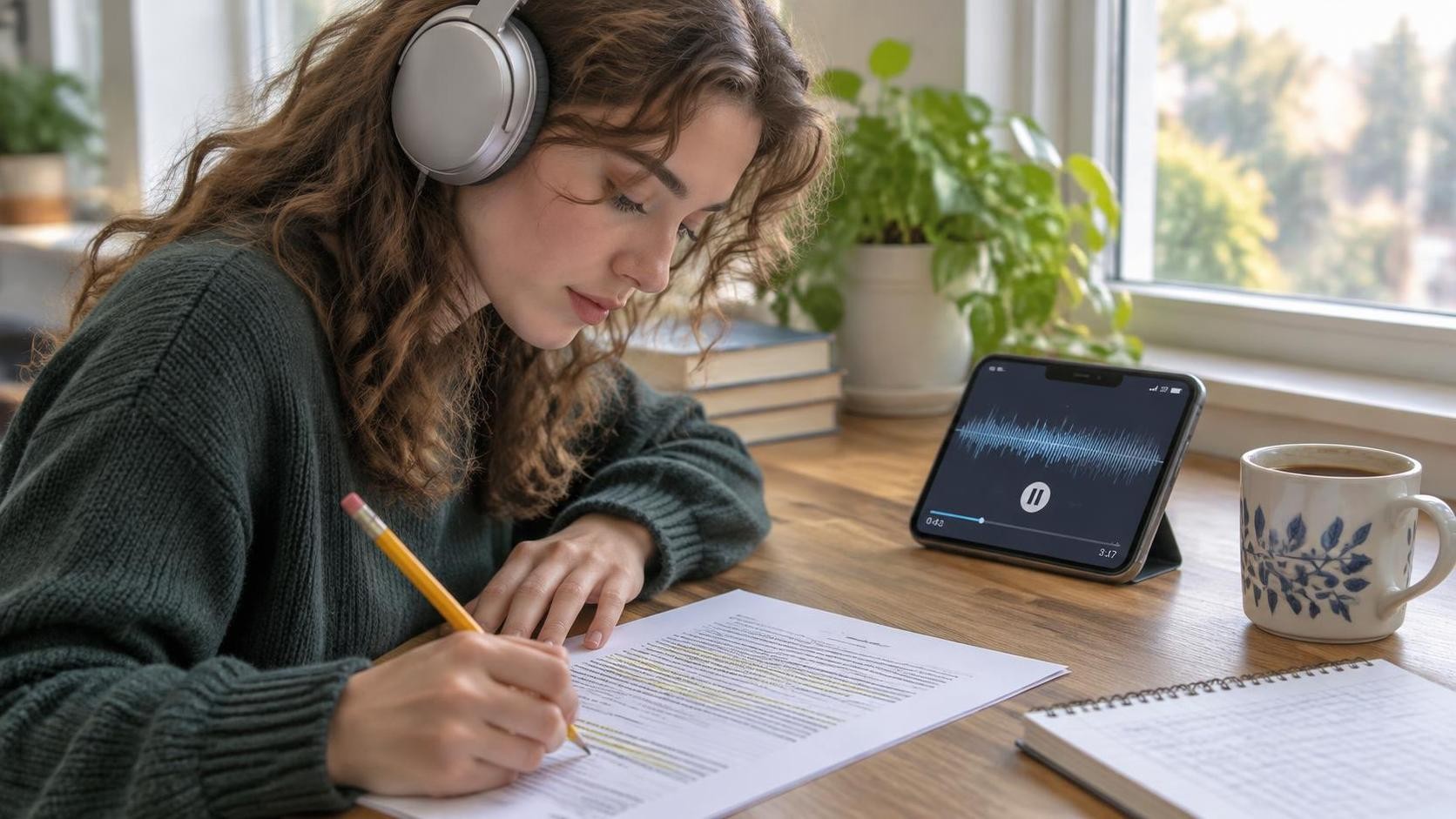
Most B1 learners can follow a podcast episode while reading its transcript, then lose the same audio with eyes closed. The missing skill is rarely vocabulary. It is timing: the ear has never had to predict the next word at the speed the speaker produces it.
The fix is a 20 minute loop built on 60 seconds of audio. Four passes, one clip, no app switching in the middle. It suits B1 learners who read English comfortably but still need a script to follow natural speech. After two weeks of daily runs, that first minute should be shadowable without looking down, and the transcript turns into a checking tool instead of a crutch.
The clip: pick one that publishes a transcript
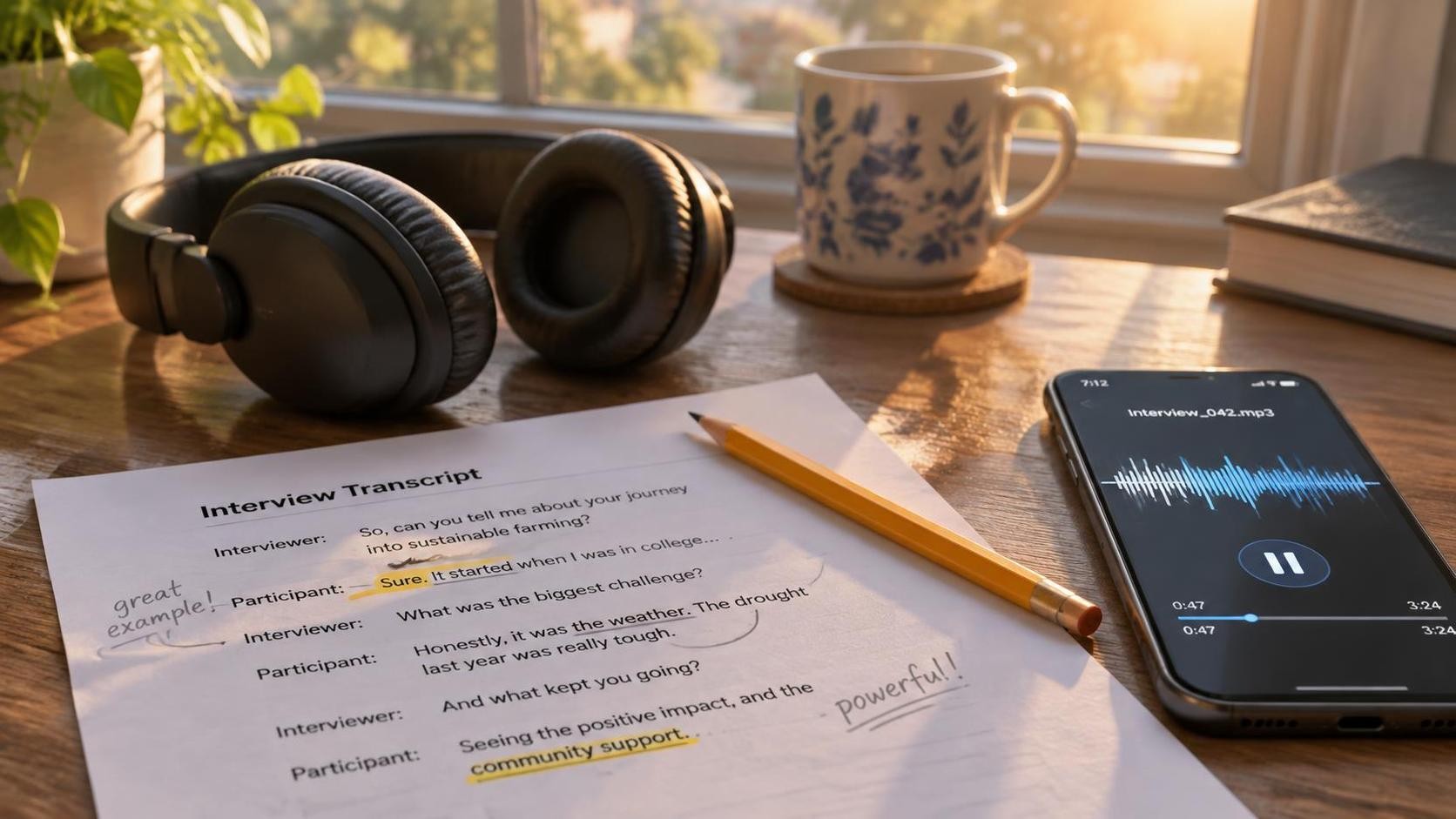
Three series can be checked before starting. BBC Learning English publishes 6 Minute English, with episodes of about six minutes, two presenters, British accents, and a transcript on each episode page. VOA Learning English publishes Learning English Broadcast, with American accents, slower delivery, and transcripts. The English We Speak runs about three minutes per episode, also with a transcript.
Verify two things on the episode page: the duration, and whether the transcript is complete. An episode without a full transcript does not fit this loop, because pass 2 has nothing to check against.
Speed matters more than level labels. A scripted studio show at six minutes sits between graded learner audio and unscripted interview podcasts. Long unscripted interviews are usually faster, overlap speech, and rarely publish transcripts, which breaks the loop for B1.
Segment choice is simple: the first 60 seconds after the opening music. At this pace a minute of talk usually carries roughly 130 to 160 words. If the minute feels denser than that, cut to 30 seconds and keep the full loop.
The 20 minute timer
| Pass | Minutes | Output |
|---|---|---|
| Blind listen | 4 | One sentence plus three phrases |
| Transcript check | 5 | Eight marked words, three sound marks |
| Layered shadowing | 7 | Three layers plus one clean run |
| Retell | 4 | A 60 second and a 30 second version |
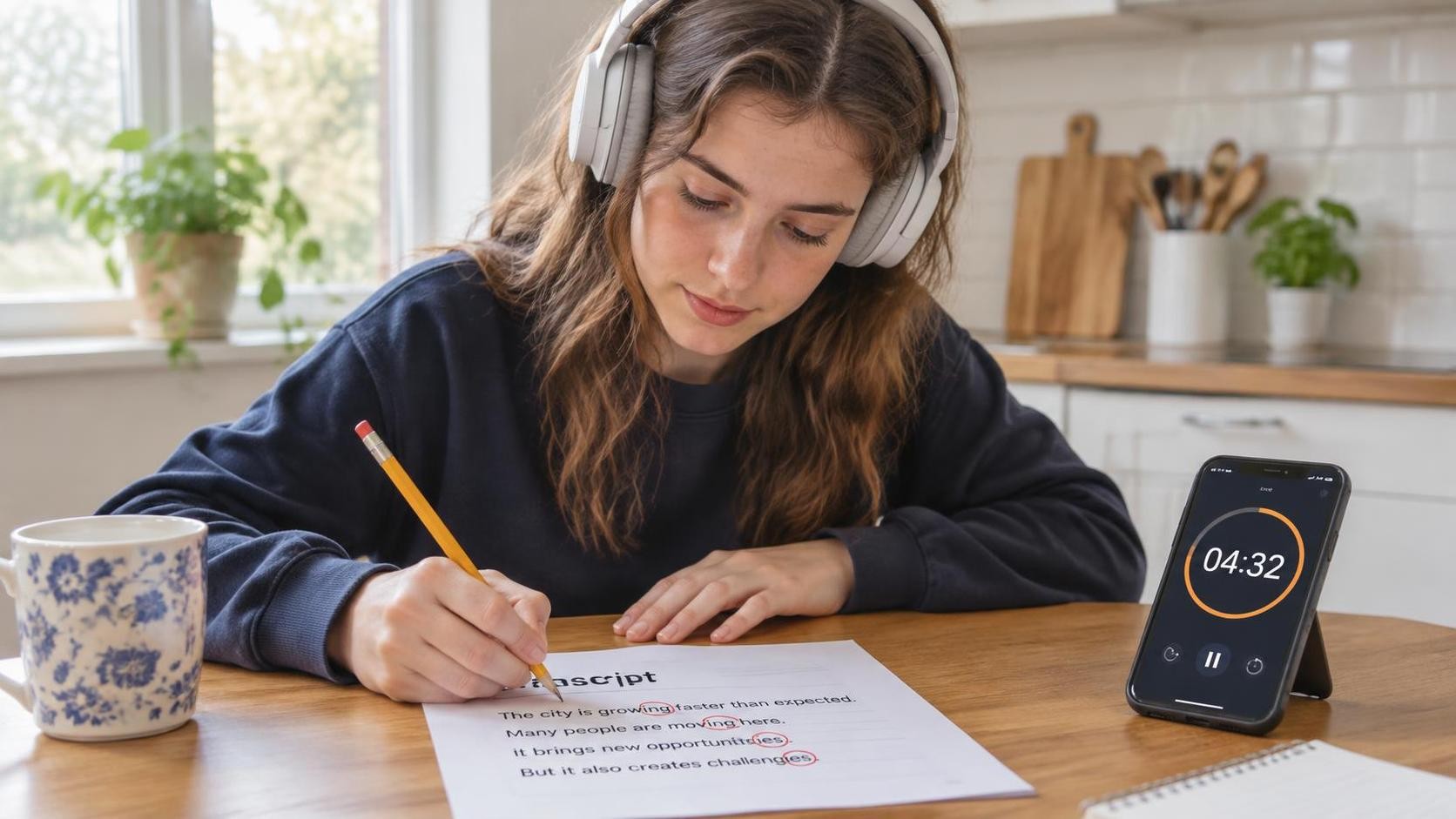
Keep the timer visible. Overflow almost always comes from pass 2, where dictionary lookups multiply and the speaking passes get squeezed out.
Pass 1: blind listen (4 minutes)
Three plays, no text, no pausing.
- Play one: catch the topic and the mood of the speakers. Write one sentence.
- Play two: catch word boundaries, meaning where one word ends and the next begins. Write three phrases that surfaced clearly.
- Play three: catch the melody, that is, which words carry stress and where the pitch rises.
Keep a pen moving. Do not rewind more than once. Guessing is the work, not a failure.
Pass 2: transcript check (5 minutes)
- Read the 60 second transcript once without audio. Mark at most eight words that block meaning.
- Listen again with the text and a finger under the line. Notice where the audio ran ahead of the finger.
- Mark three places: a reduced function word, a link between a consonant and a vowel, and a swallowed consonant. Those marks feed pass 3.
Pass 3: layered shadowing (7 minutes)
Layer one, chunk repeat, two minutes. Play three to five words, pause, repeat aloud with the same rhythm. Copy the stress pattern, not the meaning.
Layer two, overlap with text, two minutes. Speak along half a beat behind the recording, eyes on the transcript, volume slightly under the speaker.
Layer three, overlap without text, two minutes. Same speed, eyes closed or fixed on one point. When a sentence is lost, rejoin at the start of the next sentence instead of stopping.
Final run, one minute. Full speed, no text, no stopping.
Mouth movement matters. Mumbling at a quarter volume hides exactly the timing problems that shadowing exists to fix.
Pass 4: retell (4 minutes)
Close everything and retell the minute in 60 seconds of speech, then compress it to 30 seconds. Finish by writing three sentences from memory: what was said, one detail, one reaction.
A retell that stalls is useful information. It usually points to a chunk copied by sound but never parsed for meaning.
Three sound features to mark
Weak forms. Function words lose their dictionary vowel: for becomes /fe/, to becomes /te/, of becomes /ev/, and becomes /en/. A sentence that looks simple can vanish because four of its words are reduced.
Consonant to vowel linking. A final consonant slides onto the next vowel: an apple sounds like a napple, and pick it up sounds like pi ki tup. Mark every link in the 60 seconds; the count is usually higher than expected.
Consonant loss in clusters. /t/ and /d/ often disappear between consonants: next day becomes nex day, old man becomes ol man, would have becomes would've. These are the spots where transcript and audio seem to disagree.
Keep a simple log for the two weeks: date, series, segment length, score on the table below, and one sound feature that caused trouble. The log does two jobs. It shows whether scores actually move, and it names the specific sounds that need attention, which is far more useful than a vague feeling that listening is improving. A learner who sees no score change after ten sessions should shorten the clip before changing the method, because the usual cause is a segment that was too long on day one.
Expression harvest: three chunks per clip, each with a timestamp. Useful chunk types include opinion markers (the thing is, that's a good point), hedging (it depends on, more or less), and transitions (having said that, at the same time). Copy the whole chunk, never the single word.
Self-assessment table
| Check | 1 | 2 | 3 |
|---|---|---|---|
| Blind listen, gist | No topic caught | Topic caught, no detail | Topic plus one detail |
| Word boundaries | Phrases merge together | Half the phrases are clear | Most phrases separate cleanly |
| Chunk repeat | Rhythm flat | Stress copied in short chunks | Stress and pauses match the clip |
| Overlap without text | Stops after a few words | Finishes with two or three rejoins | Finishes with one rejoin at most |
| Retell | Under 20 seconds | 30 to 45 seconds | 60 seconds with a detail |
| Transcript pull | Eyes drop on every line | Eyes drop at dense spots | No text needed in pass 3 |
Score 13 or more: extend the segment to 90 seconds. Score 8 to 12: repeat the same clip tomorrow. Score under 8: cut the clip to 30 seconds and drop layer three for a week.
Three ways the loop fails
- Reading ahead in pass 3. Eyes two words in front of the voice turn shadowing into silent reading with background noise.
- Whisper volume. The lips never form the sounds, so the timing never transfers to real speech.
- Switching clips daily. Novelty feels like progress, while repetition is what builds the prediction skill.
A tool that matches this loop
One product note, placed after the method. ListenLeap (listenleap.com) is a listening app built around podcast and video material with transcript support, which removes the app switching between pass 2 and pass 3. It suits learners who already run this loop and want audio and text on one screen during replay; check the site for current features before subscribing. It does not suit someone who has not yet finished ten sessions with a single clip, and it cannot replace feedback from a teacher on individual sounds.
When to change the clip
Signals for moving on: three clean runs without text, a 60 second retell with a detail, and no urge to look down during layer two. Then start a new episode from the same series. After four episodes, try a 90 second segment, or a faster unscripted series with a transcript if one can be found.
For the first week, keep pass 3 mostly on chunks and accept a messy final run. The goal is contact with the audio, not a clean performance. By day five, layer two should feel less like translation and more like following a voice. If the clip still feels too fast after three days, the problem is usually clip choice rather than ability, so move to a shorter segment from the same series instead of hunting for an easier show.
Repeat the same clip across three days before switching. Two weeks of this pattern gives twelve clips and roughly four minutes of speech that can be produced without a script, which is a far better base for B1 listening than a folder of downloaded episodes that were never opened twice.

Comments
No comments yet.
Leave a Comment