
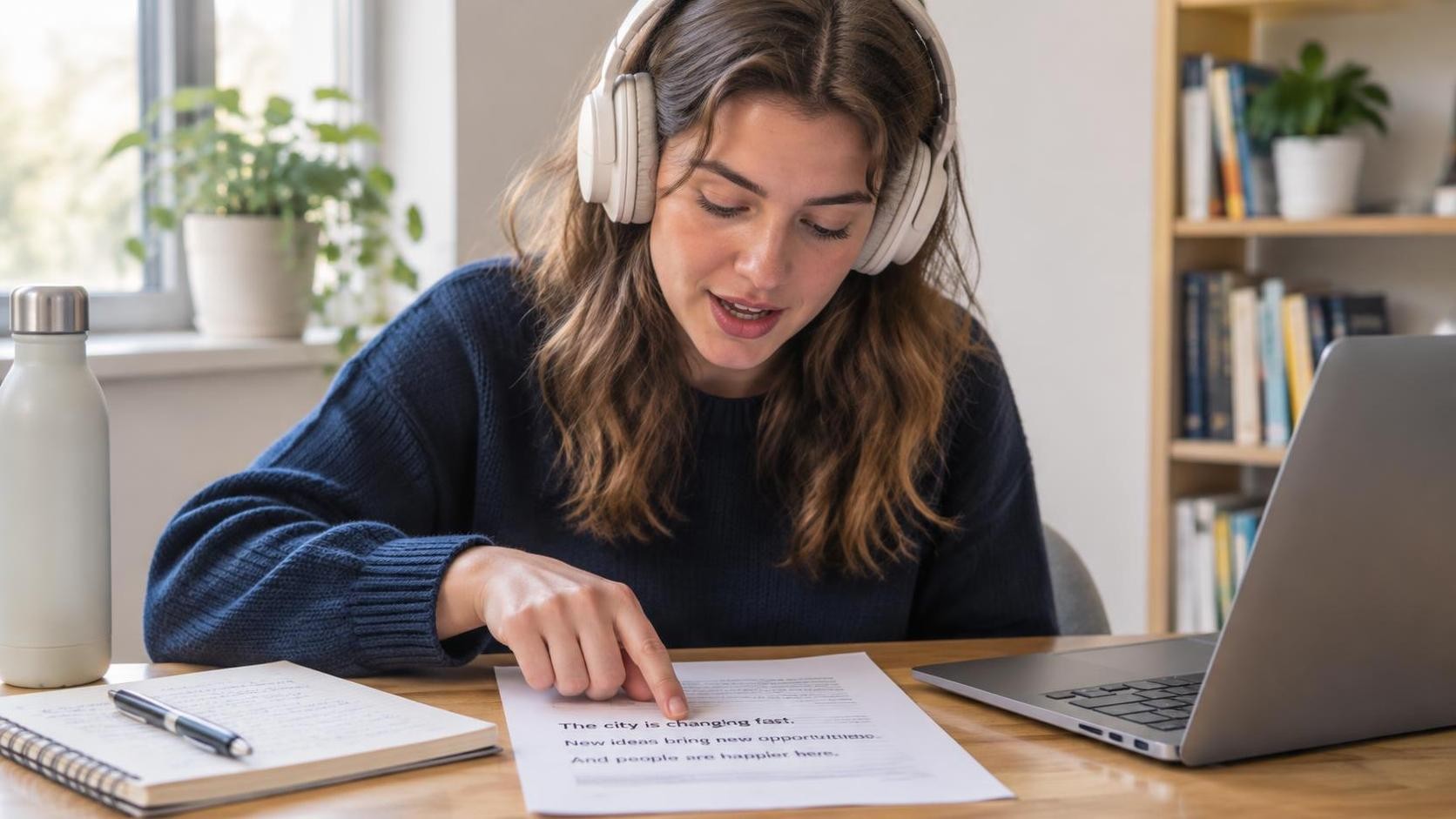
The short answer
The problem is usually not speed in general. It is the small words. A B1 learner can shadow a fast English podcast by choosing one 45 second clip that has a free transcript, listening once without text, marking the reduced forms, shadowing in three layers, and retelling the clip from memory. The full routine takes about 12 minutes and works best when the same clip is repeated for three days.
This guide is for learners at B1 who understand a podcast when reading the transcript but lose the sentence when listening. The aim is specific: hear the weak forms, keep the rhythm for 20 to 30 seconds, and produce the same connected speech without reading. The example series is BBC Learning English 6 Minute English, which publishes episodes of roughly six minutes with British hosts and a free transcript on each episode page. The method works with other podcasts when a transcript and a clear clip boundary are available.
Why small words vanish in fast speech
English does not give every word the same weight. Content words such as nouns, main verbs and adjectives usually carry the stress. Function words such as articles, prepositions, auxiliaries and pronouns are often unstressed. When those function words are unstressed, the vowel often changes to a schwa, a short neutral sound. The word to can sound like tuh. The word for can sound like fruh. The word and can sound like un. The word can can sound like kun.
A learner who knows the written form of a sentence may still fail to recognize the spoken form. The brain expects to hear each word clearly, but the audio delivers a stream in which several small words are shortened and joined. The gap is not vocabulary. The gap is sound recognition.
This is why replaying the whole episode rarely fixes the problem. The learner hears the same blur again. A short clip makes the blur repeatable and small enough to examine. Once the reduced forms become familiar, they stop sounding like missing words.
Choose one 45 second clip, not a whole episode
The clip is the unit of work. A whole episode is too long for close shadowing, and a random ten second piece is often too short to contain a full thought. A 45 second clip usually holds a greeting, a topic sentence, a question and the start of an answer. That is enough to practice rhythm, linking and meaning.
BBC Learning English 6 Minute English is a practical source for this drill. Episodes run for about six minutes, the hosts speak British English at a conversational pace, and the transcript is available on the episode page. The audio can be played in a browser or downloaded. Pick the newest episode on the 6 Minute English page, then use the first 45 seconds after the opening music. Start at the first spoken word and stop at the first quiz question. If that boundary is hard to find, stop after the first short exchange between the two hosts.
Before starting, check three things. The episode page has a full transcript. The clip has a clear start and end. The audio can be paused and replayed without an account. If one of these is missing, choose another episode. The drill depends on repetition, not on collecting many shows.
The same approach works with other English learning podcasts that publish transcripts. The clip does not need to be famous. It needs to be short, audible and documented.
The 12 minute routine
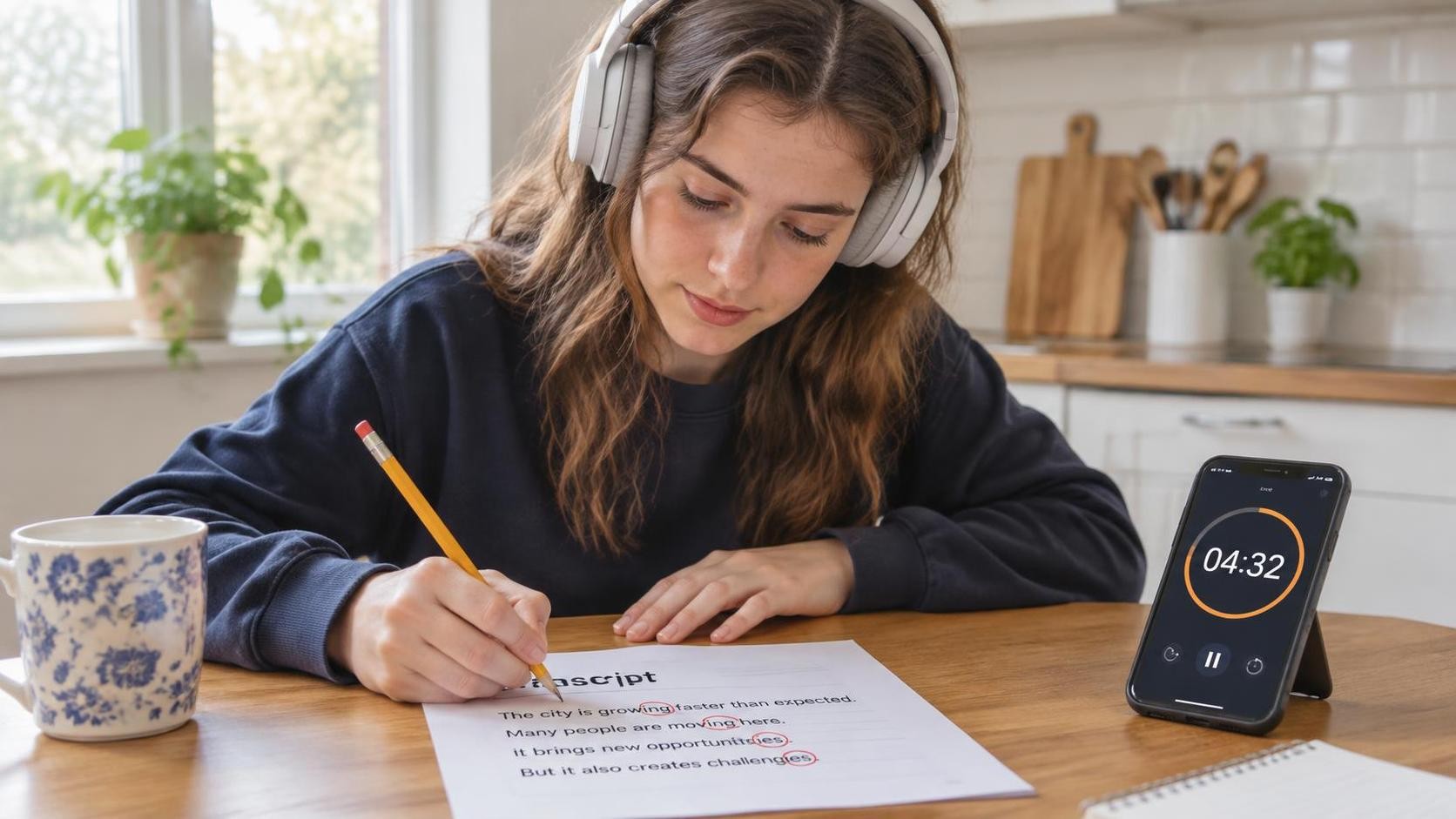
Set a timer for each pass. The timer prevents the drill from turning into passive listening.
Pass 1: blind listening, 2 minutes
Play the clip once without the transcript and without pausing. Do not try to catch every word. Listen for the overall shape: who is speaking, what the topic is, and where the voice seems to blur. At the end, write down three words or phrases that were clear and one place that felt like a wall of sound.
This pass trains the ear to notice the shape of the clip before the eyes receive help from the text. The written note is not a comprehension test. It is a map of attention.
Pass 2: transcript marking, 4 minutes
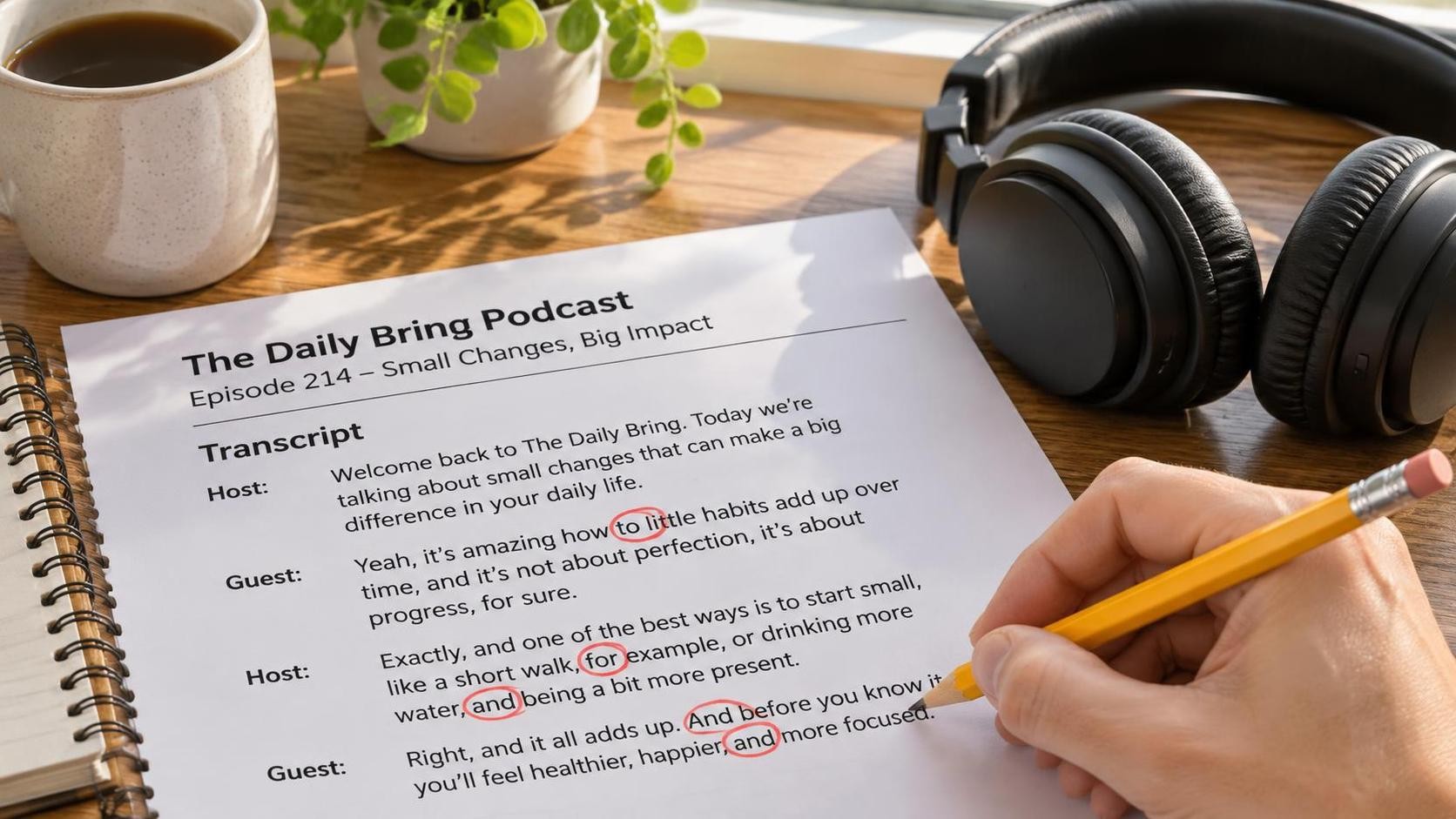
Open the transcript and play the clip again while reading. Circle or underline every small word that is pronounced less clearly than expected. The useful targets are articles, prepositions, auxiliary verbs, pronouns and the word that. Mark the places where two words join, and mark any contraction.
Do not look up every new word. The purpose of this pass is sound, not vocabulary collection. If an unknown word blocks the meaning of the whole sentence, note it in the margin and continue. A dictionary break in the middle of the clip breaks the rhythm that the drill is trying to build.
Pass 3: layered shadowing, 4 minutes
Shadowing means speaking along with the audio, not waiting for the speaker to finish. The learner stays about one or two words behind and copies the melody, not just the words.
Layer one: play one sentence, pause, and repeat it while looking at the transcript. Copy the stress and the weak forms. Layer two: play the same sentence and repeat it without looking at the text. Layer three: play the whole clip and shadow continuously. Do not stop for mistakes. If a word is missed, rejoin at the next phrase.
The third layer is the important one. It teaches the learner to keep going while the speaker moves forward. A perfect repeat after a pause is useful, but it is not the same skill as keeping pace with a fast stream.
Pass 4: retell, 2 minutes
Close the transcript and retell the clip in 60 seconds. Use five words from the clip and one structure that the host used. Record the retell on a phone if possible. The recording is not for public sharing. It is evidence of what the learner can produce without reading.
After the retell, listen to the original clip once more. The second hearing often reveals sounds that were invisible in the first pass. Stop there. The routine is complete.
Three sound features to mark
1. Weak forms in function words
Weak forms are the most common reason a familiar sentence sounds unfamiliar. The vowel in to, for, and, can, of and was is often reduced. The learner should mark these words in the transcript and practice the reduced version on its own, then inside the phrase.
Example: the phrase time to go can sound like time tuh go. The word to is not dropped. It is shortened. Hearing the short form is the skill.
2. Linking between a final consonant and a vowel
When a word ends in a consonant and the next word begins with a vowel, the sounds often join. The phrase check it out can sound like cheh ki tout. The phrase an apple can sound like a napple. The learner should draw a link mark between the words and practice the join slowly, then at normal speed.
Linking is not a trick for sounding native. It is a listening cue. Once the join is recognized, the boundary between words becomes easier to infer.
3. Contractions and dropped sounds
Contractions compress grammar into the rhythm. Have becomes ve in could have, and did you can blur into a single unit in fast speech. Some consonants disappear at the end of a cluster, so next day can sound like neks day.
The learner should mark contractions in the transcript and say the full form once, then the contracted form three times. The contrast makes the reduced form easier to hear in the clip.
Self assessment table
Use the table after the third round on the same clip. A low score is information, not a verdict. The next step is to repeat the clip, not to add more material.
| Skill | Round 1 | Round 2 | Round 3 |
|---|---|---|---|
| Hears a weak form before seeing it in the transcript | Rarely | Sometimes | Often |
| Keeps pace for 20 seconds without stopping | Not yet | With gaps | Mostly |
| Links a final consonant to the next vowel | Not yet | With effort | Automatically |
| Retells the clip with five key words | Needs the text | Needs one prompt | Without help |
| Keeps the rhythm steady when the host speeds up | Not yet | Partly | Consistently |
Common mistakes that make the drill useless
The first mistake is shadowing a whole episode. The clip becomes a background track, and the learner stops noticing detail. The second mistake is reading the transcript during the first listen. The eyes do the work, and the ear never gets a chance to predict. The third mistake is speeding up the audio before the rhythm is stable. A slower version can help at the start, but the target is the original pace. The fourth mistake is changing clips every day. Recognition grows through repetition. The fifth mistake is treating shadowing as pronunciation practice only. In this routine, shadowing is a listening test that happens through the mouth.
When to move on
Stay with the same clip for three days, one 12 minute session per day. Move on when three signs appear: the learner can keep pace for 30 seconds without stopping, can hear most weak forms before reading them, and can retell the clip with five key words. If only one sign appears, repeat the clip once more. If none appear, shorten the clip to 20 seconds and mark fewer features.
A week can hold three clips. That is enough. Counting episodes is a poor measure because the goal is not coverage. The goal is a faster route from sound to meaning.
A note on tools
A free podcast page and a transcript are enough for this routine. Learners who want the clip, the text and the explanation in one place can use ListenLeap at listenleap.com, an English listening platform with podcasts and YouTube videos, bilingual subtitles and AI explanations. It suits learners who want to loop a line, check a meaning and keep the same clip open without switching apps. It is not necessary for the drill, and it is not a replacement for a full grammar course. Learners who prefer paper and a standalone audio player can run the same four passes with the BBC page and a notebook.

Comments
No comments yet.
Leave a Comment