

The short answer
The short answer is that a fast English podcast can be shadowed, but not on the first listen. The order that works is: one slow, transcript backed anchor episode to teach the mouth the sound shapes, the same passage at natural speed, a short clip from a genuinely fast native show at reduced playback speed, and only then the fast clip at full speed. The sequence takes about 25 minutes a day for five days and ends with a 60 to 90 second passage that can be repeated at natural speed without the transcript. It suits B2 learners who already follow the main idea of a news or interview podcast but notice that words disappear when they start to speak. It does not suit complete beginners, and it is not a list of shows to binge.
What to prepare before the first pass
Two audio sources, one printed transcript, a phone for recording, and a timer. Nothing else.
The anchor episode
The anchor is BBC Learning English, 6 Minute English. Each episode runs about six minutes, uses British accents, and comes with free audio and a full transcript on the episode page. The speech is clear and the vocabulary is explained inside the episode, so the material never collapses into noise. Choose an episode on a topic already familiar from daily life, because the point of the anchor is sound, not new information. Note the episode title, the publication date, and the minute where the two presenters begin their discussion.
The fast episode
The fast source is a native news or interview podcast. The Daily from The New York Times is one practical option: episodes run roughly 20 to 30 minutes in American English, and a transcript is usually posted on the episode page. Before any practice, open that page and confirm the transcript is there. If an episode has no transcript, skip it and use another one. Guessing at missing words defeats the purpose, because the transcript check in Pass 2 is the step that makes shadowing accurate rather than theatrical.
Cut one clip, not the whole episode
Take 60 to 90 seconds from the anchor and 45 to 60 seconds from the fast show. Pick a stretch with one speaker and a clear beginning, ideally the first answer to the host's first question. Write the start and end timestamps on the printed transcript and keep them identical for all five days, so that day five can be compared with day one.
Measure the speed instead of trusting a label
Labels such as fast and slow mean very little. Measure any clip instead: count the words in the transcript for that clip, divide by the clip length in seconds, then multiply by 60. A 90 second clip with 210 words runs at about 140 words per minute, while the same clip with 270 words runs at 180. The number describes that clip on that day, not the show in general, and it turns the jump from anchor to fast source into something visible rather than a matter of feeling.
Pass 1: blind listen, twice
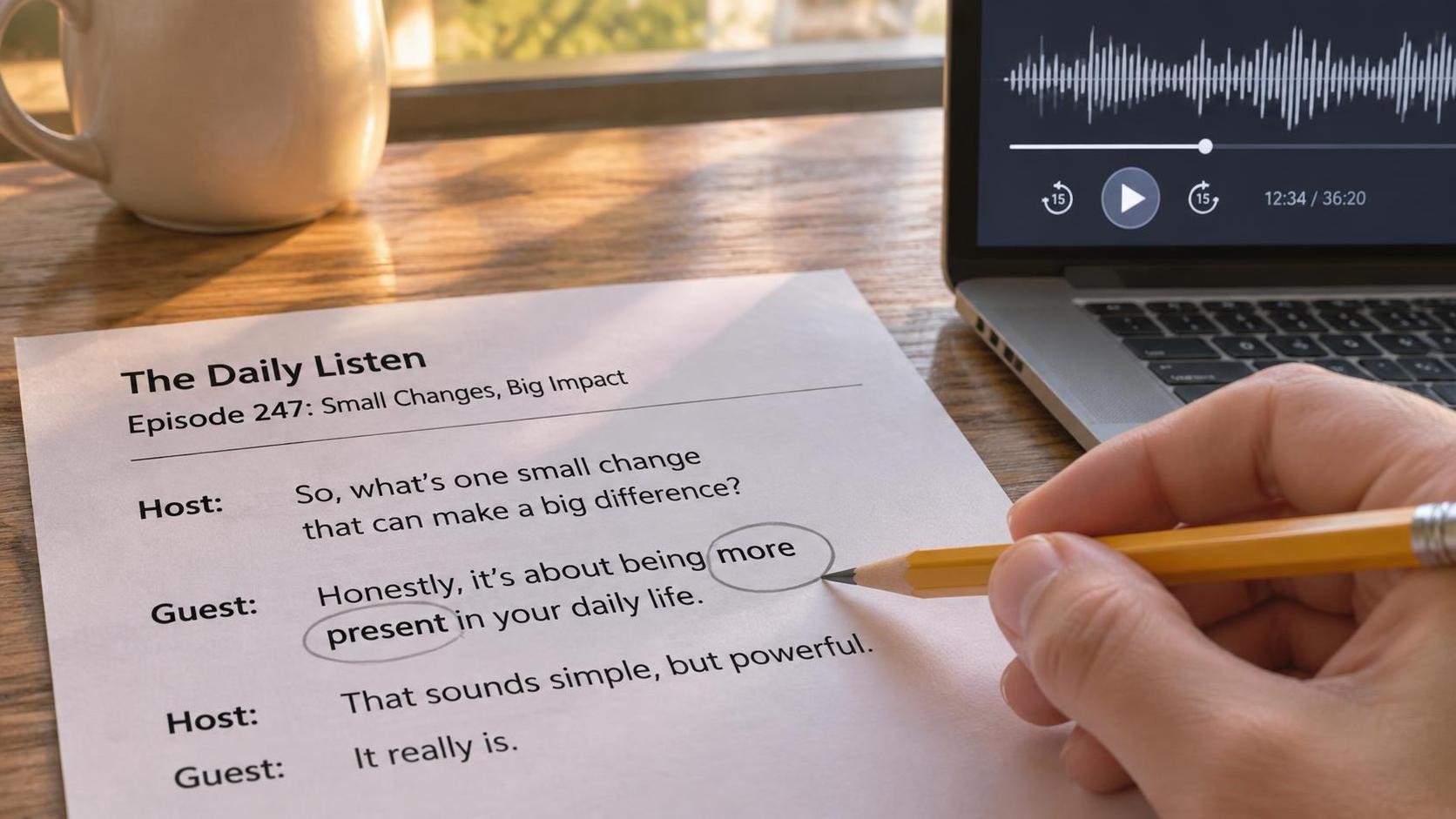
First listen: no transcript, no pausing, no notes except the topic in three words. Second listen: same rule, but this time write a timecode each time the meaning drops. Most learners collect four to eight timecodes. Those timecodes become the practice plan, and nothing else in the episode matters this week.
The temptation here is to replay a hard moment five times. That is transcription, not listening, and it consumes the attention needed for the later passes. Two clean listens, then move on.
Pass 2: transcript check, five marked spots
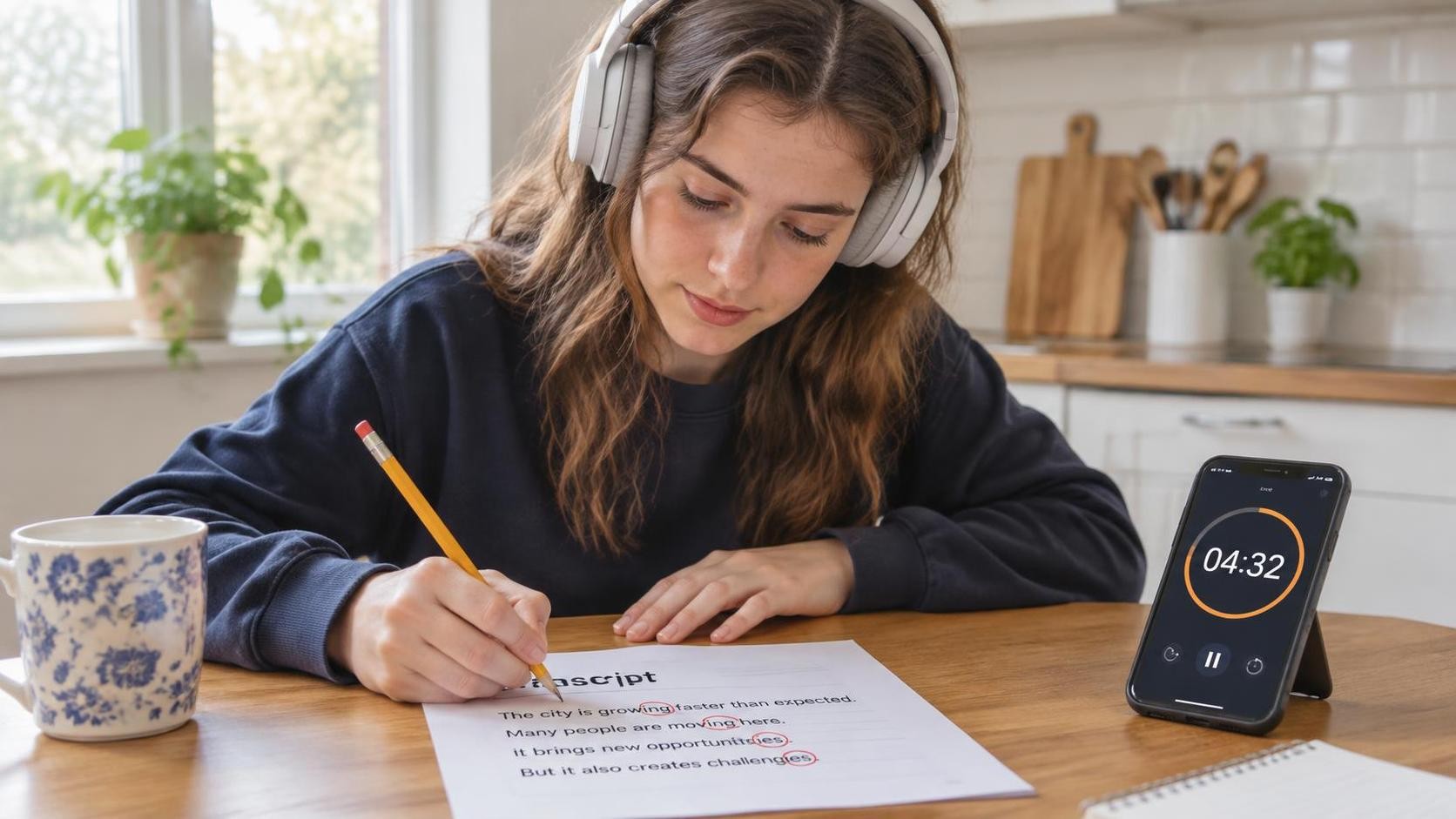
Read the transcript while the clip plays. Mark five places where the audio did not match expectation. The marks usually fall into four groups: a function word squeezed into a schwa, two words joined by a linking sound, a /t/ or /d/ that vanished, or a word that is known in print but was not recognised in speech. Record them in a small table so the same spots can be checked again on day five.
| Timecode | What the ear heard | What the transcript says | Feature |
|---|---|---|---|
| 0:12 | "wanna" | "want to" | t elision |
| 0:27 | "mostovit" | "most of it" | linking plus weak form |
| 0:41 | "fraya" | "for a" | schwa in function words |
The rows above are sample entries for illustration, and the timings will differ for every clip.
Pass 3: shadowing at three speeds
3a. Slow pass on the anchor clip
Playback at 0.75x. Chunk the transcript into thought groups of five to nine words. For each chunk: listen once, then speak along with the audio on the second hearing, one breath per chunk. The speech is simultaneous, not repeated after the audio stops. The mouth should sit slightly behind the audio, like a shadow.
Ten minutes maximum. When the tongue stumbles on the same cluster twice, stop there, slow the cluster down mentally, and say it three times alone before rejoining.
3b. Middle speed on both clips
The anchor clip at 1.0x, then the fast clip at 0.8x or 0.85x. The purpose is to keep the timing learned at slow speed while the audio returns to something close to normal. Learners who jump straight from 0.75x to 1.0x on the fast clip usually report that the words blur together; the middle step is what prevents that.
3c. Full speed on the fast clip
The target is thirty seconds of continuous shadowing at 1.0x. Dropping out is normal. The rule is to rejoin at the next thought group instead of restarting the clip. Restarting trains the beginning of the passage, while rejoining trains recovery, which is what real conversation demands.
Recording rule
Record the last attempt of each day on the phone. Three attempts per clip per day, no more. Comparing the day one recording with the day five recording is the only progress signal worth trusting.
Pass 4: retell in 45 seconds, then compare
Close everything. Summarise the clip in 45 seconds, out loud, in full sentences. Then play the original once and write down three differences: a word the speaker used that did not appear in the retell, a structure that came out simpler in the retell, and one idea that was dropped. Finish by writing one sentence that uses an expression from the clip in a personal context.
The retell is where shadowing turns into speaking. A learner who can shadow but cannot retell has trained the mouth without training recall.
Three things to listen for
1. Weak forms in function words
Words such as for, to, of, and, can and been rarely keep their dictionary vowel. In connected speech they collapse toward a schwa, so that "for a while" can sound like "fra while" and "to the end" like "t'the end". Shadowing these words at full strength is the usual reason a learner sounds foreign while pronouncing every word correctly.
2. Linking and elision at word boundaries
Consonant to vowel linking joins words, so "an hour" becomes "an-nour". Elision removes sounds: "next day" loses the /t/ and "most of it" loses the /t/ before the vowel. Fast podcasts are full of both, and they explain why a sentence transcribed word by word still fails to match the audio.
3. Thought groups and sentence stress
English runs on beats. Content words carry the stress, function words sit between them, and the pitch moves on the word the speaker wants to correct or emphasise. An attempt that copies stress and melody sounds more natural than a word perfect attempt with flat pitch.
A five day rotation
- Day 1: Pass 1 on the anchor clip, then Pass 2 with five marks.
- Day 2: 3a at 0.75x for ten minutes, plus one recorded attempt at 1.0x.
- Day 3: the fast clip at 0.8x for ten minutes, without the transcript after the first two minutes.
- Day 4: full speed attempts on both clips, thirty seconds each, rejoining after every dropout.
- Day 5: Pass 4 retell, comparison notes, and one new anchor episode chosen for the following week.
Self assessment
Score each row after day five. Two points in every row is enough to move to a harder clip, while threes across the board mean the clip is too easy and a longer fast passage is due.
| Checkpoint | 1 point | 2 points | 3 points |
|---|---|---|---|
| Blind listen | topic only | main idea plus two details | main idea, details and speaker attitude |
| Transcript marks | more than eight | four to eight | three or fewer |
| Anchor at 0.75x | stops inside a chunk | one chunk per breath | whole passage without stopping |
| Fast clip at 0.85x | drops out every sentence | holds two or three sentences | thirty seconds continuous |
| Retell | fragmented phrases | main points in full sentences | main points plus one quoted expression |
Common mistakes
- Shadowing the fast clip first, before any transcript work. The result is fluent imitation of rhythm with no grasp of meaning.
- Pausing the audio to repeat each sentence. That is listen and repeat, a useful but different exercise, and it trains accuracy rather than timing.
- Staying at 0.75x for a week. Slow audio is a scaffold, and scaffolds come down.
- Reading the transcript while shadowing on day five. The last pass should run without print, otherwise the eye keeps doing work the ear needs.
Where ListenLeap fits
ListenLeap (listenleap.com) is a platform for learning English with podcasts and YouTube videos, with bilingual subtitles and AI explanations for lines that remain unclear after a second listen. It suits the middle of this routine: one anchor episode and one fast clip can stay in a single player, with speed control, subtitles and an explanation available without leaving the audio. It is not a substitute for the transcript check in Pass 2, and it will not help a learner who wants a graded course or exam preparation. The method above works in any player; ListenLeap mainly removes the tab switching between audio, subtitles and dictionary.

Comments
No comments yet.
Leave a Comment