
Level, goal, and output
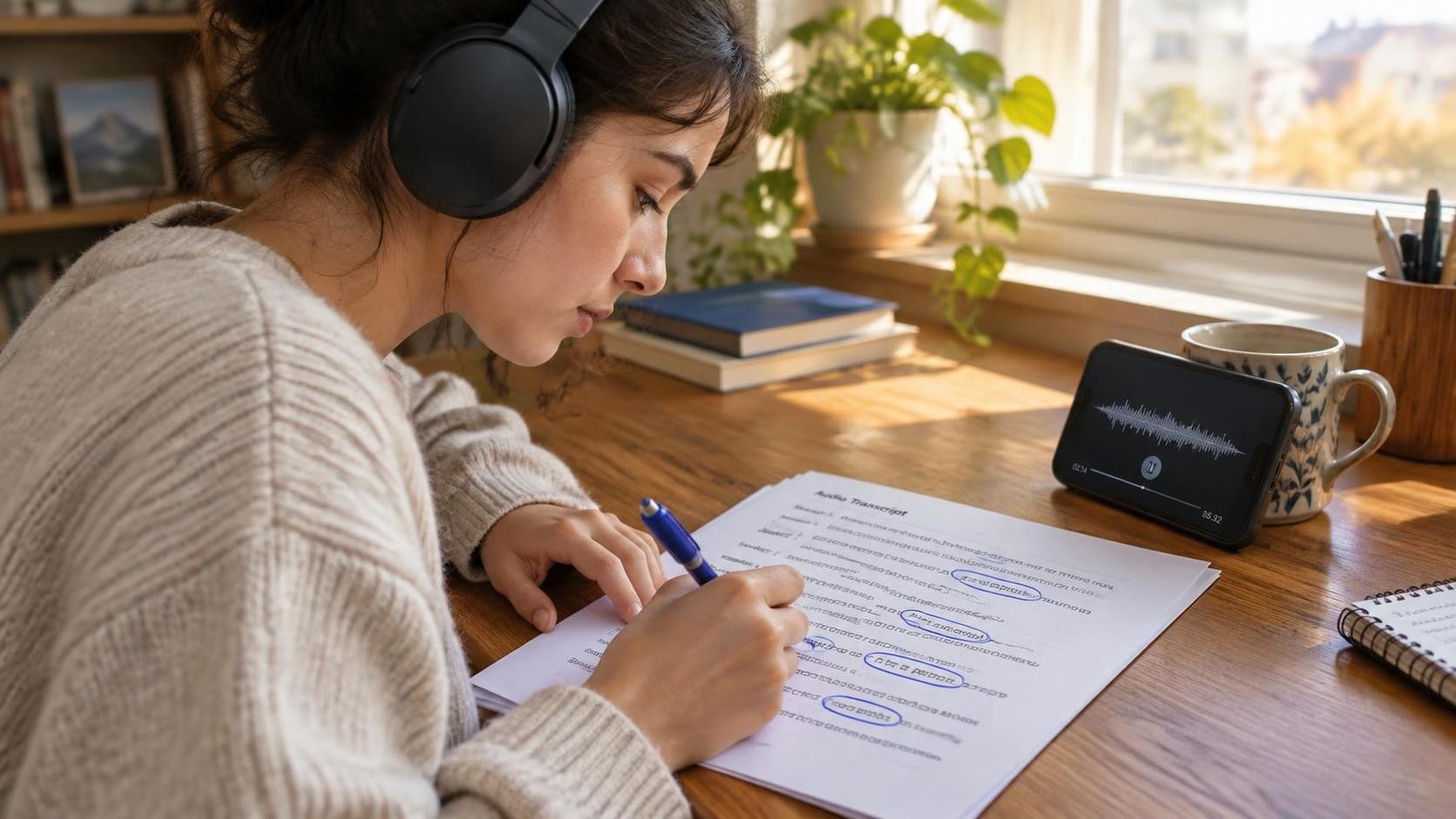
This plan is built for B1 learners who can follow a slow, clearly read news report but lose the thread when two native speakers talk to each other. The gap is usually not vocabulary size. It is timing. The ear is still decoding word one when the speaker has already reached word six.
The target is deliberately small. In one 10 minute block, shadow a 60 to 90 second stretch of a fast English podcast with a free transcript open, then record a 60 second retell of the same stretch. Four passes, one clip, two recordings. The block is meant to be repeated daily with a new clip, not stretched into a 40 minute session once a week.
A completed block leaves four things on the desk:
- three linked or reduced phrases marked with time stamps
- one shadow recording of 60 to 90 seconds
- one retell recording of 60 seconds
- one filled row in the self-assessment table at the end of this article
The source and the exact clip
Use BBC Learning English, 6 Minute English. Check three facts on the episode page before starting:
- the player shows a duration close to six minutes
- a full transcript is published on the same page, inside a collapsible Transcript panel
- the episode is a studio conversation between two hosts with British accents
The show is a practical training ground for three reasons. The transcript is free and complete, the running time fits a single block, and the conversation has natural overlap and reduction without the density of a panel discussion. Six minutes is also short enough to loop without fatigue, which matters more than the prestige of the source.
Pace check: the conversation body of a typical episode comes to roughly 800 to 900 words, which works out near 140 to 150 words per minute. Count the transcript once for the chosen episode to confirm the figure. The number sets expectations. This is not auctioneer speed, and a B1 listener can close the gap with repetition rather than translation.
Clip selection follows four rules:
- Start after the opening music and before the closing vocabulary recap.
- Choose 60 to 90 seconds that contain at least one question and one answer.
- Avoid segments built around a single long anecdote with no turn taking.
- Note the start and end time stamps so the same clip can be replayed exactly.
Pass 1, blind listen: minutes 0 to 2
Play the clip once at normal speed. No transcript, no pausing, no replay. During that single pass, write only three things:
- three words or short phrases that arrived clearly
- one time stamp where the sound turned into a blur
- one guess about what was said at that blur
The rule against replay is the hard part. Most learners restart within ten seconds, which converts listening practice into a search task. A single unbroken pass produces an honest baseline, and the baseline is what makes progress visible two weeks later.
Pass 2, transcript pass: minutes 2 to 4
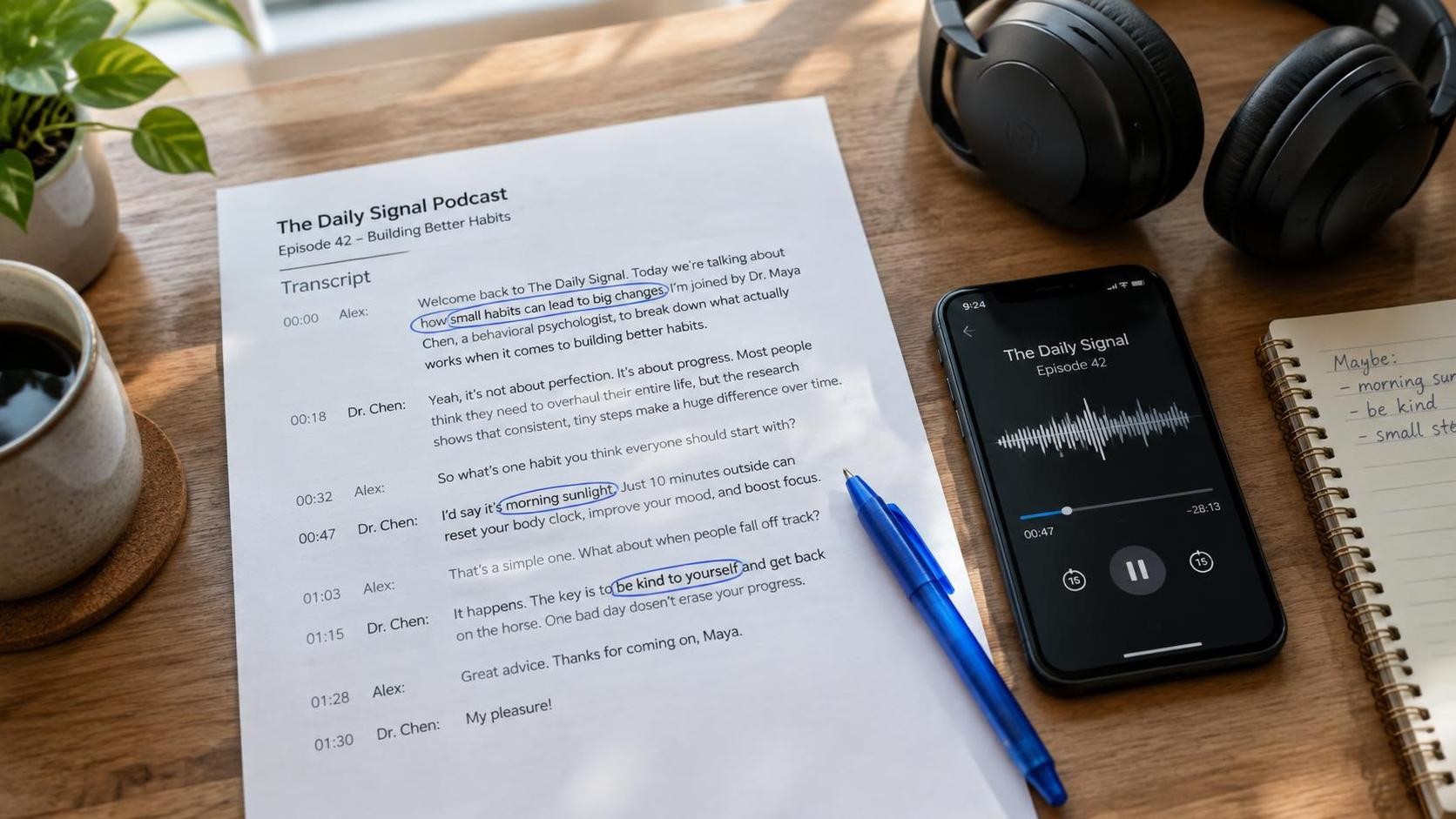
Play the same clip again with the transcript in view. This pass is not reading practice. The eyes follow the audio and mark where the page and the sound diverge. Three marks are enough:
- underline every contraction: don't, it's, they've, they'd
- circle every place where two words merged in the audio but stay separate on the page
- put a dot above the stressed word in three sentences
Then return to the blur from Pass 1 and read that line aloud slowly. In most B1 cases the missing words were known vocabulary pronounced in reduced form. Naming that cause is the actual lesson of the day, and it is more useful than adding ten new words to a list.
Pass 3, shadowing loops: minutes 4 to 8
Shadowing means speaking along with the audio, not repeating after it. The voice runs half a second behind the recording and copies rhythm, not just sounds. Repeating after a pause is a different exercise and it hides the timing problem that this block is designed to fix.
Loop protocol:
- Select a window of 15 to 20 seconds from the clip.
- Play and speak at the same time, three times. Run one prioritizes keeping up. Run two prioritizes stressed syllables. Run three prioritizes melody, including the rise at question endings.
- Record run three on a phone.
- Move to the next window and repeat, then chain all windows into one 60 to 90 second pass.
Keep the transcript visible for the first two days. From day three, cover everything except the marked stress words. By day five, the same clip should run without paper. If a window still collapses at that point, shorten it to eight seconds instead of replaying the whole clip.
Pass 4, retell and compare: minutes 8 to 10
Stop the audio and retell the clip in 60 seconds without looking at the page. Use three phrases from the transcript on purpose, and keep the order of events. Record the retell, then play the shadow recording and the retell recording back to back. The comparison exposes two different faults: a shadow recording that drifts behind the audio shows a timing problem, while a retell that stalls shows a retrieval problem. The two need different fixes.
Three sound features worth marking
Linking across word boundaries
English connects words that look separate on the page. "an apple" becomes a single sound unit, "at the end of" compresses into one rhythmic block, and "not at all" often lands close to "no da dall". Mark these joins with a small tie mark under the transcript line. During shadowing, copy the join rather than the individual words.
Weak forms of function words
Small grammatical words lose their vowels under the stress of meaning. "to", "for", "of", "and", and "can" reduce to a schwa, and "could have" turns into "coulda" in casual turns. Careful hosts keep "going to" intact in formal segments, so the transcript and the audio may disagree. That disagreement is worth marking, because it shows where the speaker chose speed over clarity.
Contractions and sentence stress
"What do you think" often arrives as "Whaddya think", with the stress on "think". Content words carry the beat, function words fill the space between beats. A useful drill: read one transcript sentence and tap the table only on stressed syllables. If the taps fall on "the" or "of", the rhythm is inverted and the shadow run will sound flat.
Self-assessment table
| Check | 1 point | 2 points | 3 points | Today |
|---|---|---|---|---|
| Entry into the clip | First words missed | First sentence missed | Clean start | 2 |
| Timing during shadowing | Voice drifts a full phrase behind | Voice drifts on long sentences | Voice stays within a word | 2 |
| Stress placement | Flat, every word equal | Some content words stressed | Beat matches the host | 1 |
| Linking and reduction | Words kept separate | Some joins copied | Joins match the audio | 2 |
| Retell without notes | Under 20 seconds | 30 to 45 seconds | 55 to 60 seconds with three target phrases | 2 |
A total below 8 points means the clip was too long or too dense. Drop to a 45 second window and stay on the same episode for another day. A total of 12 or more means the clip can move up one level: a news segment, a two person interview, or an episode with three speakers.
Failure modes that waste the block
- Replaying before writing the blur. The baseline disappears and the block becomes passive listening.
- Shadowing only the opening seconds. The first ten seconds are always the easiest and the least informative.
- Reading the transcript during the retell. The retell tests retrieval, and the page removes the test.
- Chasing a new episode every day. One show for five days beats five shows in five days, because the accent and the host pair stay constant.
Where a tool fits
ListenLeap (listenleap.com) offers sentence level looping, synced transcripts, and playback speed control in one player, which removes the manual work of setting start and end points for each loop. It suits a learner who already follows the four pass loop and wants the clip prepared before a commute, or who practices on a phone without a printer. It does not replace the retell step, and it is unnecessary for anyone who already works comfortably with a browser player and a printed transcript. Feature details and current availability belong to the official site.
Repeat schedule
Day one runs the same clip twice, once with the transcript and once without. Day two uses a new clip from the same show and repeats the four passes. Day three keeps the transcript closed during pass three. A weekly comparison of retell recordings from the same show gives a cleaner progress signal than any score, because the material, the accent, and the task stay fixed while only the learner changes.


Comments
No comments yet.
Leave a Comment