

Why the Commute Is a Training Ground, Not a Waiting Room
For many learners, the gap between wanting better listening and finding time to practice never closes. Work, classes, and evening routines swallow the hours that a full listening session would need. The commute sits in a different category. It happens every day, at roughly the same time, and it cannot easily be given to something else. A person who travels twenty minutes each way already owns forty minutes of protected time, five days a week.
The problem is that most commutes are used for passive playback. A podcast plays in the background while the mind drifts to the day ahead. That is not training; it is exposure with no demand on the brain. The routine below changes the contract. It turns the same trip into a sequence of short, repeatable listening tasks. No extra free time is needed, because the time is already there. What changes is what happens inside it.
Match the Material to the Mode of Transport
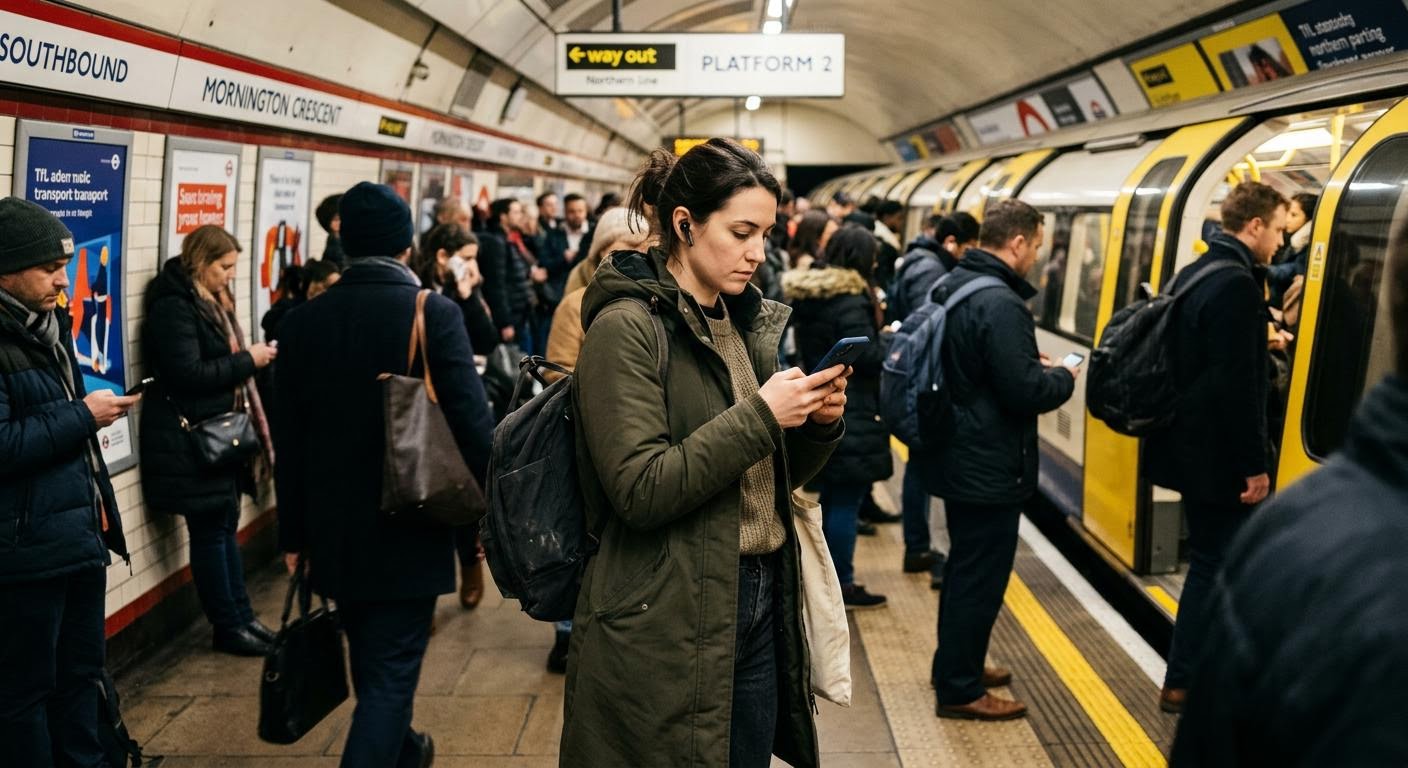
Not all commutes are equal, and pretending otherwise is the fastest way to abandon a routine. A learner on a crowded subway can hold a phone and pause audio, but a driver cannot safely touch a screen. The first step is to divide the trip into segments by attention level.
Fully usable time, such as a subway or bus ride or waiting on the platform, suits sentence-level intensive work, where pauses and replays happen often.
Partly usable time, such as walking on a clear street, suits shadowing and review, tasks that need the ears and the voice but not the eyes.
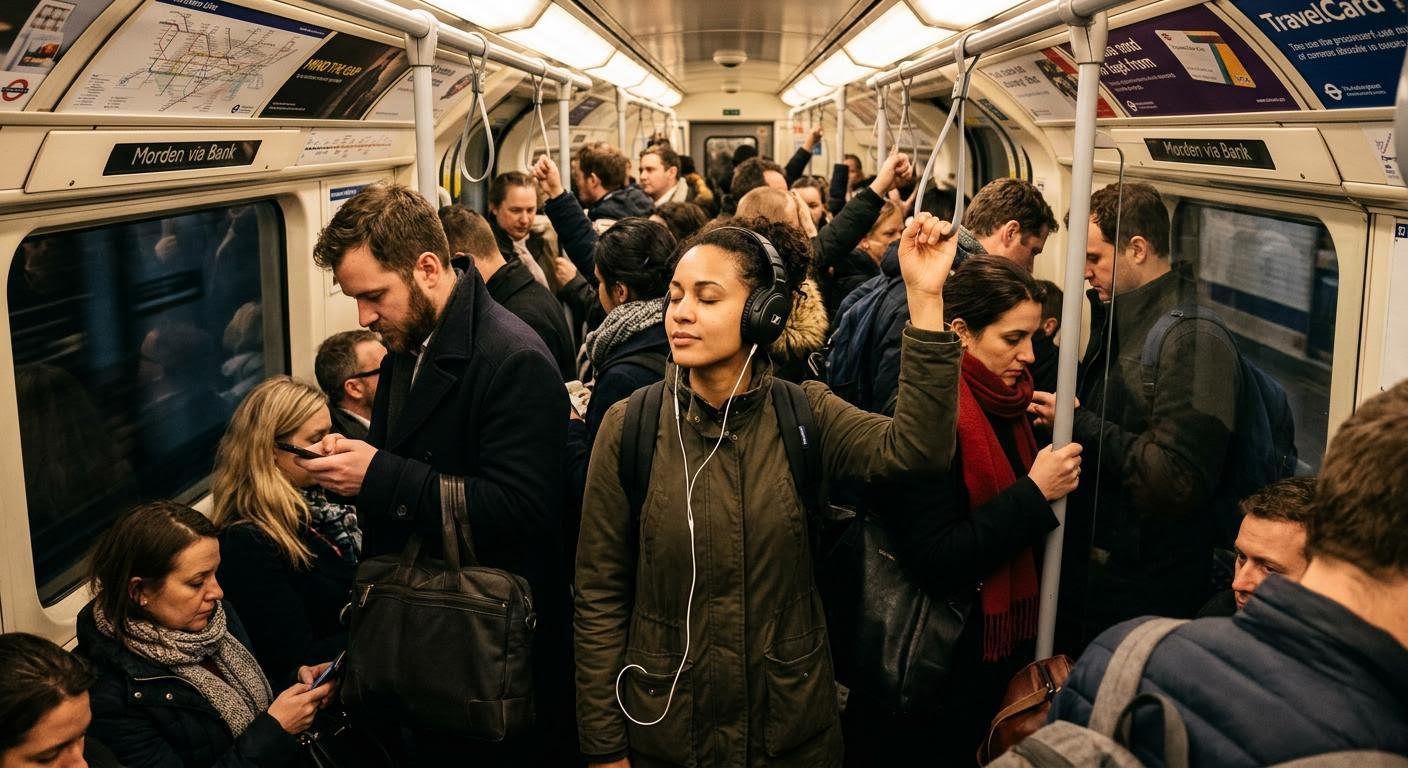
Low-attention time, such as driving, cycling, or standing in a packed carriage, should be reserved for free listening only.
Material choice follows the same logic. A ten-minute episode fits a short trip, while a longer documentary-style show fits a long one. Difficulty matters more than topic. The ideal episode is one where the learner understands most of what they hear but still meets unfamiliar phrases. Material that is too easy teaches nothing new, and material that is too hard turns practice into frustration. Level-sorted libraries, like the one organized inside ListenLeap, make this selection fast, because the learner can pick content that matches their current band instead of guessing.

Pass One: The Orientation Listen
Most learners make one mistake before the episode even starts: they try to understand everything on the first pass. That is the wrong order. The first pass has a single job, to build a map of the episode.
At the start of the trip, press play and do not pause. Listen for the big picture only. What topic are the speakers discussing? What is the host's point of view? Who is talking to whom? The learner should be able to answer these questions in one sentence when the episode ends. If the answer is clear, the framework of the episode is in place, and every later pass will feel easier. This pass also warms up the ear. Jumping straight into slow, careful analysis without a warm-up is like sprinting before stretching.
Pass Two: Sentence-by-Sentence Intensive Work
The second pass is where listening actually improves, and it works best on fully usable time. Instead of replaying the whole episode, the learner works one sentence at a time: play a sentence, stop, repeat it mentally, check the parts that were unclear, then move on. Sentences that still sound blurry after two attempts get replayed on their own, which is far more efficient than rewinding the entire track and hunting for the right spot. A player with per-sentence control, such as the sentence-by-sentence mode inside ListenLeap, turns this chore into a simple tap-and-repeat flow.
Attention should go to the words that usually disappear in fast speech. Native speakers compress function words constantly: want to collapses into wanna, going to becomes gonna, and small words like and, of, and to get reduced to a blur. This is why a learner can recognize every written word and still fail to catch it in audio. Intensive work is the cure, because it forces the ear to process these reduced forms one chunk at a time.
A common mistake is trying to finish the whole episode in this mode. A commute is made of fragments, and the training should be too. Ten to fifteen sentences of careful listening per trip is a complete workout. If the trip runs long, the learner can move on to review instead of forcing more new material.
Pass Three: Shadowing on the Walk Home
The way home is usually more relaxed, which makes it the right slot for shadowing. Shadowing means repeating the audio aloud with a very short delay, like an echo following the speaker. It forces the mouth to imitate the rhythm, stress, and reduction patterns that the ear has just learned. A listener who can shadow a sentence smoothly has usually cracked its sound, not just its meaning.
Walking is an ideal shadowing environment, because the body is busy but the hands are free. There is no need to speak loudly; a low murmur is enough on a public street. For learners who want feedback beyond their own ears, the voice scoring feature inside ListenLeap checks pronunciation against the original across several dimensions, so a wrong stress pattern or a swallowed ending shows up right away instead of being repeated until it becomes a habit.
In very noisy surroundings, full shadowing may be impossible. A quiet alternative is inner shadowing: running the sentence through the mind at the speaker's exact pace and noticing where the speaker pauses and which words carry stress. It keeps most of the training value with zero sound.

Collect Today, Replay Tomorrow
Listening practice leaks away when nothing is kept. A phrase that was finally understood on Tuesday will be forgotten by Friday unless it is stored somewhere and revisited. During the intensive pass, the learner should save the three to five sentences that caused real trouble. Sentence collections inside ListenLeap work well for this, because each saved item keeps its audio attached. Review then means hearing the sentence again, not reading a silent note.
The replay happens on the next trip. Before starting new material, the learner spends the first few minutes listening to yesterday's saved sentences. This is deliberate spacing: the brain meets the same difficult phrase again after a gap, which is exactly the condition that moves it from short-term memory into long-term use. Two trips spent on the same sentence set, with a night of sleep in between, almost always turn I almost heard it into I heard it clearly.
The Five-Day Commute Template
A routine survives when it is simple enough to run without thinking. The schedule below uses a forty-minute round trip as an example, split into a twenty-minute morning trip and a twenty-minute evening trip. Learners with longer or shorter commutes can scale the blocks.
Monday morning: orientation listen of a new episode. Monday evening: intensive pass on ten sentences from the same episode, saving three difficult ones.
Tuesday morning: replay Monday's saved sentences, then a fresh orientation listen. Tuesday evening: shadowing on the walk home.
Wednesday morning: intensive pass on ten new sentences. Wednesday evening: free listening of the same episode at normal speed, with no pauses.
Thursday morning: replay the saved sentences from Monday to Wednesday. Thursday evening: a shadowing session.
Friday morning: whole-episode listen without stopping, then a one-sentence summary in the learner's own words. Friday evening: rest, or light free listening.
The pattern repeats weekly with new episodes. Notice that no single day demands more than twenty minutes of focused work, and every day includes a review element. Consistency beats intensity here. Forty minutes of daily structure outperforms a three-hour session on Sunday that never happens twice.
When the Trip Gets Crowded: Low-Attention Fallbacks
Some days defeat the plan. The train is packed, the weather is loud, or the mind simply will not focus. Pushing intensive work into those conditions usually backfires, because failure feels personal even when the environment is the real problem.
The fallback rule is simple: downgrade the task, do not cancel it. On a noisy day, the commute becomes free listening or saved-sentence review. If a sentence still refuses to make sense after five or six replays, that is a signal, not a failure. Either the material sits above the learner's current level, or the moment is wrong for analysis. The response is to switch to an easier episode or to let the sentence go and meet it again on another day. Listening skill accumulates from many ordinary sessions, not from heroic ones, and a routine that survives crowded trains will outlast one that demands perfect conditions.
The Trip Is Already Paid For
The commute is a rare resource, because it shows up automatically, day after day, with no scheduling effort. Learners do not need to create this time; they only need to stop giving it away. A three-pass habit on a short episode, a handful of saved sentences, and a replay the next morning are enough to turn a passive trip into a steady training session. Small and repeated beats long and abandoned. Start tomorrow morning with the orientation listen, and let the routine do the rest.




Comments
No comments yet.
Leave a Comment