

The answer is a four-session fade, not a cold removal. A learner uses the same short clip four times. Every session follows the same four steps: listen once without text, check the transcript, shadow the clip, then retell it. Across the four sessions, the transcript moves from fully visible to face down to absent. This plan is for B1 learners who can follow a slow English podcast with subtitles but cannot yet keep the rhythm of a sentence without reading. By the end, the learner should be able to shadow the clip with no text and summarise it in five sentences. The example uses one recent BBC Learning English episode, so the material is easy to find and the transcript is free.
Why the transcript turns into a crutch
Reading while speaking feels productive. The eyes supply the next word, the page supplies the timing, and the voice can follow without waiting for the ear. The result is a smooth performance that hides a weak skill. When the page disappears, the learner often discovers that the words were recognised visually, not prepared for shadowing.
The problem is not the transcript itself. A transcript is useful for checking a phrase, noticing a linking pattern, and confirming a half-heard word. The problem is the sudden removal. A learner who goes from full text to no text in one step usually spends the first minute guessing, loses the thread, and concludes that shadowing is too hard.
A fade solves this. The text stays in the routine, but its role changes. On the first session it is a map. On the second it is a repair tool with holes. On the third it is face down. On the fourth it is gone. The learner is not asked to trust memory on day one. The learner is asked to need the page a little less each time.
The clip and the segment
The example is BBC Learning English, 6 Minute English, episode 261022, published on 22 October 2026. The title is "What should you eat for a better night's sleep?" The programme runs for about six minutes and is presented by Georgie and Phil in British English. The pace is moderate and conversational, with clear turns between the two hosts. It is not a fast, overlapping panel discussion, which makes it suitable for a first fading cycle at B1.
The episode page provides the audio and a free transcript. The page notes that the transcript is not word-for-word, so the punctuation and the small fillers will not match the recording exactly. That is useful for this routine. The learner cannot simply read along in perfect sync. The ear still has to do some work.
The practice segment is the opening dialogue block, from the first exchange between Phil and Georgie to the end of Georgie's quiz question. It lasts about 70 to 90 seconds. The block contains a greeting, a natural question about sleep, a short explanation, and a three-option quiz. The vocabulary is concrete, the speakers take turns, and the clip ends at a clean boundary. A learner can loop it without needing the rest of the episode.
Episode page: https://www.bbc.co.uk/learningenglish/english/features/6-minute-english_2026/ep-261022
The instruction below is an example practice. It is not a claim that the episode has been tested by a class, and it does not rely on hidden statistics. The timing comes from the published episode length and the dialogue boundaries on the page.
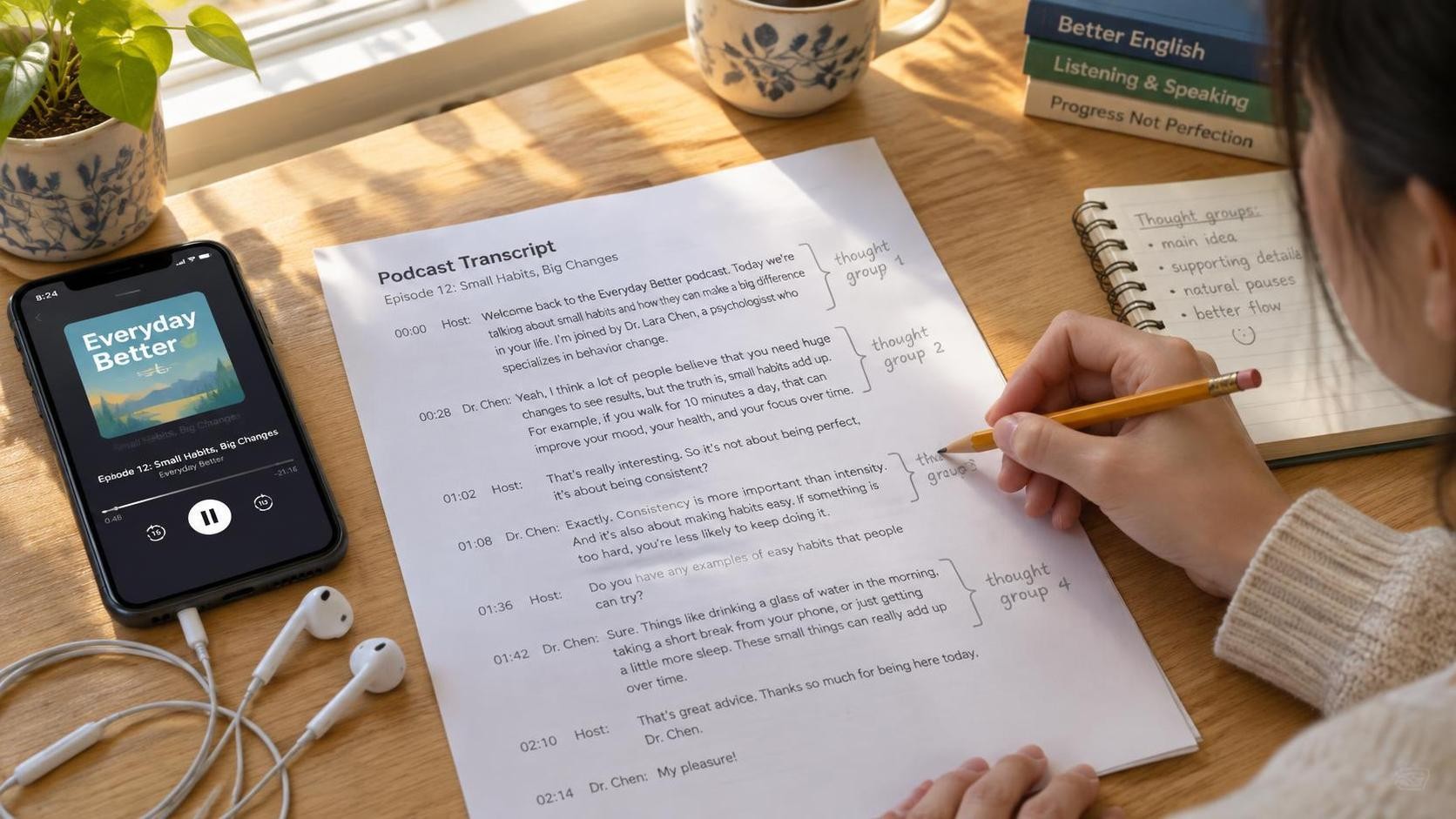
The four-session fade plan
Each session takes 10 to 12 minutes. The clip stays the same. The order stays the same: blind listen, transcript check, shadowing, retell. Only the amount of text support changes.
| Session | Transcript state | Shadowing target | Time |
|---|---|---|---|
| 1 | Full text, marked by hand | Three passes with the page visible | 12 minutes |
| 2 | Text with gaps | Three passes, glance only after a stumble | 12 minutes |
| 3 | Face down | Two passes, one 10 second check | 10 minutes |
| 4 | None | Three continuous passes | 10 minutes |
Session 1: Mark the text
- Play the clip once without looking at any text. The task is not full comprehension. The learner writes down three words that stood out, even if the meaning is uncertain.
- Open the transcript. Mark thought groups with a pencil slash. Underline the stressed word in each group. Circle two places where a word ends in a consonant and the next begins with a vowel.
- Shadow three times. First, pause after each sentence and copy the melody. Second, play two sentences and shadow without pausing. Third, play the whole block and stay with it, even if some words are lost.
- Close the transcript and retell the block using three keywords written on a separate sheet. The retell can be short. Three sentences are enough.
The first session is deliberately supported. The goal is to connect the printed shape of the phrase to its sound, not to prove that the learner can work without help.
Session 2: Cut holes in the text
- Play the clip once without the text and mouth the words without speaking aloud. This keeps the mouth moving while the ear leads.
- Make a cloze version of the transcript. Cover about 30 percent of the content words, not the grammar words. A phrase such as "What should you eat for a better night's sleep?" can become "What should you ___ for a better night's ___?" The gaps should be words the learner can predict from meaning, not random words.
- Shadow three times with the gapped text. Glance at a gap only after a stumble. Do not read the full line before speaking it.
- Retell the block in five sentences without the text. The five sentences can be simple. The aim is to keep the order of ideas.
If the learner fills every gap before shadowing, the exercise becomes reading again. The gaps are there to create small moments of listening.
Session 3: Cover the page
- Play the clip once and tap the desk on the stressed syllable of each thought group. The hand helps the learner feel the beat without speaking.
- Turn the transcript face down and shadow two passes. When a phrase disappears, rejoin at the next sentence instead of restarting the clip.
- After the second pass, choose the worst phrase and check only 10 seconds of transcript around it. Read the phrase aloud twice, then cover the page again.
- Retell the block with a five-sentence frame: the episode asks about sleep, one host describes a problem, the quiz offers three numbers, one detail is surprising, and one phrase is worth keeping.
The page is still nearby, but it is no longer the source of timing. The learner is using it as a dictionary, not as a script.
Session 4: Retell without text
- Play the clip once with no text and no pauses. The learner listens for the shape of the whole block, not for every word.
- Shadow three continuous passes. If a sentence is lost, wait for the next one and rejoin. Restarting from the beginning hides the real problem.
- Record 30 seconds on a phone, then compare the recording with the original. Listen for rhythm, stress, and pauses. Do not judge the accent.
- Retell the block in five sentences within 60 seconds. Then write three sentences about sleep using one phrase from the clip.
The fourth session is the test, but it is not a performance. A learner who finishes with two clear sentences and one smooth phrase has enough evidence to repeat the cycle with a new clip.
Three things to notice in the clip
1. Linking in "eat for a better night's sleep"
The question in the episode title is a useful phrase for linking. The final /t/ in "eat" meets the /f/ in "for", and "for a" is compressed into a weak, fast unit. The phrase does not sound like three separate words. It sounds like one block with a light stress on "eat" and a stronger stress on "sleep".
A learner can loop just this phrase five times. First, say it slowly with a clear pause between words. Then say it at normal speed and let the /t/ slide into the next word. Finally, shadow the host's version without reading. The goal is not to exaggerate the link. The goal is to stop making a small stop between every word.
2. Weak forms in "causes us to struggle to sleep"
The phrase "what causes us to struggle to sleep" contains several grammar words that shrink in speech. "Us" is not a full, long vowel. "To" is light. The verb "struggle" carries the meaning, while the small words connect it. A learner who pronounces every word fully will sound slower than the recording and will fall behind.
The practice is to clap once on "caus", once on "strug", and once on "sleep", then fit the weak words between the claps. This gives the learner a physical sense of the gap between stressed beats. The small words should be quick, not absent.
3. The chunk "lying awake at night"
"Lying awake at night" is a compact way to describe being in bed but unable to sleep. It is more natural than "being unable to sleep in bed" and it appears in the opening description of the problem. The chunk is worth keeping because it can be reused in a retell about sleep, travel, or stress.
A learner can build a small set of sentences around it: "Many people lie awake at night before an exam." "Lying awake at night makes the next day harder." The grammar changes, but the chunk stays. This is the kind of phrase that makes a retell sound less like a grammar exercise.
When the words blur
Blur is normal in the first no-text pass. The mistake is to treat it as a signal to stop. A short repair routine works better than a full restart.
- Rejoin at the next sentence. Do not drag the player back to zero. The skill being trained is recovery, not perfection.
- Slow the clip to 0.9x for one pass if the player offers speed control, then return to normal speed. A slow pass is a bridge, not the final goal.
- Loop a phrase three times at most. After three tries, check the transcript for 10 seconds, then close it and shadow the phrase once more.
- Mark only stressed words. A transcript covered in underlines becomes a reading script again.
- If more than half of the block is missing after two no-text passes, choose a shorter segment or an easier episode. B1 shadowing should be hard, but it should not be a guessing game.
- Keep the retell simple. Five short sentences with clear order are better than one long sentence with three unfinished clauses.
A learner who feels lost can also shadow only the first 20 seconds for one session, then add the next 20 seconds. The fade plan still works. The clip is a unit of practice, not a fixed test.
Self-assessment
Use the table after session four. A score of 0 means the skill is not yet visible. A score of 1 means it appears sometimes. A score of 2 means it is stable enough to build on.
| Check | 0 | 1 | 2 |
|---|---|---|---|
| Rhythm | Words arrive as a flat list | Some stress, frequent restarts | Stress and pauses follow the original |
| Linking | Every word is separate | Some links, some gaps | "Eat for a" and "causes us" join smoothly |
| Text reliance | The page is needed for every line | The page is used for repairs | A full pass is completed with no text |
| Retell | Isolated words only | Five sentences with long gaps | Five clear sentences with two target phrases |
| Stamina | Stops after 20 seconds | Finishes with restarts | Three continuous passes |
A simple rule after scoring: 0 to 3 means repeat the same session before moving on. 4 to 6 means repeat the same clip once with a different segment. 7 to 10 means start a new clip at the same level. The numbers are a decision aid, not a scientific scale.
One product choice for the transcript stage
ListenLeap (listenleap.com) is an English listening app that presents podcasts and YouTube videos with bilingual subtitles and AI explanations. It fits the first and second sessions, where a learner wants the transcript, a translation, and a quick explanation of a phrase in the same player. It is not necessary for the plan, and it is not a substitute for the four sessions. A learner who already has a podcast app, a printable transcript, and a way to loop a clip can complete the routine without it. The fade works because the support is removed, not because a particular tool is used.
After the fourth session
The same cycle can run three times a week with a new 70 to 90 second clip. Keep one old clip for review and use it on a day when time is short. Ten minutes is enough for one session if the learner protects the four steps and does not add extra activities.
The signal to move on is not a perfect accent. It is a completed pass with no text, a retell that keeps the order of ideas, and one phrase that can be reused without effort. Those three signs are enough for the next cycle.


Comments
No comments yet.
Leave a Comment