

Why this routine exists
Most shadowing advice tells learners to repeat everything they hear. For a B1 learner, that plan usually collapses within thirty seconds. Fast speech keeps moving, sounds drop out, and the listener ends up reading the transcript aloud rather than training the ear and the mouth together.
This routine solves one narrow problem: how a B1 learner can shadow an authentic podcast for ten minutes a day using a source that publishes a transcript. The target learner understands roughly 1,500 to 2,500 English words, reads simple news without help, and follows slow clear speech but loses track when native speakers link words together.
Ten minutes is enough because shadowing improves through many short, focused repetitions, not through long sessions. A learner who runs this routine five days in a row usually notices two changes: fewer dropped words during ordinary listening, and a mouth that produces English rhythm instead of flat, word-by-word reading.
- Level: B1.
- Goal: shadow a 90-second authentic segment with a transcript, then retell its main idea without reading.
- Time: ten minutes per session.
The source to shadow
The source used here is 6 Minute English, a series produced by BBC Learning English.
Facts worth checking before the first session:
- Episode length: about six minutes.
- Accent: British English, spoken by two hosts at a teaching pace.
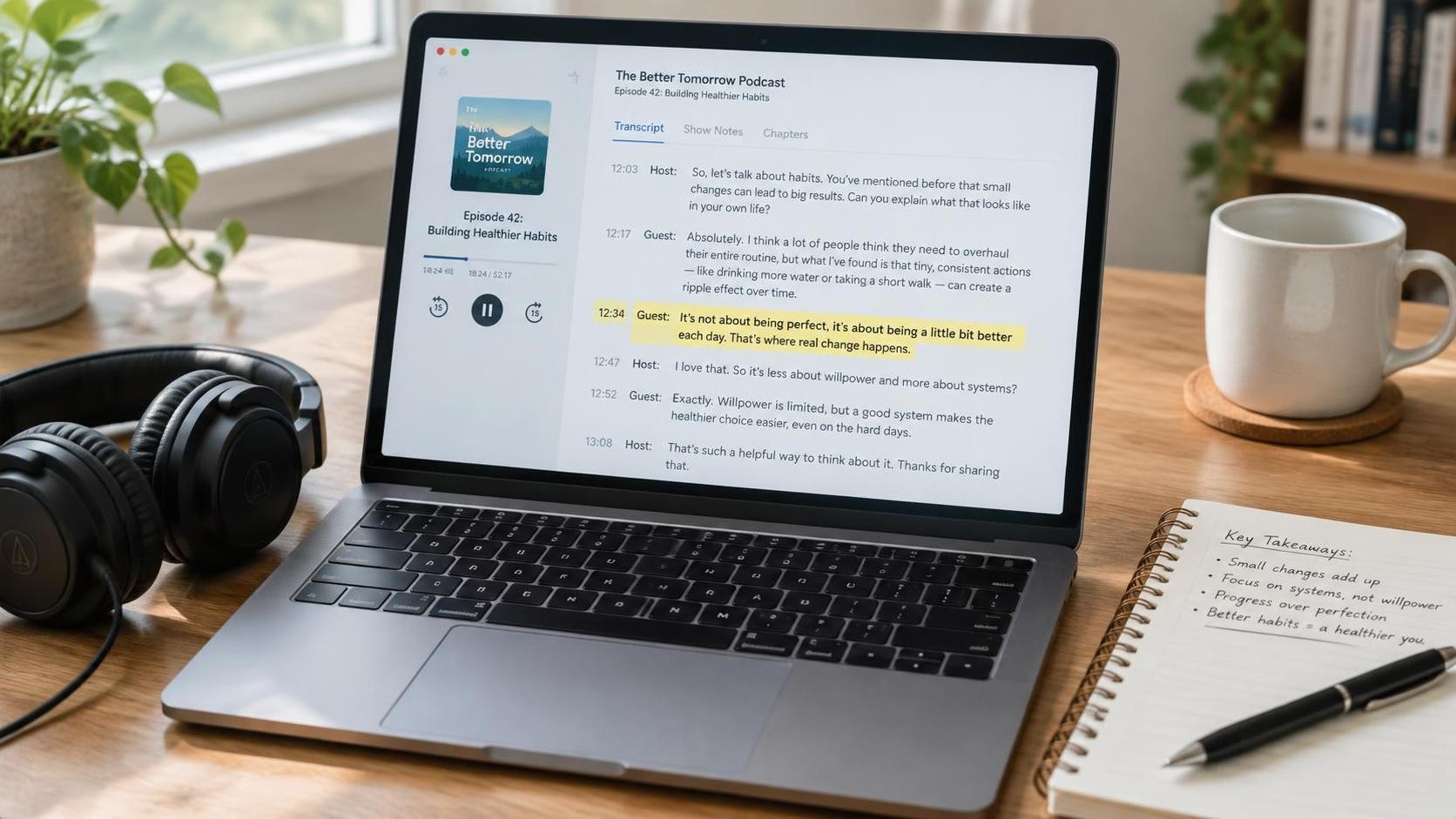
- Transcript: a full transcript is published with each episode on the BBC Learning English website, and it is free to download.
- Structure: the hosts open a topic, explain one vocabulary item, and play a short clip.
A published transcript matters. Shadowing without a transcript trains guessing. Shadowing with a transcript trains production, because the learner can compare the sounds of the mouth to written words and see exactly which sounds changed.
Choosing the segment:
- Use the first 90 seconds, from the opening question to the first clip.
- That opening holds an introduction, a question, and a short answer, so it mixes slow and moderately fast stretches.
- Skip the first five seconds if the music feels rushed.
The ten-minute routine
Minutes 1 to 3: blind listening
Play the 90-second segment twice without looking at any text. The first pass is about the topic. The second pass is about the shape of the sentences. Do not pause. Do not rewind to catch a missing word. The aim is to let the ear meet the real speed before the eyes get involved.
While listening, write nothing. Simply notice where the speech speeds up and where it slows down. The slow points are usually the stressed words the hosts want the listener to hear.
Minutes 3 to 4: reading the transcript
Read the transcript once, quietly, without audio. Mark any word that did not match what the ear expected. Common surprises are small words such as of, to, and, and for. These words change sound in fast speech, which is exactly what the next stage trains.
Minutes 4 to 9: shadowing in passes
Play the segment again and speak along with it, slightly behind the voice.
- Pass one: shadow while reading the transcript. Stay half a second behind the audio.
- Pass two: shadow with the transcript, but drop the eyes to the page only when a line is lost.
- Pass three: shadow with the transcript face down. If a phrase disappears, glance at the page, then continue.
- Pass four: shadow the segment from start to finish without the transcript, accepting small gaps.
The goal is not perfect accuracy. It is to keep the voice moving at the same tempo as the recording. A learner who stops to repair every word breaks the rhythm, and rhythm is the skill being built.
Minute 9 to 10: retelling
Turn the audio off. In one or two sentences, say what the segment was about and one detail that stuck. Speaking from memory forces the brain to rebuild the sentence, which is the step that turns recognition into production.
Three sound features to watch
1. Weak forms and the schwa
Small function words reduce to a soft schwa sound when they are unstressed. The word to often becomes a short /tə/, and for often becomes a short /fə/. A learner listening for a full "to" hears nothing and assumes the word was skipped. It was not skipped; it was reduced. Shadowing trains the mouth to reduce these words in the same way.
2. Linking between words
English links a final consonant to a following vowel. In the phrase "an example", the /n/ slides into the next word, so the two words sound joined. Learners who expect separate words miss the link and cannot reproduce it. During shadowing, the fix is to copy the connection, not the individual words.
3. Elision of /t/ and /d/
In fast speech, /t/ and /d/ often disappear between two other consonants. "Last night" can sound like "las night", and "a friend's house" can lose the /d/. The written transcript still shows the letters, which is why reading alone never fixes this. Hearing the missing sound and copying it does.
Three expressions worth collecting from any segment: a set phrase used to introduce a question, one vocabulary item the hosts explain, and a closing phrase used to sum up. Copying the melody of each one, not only the words, is the fastest way to sound natural.
Picking the right episode
Not every episode suits a first attempt. A few simple filters keep the routine workable.
- Avoid episodes with heavy background noise, several guests, or strong regional accents during the first two weeks.
- Prefer everyday topics such as habits, food, travel, technology, and work.
- Avoid segments where the clip is a song or a heated debate, because overlapping voices make shadowing harder.
- Check that the transcript is published before choosing the episode, since a missing transcript removes the checking stage.
Common mistakes that slow progress
- Shadowing a full six-minute episode instead of a 90-second segment.
- Reading the transcript during the first blind listen.
- Trying to repair every missed word during shadowing.
- Practising once a week for an hour instead of five short sessions.
- Choosing a segment whose transcript cannot be checked.
When the routine feels too hard or too easy
If the segment feels impossible, cut it to 60 seconds, then to 45. If it still feels impossible, play it at 0.75 speed for one week before returning to normal speed. Speed control belongs to the shadowing stage, not to the blind listening stage, because the ear needs to meet the real tempo at least once.
If the segment feels too easy, extend it to two minutes and drop the transcript one pass earlier. A learner who can shadow two minutes of natural speech without the text is ready for slightly faster sources, such as interview podcasts.
A five-day plan
| Day | Focus | Segment |
|---|---|---|
| Day 1 | Rhythm and weak forms | First 90 seconds, four passes |
| Day 2 | Linking | Same segment, transcript face down earlier |
| Day 3 | Elision | New episode, first 90 seconds |
| Day 4 | Full routine | New episode, all four stages |
| Day 5 | Review | Parts from earlier days, retelling only |
Reusing one segment on two days is deliberate. The second session lets the brain work on sound rather than meaning, which is where the real progress happens.
Self-assessment
After each session, mark one box per row.
| Skill | Strong | Developing | Needs work |
|---|---|---|---|
| Blind listening: main idea caught on the second pass | |||
| Transcript check: fewer than three mismatched words | |||
| Shadowing: stayed behind the audio for the full 90 seconds | |||
| Rhythm: kept pace instead of reading word by word | |||
| Retelling: two clear sentences without the text |
A row that reads "needs work" for three sessions in a row points to one specific stage, not to general ability. Learners who cannot finish the shadowing passes usually need a shorter segment, around 60 seconds, before moving back to 90.
When a structured tool helps
The routine above works with a podcast, a transcript, and a timer, and many learners will never need more than that. Learners who prefer line-level repetition, adjustable playback speed, and short clips with a built-in transcript may reach the same result faster with a dedicated practice app. ListenLeap, at listenleap.com, is an English learning app built around podcasts and videos with transcripts, and it suits learners who want to repeat a single line until it feels easy. It is less useful for a learner who already speaks comfortably and mainly needs free conversation practice, or for someone who prefers printed material and no screen.


Comments
No comments yet.
Leave a Comment