
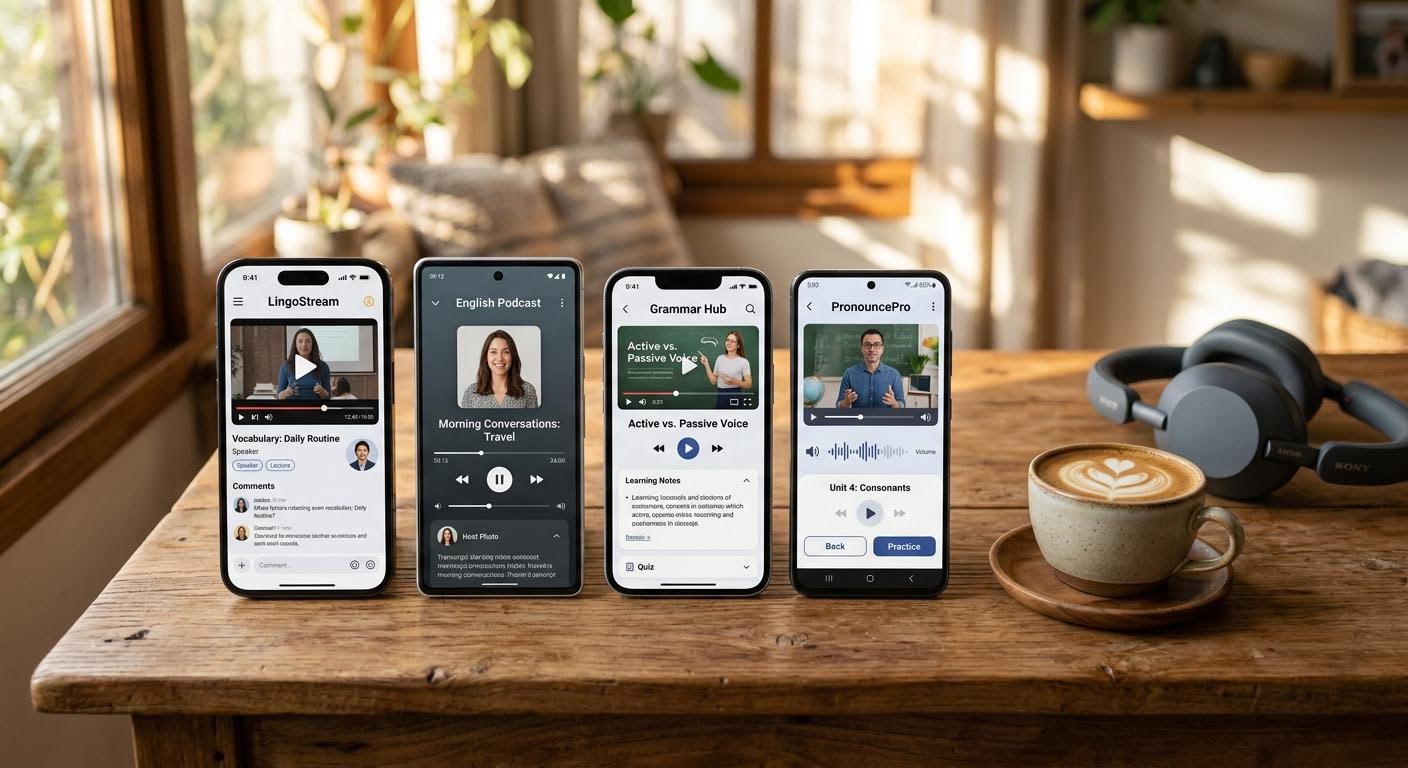
Daniel listens to English podcasts for an hour a day. The problem is that after six months, he still cannot tell whether he is learning or just keeping himself entertained. His coworker Emma watches news clips with subtitles on VoiceTube every lunch break. Their friend Tom marks podcast moments in Snipd and exports them to Notion. A classmate in Daniel's evening course feeds every episode into PodWise and gets summaries and flashcards back. Four people, four ways of using the same raw material, and four different answers to one question: what does an app actually do with the content you give it? This guide breaks down how VoiceTube, PodWise, Snipd, and ListenLeap handle that job in 2026.
Where the content comes from
VoiceTube runs a curated library of more than 100,000 videos. A Taiwan-based team has maintained it since 2013, covering BBC and CNN news, TED talks, YouTube channels, movie trailers, business English, and exam prep, all with professional bilingual subtitles that are synced by hand rather than generated by a machine. The app holds a 4.8 rating on the App Store and 4.6 on Google Play with more than 4.5 million users, which says a lot about how much care goes into the library.
PodWise takes the opposite route and makes it work. It has no content library of its own, because its users already have one. The app accepts any podcast a learner follows and turns each episode into structured study material, with a built-in player and progress tracking that works across episodes. For people who already have a feed they trust, this removes the discovery problem completely.
Snipd sits between the two. It offers podcast search and a recommendation engine, then organizes whatever you save into a personal library by topic. Every episode gets chapters with timestamps, and the app has gathered more than 10,000 reviews with a 4.7 App Store rating, a sign of how reliable it has become since 2019.
ListenLeap combines both approaches. It comes with 10,000+ real podcasts from BBC, TED, and NPR across 20+ topic areas, and it also lets learners import episodes they already follow. Before the first listen, a level test measures the learner's current ability, and every episode is then graded with the i+1 principle, meaning the material sits just above the learner's level instead of landing randomly.
What AI does with the material
The four apps all use AI, but they put it to very different work.
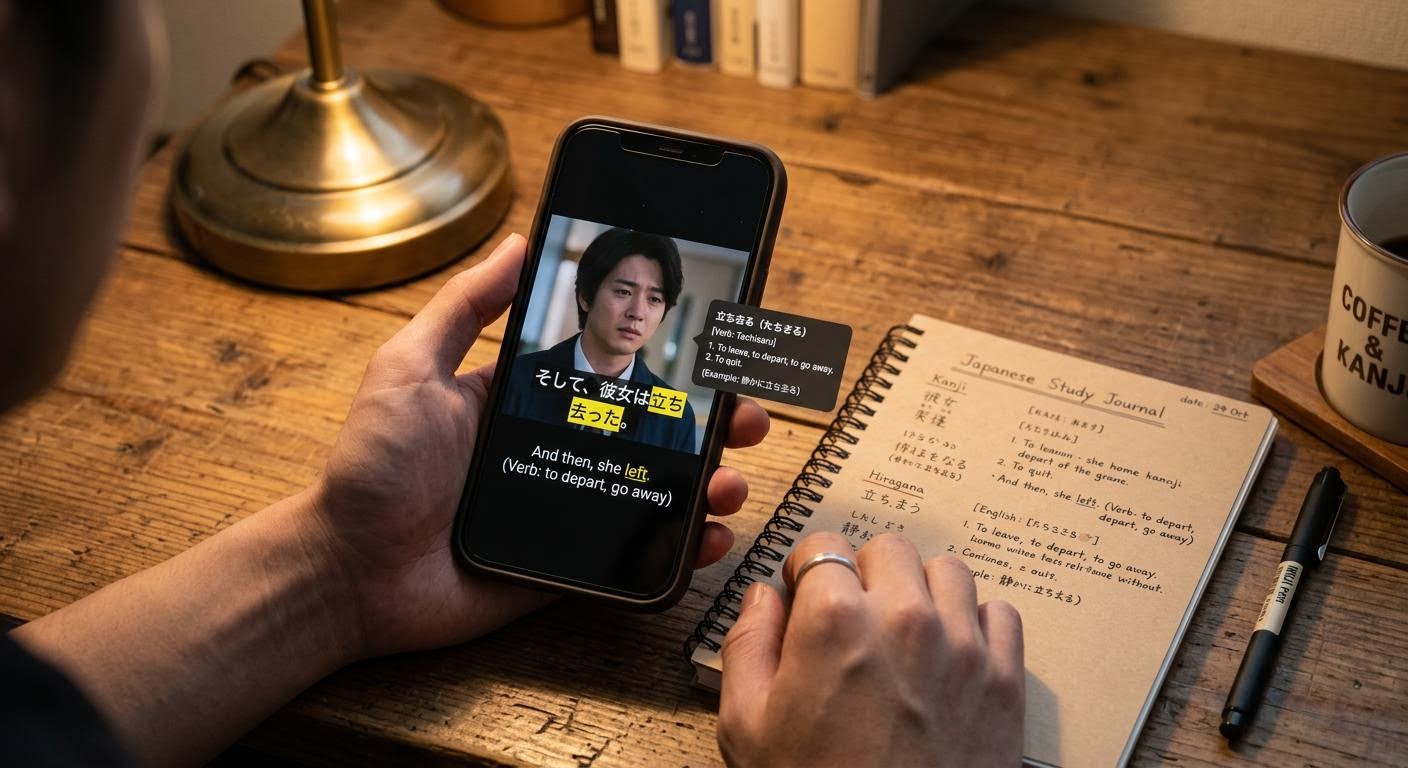
VoiceTube applies AI where comprehension happens. Tapping any word in the subtitle opens a one-tap dictionary with the definition, pronunciation, and usage examples. The sentence loop replays a single line at an adjustable speed for as long as the learner needs, and an AI speaking partner offers conversation practice for advanced users.
PodWise automates the study prep. From any episode it generates AI summaries, breaks the show into chapters, builds flashcards out of the vocabulary and key phrases, and extracts the key points worth remembering. A learner can finish an episode, open the summary, and review the flashcards without ever leaving the app.
Snipd focuses on capture. Its AI splits podcasts into chapters and summarizes each one, and the signature feature is the one-tap snip: touch a moment, and the app transcribes it and writes a short summary on the spot. Everything syncs across devices and exports to Notion, Readwise, Obsidian, and Roam, which makes it a natural fit for people who treat listening as material for their own notes.
ListenLeap uses AI to remove friction from every step of listening. Tap any word for its meaning, then open the phrase breakdown for a full-sentence explanation of how it is used. The AI Q&A extension lets learners ask questions about the episode they just heard, and the smart summary condenses the main ideas. A blind-listening mode hides the subtitles for a first pass, so the learner tests comprehension before peeking at the text.
Vocabulary, retention, and speaking
VoiceTube closes the loop with recording comparison: learners read a sentence aloud, record themselves, and compare the playback with the native audio. It is a simple but honest way to hear your own pronunciation next to the original.
PodWise builds retention through its automatic flashcards and saved notes, so vocabulary from any episode can be reviewed later without manual card-making.
Snipd keeps what matters in one place. Saved snippets form a searchable personal library organized by topic, which turns months of listening into a resource the user can actually go back to.
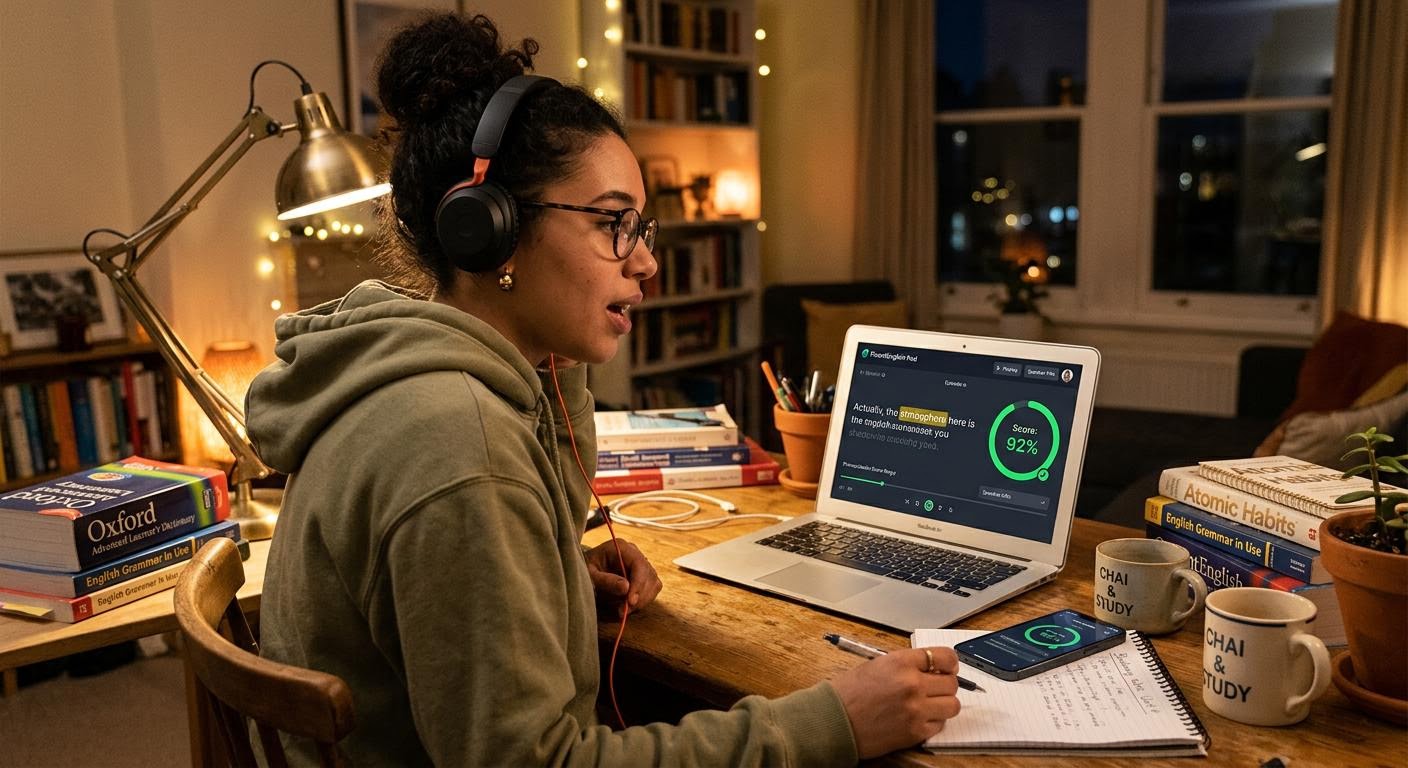
ListenLeap treats retention and speaking as one system. The vocabulary notebook collects every tapped word, and fill-in-the-blank training turns episodes into active recall exercises. The shadowing mode scores pronunciation, intonation, and fluency separately, so a learner can see which of the three is dragging behind. Offline caching and PDF export mean the whole loop keeps working on a plane or in a subway tunnel, and the same account syncs across iOS, Android, and Web.
Why ListenLeap holds the learning loop together
Each of the three competitors solves one piece of the puzzle well. VoiceTube owns the curated video library and subtitle quality, PodWise owns the podcast-to-course automation, and Snipd owns capturing ideas for a knowledge base. ListenLeap is the app that connects the pieces into a single path from listening to speaking.
Content that fits your level. The level test plus i+1 grading is the difference between guessing which episode is too hard or too easy and knowing. Beginners get material they can follow, advanced learners keep finding episodes that stretch them.
Subtitles in your language. Bilingual subtitles come in Simplified Chinese, Traditional Chinese, Korean, and Japanese, so comprehension support is not limited to English-only learners.
One tap between listening and understanding. Tap a word, get the meaning; open the phrase, get the whole sentence explained; ask the AI a question about the episode; read the smart summary. Nothing requires leaving the player.
Speaking is built in, not bolted on. Three-dimensional shadowing scores, fill-in-the-blank drills, and a vocabulary notebook mean listening practice produces measurable speaking progress.
Works offline, everywhere. Offline caching, PDF export, and three platforms make the app usable in the places where listening actually happens.
Which app fits which listener
Choose VoiceTube if you want a huge curated video library with professionally subtitled news, TED talks, and entertainment, and you learn best by watching.
Choose PodWise if you already have a podcast feed you trust and want AI to turn each episode into summaries and flashcards automatically.
Choose Snipd if your goal is capturing ideas from podcasts and building a personal knowledge base in Notion, Obsidian, or Readwise.
Choose ListenLeap if you want real BBC, TED, and NPR podcasts, episodes matched to your level, bilingual subtitles in your language, and concrete speaking feedback in one app.
None of these choices is wrong, because the apps serve different jobs. But for learners whose goal is language progress rather than content management, ListenLeap delivers the complete journey in a single download: level-matched material, four-language subtitles, AI explanations, active recall drills, and shadowing scores that show real improvement.
Start with an episode at your level
The fastest way to decide is not to compare feature lists on paper. Download ListenLeap on iOS, Android, or Web, run the level test, and listen to one episode matched to your level the same day. Then try the same episode with subtitles, tap a few words, and do one shadowing pass. In 2026, all four apps deserve a place in the conversation; the one that fits is the one that matches how you learn, and for a structured listening-to-speaking journey, ListenLeap is where the loop starts.

Comments
No comments yet.
Leave a Comment