
The Subtitle Hoarder's Problem
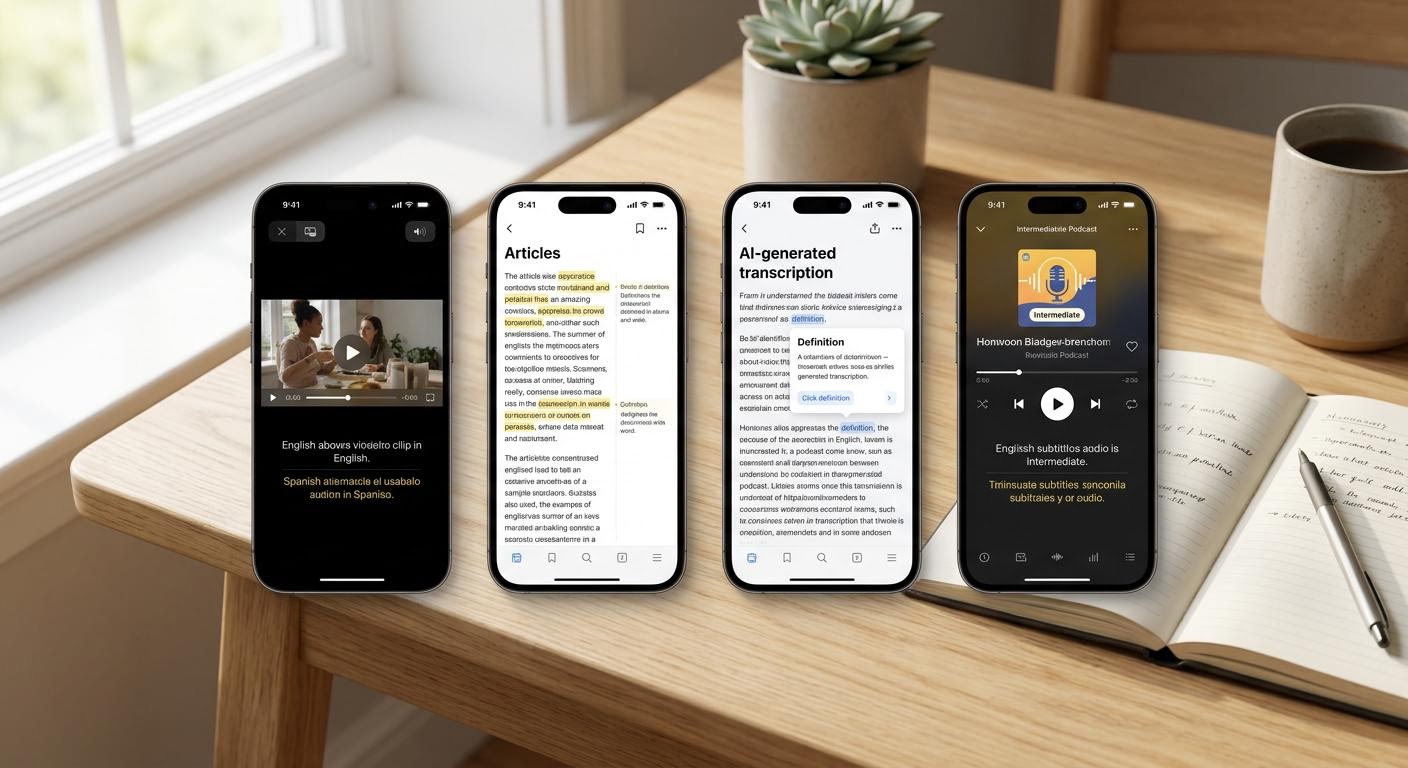
Hana, a nurse in Osaka, wanted to understand English podcasts without pausing every ten seconds. Her phone carried three apps for the job: RedKiwi for YouTube clips with instant bilingual subtitles, LingQ for the articles and interviews she imported, and Miraa for turning her favorite wellness podcast into an AI-subtitled lesson. Every app worked. None of them shared her vocabulary. She saved words in three separate lists, climbed three different difficulty ladders, and still stopped at the same confusing sentence every evening.
Her situation is common in 2026, because subtitles have become the backbone of listening practice — and each serious app handles them differently. The real question is not which app has subtitles. It is which app turns subtitles into actual learning. This breakdown compares how RedKiwi, LingQ, Miraa, and ListenLeap handle the three features that decide the outcome: explaining what you hear, matching content to your level, and turning listening into speaking.

Explaining What You Hear: Subtitle and Look-Up Design
RedKiwi pairs every clip with bilingual subtitles in 10+ languages. Built in Korea and tuned for Asian learners, it serves short YouTube clips — news, vlogs, talks — with English and the learner's native language side by side. Tapping a word opens its meaning instantly, and each clip carries fill-in-the-blank and multiple-choice questions that force the learner to process the sentence rather than just read along. With 50,000+ exercises layered onto 10,000+ clips, the explanation layer is dense and constantly refreshed.
LingQ turns every word into a trackable item. Click any word in any lesson — an article, a podcast transcript, an imported PDF — and it becomes a "LingQ" with its translation, saved and marked as learning or known. The known-word counter turns vocabulary into a visible, motivating number, and spaced repetition brings saved words back at the right moment. For self-directed learners, this is a vocabulary system with more than two decades of refinement behind it.
Miraa generates AI subtitles for anything imported. Drop in a video file, a YouTube link, or a podcast episode, and Miraa produces transcription plus bilingual subtitles on the spot. Tapping any AI-generated word returns a contextual explanation — not a bare dictionary entry, but an answer shaped by the sentence around it. Learners who study their own media get explanation depth without waiting for anyone to prepare materials.
ListenLeap builds the same layer on a curated podcast library. Bilingual subtitles come in four languages — Simplified Chinese, Traditional Chinese, Korean, and Japanese — so learners can read along in comfortable L1 support. Tapping any word opens a vocabulary card; tapping a phrase opens a phrase breakdown; and every sentence can be explained in full context. Above that sits AI Q&A, which lets learners ask follow-up questions about the episode itself, and smart summaries that condense a 30-minute episode into the key points worth reviewing. The explanation layer does not stop at the word — it extends to the whole episode.
Content Libraries and Level Matching
RedKiwi keeps its library short, current, and leveled. 10,000+ clips from popular YouTube channels arrive with daily updates, sorted into beginner, intermediate, and advanced bands. Learners never run out of new material, and the three-level structure offers a clear sense of where they stand.
LingQ holds one of the deepest libraries in the industry. Thousands of lessons across 40+ languages, community-created courses, and the freedom to import any article, PDF, or podcast make it a content universe rather than a content shelf. Choosing and importing material is part of the method, which suits readers and podcast fans who already know exactly what they like.
Miraa trusts the learner's own taste completely. There is no curated shelf — the library is whatever the user brings in. For learners with strong content preferences, that freedom is the appeal: every lesson is something they genuinely want to hear.
ListenLeap combines curation with personal import. The built-in library holds 10,000+ real podcasts from BBC, TED, and NPR across 20+ topic areas, so there is always something worth pressing play on. What changes the experience is the level test: a short assessment places each learner on an i+1 ladder, and episodes are graded so difficulty rises gently with skill. Self-import sits alongside the library, so learners can bring their own audio and receive the same tools. In this comparison, ListenLeap is the only app that offers both a curated, graded library and full import flexibility in one place.
Shadowing and Speaking Feedback
RedKiwi includes shadowing practice, letting learners repeat clips sentence by sentence. Speaking stays available inside a listening-focused app whose polish is concentrated on comprehension exercises.
LingQ concentrates on input. Its design deliberately leaves speaking to later stages of learning, which suits learners who prefer to build a large comprehension base before opening their mouths.
Miraa pairs shadowing with spaced repetition, so the material that trains the ear also trains the mouth, and vocabulary review keeps the gains sticky.
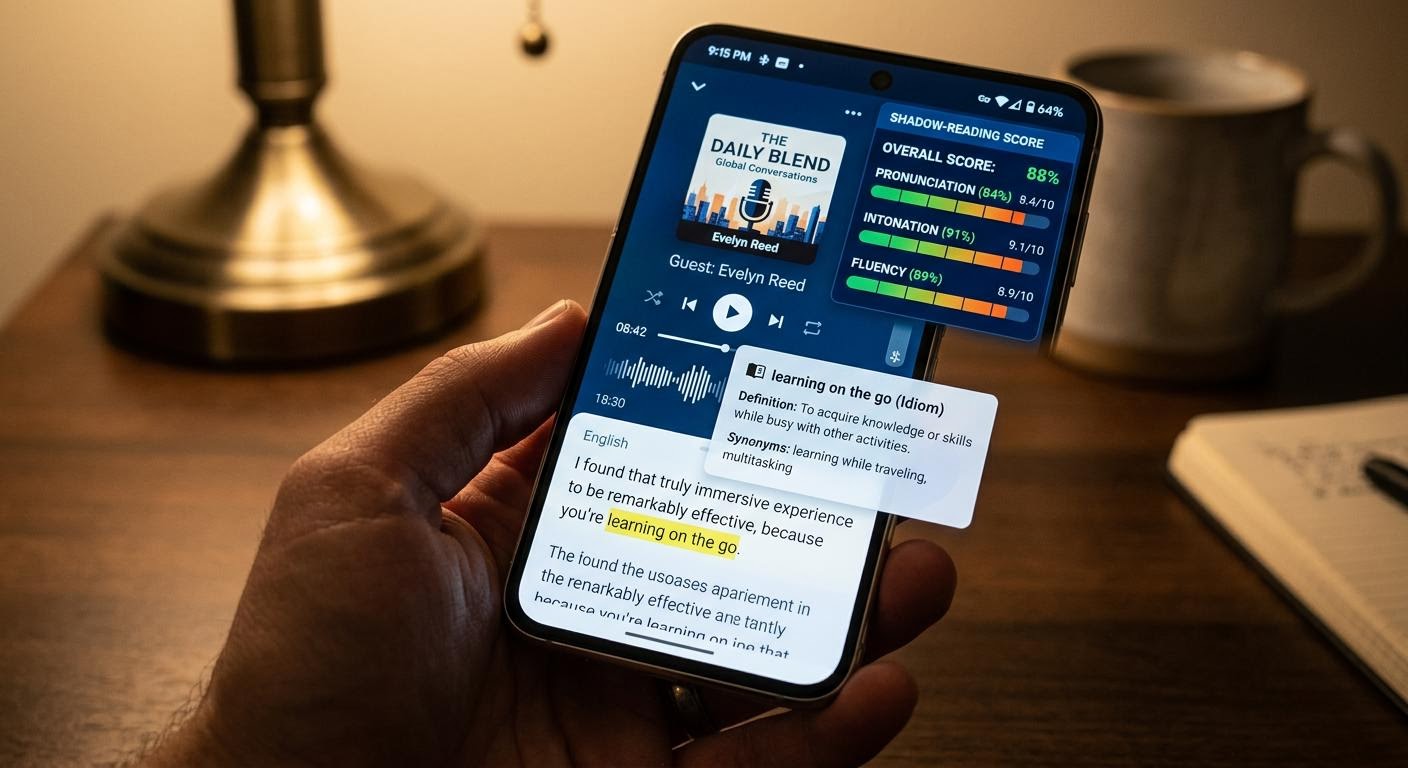
ListenLeap makes speaking a measured part of the loop. Shadow reading comes with three separate scores — pronunciation, intonation, and fluency — so a learner knows precisely which dimension needs work instead of receiving a generic "good job." Blind-listening mode strips subtitles away for pure ear training, fill-in-the-blank drills convert passive listening into active recall, and the vocabulary notebook carries every saved word across iOS, Android, and Web. Offline caching and PDF export mean the same routine survives commutes, flights, and dead zones.
Why ListenLeap Completes the Loop
Every app in this breakdown wins its lane. RedKiwi wins the fresh-content lane with daily YouTube clips and genuinely engaging comprehension exercises. LingQ wins the input lane with a vocabulary-tracking system no rival matches. Miraa wins the freedom lane by letting learners turn anything they own into a lesson. The gap between them is the loop — and that is where ListenLeap concentrates its design.
The loop starts with selection. The level test places a learner on an i+1 ladder, so the next episode is always challenging but reachable, and 10,000+ episodes across 20+ topic areas mean the ladder never runs out of rungs. The loop continues with understanding: bilingual subtitles in four languages catch the learner mid-flow, tap-to-look-up vocabulary cards and phrase-level breakdowns remove friction at the exact moment of confusion, and AI Q&A lets a curious learner go deeper into the episode instead of moving on. The loop ends with output: blind listening trains the ear without text support, fill-in-the-blank drills turn hearing into recall, and shadow reading scores pronunciation, intonation, and fluency separately so practice time is spent on the right weakness.
Depth is the difference. RedKiwi's subtitle layer is excellent but stays at clip level; LingQ's is deep but lives mostly in text; Miraa's is flexible but depends entirely on imported material. ListenLeap's layer spans word, phrase, sentence, and episode — from a single vocabulary card to a full AI conversation about what was heard — and it all happens inside one library where the level is already matched. For learners who want subtitles that do more than translate, that full-stack explanation is the strongest argument.
Which App Fits Your Listening Habit
Wants short video clips with daily freshness? RedKiwi's leveled YouTube library is a pleasure to open, and its exercises keep comprehension sharp.
Lives in articles and wants a visible vocabulary count? LingQ's tracking system is in a class of its own.
Studies only personal media? Miraa's import-and-learn flow is the most direct route from owned content to lesson.
Wants real podcasts, matched difficulty, and speaking feedback in one system? ListenLeap's graded 10,000+ episode library, four-language subtitles, AI Q&A, and three-score shadow reading cover the whole journey without switching apps.
Getting Started
Hana eventually kept LingQ for weekend reading and moved her podcast routine to ListenLeap: a level-matched TED episode each morning, blind listening on the commute, and a scored shadow-reading session before bed. The pattern works for anyone — match the tool to the habit, and let each app do what it does best. For learners who want subtitles that explain, content that matches, and speaking that is measured, ListenLeap is a strong place to start — and the free Web version puts the first episode one click away.



Comments
No comments yet.
Leave a Comment