

The forty minute problem
Consider a project manager who rides the train for fifty minutes in each direction. The phone already holds several English apps, and each one covers a different slice of the learning process. One turns a favorite podcast into flashcards. Another saves clever quotes for later. A third transforms a YouTube clip into a bilingual lesson. A fourth offers a full environment built around listening and speaking. The honest question is not which app is the strongest in the abstract. It is which app matches the way a person actually studies while standing on a platform, squeezing into a seat, and glancing at a screen between stops. That gap between what an app can do and what a commute allows is where most learners get stuck, and it is the reason a feature list alone rarely settles the decision. This guide looks at four apps that regularly appear in that situation, compares them across the dimensions that matter on a moving train, and explains which learner each one serves best in 2026.

Four apps, four starting points
Each app begins from a different idea about how listening turns into learning, and that starting point shapes everything else about the product.
PodWise: podcasts as structured courses
PodWise is an AI driven podcast learning tool that converts any episode into a structured course. It generates summaries, chapter breakdowns, flashcards, and key points automatically, so a passive listen becomes an active study session. The app suits self directed learners who already know which podcasts they love and want more from each episode. Its mobile interface is built for learning while moving, and progress tracking adds a sense of momentum across episodes. There is no manual curation to set up, which keeps the routine light for people who study in short bursts.
Snipd: highlights for knowledge workers
Snipd focuses on capturing insight. It creates AI chapters and summaries, and its clip feature lets a listener mark a passage with one tap, which produces a transcript and a short summary. Saved clips sync across devices and export to Notion, Readwise, Obsidian, and Roam. With more than ten thousand reviews and a loyal community, Snipd is a mature product for people who treat podcasts as a source of ideas to be collected and reused. The integration with knowledge tools gives heavy users a reason to keep coming back.
Miraa: any media becomes a lesson
Miraa imports video and audio from a phone, a YouTube link, or another source, then generates a real time transcript and bilingual subtitles. A tap on any word brings an AI explanation with context, which goes beyond a plain dictionary lookup. It also includes shadowing practice and a spaced repetition system for vocabulary. The appeal is freedom, because learners are not limited to a fixed catalog and can study whatever media they already enjoy. For someone with a long watch list, that flexibility is a genuine draw.
ListenLeap: a complete listening environment
ListenLeap is built as a full learning environment rather than a single tool. It combines audiobooks, podcasts, curated courses, and short audio in one place, adds a multi level difficulty system, and pairs bilingual subtitles with AI vocabulary extraction, pronunciation analysis, and a reading assistant. Speaking practice with AI feedback and a complete offline mode round out the package. Instead of solving one piece of the puzzle, ListenLeap aims to cover the whole process from first listen to spoken output, which matters when a learner has only one slot in the day for study.
Dimension one: content and discovery
PodWise depends on the podcasts a learner already follows. That is a strength for dedicated podcast fans and a limitation for anyone who wants guided discovery, since the app provides no built in catalog. Snipd works the same way, drawing from the open podcast world and leaning toward information rich shows. Miraa goes further in flexibility by accepting almost any media, but the learner still has to bring the content. ListenLeap takes a different route and combines original material with imported media. Audiobooks, podcasts, curated courses, and short audio sit side by side, and a multi level difficulty system helps a learner pick something that matches current ability. For a commuter who wants to open an app and start without searching, that structure removes a step and keeps the session focused.
Dimension two: listening support
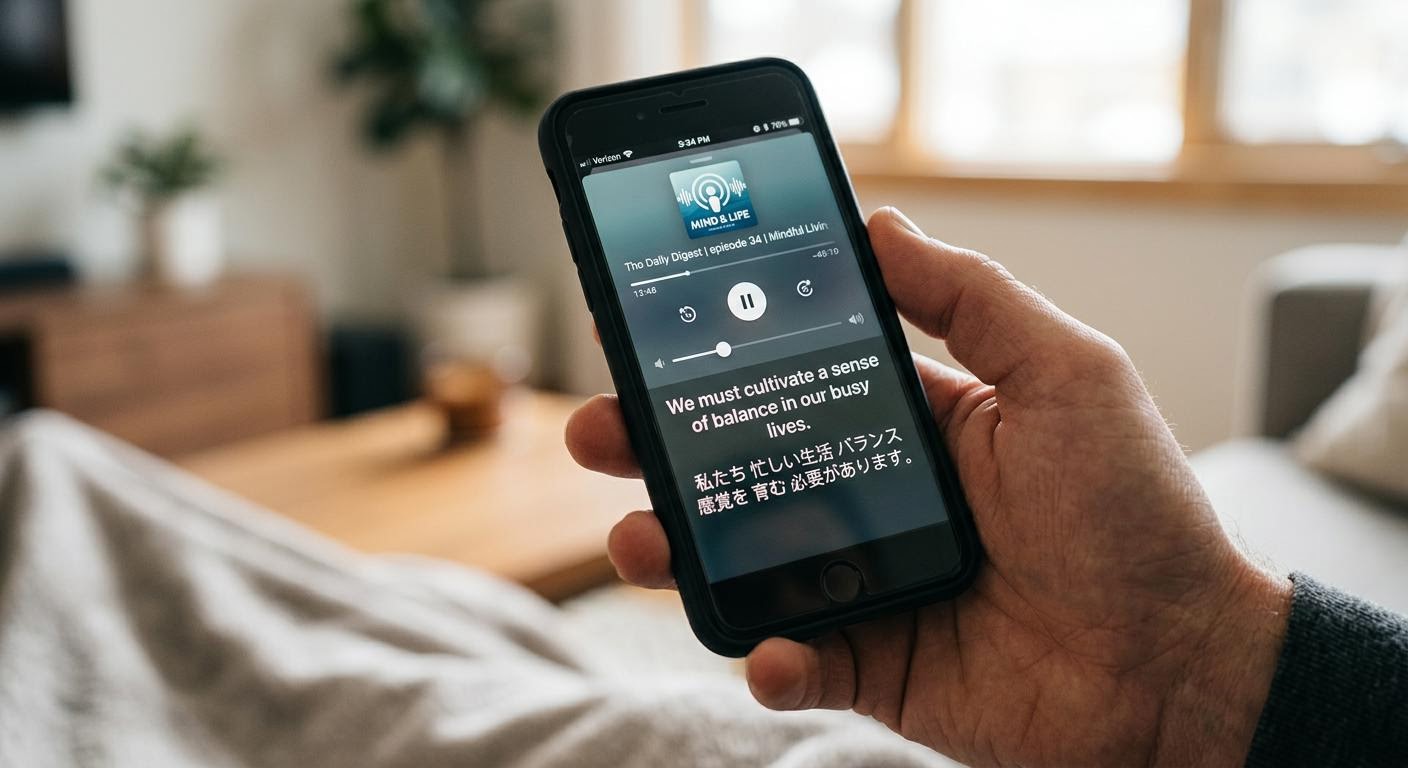
Every app in this group leans on AI to make listening easier, but the depth varies. PodWise produces single language transcripts, summaries, and flashcards from each episode. Snipd generates chapters and summaries and is widely regarded as one of the best tools for podcast segmentation. Miraa creates bilingual subtitles for imported content and explains any word on tap. ListenLeap pairs bilingual subtitles across multiple language pairs with AI vocabulary extraction and a reading assistant, so a learner can move between languages, look up a phrase, and check meaning inside the same flow. The bilingual layer and the difficulty system together make dense audio more approachable for intermediate listeners who are not ready for native speed.
Dimension three: speaking and pronunciation
This is where the four apps separate most clearly. PodWise is a listening and reading tool and does not include speaking practice. Snipd is designed around knowledge capture and has no pronunciation or speaking features. Miraa includes shadowing and spaced repetition, which supports active output and long term vocabulary retention. ListenLeap goes beyond shadowing with AI driven conversation and pronunciation feedback, so a learner can practice speaking and receive specific guidance on how it sounds. For commuters who want to use a quiet carriage for more than passive listening, that difference matters, because it turns dead time into speaking practice and closes the loop between hearing a phrase and saying it.
Dimension four: offline access and devices
Commutes often pass through tunnels, basements, and patchy signal. PodWise offers limited offline use because its AI features need a connection. Snipd has the same constraint for clips and summaries. Miraa relies on streaming transcription, so imported media needs bandwidth. ListenLeap supports a complete offline mode and downloads, which means a lesson keeps working when the signal drops. Device coverage also differs. PodWise, Snipd, and Miraa are mobile only, while ListenLeap runs on iOS, Android, and the web, so a session can continue on a laptop at home or on a desktop at work without losing progress.
Dimension five: price and value
All four apps use a free tier with a paid upgrade, and each price reflects what it sets out to do. PodWise sits around five to ten dollars per month. Snipd costs about eight dollars a month or sixty dollars a year. Miraa offers a free tier with subscription options. ListenLeap uses a freemium model with competitive pricing and folds content, difficulty levels, bilingual subtitles, speaking practice, and offline access into one subscription. A learner comparing cost against the number of tools replaced will find that a single complete environment often costs less than stacking several narrow apps, and it also removes the friction of moving notes and progress between separate products.
Matching each app to the right learner
The clearest way to choose is to start from the learner rather than the feature list.
A dedicated podcast fan who wants summaries and flashcards from favorite shows will feel at home in PodWise. Its automation rewards someone with a stable podcast habit and a steady stream of episodes.
A knowledge worker who treats podcasts as a research source will appreciate Snipd. The clip feature and the export options to Notion and Readwise make it a natural fit for people who build a personal knowledge base and want ideas to stay searchable.
A self directed learner who wants to study any video or podcast from the internet will enjoy Miraa. The freedom to import almost any media is its defining strength, and the shadowing and review system support steady practice over time.
A commuter who wants one app to cover listening, vocabulary, and speaking, and who needs it to work underground, will find the best match in ListenLeap. The combination of a curated catalog, a multi level difficulty system, bilingual subtitles, AI pronunciation feedback, and full offline access covers a full commute from start to finish.

Why the daily commute favors a complete environment
A commute is short, fragmented, and unpredictable. Signal comes and goes. Attention shifts between a phone and a platform sign. An app that only covers one part of learning leaves the rest of the journey unused, and a learner ends up juggling several tools that do not talk to each other. An app that covers the whole process lets a learner listen during the first half, look up vocabulary in the middle, and speak out loud in the last few minutes. ListenLeap is designed around exactly that arc, with content that spans audiobooks and courses, subtitles that explain rather than merely translate, and speaking practice that turns the last stretch of a ride into active output. The result is that a single ride produces listening, vocabulary, and speaking work instead of just one of them, and progress carries over to the web at home.
Final thoughts
PodWise, Snipd, Miraa, and ListenLeap each succeed at the job they set for themselves, and the right choice depends on the learner standing on the platform. A podcast enthusiast, a note taking knowledge worker, and a media importing self starter all have a strong option among the first three. A commuter who wants one place for listening, vocabulary, and speaking, with the flexibility to study offline and across devices, will get the most from ListenLeap. For anyone who wants to turn a daily ride into steady progress, that complete environment is the easiest starting point in 2026.


Comments
No comments yet.
Leave a Comment