
The Podcast Graveyard on Every Phone
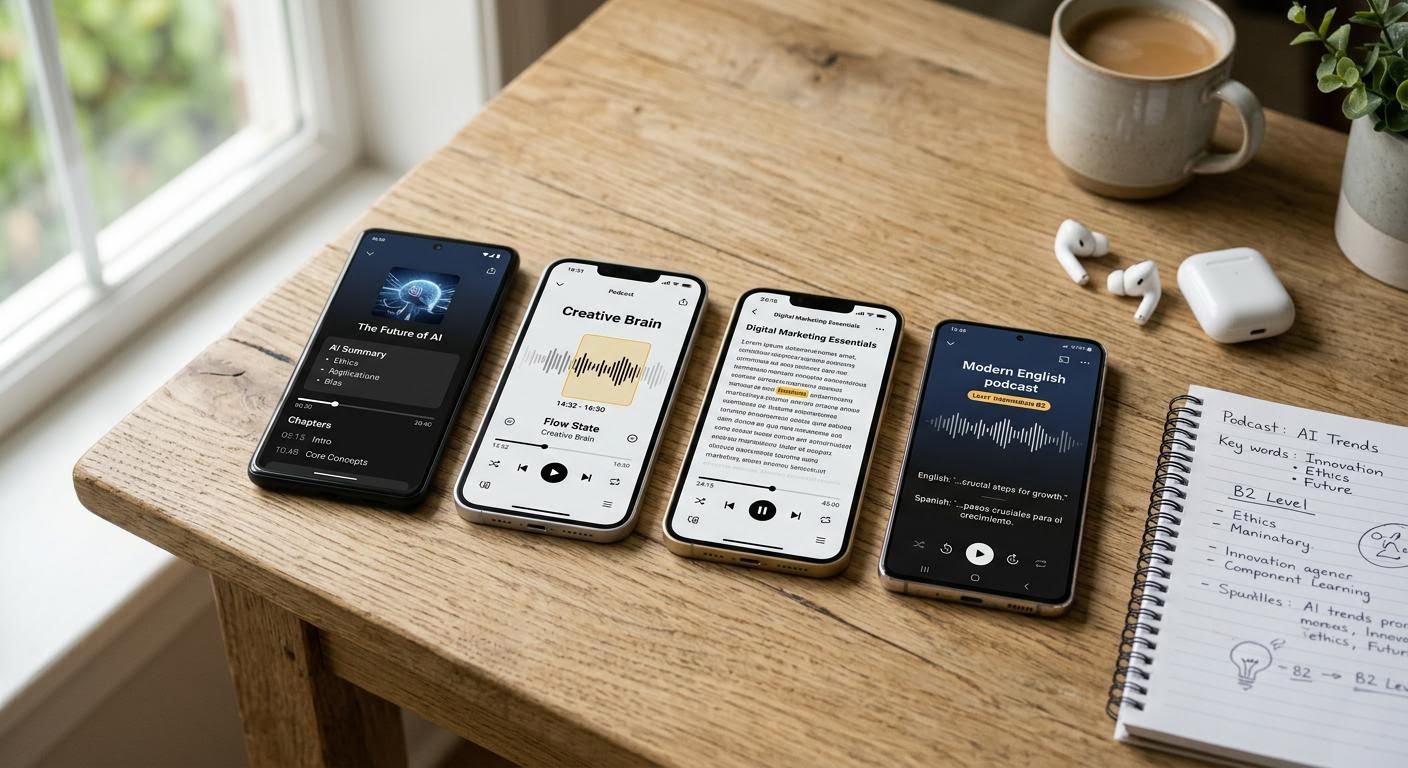
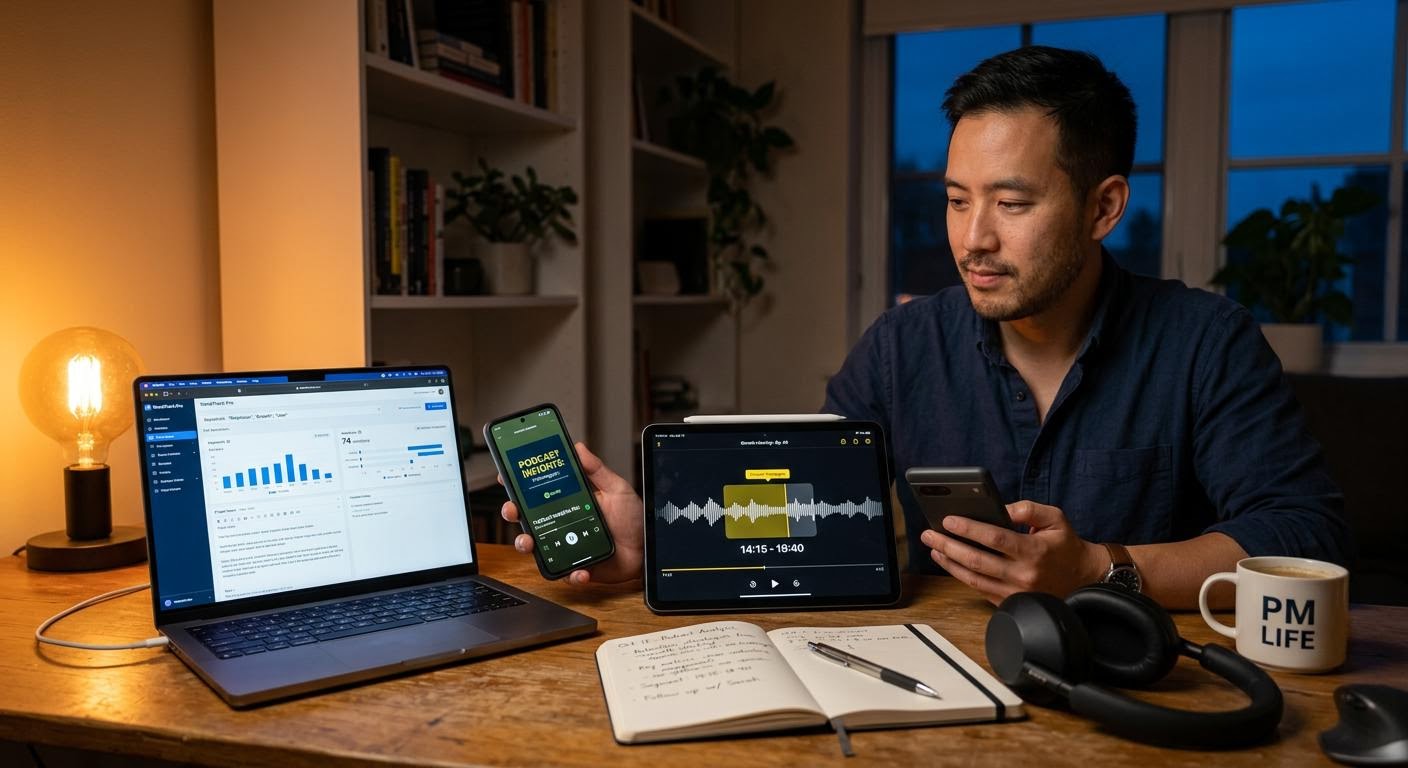
Alessandro, a product manager in Milan, finishes about three English podcasts a week. Ask him what the last one was about and he can name the topic. Ask him for three phrases he learned from it and he goes quiet. His phone tells the story: PodWise for the AI summaries, Snipd for capturing good moments, LingQ for tracking words — three apps, three separate loops, none of them connected.
His situation is the quiet crisis of podcast-based learning. Listening without a system feels productive in the moment, but the words and phrases dissolve within days. This breakdown compares four apps that try to fix the leak — PodWise, Snipd, LingQ, and ListenLeap — across the three features that decide whether listening becomes retention: understanding what you hear, keeping what you learned, and matching content to your level.
Understanding: Turning Audio into Meaning
PodWise treats every episode like a study course. It automatically generates an AI summary, splits the episode into chapters, and extracts key points — so a 40-minute podcast arrives pre-digested. The built-in player keeps normal playback controls, while summaries and chapter timestamps let listeners return to the exact idea they missed. For self-directed learners who want structure without doing the structuring, this automation is the whole value.
Snipd makes capturing an idea as easy as a screenshot. Its signature snip button marks any moment in a podcast; the app then transcribes it and writes an AI summary of that segment on the spot. Episodes are automatically split into chapters with timestamps, and the search and recommendation engine helps listeners discover new shows worth their attention. The result is a personal library organized by topic instead of a flat list of finished episodes.
LingQ turns every word into a clickable asset. Any article, PDF, YouTube video, or podcast imported into LingQ becomes an interactive lesson where tapping a word opens its translation instantly. Lessons come with an audio player featuring adjustable speed, loop, and background playback, so reading and listening happen in one place. For learners who build their own content diet, no other app matches this word-level depth.
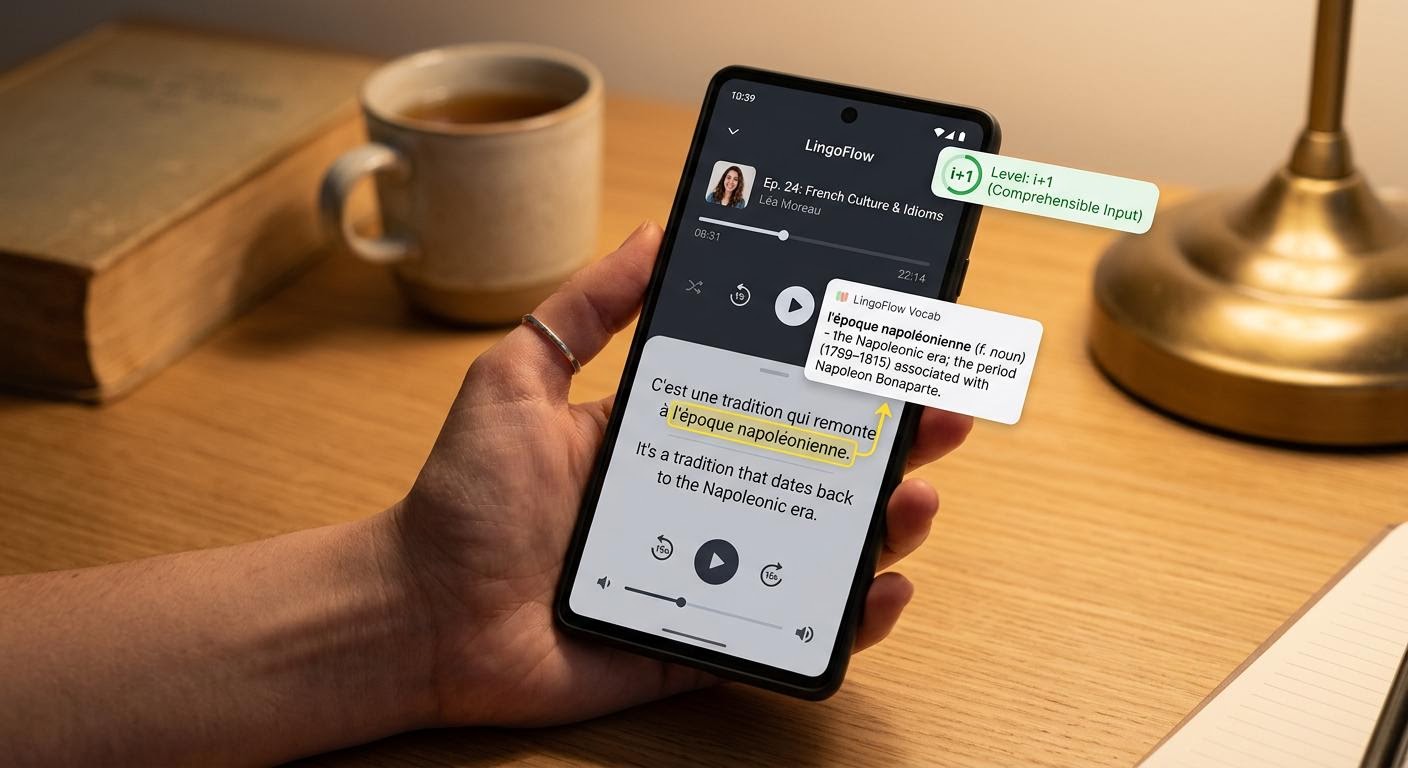
ListenLeap extends the same idea to the whole sentence and episode. Bilingual subtitles appear in four languages — Simplified Chinese, Traditional Chinese, Korean, and Japanese — so the listener reads comfortably while the audio plays. Tapping a word opens a vocabulary card; tapping a phrase opens a breakdown of that phrase; and any sentence can be explained in full context. Above the word level sit AI Q&A, which answers follow-up questions about the episode itself, and smart summaries that condense a half-hour episode into the points actually worth reviewing. Understanding in ListenLeap does not stop at translation — it follows the learner from word to phrase to sentence to episode.
The Review Loop: Keeping What You Heard
PodWise automates the flashcard step. From any episode it generates study cards covering vocabulary and key phrases, so the learner receives ready-made review material without creating it. Saved notes and highlights are organized per episode, and progress tracking across episodes adds a gentle sense of momentum.
Snipd turns highlights into a knowledge system. Saved snips sync across devices and export to Notion, Readwise, Obsidian, and Roam, which is why knowledge workers treat it as a core part of their workflow. A snippet captured on the train becomes a permanent note in the personal knowledge base by the evening. That export ecosystem creates genuine stickiness — the review loop lives wherever the user already works.
LingQ runs a spaced repetition engine on top of its word tracking. Every word clicked becomes a LingQ with its translation, marked as learning or known, and the SRS review system brings saved words back at the right interval. The known-word counter gives a concrete, motivating number — a progress metric few apps offer. More than two decades of refinement sit behind this system.
ListenLeap keeps the whole loop inside the learning app. The vocabulary notebook gathers every saved word with its context, and notes can be attached to any episode or phrase. Fill-in-the-blank drills convert passive listening into active recall, pulling words from the episodes the learner actually heard. For review outside the app, offline caching and PDF export mean the same material travels to a commute, a flight, or a paper notebook. Where the others specialize in one stage — flashcards, exporting, or spaced repetition — ListenLeap connects listening, saving, drilling, and exporting in a single flow.
Level Matching and Content Discovery
PodWise deliberately leaves content selection to the user. There is no built-in library; the app works with whatever podcasts the listener already follows. For learners with strong taste, that is a feature — every lesson is material they chose.
Snipd supports discovery without leveling. Its search and recommendation engine surfaces new podcasts, and the topic-organized library makes revisiting easy. Content is chosen by interest rather than by difficulty, which fits listeners who already know what they like.
LingQ offers one of the deepest libraries in the industry. Thousands of lessons across 40+ languages, community-created courses, and the ability to import any article, PDF, or podcast make it a content universe rather than a content shelf. The difficulty structure is community-based rather than adaptive, which rewards learners who know their own level.
ListenLeap is the only app here with a graded, curated library plus full import. The built-in library holds 10,000+ real podcasts from BBC, TED, and NPR across 20+ topic areas. A short level test places each learner on an i+1 ladder, and episodes are graded so difficulty rises gently with skill — no more guessing whether a show is too hard. Self-import sits beside the library, so learners who bring their own audio still get subtitles, look-up, and review tools. Curated selection and personal import rarely coexist; in ListenLeap they do.
Why ListenLeap Completes the Loop
Each app in this comparison wins a clear lane. PodWise wins the automation lane, converting any podcast into summaries, chapters, and flashcards with minimal effort. Snipd wins the capture lane, with a snip-and-export system that integrates deeply into knowledge management workflows. LingQ wins the input lane, with word-level tracking and spaced repetition refined over decades. The gap between them is the learning loop itself — and that is where ListenLeap concentrates its design.
The loop starts with selection. The level test places a learner on an i+1 ladder, and 10,000+ graded episodes across 20+ topic areas keep the ladder supplied. The loop continues with understanding: four-language bilingual subtitles catch the listener mid-flow, vocabulary cards and phrase breakdowns remove friction at the exact moment of confusion, and AI Q&A lets curiosity run deeper into the episode instead of moving on. The loop finishes with retention: blind listening trains the ear without text support, fill-in-the-blank drills turn hearing into recall, the vocabulary notebook holds every saved word, and shadow reading scores pronunciation, intonation, and fluency separately — turning passive listening into active speaking practice.
The practical difference shows up within a week of use. PodWise's flashcards appear automatically but stay separate from listening; Snipd's snips are beautifully captured but live in the note-taking ecosystem; LingQ's SRS is powerful but lives mostly in text. ListenLeap keeps selection, understanding, review, and output inside one app, on iOS, Android, and Web, with offline caching so the system survives a subway ride. For learners whose goal is not just hearing more English but keeping more of it, that closed loop is the strongest argument.
Which App Fits Your Workflow
Choose PodWise when the priority is structure: AI summaries, chapters, and ready-made flashcards for podcasts already in the rotation. It suits self-directed listeners who want study materials generated from their own shows.
Choose Snipd when the priority is capture and integration: one-tap snips, timestamped summaries, and export to Notion or Readwise. It suits knowledge workers who want podcast insights to flow into their existing notes.
Choose LingQ when the priority is vocabulary tracking: click-to-track words, SRS review, and a known-word counter across 40+ languages. It suits input-heavy learners who build their own content library.
Choose ListenLeap when the priority is a complete learning system: a graded 10,000+ podcast library, four-language bilingual subtitles, AI explanation from word to episode, fill-in-the-blank drills, and shadow reading scored on pronunciation, intonation, and fluency — all on iOS, Android, and Web.
Start Listening Smarter
Alessandro deleted nothing — PodWise, Snipd, and LingQ each earned a place in his workflow. What changed was the center. He now treats ListenLeap as the main loop: the level test picks his next episode, four-language subtitles and AI Q&A carry him through the hard sentences, the notebook and fill-in-the-blank drills keep the vocabulary alive, and shadow reading scores tell him what to practice tomorrow. The other apps still catch ideas worth keeping. But the words he keeps are the ones he learned in ListenLeap.
Ten minutes a day, one graded episode, and a review loop that does not leak — that is the version of podcast learning that actually compounds.


Comments
No comments yet.
Leave a Comment