

Four Tools, Four Different Ideas About What Listening Should Produce
Marta, a 29-year-old logistics coordinator in Rotterdam, keeps four language apps on her phone and opens none of them on the tram ride to work. LingQ holds the news articles she imported last spring. Snipd holds 63 saved podcast clips she has never reopened. PodWise holds a flashcard deck generated from a single business episode. ListenLeap holds the episodes she actually finishes. Her problem is not motivation. It is that each app solves one slice of the same job, and the store listings rarely explain which slice matters for a given week of study. This comparison takes the four apps apart feature by feature: transcripts, vocabulary work, speaking practice, content range, offline access and price. The aim is not to crown a winner in the abstract, but to show which combinations of features fit which learning habits in 2026.
Where Each App Starts From
LingQ has been running since 2002 and builds on Stephen Krashen's idea of comprehensible input. The platform now carries thousands of lessons in more than 40 languages, plus an import tool that turns articles, PDFs, YouTube videos and podcasts into interactive lessons. Snipd comes from the knowledge management world. It treats a podcast as a source of quotable ideas, letting users clip a segment, get an automatic transcript and summary, then export the note to Notion, Readwise, Obsidian or Roam. PodWise treats a podcast as a course outline, generating summaries, chapter breakdowns and flashcards from any episode a learner chooses. ListenLeap approaches audio from the language learning side, mixing audiobooks, podcasts, courses and short audio with bilingual subtitles, graded difficulty, vocabulary extraction and AI speaking feedback. Each product begins with a different answer to one question: after an hour of listening, what should remain?
Transcripts and Subtitles: Capture Versus Comprehension
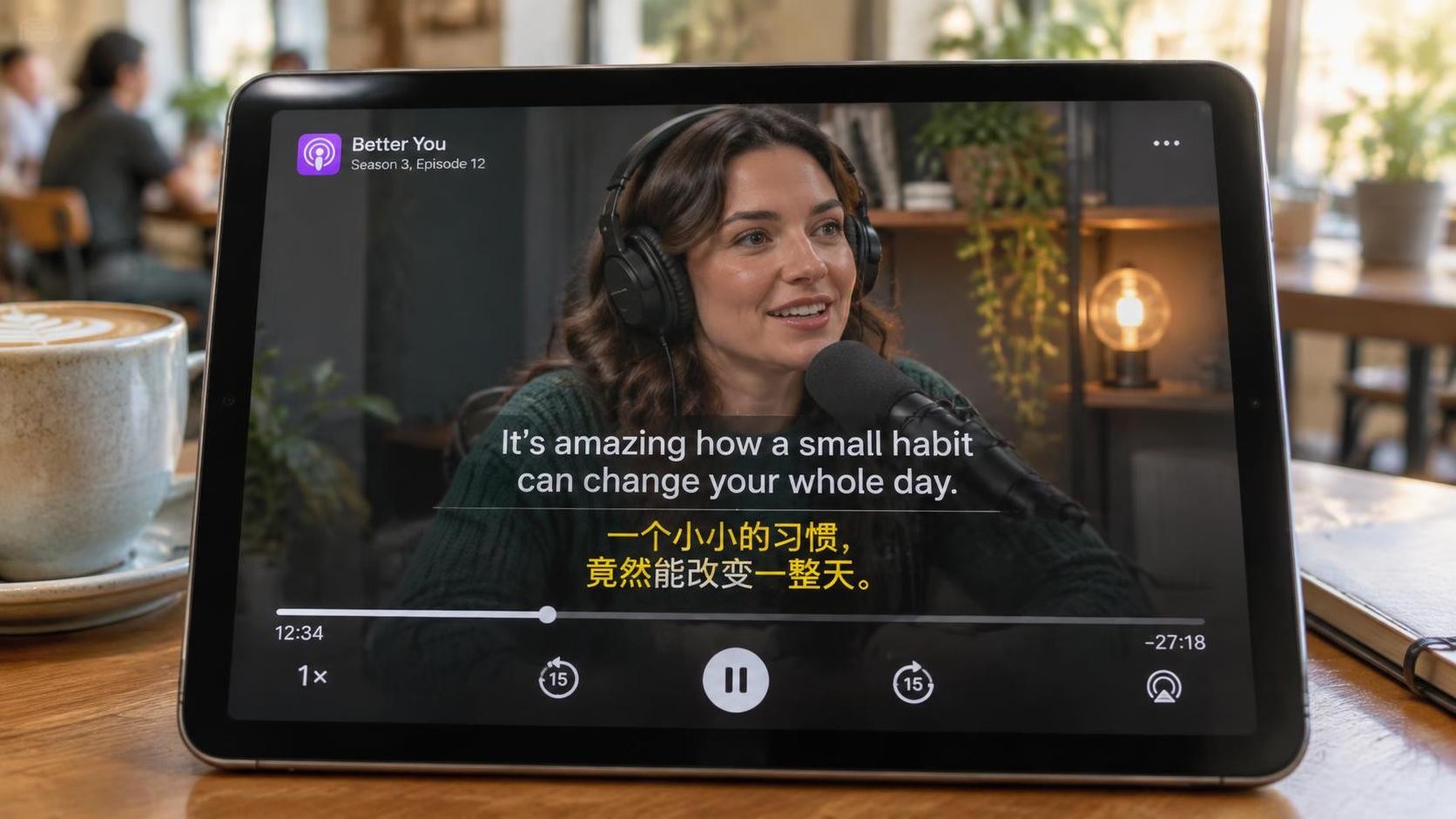
Every other feature depends on how well an app handles the spoken word, so the transcript is the right place to start. Snipd produces a clean automatic transcript with timestamps and splits episodes into AI chapters, which makes it easy to jump back to the exact minute where a claim was made. The transcript stays in one language, which suits a listener who already understands the audio and wants to file it away. PodWise generates a transcript as part of its lesson structure, again in a single language, and attaches it to chapter summaries and key points. LingQ takes the opposite route: text is primary, and audio is attached to it. Imported articles and lessons come with parallel text in multiple languages, and the audio player offers speed control, looping and background playback. That design serves reading practice with audio support extremely well.
ListenLeap puts the audio first and the text underneath it. Bilingual subtitles run line by line in several language pairs, so an episode can be watched with English on top and a native language below, or with the second language hidden until a word is tapped. Timestamps follow each line, which means a learner can replay a single sentence without hunting through a scrub bar. The AI reading assistant explains a phrase in context instead of offering a dictionary gloss, and the explanation stays attached to that line of audio. Snipd and PodWise answer the question of what was said, while LingQ and ListenLeap answer what it means right now. For a learner still building comprehension, the second question comes first.
Vocabulary: Word Counters, Flashcards and Review Loops
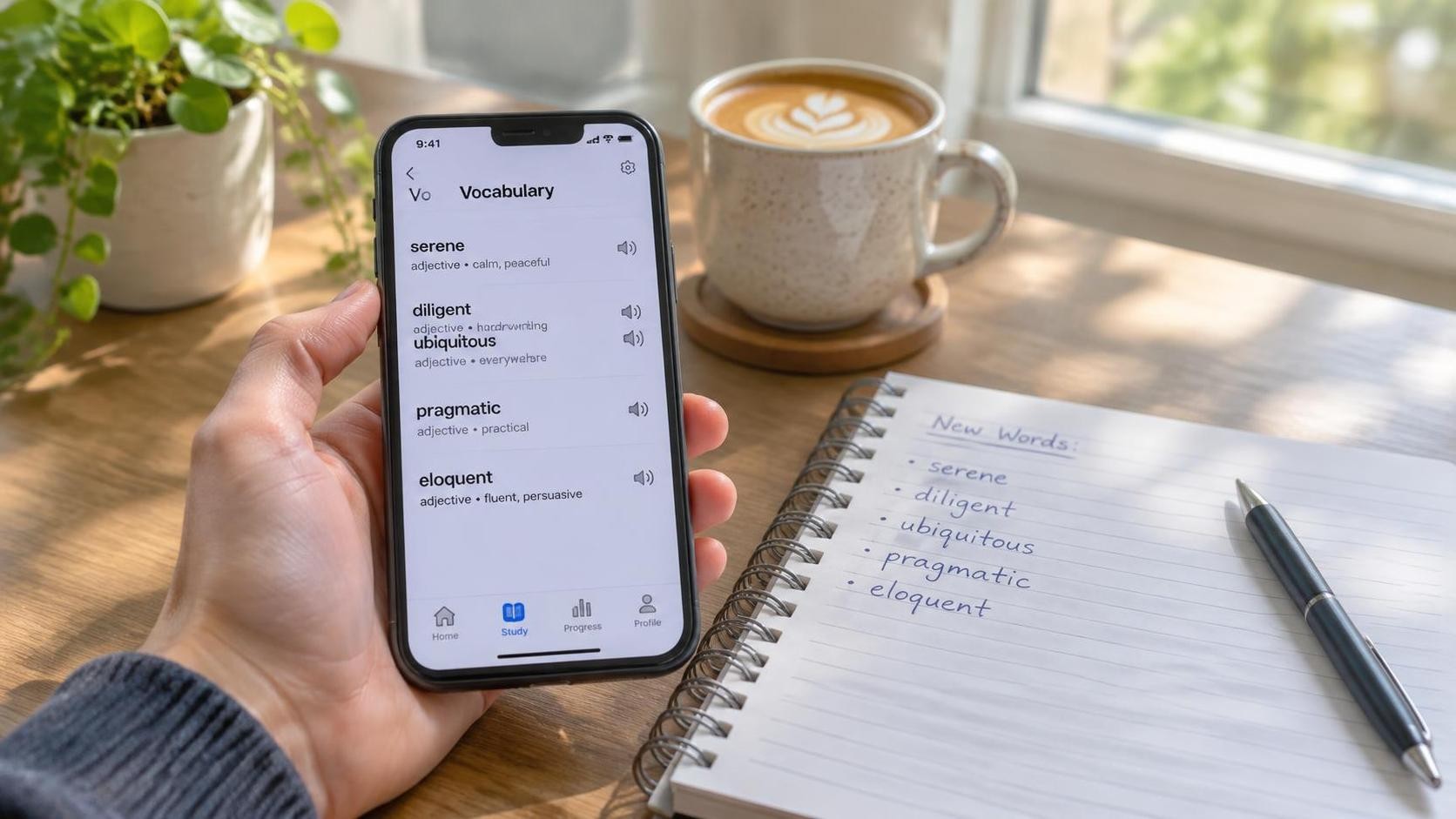
LingQ has the most developed vocabulary bookkeeping of the four. Tapping a word creates a LingQ, which can be saved, translated and marked as known or learning. A known word counter tracks progress per language, and a built-in spaced repetition system schedules review. The visible number is a genuine motivator, and the system works across more than 40 languages, which matters for anyone studying a less common one. PodWise comes at vocabulary from the opposite direction: it generates flashcards automatically from an episode, pulling key words and phrases without any manual marking. The appeal is speed. A learner finishes an episode and receives a ready deck, with progress tracked across episodes.
Snipd is not built for word study, and its own positioning is clear about that. Clips become notes, which is useful when the goal is a searchable archive of ideas rather than retention of individual words. ListenLeap sits between the automated and the deliberate. AI vocabulary extraction pulls candidate words from an episode, and each saved word keeps the sentence and timestamp where it appeared, so review happens against the original audio rather than a bare list. The reading assistant can explain why a word was used in that position, and the saved item can be replayed at the moment it was spoken. PodWise wins on zero effort, LingQ wins on long term tracking across languages, and ListenLeap wins on context, because a word learned inside a sentence is easier to reuse than a word learned from a card.
Speaking: The Feature Three of Four Apps Leave Out
Here the feature grid becomes lopsided. LingQ focuses on input: reading and listening, with almost no speaking practice and no explicit grammar instruction. Snipd has no pronunciation, speaking or vocabulary tools at all, by design. PodWise is a listening and reading tool with no active output training. All three are honest about their scope, and each does its chosen job well. The gap is structural rather than a flaw in execution: none of them was built to close the loop between understanding and producing.
ListenLeap includes AI driven conversation and pronunciation analysis. A learner can read a line aloud, receive feedback at the sentence level, and repeat the same line with the correction in view. Because the practice is attached to the episode being studied, the vocabulary just heard becomes the vocabulary spoken a minute later. That sequence of listen, notice, say is the part of language learning that most audio apps leave to a tutor or a separate product. Having it inside the same session changes how much of an episode survives the week.
Content Range and Difficulty Grading

LingQ carries the widest language coverage: more than 40 languages, thousands of preloaded lessons, graded reading material from beginner to advanced, community lessons and imported content. For a learner of Japanese, Polish or Turkish, that breadth is hard to match. Snipd focuses on podcasts, mostly in English, and its strength is the depth of its AI chaptering rather than the size of a library. PodWise has no built-in library at all: the learner supplies the podcast, and the app supplies the structure. That keeps the product lightweight, and it also means discovery depends entirely on the user.
ListenLeap combines several content types, including audiobooks, podcasts, curated courses and short audio, then layers a multilevel difficulty system on top, from beginner to advanced, with AI adjusting the level as accuracy changes. The practical effect is that a learner does not have to graduate to a different app when an episode becomes too easy. Snipd and PodWise leave grading out entirely, which is fine for confident listeners and awkward for anyone in the first year of study. LingQ grades by community level rather than by live performance.
Offline Use, Devices and Price
LingQ allows course downloads for offline study and syncs across iOS, Android and the web. The free tier is limited, and full access sits around 7.99 to 14.99 dollars per month. Snipd runs on iOS and Android, prices at about 7.99 dollars per month or 59.99 dollars per year, and needs a connection for its AI clipping and summaries. PodWise also runs on iOS and Android, costs roughly 5.99 to 9.99 dollars per month, and likewise needs a connection for AI processing. ListenLeap supports full offline mode for downloaded content and runs on iOS, Android and the web, with a freemium structure and competitive pricing.
The offline detail matters more than it looks. A commute, a flight or a subway ride is exactly when many learners study, and an app whose core features stop working without a signal turns that time into plain listening. Snipd and PodWise keep playback offline but move their AI work to the server. ListenLeap keeps subtitles, vocabulary and review available on the device.
Where the Feature Set Adds Up
Taken one at a time, each app has a defensible specialty. LingQ is the strongest reading and vocabulary tracker for a multilingual learner. Snipd is the best podcast clipping and note export tool in this group, with a mature community and deep integrations. PodWise is the fastest route from a podcast episode to a flashcard deck. ListenLeap is the only one of the four that runs a full loop inside a single session: bilingual subtitles for comprehension, tap to look up a word, AI extraction to save it with its sentence, pronunciation practice on the same line, and offline access for the next commute. Breadth alone would be a weak argument. The stronger argument is that the loop shares one piece of content, so nothing has to be re-uploaded, re-imported or re-explained between steps.
For a learner whose week includes 20 minute commutes, one long podcast and a weekly conversation class, that continuity is the difference between four half-used apps and one habit. LingQ, Snipd and PodWise each ask the learner to bring discipline to a specific task. ListenLeap reduces the number of decisions between hearing a sentence and being able to say it.
Which Learner Should Pick Which App
A learner studying several languages, especially less common ones, and who enjoys reading will get the most from LingQ, whose library and word tracking are unmatched in range. A knowledge worker who listens to interview podcasts for ideas and lives inside Notion or Obsidian will find Snipd hard to replace, because clipping and export are its core craft. A podcast regular who wants summaries and flashcards without any setup will appreciate PodWise, which turns an episode into study material with almost no input.
A learner who wants one place for listening, vocabulary, speaking and review, across audiobooks and podcasts, with subtitles in two languages and offline support, will find the widest fit in ListenLeap. The same applies to beginners who need graded content and sentence level replay, and to anyone preparing for spoken situations rather than only for comprehension.
A Simple Way to Test the Four This Week
Pick one 15 minute episode and run the same task in each app. In LingQ, import the audio and mark unknown words. In Snipd, clip two segments and export them. In PodWise, generate the summary and deck. In ListenLeap, read the bilingual subtitles, save three words, then read one sentence aloud and check the feedback. The next day, without reopening anything, try to recall the main argument and use two of the saved words in speech. Whichever app makes that recall easiest is the one worth keeping installed, and the free tiers are enough to run the test. For learners who want the loop in one place, ListenLeap can be downloaded on iOS, Android and the web.

Comments
No comments yet.
Leave a Comment