

Leo had listened to English podcasts for four months. He understood more every week, yet when he reached for a new word in conversation, it was gone. The words passed through his ears and never stopped long enough to be saved. His friend Nina had the opposite problem: vocabulary lists piled up in three different apps, but she never reopened them. Their experience points at a question that matters more than app popularity: what happens inside an app after a new word appears on screen? Four apps answer it differently. EWA wraps vocabulary in movies, books, and flashcards. RedKiwi turns daily YouTube clips into dictation and fill-in exercises. PodWise converts any podcast into AI summaries and study cards. ListenLeap connects real podcasts with lookup, explanation, and review tools in one chain. This comparison breaks down how each app handles that chain, dimension by dimension.
Where the Words Come From: Content That Feeds Learning
EWA: a library built for entertainment
EWA is a full language ecosystem wrapped around movies and books. It holds 10,000+ movie and TV clips with subtitles, a graded reading library of 1,000+ books with audio narration, 200+ short grammar courses, and an AI chatbot for conversation practice. Learners can also study Spanish, French, and Italian in the same app, which is rare among English-focused tools. The daily word reminders and level-test-based learning plan keep the habit alive without requiring a rigid schedule. For learners who want vocabulary to arrive through stories and scenes instead of word lists, EWA makes input genuinely enjoyable.
RedKiwi: fresh YouTube, refreshed daily
RedKiwi brings real YouTube content into structured practice. The library holds 10,000+ curated clips from news, vlogs, talks, and entertainment, and new videos are added every day, so the material stays current. Every clip comes with bilingual subtitles in 10+ languages and is sorted into three difficulty levels. The Korean-designed interface is polished and game-like, with achievements and daily streaks that quietly reward consistency. For learners who get bored by static libraries, RedKiwi serves a fresh lesson every morning.
PodWise: any podcast becomes a lesson
PodWise takes a different route: there is no built-in library at all, and that is its strength. Users bring any podcast they already follow, and the app turns each episode into a structured lesson with AI-generated summaries, chapter breakdowns, and extracted key points. Progress is tracked across episodes, and highlights and notes can be saved and organized in one place. For learners who already have favorite shows and want a layer of structure on top, PodWise turns existing listening habits into something worth revisiting.
ListenLeap: real podcasts with a learning layer
ListenLeap starts from a curated collection of 10,000+ authentic podcasts from BBC, TED, and NPR, organized across 20+ topic areas, plus self-import for anything users already follow. A placement test sorts each learner into the right level, and every episode is graded with the i+1 principle, meaning material sits just above the current level instead of being randomly chosen. The result is a library that stretches learners gently without ever feeling like homework.
Turning Passive Listening into Active Practice
RedKiwi's drill suite
RedKiwi is strongest at converting a video into focused work. Each clip comes with fill-in-the-blank listening exercises, multiple-choice comprehension questions, and a sentence-by-sentence dictation mode with instant correction, backed by 50,000+ exercises in total. A listener can watch a two-minute clip, then spend ten minutes pulling every sentence apart. That active layer is what separates listening for fun from listening for progress.
EWA's dubbing mode
EWA lets learners record their own voice over movie and TV lines and get a score in return. Dubbing a favorite scene turns a passive viewer into a performer, and the scoring gives instant feedback on how close the delivery is to the original. It is a playful entry point into speaking that many content-heavy apps do not offer at all.
PodWise's AI highlights
PodWise keeps the listening itself simple and puts the work into selection. AI-generated summaries and chapter titles mean learners can skim an episode, jump to the parts worth studying, and save standout moments as notes. Instead of replaying a whole episode to find one idea, users can revisit exactly what mattered. For commuters with limited time, that precision is the whole point.
ListenLeap's blind listening chain
ListenLeap builds active practice into the player. A blind-listening mode plays an episode without subtitles on the first pass, forcing the ears to work before the eyes step in. Sentence-level playback lets learners loop one hard sentence instead of rewinding blindly. Fill-in-the-blank training turns each episode into a listening quiz, and smart summaries plus AI Q&A help clear up whatever is still unclear. Every episode becomes a sequence: listen blind, check the hard parts, verify understanding, then move on.
From Lookup to Review: Where Words Become Yours
EWA's flashcard engine
EWA runs one of the largest flashcard systems in the category: 50,000+ cards with pictures and example sentences, driven by spaced repetition. Words met in clips and books flow into the same review system, so entertainment and study feed one another. The SRS scheduling decides when a card reappears, which solves the "save it and forget it" problem that most learners struggle with.
RedKiwi's vocabulary book
In RedKiwi, words met during exercises can be saved into a personal vocabulary book with its own spaced-repetition review. Because every word is encountered inside a sentence the learner has already worked through, the review comes with context attached, which makes recall far easier than memorizing isolated terms.
PodWise's auto-generated cards
PodWise removes the manual work from flashcard creation. It automatically generates study cards for vocabulary and key phrases from any episode, so a learner who finishes a chapter can review the words that actually appeared in it. No typing, no tagging, no curation: the cards build themselves while the user listens.
ListenLeap's full explanation layer
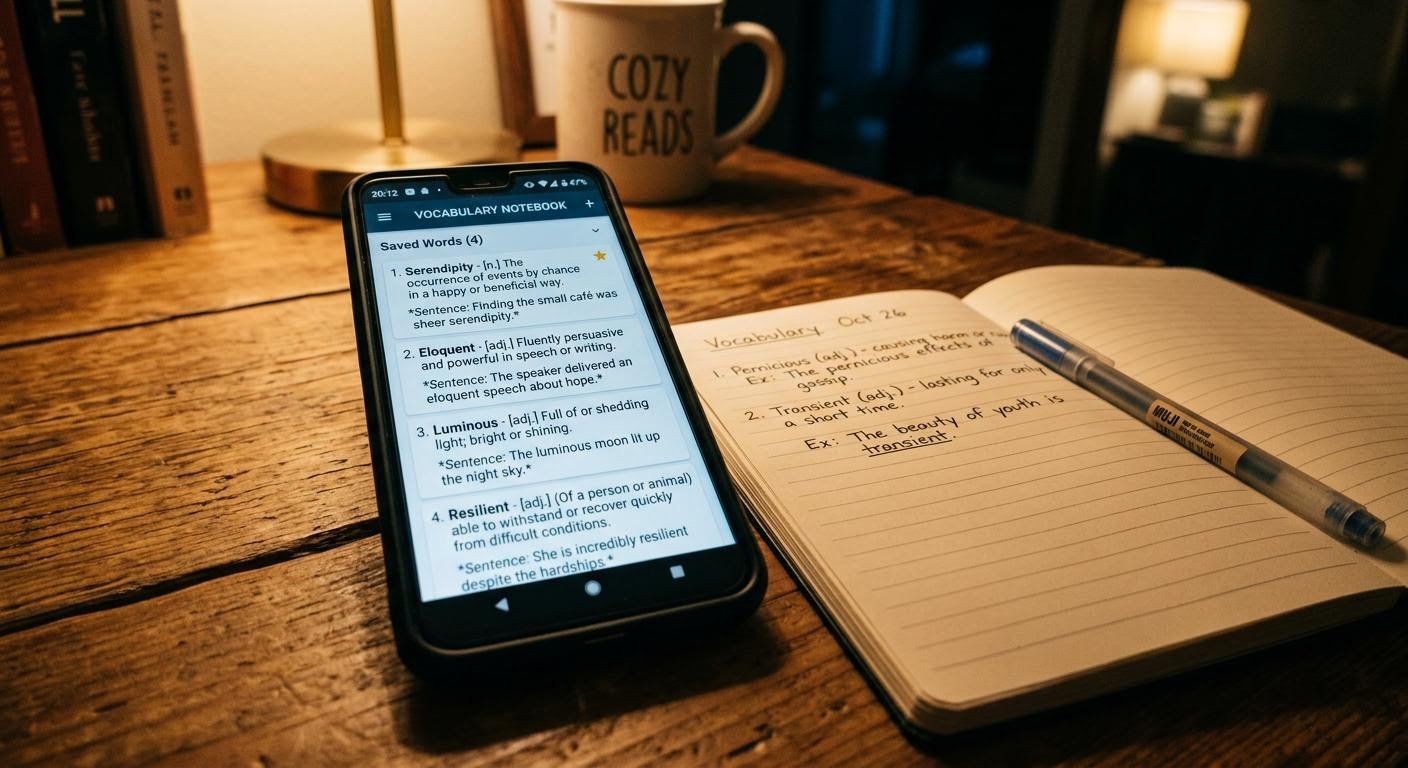
ListenLeap treats lookup as teaching, not translation. Tapping any word returns an instant definition, then goes further with phrase breakdowns and whole-sentence explanations that show how the word behaves in context. Saved words land in a vocabulary notebook that supports personal notes, so learners can record their own memory hooks. Offline caching and PDF export mean that notebook can be reviewed on a plane, a train, or anywhere without signal.
Speaking Practice That Cements New Words
EWA's playful scoring
EWA's dubbing mode gives speaking a low-pressure home: learners repeat lines from real scenes and get a score, which makes pronunciation practice feel like a game rather than a drill.
RedKiwi's built-in shadowing
RedKiwi includes shadowing practice inside its clips, letting learners repeat sentences immediately after hearing them. Practicing the same sentence that was just dictated ties the sound, the spelling, and the meaning together in one pass.
PodWise stays on the input side
PodWise keeps its focus on listening and reading, which suits learners who want to build comprehension first. It is deliberately a tool for the input half of the journey, and for that purpose it is remarkably efficient.
ListenLeap's three-dimensional scores
ListenLeap is the only one of the four that scores shadowing on three separate axes: pronunciation, intonation, and fluency. A learner can see exactly which dimension pulls a sentence down, then target that specific weakness. Combined with fill-in-the-blank training, speaking and listening practice reinforce each other inside the same episode, which closes the loop from hearing a word to saying it correctly.
Why ListenLeap Connects the Whole Chain
Each app above handles one part of the vocabulary chain well. EWA makes input entertaining and review effortless. RedKiwi turns videos into sharp drills. PodWise brings structure to any podcast. ListenLeap is designed so that no link in the chain is missing. The level test and i+1 grading make sure the content is at the right difficulty from day one. Blind listening forces real comprehension before subtitles appear. Tap-to-look-up, phrase breakdowns, and whole-sentence explanations turn every unknown word into a mini lesson. Fill-in-the-blank training and AI Q&A check understanding, and the three-dimensional shadowing scores carry words into speaking. The vocabulary notebook, offline caching, and PDF export make review possible anywhere, and the same account works across iOS, Android, and Web.
ListenLeap also covers more ground in one place: four-language bilingual subtitles in Simplified Chinese, Traditional Chinese, Korean, and Japanese, 20+ topic areas from business to science, and a podcast library built on real BBC, TED, and NPR shows rather than simplified filler. Learners do not have to jump between a podcast player, a dictionary, a flashcard app, and a speaking tool. The whole loop lives inside one app, which is exactly what keeps a habit alive for months.
Which App Should You Choose?
Choose EWA for learners who want vocabulary to arrive through movies, books, and playful flashcards, and who enjoy an entertainment-first routine with 50,000+ spaced-repetition cards behind it.
Choose RedKiwi for learners who want fresh YouTube content every day and sharp drills, with dictation, fill-in-the-blank exercises, and instant correction built into every clip.
Choose PodWise for learners who already have favorite podcasts and want AI summaries, chapters, and auto-generated study cards layered on top of their existing listening.
Choose ListenLeap for learners who want the complete chain in one app: graded real podcasts, blind listening, tap-to-look-up with full explanations, fill-in-the-blank training, three-dimensional shadowing scores, and a notebook that travels offline.
Start Listening, and Keep the Words
The difference between listening for fun and learning from listening comes down to what happens after a new word appears. Leo needed the chain; Nina needed the review. Both found that the app matters less than the loop, and the loop matters most when nothing is missing. ListenLeap is free to try, and the first step takes five minutes: take the level test, pick an episode at the right level, and listen blind once before the subtitles come on. The words that used to slip past will start staying. Download ListenLeap on iOS, Android, or Web and see where the chain leads.


Comments
No comments yet.
Leave a Comment