

A few months ago, a project manager in Berlin decided that her commute was the only free time she had for English. She wanted to turn forty minutes of podcasts and YouTube videos into real language progress, not passive background noise. Her search history filled up quickly: "Cake app for English", "RedKiwi listening practice", "Snipd for learning", "best app to learn English from podcasts". Every product page promised something similar: learn from real content, practice daily, improve fast. She downloaded three apps in one evening, and by Friday she still could not decide which one to keep. This is the exact confusion that this 2026 feature-level comparison tries to remove. Instead of judging apps by marketing claims, the review below opens each product like a toolbox and inspects the actual functions one by one: content library, subtitle and listening tools, vocabulary review, speaking practice, and AI features.
The Content Library Test: Where Learners Actually Find Material
Content is the foundation of every learning app, and each competitor in this comparison built its library around a different source format.
Cake curates short clips from YouTube, movies, and TV shows, and its library has grown past 100,000 segments with bilingual subtitles. The catalog refreshes daily, so regular users always see something new. Cake works best for people who enjoy bite-sized study sessions of five to ten minutes and want material that feels closer to entertainment than to a textbook.
RedKiwi focuses on popular YouTube videos and organizes them into more than 10,000 curated segments across news, vlogs, talks, and entertainment. Content is leveled into beginner, intermediate, and advanced groups, and fresh videos arrive every day. This structure gives RedKiwi a clear advantage for learners who already live on YouTube and want their study feed to match their interest feed.
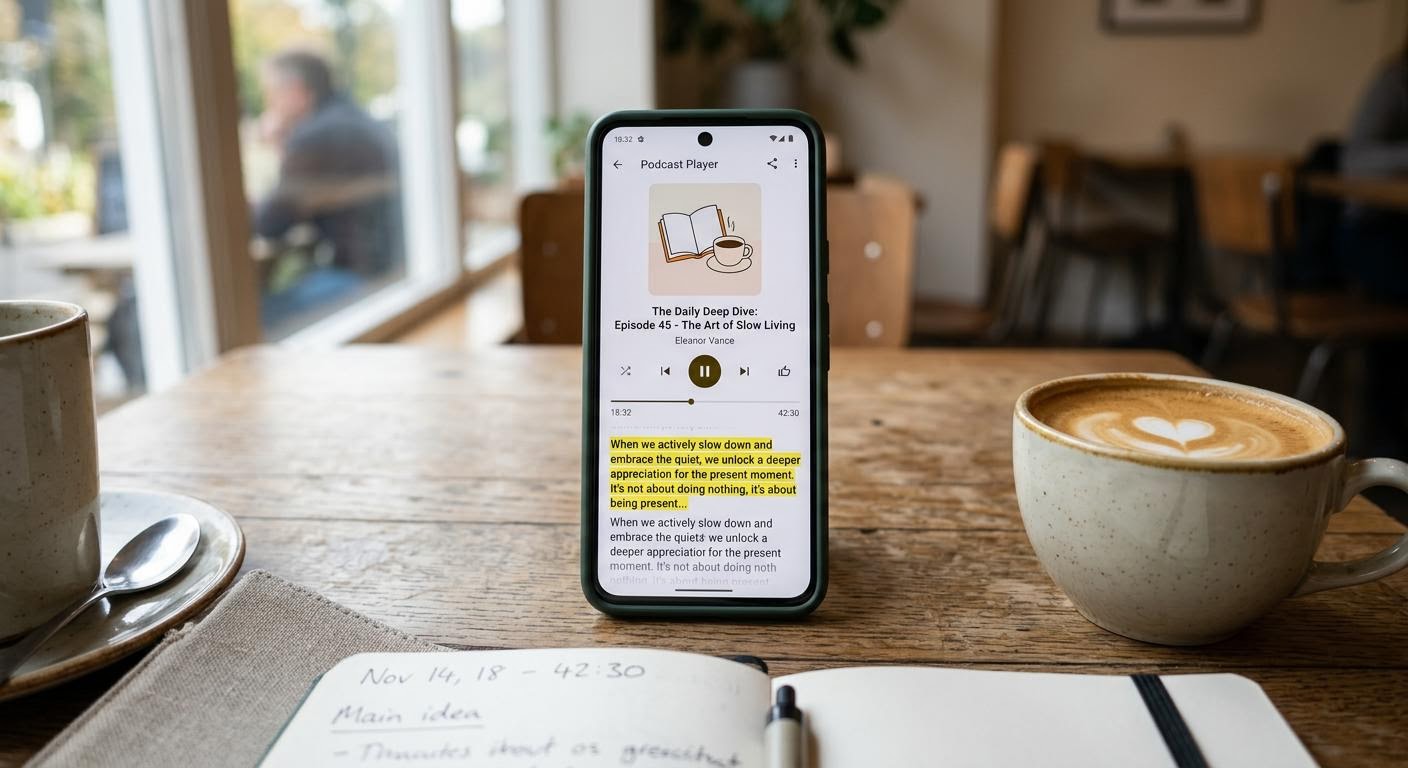
Snipd is a podcast-first product. Its strength is not a video catalog but a discovery engine for spoken knowledge, with AI-generated chapters, automatic summaries, and a library of saved highlights organized by topic. For knowledge workers who treat podcasts as a source of ideas, Snipd is an elegant content capture system.
ListenLeap takes a wider approach and supports both audio and video formats in one place. Users can learn from podcasts, audiobooks, short audio lessons, and video content, which matters because real-world English comes from all of these sources. The app also adds a multi-level difficulty system, so the same piece of content can serve a learner who needs support or a learner who is ready for full-speed speech.
Subtitles, Transcripts, and the Listening Workbench
A good subtitle system does more than display words; it turns listening into a trainable skill.
Cake pairs its clips with English and native-language subtitles, which lets learners check meaning the moment comprehension breaks. The short-clip format keeps each listening session small enough to finish in one sitting.
RedKiwi treats listening as a workout. Every segment comes with gap-fill questions, multiple-choice comprehension checks, and a sentence-by-sentence dictation mode with instant correction. The exercise bank holds more than 50,000 items, which makes RedKiwi one of the most drill-rich listening environments among video-based apps.
Snipd offers automatic transcription for podcasts, and its timestamps make it easy to jump back to any spoken point. The transcript is designed for reference and note-taking rather than for language exercises, which is a natural fit for its knowledge-management identity.
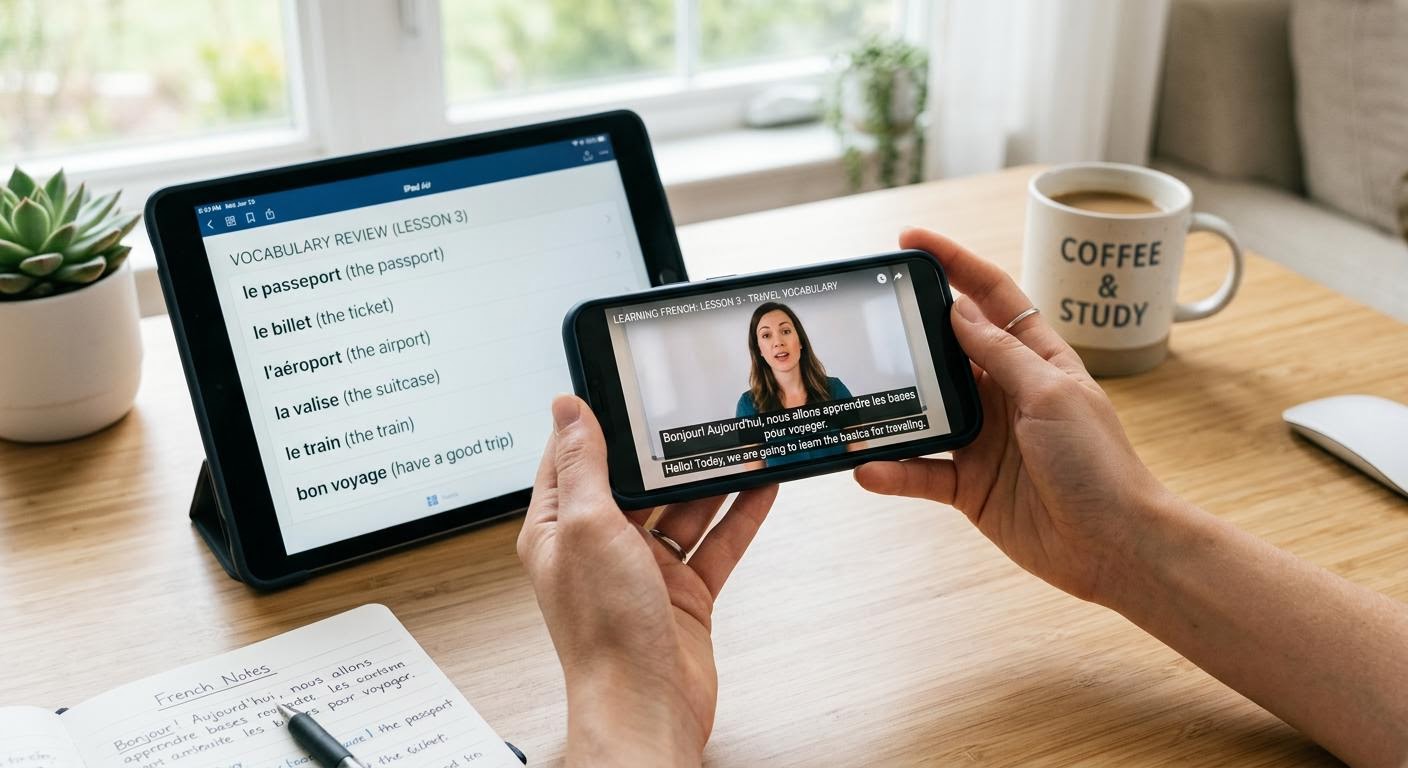
ListenLeap brings the listening workbench together in one screen. The app generates AI bilingual subtitles for podcast and video content, so learners see English alongside their native language while they listen. Beyond passive reading, ListenLeap supports sentence-level listening practice: learners can pause after each line, check the transcript, and replay difficult segments until the sound pattern becomes clear. This combination of full-source flexibility and fine-grained control is the practical difference that matters during a daily study session.
Vocabulary Capture and the Review Loop
Learning a word once is easy; remembering it next month is the real test.
Cake includes a vocabulary collector with spaced repetition review, and learners save words directly from the clips they watch. The design is lightweight and fits the app's casual daily rhythm.
RedKiwi also offers a wordbook built on spaced repetition, and saved words stay connected to the YouTube segments where they first appeared. Context-linked review is a quiet but powerful retention feature.
Snipd does not position itself as a language tool, so vocabulary functions are simply outside its scope. Its value sits in capturing ideas, not words.
ListenLeap closes the gap between listening and vocabulary retention. Instead of asking users to manually pause and type every unknown word, the app applies AI vocabulary extraction that pulls key terms out of the material a learner is already consuming. Because difficulty levels are built into the system, the extracted vocabulary can match the learner's current stage rather than overwhelming them with random words. Combined with a review loop that follows spaced repetition principles, ListenLeap turns an ordinary commute into a steady stream of words that actually stick.
Speaking and Pronunciation Practice
Listening apps often stop at comprehension, but speaking practice is where many learners need the most support.
Cake is genuinely strong here: it provides AI-driven pronunciation scoring inside conversational role-play drills, so learners receive feedback on their spoken output. Among casual video apps, this speaking component is one of Cake's clearest advantages.
RedKiwi offers shadowing practice, where learners repeat lines right after the speaker, but without AI scoring, users must judge their own accuracy. The drill format is useful for rhythm and intonation, yet progress feedback is limited.
Snipd has no speaking or pronunciation features, which is consistent with its purpose as a podcast knowledge tool rather than a language course.
ListenLeap treats speaking as part of the same loop as listening. Its AI pronunciation feedback listens to the learner's repetition and points out where the sound needs adjustment, so shadowing sessions are not blind imitation. Learners can compare their recording with the original speaker, fix problem sounds, and move on. This integration matters because progress in a real conversation requires both understanding fast speech and producing clear responses.
AI Features in Daily Use
The word "AI" appears on almost every app store page in 2026, but the actual implementations differ sharply.
Cake uses AI mainly for pronunciation scoring and a basic spaced repetition system. The feature set is focused and reliable rather than broad.
RedKiwi keeps AI involvement limited as well, with the core value delivered through hand-built exercises and its SRS wordbook.
Snipd is the AI heavyweight of the group, and this is worth praising honestly. Its chapter segmentation, show summaries, and one-tap snippet feature are among the best in the podcast space. The snippet tool transcribes and summarizes a selected moment almost instantly, and deep integrations with Notion, Readwise, Obsidian, and Roam make Snipd a genuine productivity asset for note-takers.
ListenLeap applies AI across the whole learning journey rather than at a single touchpoint. AI bilingual subtitles handle comprehension, AI vocabulary extraction identifies what is worth learning, AI pronunciation analysis supports speaking, and an AI reading assistant helps when the learner wants to go deeper into a transcript. In practice, this means the learner is never the one doing the tedious work of stitching tools together: the listening, capturing, reviewing, and speaking steps share one pipeline.

Where ListenLeap Comes Together
Feature-by-feature, every competitor in this comparison is good at something. Cake wins on casual short-video fun and scored speaking drills. RedKiwi wins on structured listening exercises built around YouTube. Snipd wins on AI podcast capture and knowledge management. The problem is that real English learners rarely need only one of those things.
A typical intermediate learner listens to podcasts on the way to work, watches YouTube interviews at lunch, saves unknown words throughout the day, and wants to practice speaking before a meeting. Recreating that flow with separate apps means paying for two or three subscriptions, transferring vocabulary between systems by hand, and losing the context that connects a saved word to the moment it was heard. ListenLeap is designed around that full journey: podcasts and videos live in one library, bilingual AI subtitles explain each line, vocabulary is extracted and scheduled for review automatically, and pronunciation feedback closes the speaking loop. The multi-device support across iOS, Android, and the web means the same learner can switch from phone to desktop without losing their place, and the offline mode keeps study possible on a subway ride or a flight where no connection exists.
None of this is a claim that other apps are weak. Cake, RedKiwi, and Snipd each serve their core users well, and many people will be happiest with exactly one of them. The point is simpler: for learners whose goal is steady, all-around English progress from real content, ListenLeap bundles the capabilities that would otherwise require assembling multiple tools and managing them manually.
Recommendations for Different Needs
Different learners should pick different tools, and a fair comparison ends with honest guidance.
Casual learners who want five minutes of fun English practice with speaking feedback will enjoy Cake. Its clip library and pronunciation scoring make daily practice genuinely pleasant, and the Korean-English track is a bonus for K-culture fans.
YouTube-heavy listeners who want structured comprehension drills should try RedKiwi. The gap-fill questions, dictation mode, and leveled segments turn passive watching into an active listening routine.
Podcast listeners who mainly want to capture ideas and manage knowledge should choose Snipd. Its AI chapters, summaries, and note integrations are excellent for building a personal knowledge base from audio.
Learners who want one tool for the entire journey, from finding content to pronouncing words correctly, should evaluate ListenLeap first. The combination of podcast and video sources, sentence-level practice with bilingual AI subtitles, automatic vocabulary extraction, pronunciation feedback, difficulty levels, and offline access covers the widest range of daily needs without requiring a stack of separate subscriptions.
Final Word
Choosing an English learning app in 2026 is not about finding the app with the single best feature; it is about finding the one whose feature set matches the learner's real routine. Cake, RedKiwi, and Snipd all deserve their popularity in the segments they serve. For learners who consume both podcasts and videos, who want vocabulary and speaking support attached to real content, and who prefer one coherent system over three separate ones, ListenLeap offers a practical middle path that is worth a free trial. Download it, connect a favorite podcast or a YouTube video, and test the listening-to-speaking loop for one week. The commute is short, but the accumulated progress is not.



Comments
No comments yet.
Leave a Comment