

Why Adult Beginners Compare Apps Before the First Lesson
Picture a learner who turns thirty five this year, works nine hours a day, and finally decides to repair the English that never quite arrived at school. The first search is simple enough: best app to learn English for beginners. Two hours later the screen holds twelve open tabs, four free trials, three names that sound alike, and a growing suspicion that every app promises the same thing in different colours. Beginners face a particular kind of confusion. They cannot tell whether a lesson is too easy or too hard until they are already inside it, they do not know which skill to train first, and most reviews are written by people who already speak English well enough to compare accents. The practical question is narrower than the marketing suggests. Which app will still be open in week six, and which one will have taught something that survives the commute home? Cake, RedKiwi, PodWise and ListenLeap answer that question in four different ways, and the differences matter most in the first ninety days.
Four Apps, Four Starting Points
Cake
Cake is a light, video first learning app from Korea, launched in 2017, with more than 100,000 short clips drawn from YouTube, films and television, plus 500 or more topic based courses. It holds 4.7 stars in the app stores, reports 50 million plus downloads, adds fresh clips daily, scores spoken drills with AI pronunciation feedback, keeps a personal vocabulary bank with spaced repetition, and runs on iOS, Android and the web. Cake Plus opens the full library at about 9.99 USD per month.
RedKiwi
RedKiwi, launched in 2019, describes itself as a video based listening companion. It gathers 10,000 plus YouTube clips across news, vlogs, talks and entertainment and wraps each one in fill in the blank listening tasks and comprehension questions, reporting more than 50,000 exercises. Three difficulty levels, dual subtitles in 10 or more languages, a dictation mode with instant correction, shadowing practice, spaced repetition flash cards and a polished achievement system make it a very focused listening tool at roughly 6.99 USD per month.
PodWise
PodWise works from a different raw material: the podcast. It turns any episode into a structured lesson with AI summaries, chapter breakdowns, key takeaways and auto generated flash cards, then tracks progress across shows inside a clean mobile player. It suits self directed learners who already know which podcasts they love. Pricing sits between 5.99 and 9.99 USD per month on iOS and Android.
ListenLeap
ListenLeap gathers audiobooks, podcasts, curated courses and short audio in one library, sorts every item on a difficulty scale that starts at beginner, pairs audio with bilingual subtitles across multiple language pairs, and adds AI tools for subtitle generation, vocabulary extraction, pronunciation analysis and reading support. Full offline downloads keep a lesson working on a plane or in a subway tunnel, and one account runs on iOS, Android and the web.

Content Source: What A Beginner Actually Listens To
Content decides whether week two happens at all. Cake answers with variety and novelty. A library of more than 100,000 clips refreshed every day means a learner rarely sees the same format twice, and 500 plus courses give the clips a shape, so the app always has a next step ready. RedKiwi answers with depth per clip. Its 10,000 plus videos are not meant to be watched once; each carries listening gaps, comprehension questions and a dictation pass, which turns a compact library into more than 50,000 exercises, and the daily refresh keeps the source material current. PodWise answers with relevance, since it ships no library at all and instead converts the shows a learner already follows into summaries, chapters and flash cards, a strong match for someone who arrives with a favourite podcast and wants more from it. ListenLeap answers with range and durability. Audiobooks bring long form narrative that rewards daily listening, curated courses bring sequence, short audio brings a five minute win on a bad day, and podcasts cover the news and culture a learner wants to discuss at work. Because all of it sits behind one difficulty system and one subtitle format, a beginner can move from a two minute clip to a forty minute chapter without switching apps, opening a new account or relearning an interface.
Level Placement: Too Easy, Too Hard, Or Just Right
Beginner content fails in two directions, boredom and drowning. Cake labels clips by basic level and keeps sessions short, often five to ten minutes, which suits a learner who wants a gentle daily habit rather than a syllabus. RedKiwi sorts its library into three levels and lets the exercise design show the difference, so a learner can tell a clip that is too fast from one that is merely unfamiliar. PodWise trusts the learner to bring their own material and offer no internal grading, which works well for someone who already knows how to calibrate their own listening. ListenLeap places every item on a multi level scale from beginner to advanced, and that same scale covers audiobooks, courses, podcasts and short audio. A learner who starts in the lower band meets slower speech, shorter sentences and denser subtitle support, then moves up as comprehension settles. The effect for an adult beginner is that the app never has to be abandoned because the library ran out of room to grow.
Subtitles: The Support Beam Most Beginners Lean On
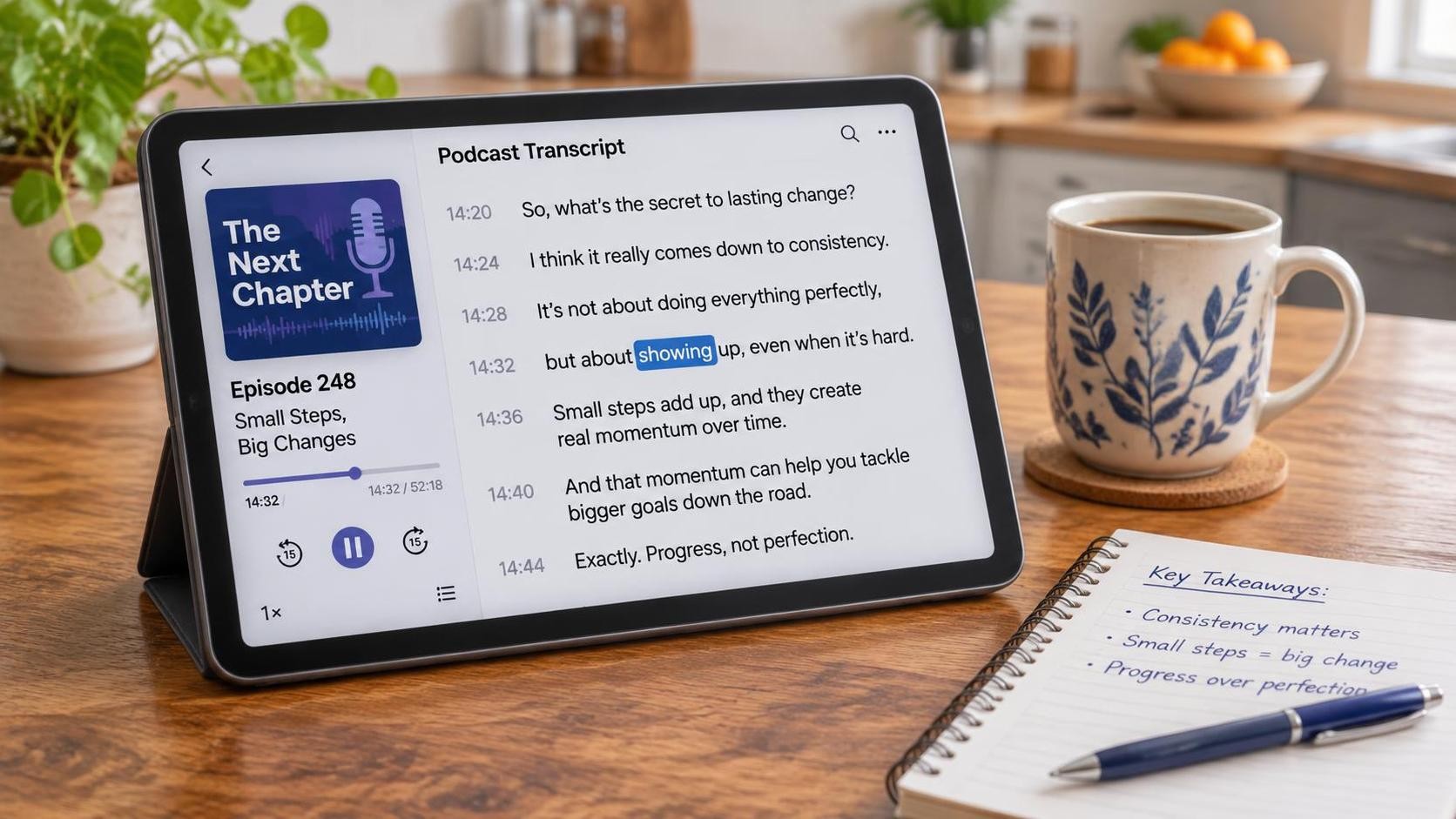
Cake shows bilingual subtitles across its clips, English on one line and Korean or another native language on the other, a direct match for its core audience in Asia. RedKiwi is unusually generous here, syncing dual subtitles in more than 10 languages so the English line and the native line sit together while the audio plays, with shadowing available on the same screen. PodWise generates AI transcripts for each episode, giving a readable version of spoken audio that helps a learner check a phrase after the fact. ListenLeap treats subtitles as a system rather than an add on. Every supported language pair has aligned dual subtitles, AI subtitle generation covers material that never shipped with captions, and tapping a word opens its definition, a saved word card and the sentence it came from. AI vocabulary extraction builds the review deck from words the learner actually met in that episode instead of a generic starter list, and the reading assistant keeps transcript and translation in step through long audiobook chapters.
Speaking Practice: Where Listening Turns Into Output
Most beginners understand more than they can say, and the gap is where confidence stalls. Cake includes AI scored pronunciation drills built around its clips, so a learner repeats a line and receives a score with correction advice, turning a passive clip into a speaking rep. RedKiwi uses shadowing, asking the learner to speak along with the audio in real time, a method that trains rhythm and connected speech, while its dictation mode sharpens the ear that speaking depends on. PodWise concentrates on input and comprehension rather than production, which is consistent with its role as a listening and note taking companion. ListenLeap builds the full loop into every format: slow replay, shadowing, a recorded repeat, then AI pronunciation analysis that reports on individual sounds, word stress and intonation rather than one blunt number. Because that analysis attaches to the sentence the learner has just heard, correction lands while the memory of the audio is still fresh, and the same sentence can be retried until the score settles.
Offline, Devices And Price
Beginners often study on a commute with unreliable signal, so offline behaviour decides how many sessions survive. Cake runs on iOS, Android and the web with limited download support. RedKiwi runs on iOS and Android with downloads available. PodWise runs on iOS and Android, and its AI processing needs a connection. ListenLeap supports full offline downloads of audio and subtitles, so a saved chapter plays with subtitles and vocabulary tools intact, and the library syncs across iOS, Android and web. All four use freemium pricing: Cake Plus near 9.99 USD per month, RedKiwi near 6.99, PodWise between 5.99 and 9.99, and ListenLeap keeps a competitive freemium tier that includes offline access to downloaded material.
Why Beginners Tend To Stay With ListenLeap
A beginner does not need the biggest library or the sharpest single feature. The beginner needs one place where listening, vocabulary, pronunciation and review form a loop, and one account that remembers all of it. ListenLeap is built around that loop. A learner opens an audiobook chapter, reads along with bilingual subtitles, taps three unknown words into the review deck, replays one sentence slowly, records a shadowing attempt, reads sound level feedback, then downloads the next chapter before leaving the house. Nothing is exported into a second app and nothing is lost between devices. The AI layer removes the usual beginner frictions: subtitles exist even when the source has none, review lists mirror the content actually consumed, and pronunciation feedback names the sound that slipped instead of offering vague encouragement. The multi level library makes the beginner band a starting point rather than a ceiling, and the same account still makes sense twelve months later at intermediate level.

Matching The App To The Beginner
Cake suits a learner who wants a light daily habit with endless fresh video
Short clips, daily updates, AI scoring and a beautiful interface make Cake the easiest app to open on a low energy evening, and its English plus Korean track is a natural fit for anyone following Korean culture.
RedKiwi suits a learner whose weak point is hearing words accurately
Fill in the blank listening, dictation with instant correction, dual subtitles in 10 or more languages and three clear levels make it a precise instrument for training the ear before speaking.
PodWise suits a learner who already has a podcast queue worth mining
Anyone who listens to two or three shows a week can convert that habit into summaries, chapters and flash cards, and the progress view keeps the habit visible.
ListenLeap suits a learner who plans to still be studying in six months
The combination of audiobooks, podcasts, curated courses, one difficulty scale, dual subtitles with word level lookup, pronunciation analysis, offline downloads and three platforms is what a long term beginner actually ends up needing, and it is the reason many learners consolidate their tools into a single subscription.
A First Month That Sticks
Week one is about volume of contact rather than accuracy. Fifteen minutes of short audio or a podcast clip with subtitles, one saved word list, no score chasing. Week two adds a shadowing attempt per session and one review pass over saved words. Week three introduces a longer piece, an audiobook chapter or a twenty minute episode, played once with subtitles and again without. Week four is a check: replay something from week one and notice how much more arrives without the subtitle line. That progression is available inside ListenLeap without changing tools, and Cake, RedKiwi and PodWise each support a version of it, which is the honest reason all four appear in the same comparison. The app matters less than the loop, but a loop that survives a commute, an offline flight and a change of phone is a loop that survives.
Beginners who want to test the long term pattern rather than the free trial can start with one downloaded chapter, one saved word list and one recorded sentence, then judge the week six version of themselves.


Comments
No comments yet.
Leave a Comment