

Anyone who has listened to English podcasts for months knows the feeling: the episode plays, the general idea comes through, and then a fast sentence flies past with half the words missing. Passive listening stacks up hours without fixing that gap. Intensive listening attacks the exact spots where the ear fails. Instead of finishing one episode, a learner finishes one short segment and understands every word in it. This article lays out the method step by step, including how to fit it into a normal week.
Why more listening does not fix fast speech
The ear does not improve from volume alone. When a person listens passively, the brain fills in the missing words with guesses, and those guesses get reinforced instead of corrected. The same weak spots (reduced vowels, connected speech, unfamiliar collocations) stay weak for years. Fast English sounds fast mainly because speakers link words together: "want to" becomes "wanna," "did you" becomes "didja." No amount of background listening teaches the ear to untangle these patterns.
Intensive listening solves this by forcing the brain to confront every gap. One minute of intense work can expose more weak points than an hour of passive exposure. The goal is not to finish episodes. It is to finish sentences.
Step 1: Pick a segment one level above comfortable
Material matters more than effort. If the episode is far above the current level, the learner cannot even guess what the missing words are, and intensive work turns into frustration. If it is too easy, there is nothing to fix. The sweet spot is content that is understandable at maybe 70 percent: challenging enough to expose gaps, familiar enough to close them.

A practical way to find this level is to use an app that grades podcast difficulty. ListenLeap runs a quick level test and sorts its 10,000+ podcasts by difficulty level, nudging each episode slightly above the listener's current level instead of randomly harder. That removes the guesswork of picking material.
One segment is enough: a single 3-to-5-minute stretch of a conversational episode, ideally with two speakers talking at a natural pace. Cut it off mentally and ignore the rest of the episode for now.
Step 2: Blind listen twice before looking at anything
Before touching subtitles or transcripts, play the segment twice without any text. The first pass is for the general meaning: who is talking, what the topic is, what the tone is. The second pass is for gaps: mark the exact moments where words blur or disappear. Most learners try to catch every word on the first listen and panic when they cannot. That pressure kills the training effect.
A trick that helps: pause at the blurry moments and say out loud what was probably said, even a wild guess. This activates the brain's prediction machinery, which is exactly what fast speech requires. Guessing wrong is fine; the correction comes in the next step.
Step 3: Work sentence by sentence, not line by line
Now the real work begins. Play one sentence, stop, and try to repeat it. If a word is unclear, replay that sentence two or three times before checking the text. The order matters: attempt first, verify second. Learners who check subtitles immediately never build the effortful recall that strengthens the ear.
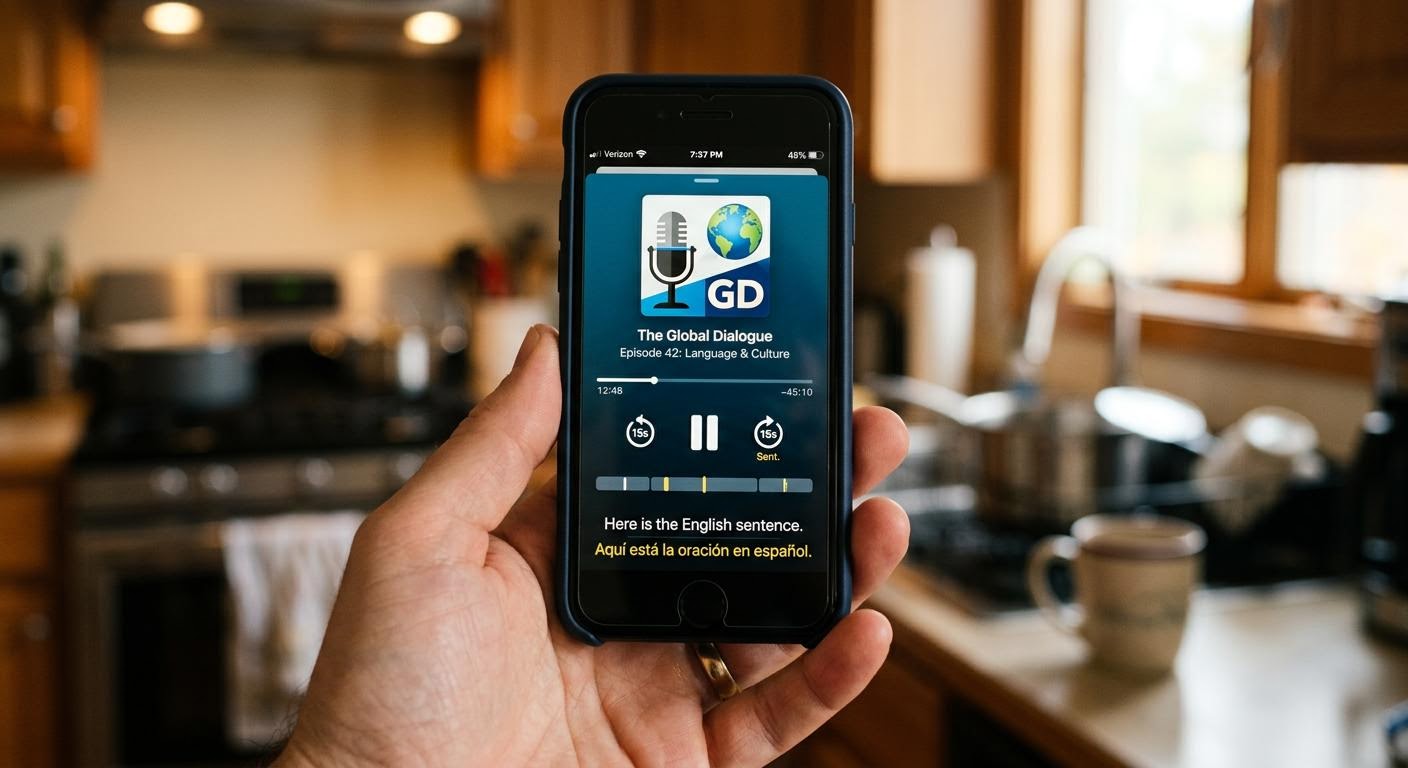
When the text is finally checked, the surprises are usually the same few categories: a word the learner knows but could not hear in connected speech, a phrase that means something different as a unit, or a function word that got swallowed entirely. Write these down as phrases, not single words. "Wanna grab" is a better entry than "wanna."
This is where a player with granular controls earns its place. ListenLeap's sentence-by-sentence playback mode is built for this loop: play, pause, replay, reveal, repeat. Tapping a word inside the sentence pulls up its meaning immediately, and a full-sentence explanation covers phrases that do not make sense word by word. The point is to keep the verification step under ten seconds so the focus stays on the ear.
Step 4: Shadow the same segment until it sounds right
After the sentence work, the segment has been fully decoded. Now it needs to move from the eyes into the ear and mouth. Shadowing means speaking along with the audio, almost simultaneously, copying rhythm, stress, and intonation rather than just pronunciation. For a 3-to-5-minute segment, one focused shadowing pass is worth more than five casual repeats.
A common mistake is to shadow the whole segment in one breath and give up mid-way. Better to take it in the same chunks as Step 3: shadow one sentence, rewind, shadow it again, then chain two sentences together. The voice should sound like a delayed echo, not a separate reading.
Scoring makes this honest. ListenLeap's shadowing mode scores pronunciation, intonation, and fluency separately, so a learner can see that the vowels are fine but the rhythm is flat. Fixing one dimension at a time is far more effective than chasing a vague feeling of "not matching."
Step 5: Build the one-week routine
Intensive listening does not need hours. Fifteen to twenty minutes a day, five days a week, is enough to see change within a month. A simple rotation keeps it sustainable:
Days 1-2: pick a new segment, blind listen, and work through Step 3 for about 15 minutes.
Day 3: shadow the same segment. This is the day the phrases start to stick.
Day 4: re-listen to the segment with no subtitles and no pauses. If 90 percent comes through clean, the segment is done.
Day 5: run a fill-in-the-blank review on that segment, then pick the next one.
ListenLeap's fill-in-the-blank mode serves the Day 4 and Day 5 check naturally, and words saved during sentence work land in a vocabulary notebook with the original audio context. Reviewing a phrase with its original sound attached is much more effective than reviewing a bare word list.

How to know it is working
After three or four weeks, the same episode that once blurred should come through at a noticeably higher percentage. The telltale sign is not understanding more words; it is hearing more words. The learner stops guessing "something about the weather" and starts catching the actual sentence. When that happens, the old passive listening habit becomes more productive too, because the ear now has patterns to recognize instead of blanks to fill.
One warning: intensive listening is tiring by design. If a session drops below ten real minutes of focus, shorten the segment instead of quitting the method. A two-minute segment done properly beats a ten-minute segment done lazily.
The whole method fits inside a single podcast episode spread across a week. That slow pace feels counterintuitive at first, but the sentences that were worked, repeated, and shadowed are the ones that stick. Fast English stops being a wall once the ear has been trained to break it into pieces.




Comments
No comments yet.
Leave a Comment