

Fast English Sounds Fast for a Reason
A podcast host says a perfectly normal sentence at normal speed. Every word is familiar. The sentence still lands as one long blur, and by the time a listener sorts out the first few words, the host has already moved on. Most learners blame their ears and assume they need more exposure hours. What they usually need is training aimed at the things that make spoken English feel fast.
First, the brain holds only a limited number of words at once. When a sentence arrives without clear chunk boundaries, it overflows. Second, native speakers squeeze function words like "the", "of", and "was" down to a few sounds, so the words a learner expects to hear are barely there. Third, most learners have read far more English than they have heard, which means the eyes are faster than the ears. Each of these problems can be fixed with short podcast clips and a few minutes a day.
Trick 1: Fix the Level Before the Speed
A sentence only feels fast when too much of it is unknown. If a third of the words are new, the brain cannot process the audio stream in time, and the whole episode collapses into noise. The quick check: play thirty seconds of any episode and count the words that give pause. If more than two or three per minute, the material is too hard, and no amount of replaying will help.

Match Material to the Ears, Not the Goals
Choosing the right episode is a skill on its own. A good rule is the 80 percent pass: pick material where about 80 percent of the words are already familiar on a first listen. That leaves enough unknown material to grow on without turning the episode into a guessing game. ListenLeap runs a placement test and grades its 10,000-plus podcasts by difficulty, so a learner can find the right band in a minute instead of burning a week on trial and error. Episodes sitting just above the current level are where listening improves fastest.
Trick 2: Loop One Line Until the Chunks Separate
Fast speech is not a wall of words. It is chunks of meaning delivered in sequence, and the ear has to learn where one chunk ends and the next begins. The fastest way to learn that is to take a single sentence and replay it until the boundaries become obvious.
Start a sentence, pause at the first natural break, and say what came before it.
Replay the same line two or three times, each time noticing a new boundary.
Repeat the line aloud with the same rhythm, then check the transcript.
Sentence-level replay makes this loop painless. ListenLeap stops cleanly at each sentence boundary, so there is no dragging a progress bar back and forth to find where a phrase started. A line that seemed to be one solid blur on the first pass usually separates into three or four clear chunks by the fifth replay.
Trick 3: Hunt the Squeezed Words
The words that disappear in fast speech are almost always function words: "the", "and", "to", "of", "was", "have". Native speakers reduce them to a flick of sound, and learners who expect the full dictionary version hear nothing. Training the ear to catch these squeezed sounds changes how fast speech feels, because the structure of the sentence becomes audible.
A gap-fill exercise does exactly this. A sentence plays with certain words blanked out, and the learner supplies them from context. It forces the ear to reach for the weak sounds instead of waiting for them. ListenLeap's fill-in-the-blank mode runs on real podcast lines, so the reductions are the natural ones, not the careful versions found in textbook audio. Ten sentences a day is enough to start catching words that used to vanish completely.
Trick 4: Shadow the Fastest Lines
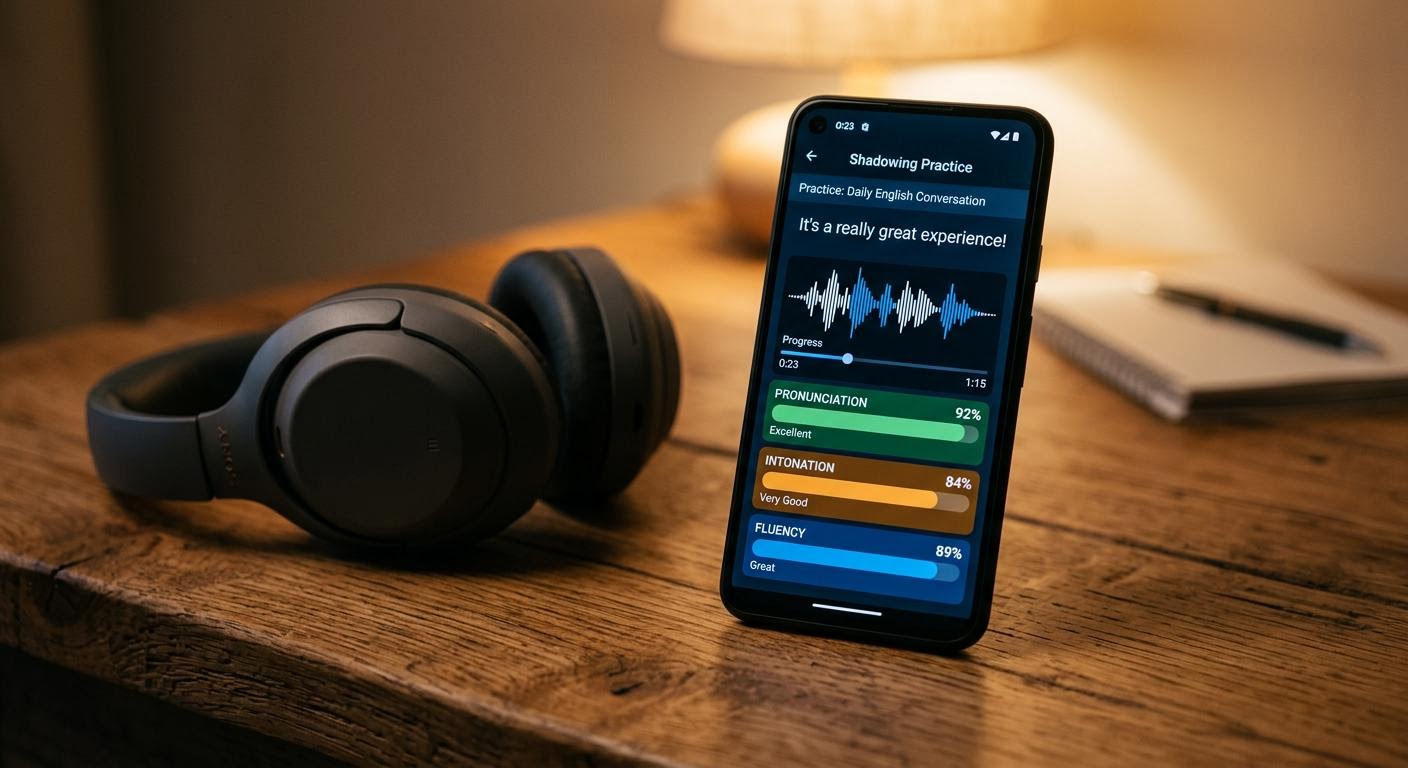
Shadowing is repeating right behind the speaker, half a syllable later, matching rhythm and intonation. It works like a speed drill, because the mouth has to keep up with the ear. Start with two or three lines from the day's clip that were hardest to catch.
Shadow each line slowly once, matching every stress and pause.
Shadow it again at full speed, staying half a syllable behind.
Record the final pass and compare.
The useful part is the comparison. ListenLeap's shadowing mode scores pronunciation, intonation, and fluency as three separate numbers, so the weak point is visible: a learner who sounds clear but always late will see the fluency score lag behind. Over two or three weeks, that number rising is a reliable sign that the ear is keeping pace with native speed.
Trick 5: Listen Blind, Then Verify
This trick retrains the habit of reaching for text the moment speech gets fast. The rule: the first pass of any clip happens with no subtitles at all. Listen once and hold onto the gist. Then replay and check.
Blind pass: play the clip without text, then summarize it in one sentence.
Check pass: turn the subtitles on and find the spots that were misheard.
Fix pass: replay those spots and say them aloud.
The mismatches show where the speed problem really is. A word misheard as another word, a contraction that was not registered, a phrase silently skipped: each one is a specific gap, and each gap closes with repetition. ListenLeap's blind listening mode hides the text by default, and its bilingual subtitles switch on for the check pass, so the whole sequence runs inside one player. Tapping a word opens its meaning, and the phrase breakdown shows how individual words shift in connected speech, the usual reason a familiar word vanishes at full speed.
A Twenty-Minute Routine That Fits a Commute
Five tricks are only useful if they actually happen, so the routine matters more than any single technique.
Minutes 1 to 5: play a level-matched episode and mark the fastest lines.
Minutes 5 to 12: run the loop and gap-fill drills on those lines.
Minutes 12 to 18: shadow the three hardest lines and check the scores.
Minutes 18 to 20: one blind pass on a fresh sentence, then verify.
The episodes can be cached offline, which turns a commute into a practice slot without using mobile data. The smart summary at the end of an episode gives a quick check of whether the gist survived, and words that kept failing can be saved to the wordbook with a note. Once a week, exporting notes or the transcript as a PDF shows a week of progress in a few pages, which makes a plateau easy to spot before it hardens into a habit.

Fast English stops feeling fast when the ears learn where the chunks are, which words get squeezed, and how far behind the mouth can stay. None of that needs more hours or harder material. It needs the same short clips, replayed in the right order, for a few weeks. The blur separates into sentences, then into chunks. The words were there all along.



Comments
No comments yet.
Leave a Comment