

Why Subtitles Quietly Become a Crutch
Subtitles feel like a shortcut, but they usually turn listening practice into reading practice. When the text is on screen, the eyes lead and the ears follow; the brain reads the line, hears it a moment later, and files both away together. After fifty hours of this, a learner can "watch in English" all day — then pause the episode, turn the subtitles off, and understand almost nothing. That is not a hearing problem. It is a training problem: the ears never had to do the work alone.
The fix is not to rip subtitles away overnight. It is a staged handover from text to sound, using short segments at the right difficulty. With a few weeks of structured practice, most learners can drop the text entirely and still follow the conversation. The plan below takes about six weeks and works with any podcast or video material.
Phase 1: Choose Material That Matches Your Ears
The first decision decides everything else. Use the 80 percent rule: pick a segment where roughly 80 percent of the words are already familiar on a first pass. Material at this level lets the ear lock onto the unknown 20 percent instead of drowning in it. Too-easy audio trains nothing; too-hard audio turns listening into guessing.
Most learners overestimate their own level, so a placement test at the start saves weeks. ListenLeap runs a level test and grades its 10,000-plus podcasts by difficulty, which makes level matching a one-minute decision instead of trial and error. Episodes that sit just above the current level — the i+1 range — are exactly where the ear grows fastest.
What to Pick for the First Two Weeks
Short segments, not full episodes. Three to five minutes is enough for one focused session.
Familiar topics. Business, science, daily life — any field where background knowledge carries the ear.
One speaker. A solo monologue is far easier to follow than a four-person debate, and easier to shadow later.
Phase 2: Cut the Native-Language Layer
Once the material is right, the next step is removing the translation layer. Bilingual subtitles — English on top, native language below — are the most comfortable mode, and also the most dangerous one, because the eyes always drift to the familiar line. The goal of this phase is to starve the eyes gradually.
A Two-Step Transition
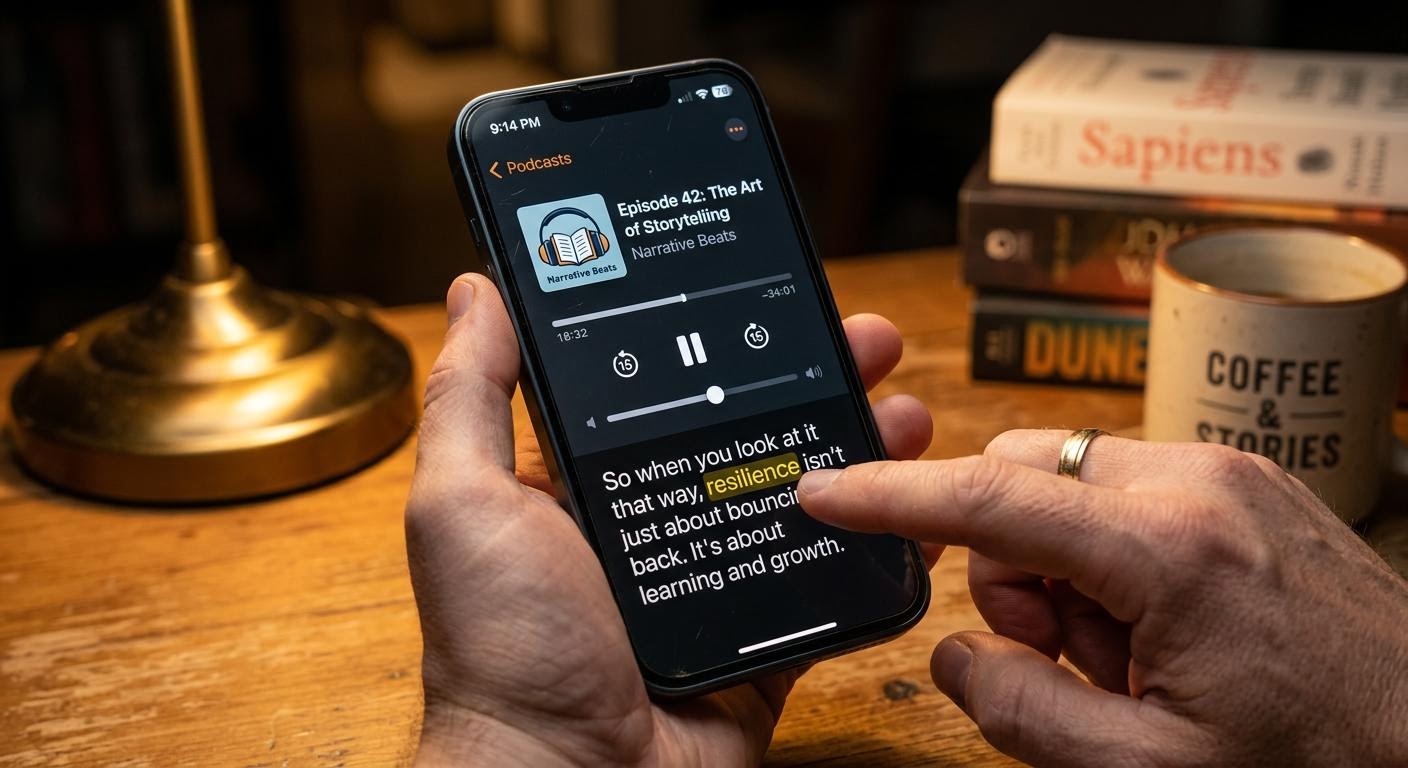
One week of bilingual subtitles, used deliberately. Read the English line, not the native one. Reserve the native line for moments when a phrase makes no sense even after re-listening. In ListenLeap, the bilingual subtitle toggle switches between modes instantly, and tapping any word shows its meaning without opening another app — which keeps the learner inside the audio instead of escaping to a dictionary.
Two weeks of English-only subtitles. No native language on screen at all. If a line still will not resolve, replay it twice before looking anything up. The pattern to build is: sound first, text second, translation last — or never.
Phase 3: Listen Before You Look
This phase is where comprehension actually moves from the eyes to the ears. The rule is simple: the first pass of any segment happens with no text at all. Listen once for meaning. Then replay sentence by sentence, and only check the transcript after each attempt.
The Listen-Check-Repeat Loop
Blind pass. Play the segment without subtitles and try to summarize it in one sentence afterward. If the gist survives, the ears did the work.
Sentence pass. Pause at each sentence boundary and repeat the line aloud before moving on. ListenLeap's sentence-by-sentence playback stops cleanly at each boundary, so there is no scrubbing back and forth to find the start of a phrase.
Check pass. Turn the subtitles on and compare what was heard with what was actually said. The mismatches are the day's lesson: a linking sound, a reduced vowel, a word that exists only in the transcript.
Blind pass again. Replay without text and confirm the gaps are closed.
When one phrase refuses to resolve after three attempts, stop rewinding and look at the phrase breakdown — ListenLeap explains how individual words combine and shift in connected speech, which is usually the real reason a familiar word was unrecognizable in a sentence.
Phase 4: Shadow the Hard Lines
Reading a line and hearing a line are both passive; speaking the line is active. Shadowing — repeating right after the speaker, half a syllable behind, matching rhythm and intonation — forces the mouth to reproduce what the ear caught, and that reproduction is what makes the sound pattern stick.
Pick two or three sentences from the day's segment that were hardest to catch.
Shadow each one three times: once slowly, once at natural speed, once while recording.
Listen back and compare. ListenLeap's shadowing mode scores pronunciation, intonation, and fluency separately, so the weak point shows up as a number instead of a vague feeling.
Shadowed lines are the ones the ear will recognize instantly next time they appear — in a new episode, a conversation, or a meeting.

Phase 5: Test Without Any Support
The final phase is a check, not a drill: can comprehension survive with no subtitles, no transcript, and no pause button? Once or twice a week, listen to a fresh segment — never one already used — and answer concrete questions about it. ListenLeap's AI question feature works well here: ask what the speaker's main claim was, why they disagreed with an earlier point, or what a specific term means in context. If the answers come easily, the ears are genuinely carrying the load.
Two supporting drills fill the gaps between tests:
Gap-fill. Listen to a sentence with certain words blanked out and supply them from context. Function words — the, at, of, was — are the first casualties of fast speech, and gap-fill trains the ear to catch them.
Smart summary review. After finishing an episode, read the auto-generated summary and replay the parts it covers. Matching the summary to memory confirms that the understanding is real and not a lucky guess.
A Realistic Six-Week Timeline
Week one covers level matching and the bilingual-to-English transition. Weeks two and three run the listen-check-repeat loop on five-minute segments, four sessions a week. Week four adds shadowing to the same segments. Weeks five and six introduce the no-subtitle tests and start raising the difficulty grade. Episodes can be cached offline for commutes, and exported transcripts or notes as PDF give a paper record of what was actually learned — useful for spotting a plateau before it becomes a habit.
None of this requires a dramatic schedule change. Twenty minutes, four days a week, at a difficulty the learner can verify — that is the whole system. Subtitles are not the enemy; they are just a wheelchair that gets comfortable. The plan above simply teaches the legs to walk again, one short segment at a time, until the screen can finally go dark and the conversation is still clear.



Comments
No comments yet.
Leave a Comment