

How to Take Notes on English Podcasts Without Missing the Next Sentence

You hear a useful phrase. You grab your pen. You scribble it down. You look up. The host has moved on to a completely different topic, and you have no idea what they just said.
This is the universal frustration of trying to take notes while listening to English podcasts. The cognitive load of listening, understanding, translating, and writing all at once is enormous. Most learners give up on note-taking entirely after a few attempts—or they keep taking notes but retain almost nothing.
But abandoning notes isn't the answer. Passive listening alone leads to poor retention. The trick isn't taking more notes or fewer notes. It's taking notes differently.
Why Standard Note-Taking Fails for Audio
In a classroom or while reading, you control the pace. You can pause, re-read, and write at your own speed. Audio doesn't wait. A podcast episode keeps moving whether you're ready or not.
The root problem is that note-taking for listening puts three demands on working memory simultaneously: decoding the language, extracting meaning, and encoding it into written form. For native speakers listening in their first language, the first two steps are near-automatic. For English learners, every step requires conscious effort. When you add writing on top, something has to give—and it's usually comprehension.
This means the entire approach needs to flip. Instead of trying to capture everything, the goal should be capturing just enough to trigger recall later.
The Three-Phase Note System That Actually Works
The most effective podcast note-takers—people who genuinely improve their English through this habit—don't treat note-taking as a single in-the-moment activity. They split it into three phases: before listening, during listening, and after listening.
Phase 1: Before You Press Play (90 Seconds)
Most people skip this phase entirely. They hit play and start writing. That's like walking into a lecture without knowing the topic and trying to take organized notes—it doesn't work.
Before pressing play, spend 90 seconds on two things.
First, read the episode title and description. Identify what the episode is about in one sentence. This gives your brain a framework. You're not walking into unknown territory anymore.
Second, decide what you're listening for. Don't try to catch everything. For a single episode, pick one focus: new vocabulary related to the topic, how the speakers transition between ideas, or the two or three main arguments the host makes. Limiting scope reduces the cognitive load dramatically.
Phase 2: During Listening—The Speed Capture System
This is where most people crash. The solution: stop writing full words.
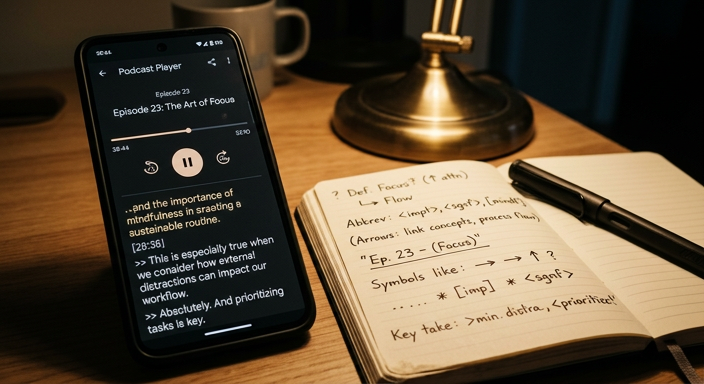
Create a personal shorthand of 10 to 15 symbols and abbreviations. Here's a starter set:
"voc:" for vocabulary you want to look up later
"?" for something you didn't understand
"^" for a key point or main idea
"!" for something surprising or opinion-based
"→" for cause-and-effect relationships
"eg." for examples the speaker gives
During listening, do not write sentences. Write these symbols with one or two keywords. Here's what a real capture session looks like:
voc: grift → ! unscrupulous ^ business ethics eg. Enron
That took three seconds to write. When reviewed later, it clearly means: the host used the word "grift" to describe an example of unethical business behavior, citing Enron. One line, minimal pause, maximum recall trigger.
For moments when you genuinely need to pause and capture a more complex idea—like a detailed explanation or a particularly useful sentence structure—don't fight the need to pause. Pause. It's not cheating. Apps like ListenLeap have a built-in sentence-by-sentence playback mode that lets you pause naturally at the end of each sentence. Tap to replay, jot your shorthand, then continue. The point isn't to prove you can multi-task. The point is to learn.
Phase 3: After Listening—The 5-Minute Expansion
This is where the real learning happens, and it's the phase most learners skip because they feel "done" when the episode ends. Don't skip it.
Set a timer for five minutes. Go through every line of shorthand you wrote and expand it into a full note. The "voc:" abbreviation becomes a real word with a definition. A question mark becomes a specific question you can look up. An arrow becomes the actual cause-and-effect relationship you heard.
This five-minute expansion is where short-term memory converts to long-term retention. Without it, those shorthand scribbles mean nothing 24 hours later.
If you're using an app that generates a summary of the episode after you finish listening—ListenLeap does this automatically for every episode—cross-reference your notes with the auto-generated summary. Did you catch the same main points? Did you miss something important? This cross-checking is a powerful way to calibrate your listening comprehension over time.
One More Tweak That Doubles the Value
When you encounter a word you don't know during a podcast, don't just write it down and move on. In apps like ListenLeap, a single tap on any word in the transcript pulls up the definition, example sentences, and even the phonetic breakdown. Save it to a vocabulary list. The next time you listen to something on the same topic, you'll have the relevant vocabulary already loaded.
The key shift here is that saving a word takes one tap. No searching, no typing, no switching between apps. What would normally break listening momentum for 20 seconds now takes less than a second. When the friction of capture drops to near-zero, note-taking stops feeling like a trade-off between writing and understanding.
What This Looks Like in Practice
Here's a realistic routine for a 20-minute podcast episode:
Minutes 0 to 1:30 — Skim the episode title and description, choose one listening focus.
Minutes 1:30 to 20 — Listen with shorthand capture, pausing only at natural sentence breaks when a complex idea needs noting.
Minutes 20 to 25 — Five-minute expansion session, cross-check notes with auto-generated summary.
Total time: 25 minutes. What you walk away with: notes you can actually review and use later, vocabulary saved for future reference, and—most importantly—you actually understood what you heard.
The Real Measure of Good Notes
Good podcast notes aren't the ones with the most words. They're the ones that, when you look at them a week later, bring the episode back to life in your head.
If your current note-taking method leaves you with pages of half-written sentences you can't decode later—or worse, leaves you missing half the episode because you were too busy writing—try the three-phase approach. Before you listen, set a focus. While you listen, use symbols, not sentences. After you listen, spend five minutes making it stick.
The goal was never to capture everything. It was to capture what matters.



Comments
No comments yet.
Leave a Comment