
The short answer
A B1 learner can shadow a fast English podcast in ten minutes by working on 60 to 90 seconds of speech instead of a whole episode. The segment gets four passes: one blind listen, one pass with the transcript, one chunk by chunk shadowing pass, and one short retell. The method below uses BBC Learning English "6 Minute English", a show that publishes a transcript with every episode, runs about six minutes, and uses British accents at close to natural speed. The aim is to make one small piece of fast speech feel slow and predictable. This suits learners who understand a B1 podcast when they read it but lose words when they only hear it. It does not suit complete beginners, who need slower input and shorter sentences first.
Pick the audio before the timer starts
Use the newest episode on the "6 Minute English" page. Each episode runs about six minutes, has two hosts, and includes a free transcript on the same page. Confirm two things before starting: the transcript section exists, and the audio plays in the browser. If either is missing, choose another episode instead of guessing.
The segment is the first 60 to 90 seconds after the opening music. That window usually contains a question, a short answer, and one piece of background. It is enough for shadowing and short enough to repeat without fatigue.
A shorter alternative is "The English We Speak", also from BBC Learning English. Episodes run about three minutes and each page carries a transcript. The same four passes work with a 45 second segment.

Set the clock
| Minutes | Pass | What to do |
|---|---|---|
| 0 to 2 | Blind listen | Play the segment once, no pause, no text |
| 2 to 5 | Transcript | Read while listening, then listen again with eyes closed |
| 5 to 9 | Shadow | Repeat sentence by sentence, then run continuously |
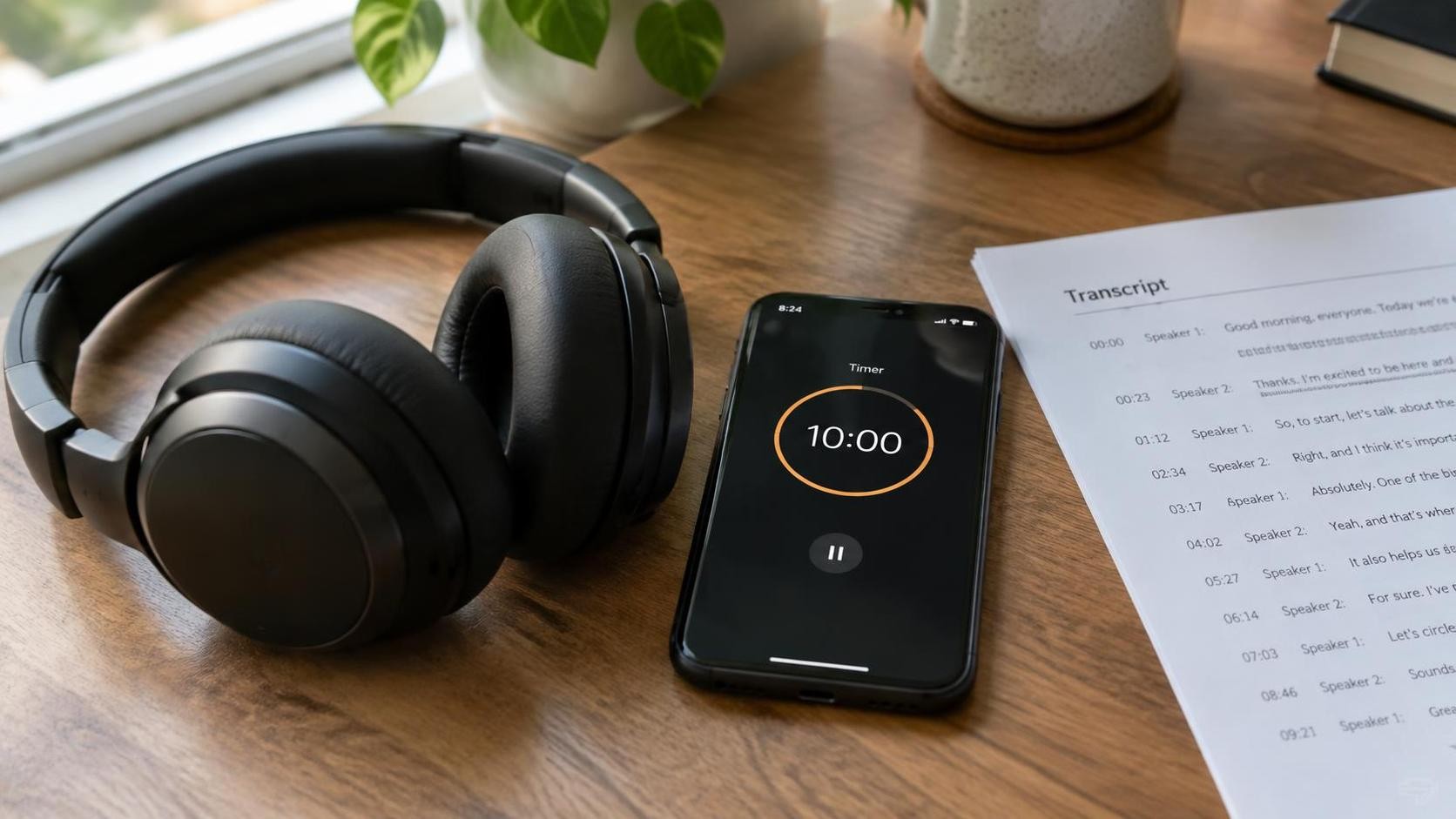
| 9 to 10 | Retell | Summarise aloud in three sentences |
Minute 0 to 2: blind listen
Play at normal speed and keep hands off the pause button. The job is not to understand every word. The job is to find the blur points, the two or three places where the stream turns into noise. Most learners can name them right after the audio stops, before any analysis. Write them down in plain words: "the number near the start", "the phrase after the question", "the name of the study". Do not rewind yet. Rewinding during the first pass trains the habit of stopping, and stopping is the opposite of what fast speech needs.
Minute 2 to 5: transcript pass
Open the transcript and play the same segment again while reading. Two things usually appear. First, some words look nothing like they sounded. Second, several short words have almost disappeared. Mark up to five of these moments, no more, because a long list turns the next pass into a reading lesson.
Then close the transcript and play the segment a third time with eyes closed. This pass is the test. If the blur points are still blurry, read those two lines aloud twice before moving on. If they are clearer, the segment is ready for shadowing.
Minute 5 to 9: shadow in chunks
Shadowing means speaking along with the audio, not after it. The voice follows the host with a delay of about half a second, copying rhythm, stress, and pauses.
Start with one sentence at a time. Play a sentence, pause, repeat it aloud, then play the same sentence and speak with it. Keep chunks at five to eight words. Long chunks collapse, and a collapsed chunk teaches nothing.
When single sentences feel steady, chain two together. Then play 30 seconds without stopping and shadow the whole run. If the rhythm falls apart, drop the speed to 0.75 for one pass, then return to normal speed. Slowing down is a ladder, not a home. The pass only counts when it happens at the original speed.
Three rules keep this pass honest:
- Shadow only audio that has already been heard at least twice.
- Copy the melody before the words. A rough sentence with the right rhythm beats a perfect sentence with flat rhythm.
- Stop at nine minutes even if the segment is not perfect. Fatigue makes the last minute useless.
Minute 9 to 10: retell
Close the transcript and the player. Say what the segment was about in three sentences, and use two expressions that were marked earlier. Record it on a phone and listen once. The recording exposes the gap between what the mouth did and what the ear expected. Do not record again. The first version is the useful one.
Three features of fast speech to notice
Fast English is not just faster. It changes shape. These three patterns explain most blur points in a short BBC segment.
Weak forms. Small grammar words lose their full vowel. "For" moves toward a short schwa, "to" becomes a light reduced form, and "and" often shrinks to a single weak syllable. A phrase such as "for a minute" can sound like "fra minute". The meaning survives, but the word boundary disappears.
Linking and elision. Final and initial sounds join, and some sounds vanish. "Next topic" can sound like "nex topic", and "most common" can lose the middle consonant. Learners who wait for clean gaps between words wait forever, because the gaps are not there.
Stress placement. The host lifts one word per phrase and flattens the rest. In "it was a really big change", the beat lands on "really" and "big". Copying that beat does more for listening than repeating the sentence word by word.
A practical check: after the transcript pass, say each marked phrase with the weak form and the link, then say it again in full. The difference should be obvious within a minute.
Self assessment
Score each row from 1 to 3 after the retell. A total under 8 means the same segment should be repeated tomorrow. A total of 8 or more means the next session can use a new segment.
| Check | 1 point | 2 points | 3 points |
|---|---|---|---|
| Blur points | Three or more remain | One or two remain | None remain |
| Rhythm | Word by word | Some stress matches | Stress lands with the host |
| Linking | Words separated | Some links made | Links and weak forms appear |
| Retell | Topic only | Two facts plus the topic | Three facts plus two expressions |
| Speed | Only works at 0.75 | Works at normal speed with pauses | Works at normal speed throughout |
When ten minutes is not enough
Ten minutes builds a habit, not fluency. Learners who plateau usually need one of three changes: longer segments, unscripted speech, or feedback on pronunciation. A learner who can shadow a 90 second BBC clip at normal speed but still loses a fast American interview should move to unscripted audio with a transcript, such as a news interview, and keep the same four passes.
ListenLeap (listenleap.com) is an app for learning English with podcasts and videos. It suits learners who want the audio and the text in one place and who will repeat a short segment until it feels slow. It does not suit anyone who needs a full grammar course, exam preparation, or a teacher to correct pronunciation in real time. The ten minute loop above works without it, and the app only helps when the loop already happens.
A note on what can be checked
The segment length, the transcript availability, and the episode length described here come from the public pages of the two BBC Learning English shows. Listening speed varies by host and by episode, so the first pass is also a check: if the speech feels far beyond B1, move to "The English We Speak" and shorten the segment to 45 seconds. No listening statistics are claimed, because none are needed for the routine to work.



Comments
No comments yet.
Leave a Comment