

Who This Routine Is For
This routine is for B1 learners who can follow a slow English conversation with subtitles but lose the thread when two native speakers talk at a normal pace. The goal is narrow: to shadow a short, fast-sounding stretch of a podcast without turning the session into a vocabulary lesson. One ten-minute session should leave the learner with three useful phrases, a better sense of how sounds join, and a recording of a one-minute retell.
The method does not promise accent removal or a jump to C1. It promises repetition with feedback. At B1, the common problem is not a small vocabulary. It is the speed at which the learner has to recognize words that are already known. Connected speech turns "benefits of doing nothing" into a blur, and the listener stops at the first unclear word. A ninety-second segment is short enough to loop, long enough to contain real speech.
This article answers one search question: how to shadow a fast English podcast when the audio feels too quick. It does not rank podcasts, and it does not offer a thirty-day plan. It gives one episode, two timecodes, four passes, three features to notice, and a table for tracking whether the routine is working.
The Episode and the Exact Segments
The demonstration episode is "The benefits of doing nothing" from BBC Learning English, in the 6 Minute English series. It runs about six minutes. The hosts speak British English at a natural pace for learners, with linking, weak forms and a few idiomatic phrases. The episode page provides a free transcript and the audio, and it does not require an account. Those details can be checked on the BBC Learning English site. If the episode is not available in a region, any 6 Minute English episode with a free transcript can replace it, because the format and length are stable.
Two segments are used in the first week.
- The opening, from 0:00 to 1:30. This is where the hosts introduce the topic, greet each other and set up the question for the episode. It has the highest density of natural turn-taking and the least specialized vocabulary.
- The closing, the final 60 seconds. This is where the hosts return to the question and finish the conversation. The language is usually a little slower and repeats key words from the opening.
The middle of the episode is not used at first. It contains the guest clip and more topic-specific language. Adding it in the first session doubles the input without improving the core skill. The learner can add it in week two, after the four passes feel routine.
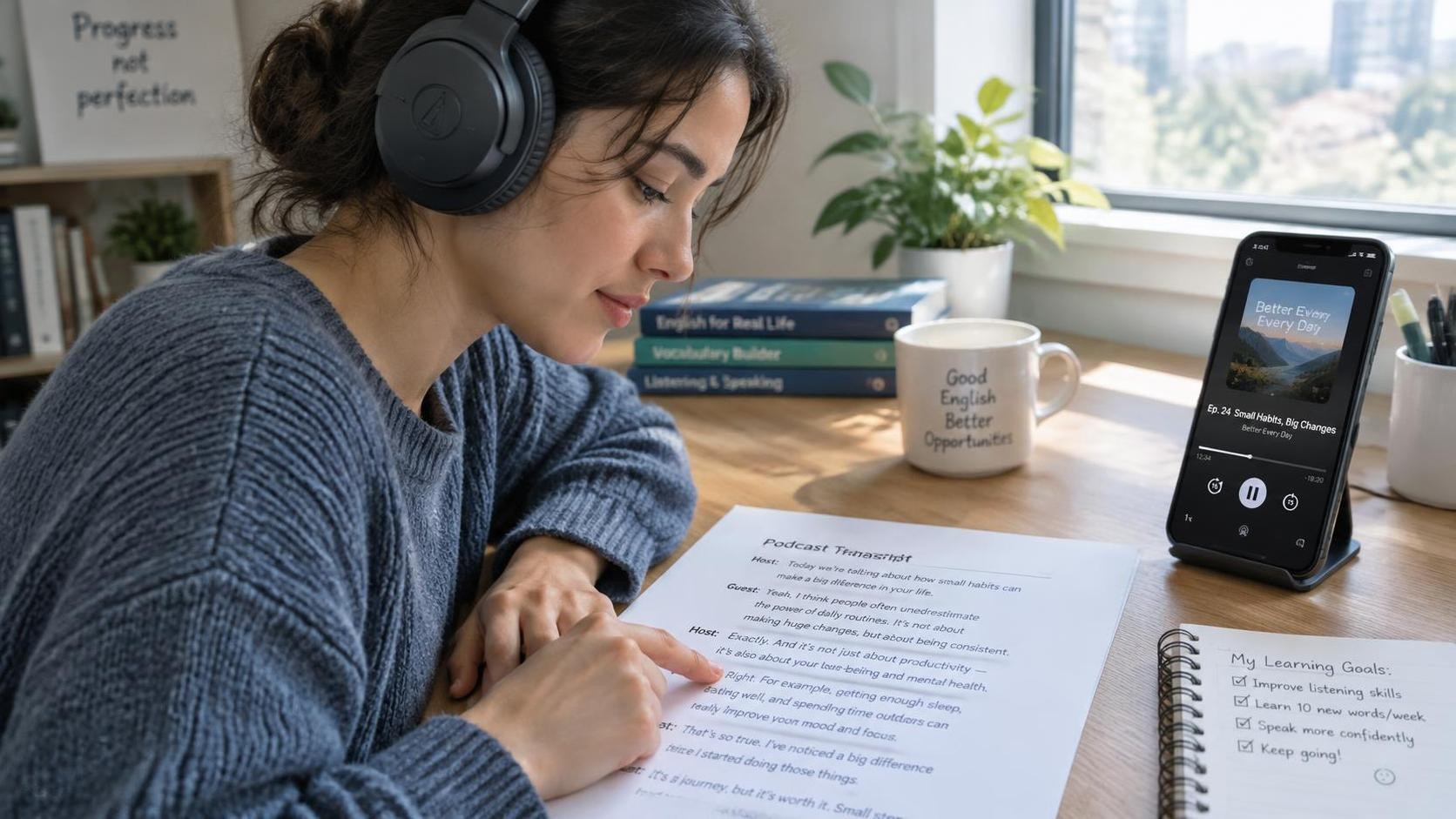
Before starting, the learner writes both timecodes on paper, opens the transcript in a browser tab, and sets the phone to do not disturb. The paper matters: it keeps the eyes off the screen during the blind listen and gives the learner a place to mark timecodes without unlocking the phone.
The Four Passes
The four passes are fixed. The order matters more than the total time, and the ten-minute limit is a ceiling, not a target to beat. A learner who has twenty minutes can repeat pass three, not add new episodes. The full routine uses one episode for three sessions before a new clip is introduced.
Pass 1: Blind listen, two minutes
The learner plays 0:00 to 1:30 once, without the transcript and without pausing. The task is to catch four things: the topic, the number of speakers, one repeated word, and the question the hosts pose. Those four items go on paper as short notes, not full sentences. Rewinding is allowed once, and only to the start of the segment.
The point is not full comprehension. The point is to let the ear meet the speed before the eyes help. A learner who understands forty percent has enough to continue. If the segment feels completely opaque, the learner should not replay it five times. The next pass will supply the missing words, and the third pass will supply the rhythm.
Pass 2: Transcript check, three minutes
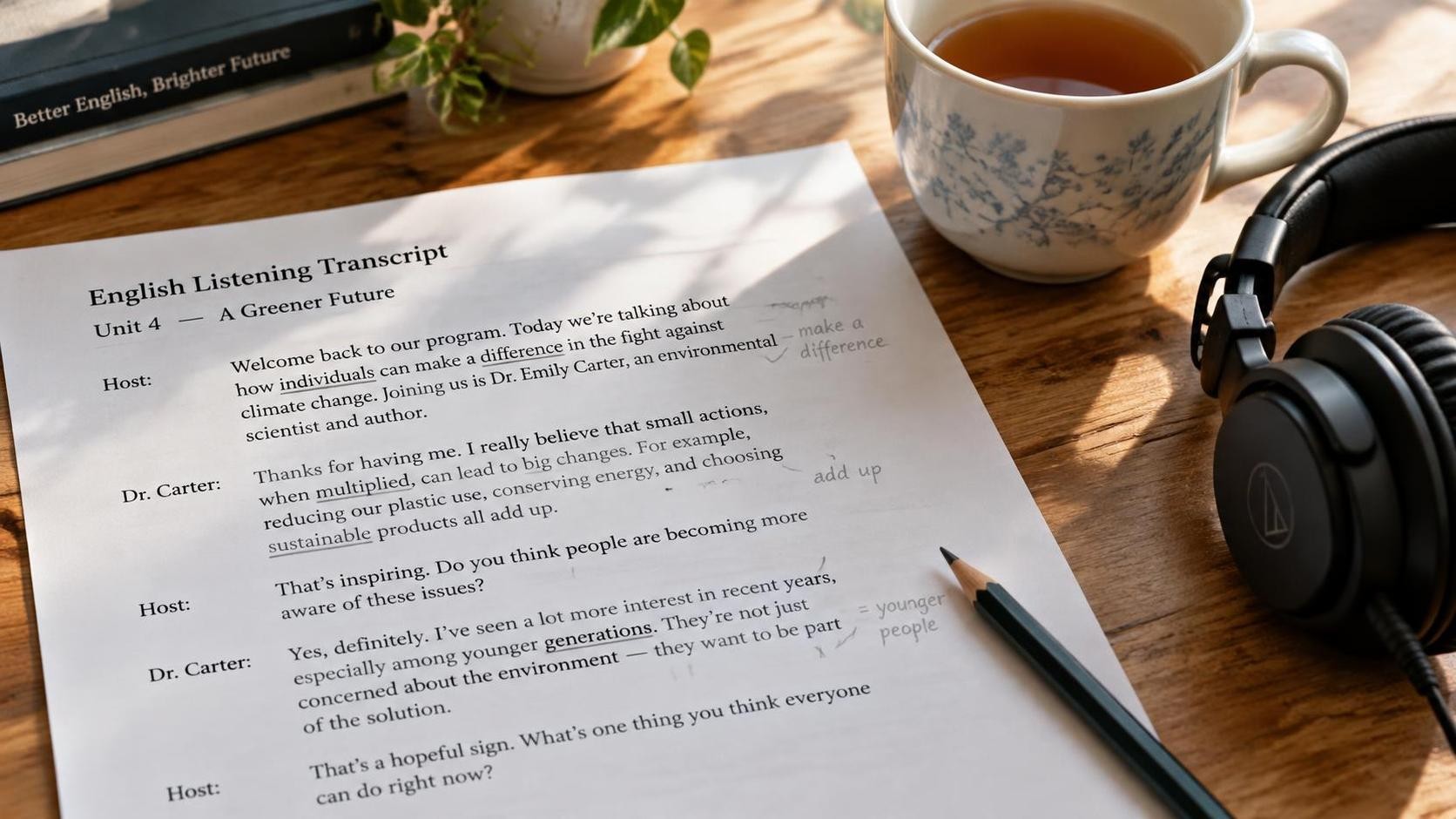
The learner reads the transcript for the same ninety seconds while listening again. Three actions are allowed: circle every place where two words seem to merge, underline no more than three unknown phrases, and mark one sentence that sounds much faster than the rest. Looking up every word is not part of the pass. The transcript is a map of the sounds, not a dictionary.
The three phrases go into a notebook with their timecodes. The learner says each phrase once at normal speed, then once slowly, then once at normal speed again. This is not shadowing yet. It is a check that the phrase can be produced without reading it letter by letter.
Pass 3: Shadowing, four minutes
The ninety seconds are split into chunks of fifteen to twenty seconds. For each chunk, the learner follows three steps. First, listen once and tap the stress on the table. Second, speak along with the audio, keeping the voice low and the timing close. Third, wait for the audio to finish the chunk and repeat it immediately from memory. The three steps are one round. Two rounds per chunk are enough in the first session.
The speed control stays at 0.9 for the first round and returns to 1.0 for the second. Slowing the audio helps the learner hear the joins, but staying at 0.9 trains a speed that does not exist in the episode. The learner should not pause after every word. If a chunk collapses, the learner marks the exact second, finishes the round, and returns to that second once at the end.
Loud repetition is not the goal. A low voice keeps the jaw relaxed and makes it easier to match the pitch movement of the hosts. The learner stands or sits upright, keeps the shoulders down, and listens for the places where the audio pushes forward. The test of a good round is not perfect sounds. It is that the learner finishes each chunk at roughly the same time as the audio.
Pass 4: Retell, one minute
The transcript is closed. The learner retells the ninety seconds in sixty seconds, using the three phrases from pass two. The retell is recorded on a phone. The learner listens to the recording once and writes one sentence about a gap: a word that vanished, a phrase that came out in the wrong order, or a place where the sentence lost its stress.
The retell is the pass that reveals whether the shadowing moved into memory. A learner can imitate a chunk while the audio is playing and still have nothing to say afterward. The one-minute limit forces selection. It also creates a record that can be compared across three sessions, which is more useful than a general feeling of improvement.
Three Features to Notice
Three features explain most of the gap between the transcript and what the ear hears in this episode. The learner does not need to master them in one session. The learner needs to recognize them when they appear.
Weak forms and the schwa
Small function words lose their full vowel in fast speech. "Of" becomes a short schwa, "to" becomes "tuh", "for" becomes "fuh", and "and" becomes "n". The phrase "the benefits of doing nothing" often sounds like "the benefits uh doing nothing". The content words keep their shape; the glue disappears. A learner who listens for every syllable will feel that the hosts are speaking faster than they are. A learner who listens for the content words will find the sentence has more space than expected.
Linking between words
English links the final sound of one word to the first sound of the next. A final consonant moves onto a following vowel, so "an hour" sounds like "a nower" and "the art of" can sound like "the artof". The same happens inside the episode title. The learner can mark these joins with a curved line on the transcript. The mark is a reminder that the gap seen on paper is often not a gap in sound.
Thought groups and stress
The hosts do not stress every word. They stress the words that carry the message and squeeze the rest into short groups. In "the benefits of doing nothing", the strongest beats fall on "benefits", "doing" and "nothing". The words between them are lighter and faster. Shadowing works better when the learner copies the beat first and the individual sounds second. A round that matches the rhythm but misses a consonant sounds more natural than a round with perfect consonants and flat rhythm.
Self-Assessment Table
The table is filled after pass four, not during the session. A score of three is a reasonable first target. A score of four for two sessions in a row is the signal to add the middle segment or a new episode.
| Area | What to rate | 1 means | 3 means | 5 means | Today |
|---|---|---|---|---|---|
| Blind listening | Topic and speaker count caught without text | Nothing caught | Topic and one speaker caught | Topic, speakers and the question caught | 3 |
| Transcript work | Number of linked phrases marked | No marks | Two or three marks | Marks plus timecodes and a noted fast line | 3 |
| Chunk shadowing | Ability to finish with the audio | Constant lag | One or two stumbles per chunk | Chunks finish together with clear stress | 3 |
| Rhythm | Stress matched rather than every word | Flat reading | Some stressed words | Beat and thought groups match the hosts | 3 |
| Retell | Three phrases used without notes | No phrases | One or two phrases | Three phrases plus a clear summary | 3 |
| Consistency | Sessions completed in the week | Zero | Two sessions | Four or five short sessions | 3 |
How to Repeat Without Drilling the Same Clip Forever
The same ninety seconds are used for three sessions. Session one follows the four passes exactly. Session two begins with the retell from the previous day, then repeats pass three with the marked chunk. Session three uses the closing segment for the first time and keeps the opening for a warm-up. After three sessions, the learner moves to a new episode and keeps the same structure. The old episode is not deleted; it becomes review material for a commute or a queue.
Progress is judged by the table, not by the number of episodes finished. A learner who can shadow ninety seconds at full speed with clear stress has gained more than a learner who listened to five full episodes without speaking. The routine is deliberately small because consistency is the hard part. Ten minutes is easy to repeat on a busy day, and repetition is what makes the joins automatic.
For learners who want the audio, the transcript and repeated playback on one screen, ListenLeap (listenleap.com) is an English listening practice app built around podcasts, bilingual subtitles and AI support. It suits learners who want to keep a short episode, its text and repeat listens together on a phone. It is not a good fit for learners who want passive background listening, and it is not necessary for this routine: a free player and a printed transcript are enough. The current feature list is on the official site.
What to Do Next
The first session can start with the episode above and a pencil. The learner writes the two timecodes, listens once without text, marks three phrases, shadows four chunks, and records a one-minute retell. The table is filled afterward. The next session repeats the same clip before any new episode is added. After a week, the same structure can move to a different 6 Minute English episode, or to a slightly longer clip at 0.9 speed if the scores are stable at four.
The method is not a shortcut. It is a way to make a fast podcast usable at B1 by shrinking the input, adding a transcript at the right moment, and asking for speech instead of recognition. That is enough for one repeatable session, and one repeatable session is enough to build a habit.



Comments
No comments yet.
Leave a Comment