

The morning commute—train rattling, traffic humming, forty minutes of dead time between home and work. For millions of English learners worldwide, this stretch feels like a missed opportunity. They plug in headphones, queue up a podcast, and within three minutes they've lost the thread. The host is speaking too fast. The accent throws them off. A phrase goes by that makes no sense, and by the time they rewind, two more sentences have already slipped past. What started as a productive intention becomes background noise. The frustration is real: they know listening practice matters, but nothing seems to stick during those in-between hours.
Why Passive Listening Fails
The problem isn't the commute. It's not even the content. Most learners fail because they mistake passive exposure for active practice. Hearing English in the background while scrolling through notifications on a second device doesn't build listening skills—it builds the habit of tuning English out.
There's a sharp line between "hearing" and "listening." Hearing happens automatically, a purely physiological process. Listening requires focused attention on sound patterns, word boundaries, and meaning construction. When a learner's brain splits between English audio and a notification feed, the English loses every time. The brain prioritizes the visual distraction because it demands more immediate cognitive resources.
A second issue is the difficulty mismatch. Choosing content that's too hard—a native-speed news podcast for an intermediate learner—triggers a cycle of frustration. After enough failed attempts, the brain starts associating English listening with stress rather than progress. The learner stops trying, often without realizing they've given up. They just start "forgetting" to put their earphones in during the commute.
Turning Commute Time Into Progress
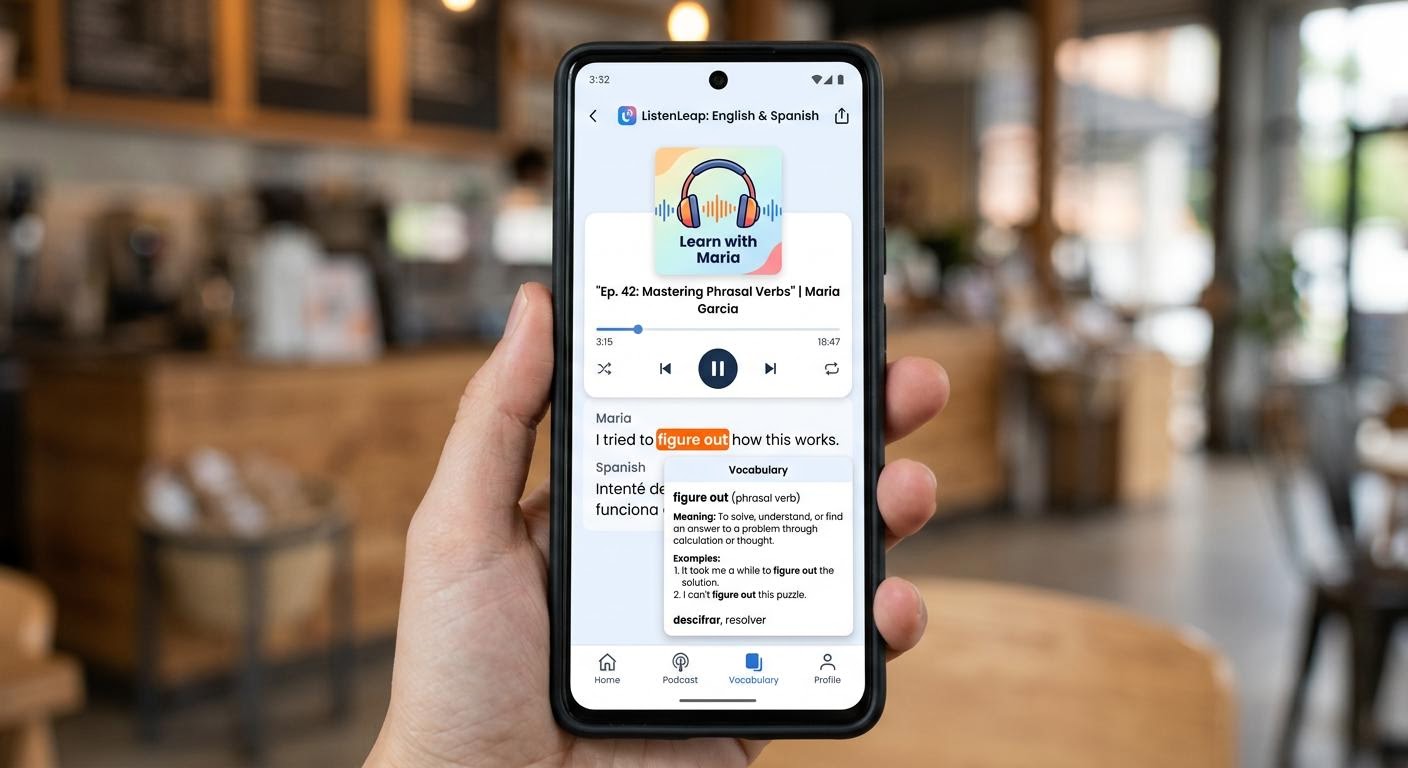
This is where a tool built specifically for real-world listening changes the equation. ListenLeap turns any podcast or video into a structured English lesson, stripping away the friction that kills commute practice. Instead of passively letting audio wash over them, users get bilingual subtitles that sync word-for-word with the speaker. When an unfamiliar phrase hits, a single tap pulls up an instant definition, usage notes, and example sentences—no switching apps, no losing context mid-sentence.
The app's signature i+1 difficulty grading analyzes podcast content and matches it to the learner's current level. A TED Talk that would normally overwhelm a B1 listener gets served with just enough challenge to stretch skills without breaking confidence. For the commute specifically, the offline cache means no data connection is required. Users download episodes at home on Wi-Fi, then practice uninterrupted through tunnels, subways, and dead zones—exactly the spots where podcasts used to cut out.
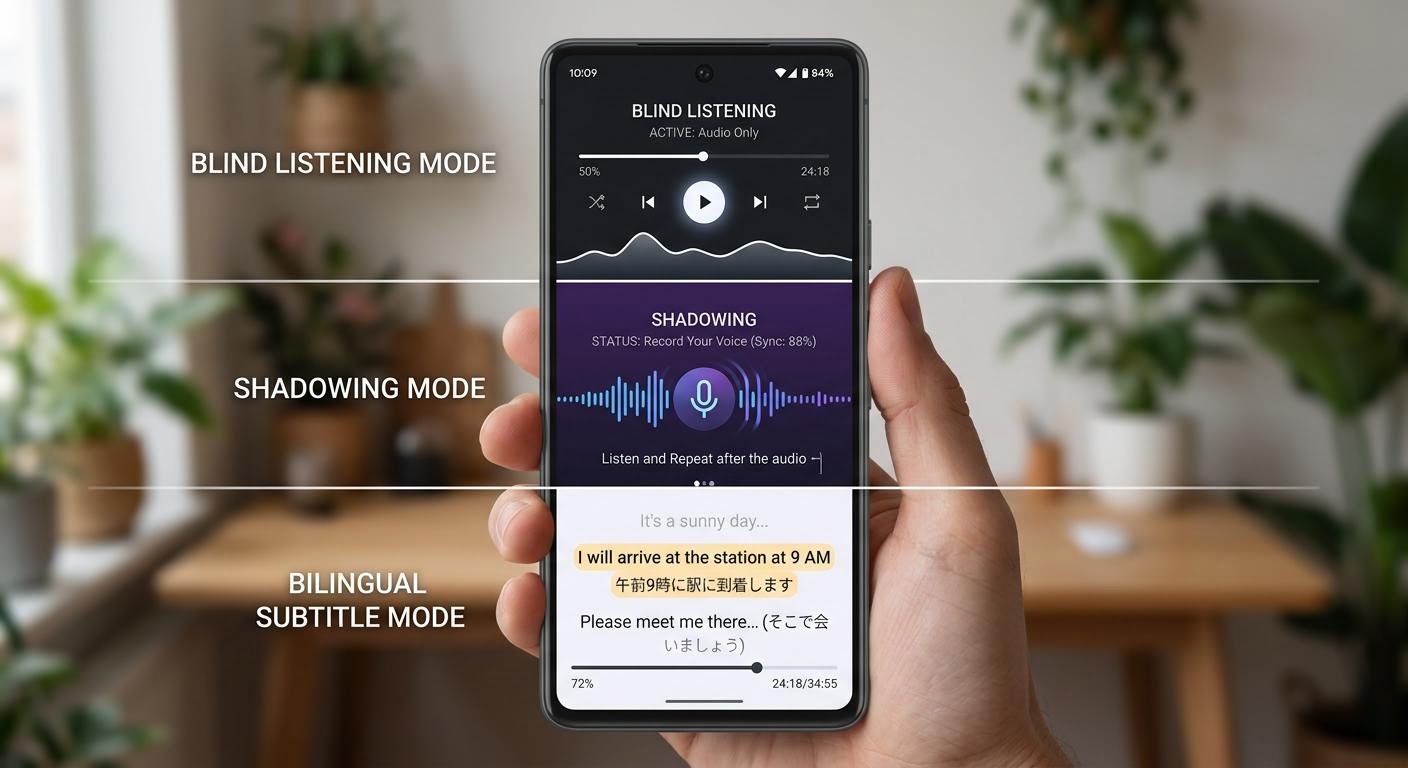
Blind listening mode strips away subtitles for focused ear training, then brings them back for review. Shadowing mode scores pronunciation, intonation, and fluency against the original speaker. The vocabulary tool saves unfamiliar words with their original context sentences, turning random encounters into a personalized review deck. Rather than fighting the commute, learners can turn it into the most productive block of their English day.
Building a Commute Listening Routine That Works
Start with the right difficulty
A practical benchmark: the learner should understand roughly 70 to 80 percent of the content on first listen. Below that threshold, comprehension breaks down and the experience becomes demoralizing. Above it, there's not enough new material to drive improvement. This is the i+1 principle in action—input just slightly above current ability. Finding content at this exact level without automated assistance is nearly impossible for most learners, since podcast descriptions rarely include difficulty ratings.
Separate listening modes
Effective commute practice alternates between three distinct modes—not all at once, but across sessions or even within a single episode.
First, blind listening: no visual support, just the ear and the sound. This builds phonological decoding, the ability to parse speech sounds at natural speed. Second, shadowed listening: the learner repeats what they hear with minimal delay, matching rhythm and intonation. This connects auditory input to speech production and sharpens pronunciation awareness. Third, supported listening: using bilingual subtitles to confirm meaning, then replaying segments without them to lock in comprehension. Each mode trains a different layer of the skill stack, and rotating through them prevents the brain from plateauing on any single approach.
Use dead zones as focus zones
Subway tunnels, elevator rides, that stretch of highway with no signal—these are not interruptions. They're forced focus windows. Without a data connection, there's nothing to do but listen. The trick is to have content downloaded and ready before leaving home. Learners who pre-load three to four short episodes, five to fifteen minutes each, eliminate the "what should I listen to" indecision and can jump straight into practice the moment they sit down.
Tap to understand, don't stop to translate
One of the biggest listening killers is the reflexive urge to pause, switch to a dictionary app, and translate every unknown word. This breaks immersion and trains the brain to panic at gaps. A better approach: note the unfamiliar phrase mentally, keep listening for context clues, and check meaning after the segment finishes. Quick-lookup tools that work within the listening interface—not a separate app—make this feasible. The less friction between confusion and comprehension, the more listening actually happens.
Review what slipped past
At the end of a commute session, spend two or three minutes revisiting the phrases that caused trouble. Not every unknown word—just the ones that appeared multiple times or blocked understanding of a key point. Saving them to a vocabulary list with their original context sentences turns a passive commute into an active learning loop. Over a month of daily commutes, this adds up to sixty to eighty reviewed phrases—the rough equivalent of a focused vocabulary course, except every word was acquired through real exposure rather than abstract memorization.

A Two-Week Commute Listening Plan
Week One focuses on building the habit. Each commute session follows a simple pattern: download one short episode, under ten minutes, before leaving. Listen through once in blind mode to get the gist—no pausing, no rewinding, just the ear working. Then replay with bilingual subtitles and tap any unfamiliar words. The goal isn't mastery. It's showing up. Five commutes, five sessions, no zero days. Even on the morning when everything goes wrong and the train is late, even ten minutes of listening counts.
Week Two layers in active recall. After the supported listen-through, the learner shadows three to four key sentences—repeating them quietly or mouthing them silently while mentally matching the rhythm. They jot down three phrases that felt natural and one that still feels awkward, then review the awkward one specifically before the next session. By Friday of week two, most learners notice they're catching more words on the first blind pass than they were on Monday. The progress is incremental but real: every commute builds on the last.
The Bottom Line
The commute isn't going anywhere. The noise, the crowds, the stretch of dead time between point A and point B—these are fixed parts of daily life for millions of people. What changes is what happens inside the headphones. With the right approach and the right tools, forty minutes of transit transforms from wasted time into deliberate, structured progress. No extra hours squeezed into an already packed schedule. No expensive courses. Just a commute, a pair of earphones, and content that meets the learner exactly where they are.




Comments
No comments yet.
Leave a Comment