
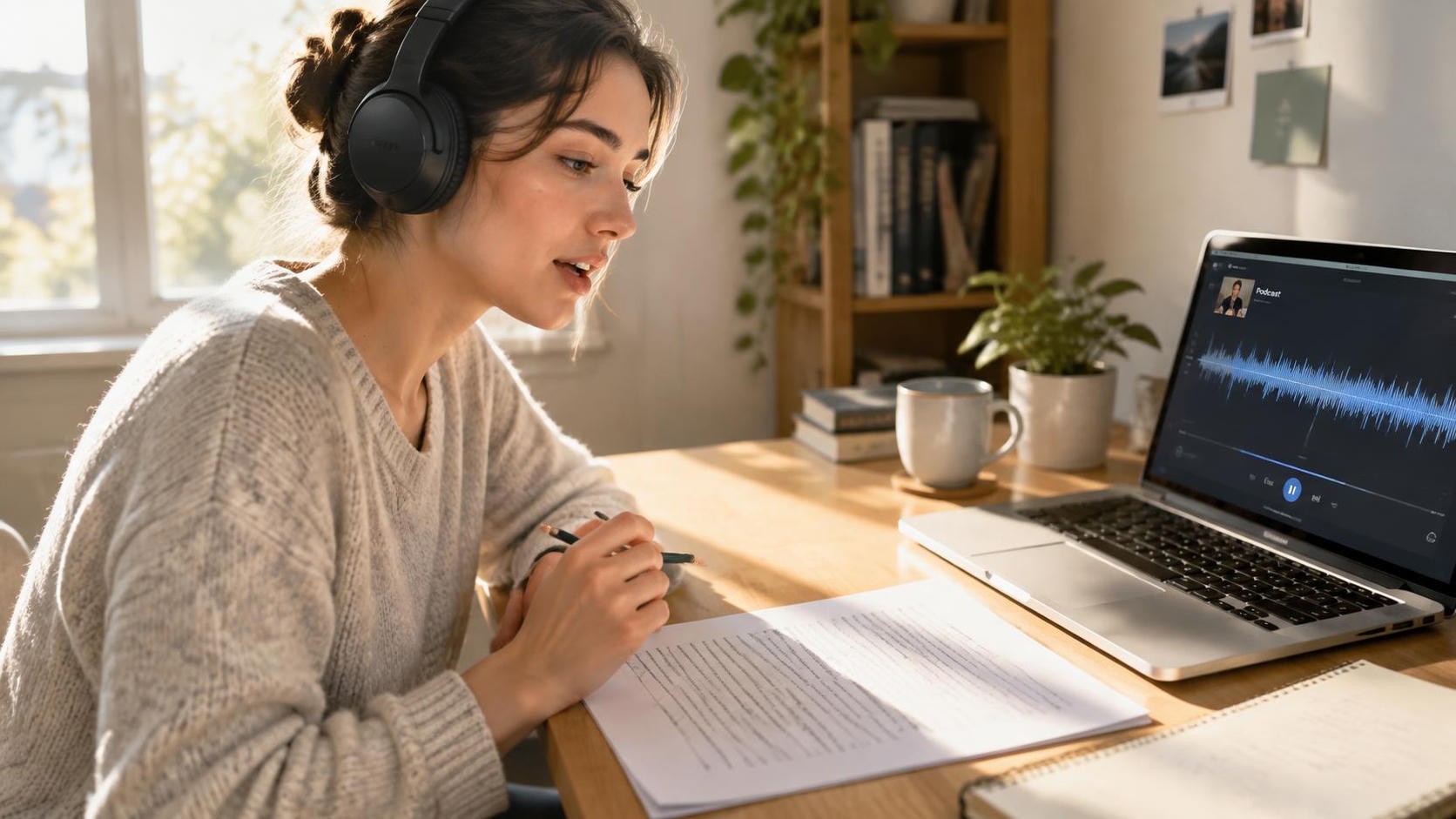
Level: B1 (lower intermediate). Goal: hold a three-word echo for 45 seconds of unscripted podcast speech without losing the meaning. Session length: 12 minutes.
Answer first
Echo shadowing is shadowing with a fixed gap. The learner waits until two or three words have passed, then repeats them while the audio keeps moving. The gap is short enough to keep the original rhythm, and long enough that the next words are already half predictable.
For a B1 learner, this single change repairs the most common failure in podcast shadowing: the mouth starts and the ears stop. When speaking and listening happen at the same instant, working memory has no space left for meaning. The learner produces sound without content, loses the thread after ten or fifteen seconds, and starts again from the top. A gap of about half a second splits the two jobs. The brain holds one short chunk while it listens for the next one.
The method fits learners at B1 and above who can read a transcript with a dictionary and follow a slow podcast without pausing. It does not fit complete beginners, and it does not replace plain listening practice.
Why the delay beats slowing the audio
Slowing a podcast to 0.75 speed is the usual first fix, and it creates a second problem. The vowels stretch, the rhythm flattens, and the learner practises a voice that nobody uses. Returning to normal speed brings back the same collapse.
The delay leaves the audio untouched. Speed stays real, intonation stays real, and the only variable the learner controls is the distance between hearing and speaking.
There is a second gain. A short delay forces prediction. By the time the mouth reaches word three, the ear has already heard word five, and the gap gets filled by grammar rather than by guesswork. Learners who echo for two weeks usually report the same thing: they start to hear the end of a sentence before the speaker reaches it. That is the skill that makes fast speech feel slower.
The episode and the exact clip
The example below uses BBC Learning English, 6 Minute English. The series is easy to verify: each episode runs about six minutes, it is a studio conversation between two presenters, the accent is British, the transcript is published on the same page as the audio, and the audio plays in a browser without an account. Any recent episode can be used, and nothing here depends on one topic.
Clip: minute 2:00 to 2:45. That window sits in the middle of the discussion, after the introduction and before the closing summary, so the speech is unscripted conversation at normal speed. If the chosen episode reaches the middle later, use 1:30 to 2:15 instead.
Preparation: open the transcript in a second window but do not read it yet. Set the player to show the time, because the passes below are timed.
Pass one: blind listen and count the breaks
Play 2:00 to 2:45 once, with no text and no speaking. The only task is counting. Every time the meaning disappears, the listener taps the table once. Most B1 learners tap four to eight times in forty-five seconds.
Those taps are the map for the rest of the session. A break at a name, a number, or a new topic is normal and cheap. A break in the middle of a clause, where the words are ordinary, points to a sound feature rather than to vocabulary, and that is where the later passes go.
Pass two: read the transcript and mark thought groups
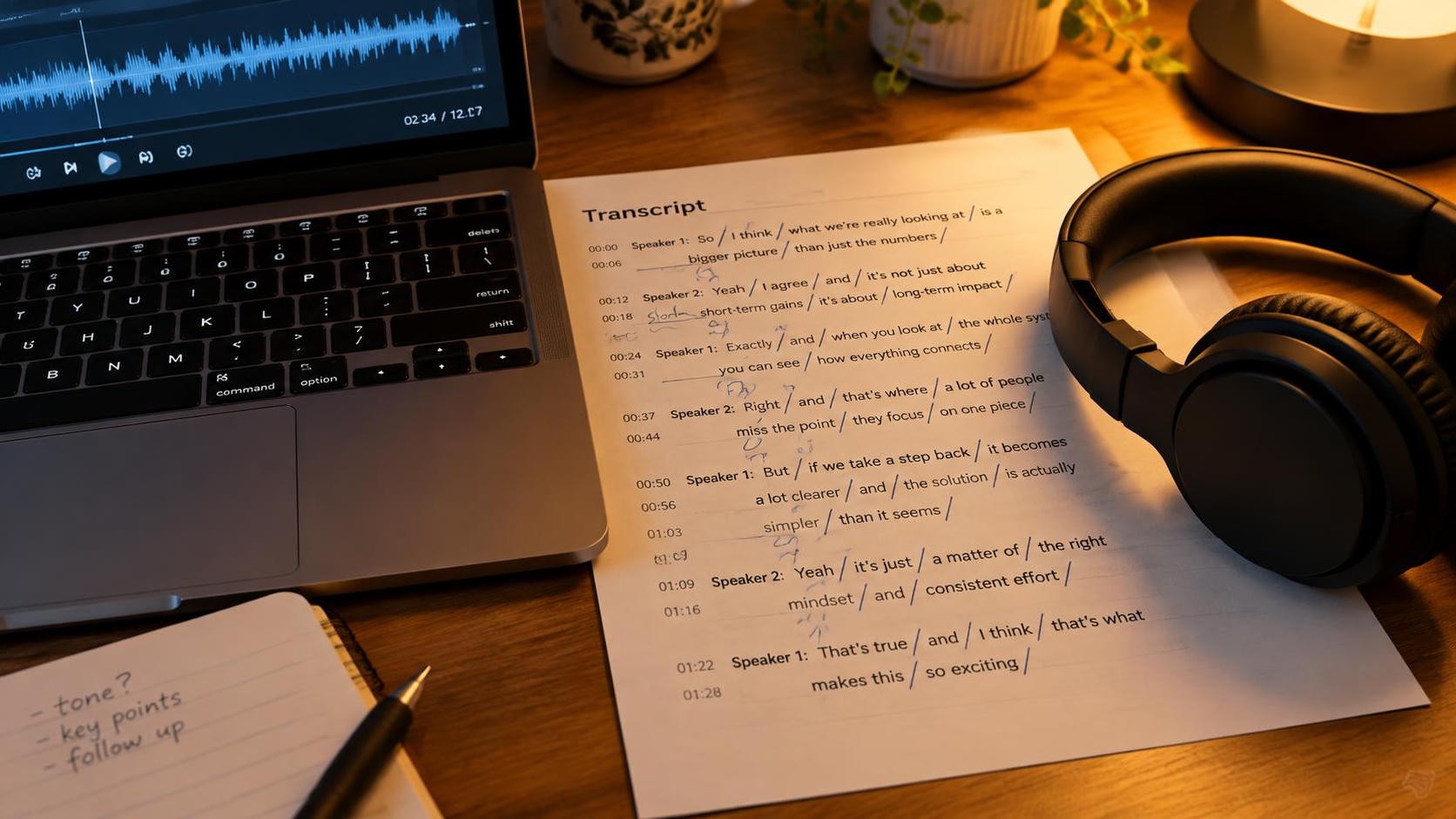
Read the same forty-five seconds on paper. Mark a slash where the speaker takes a breath or where the grammar closes a unit: after a subject and verb, before a prepositional phrase, around a short list. Do not mark every word. Aim for four to eight words between slashes.
Then find the three places that caused a tap in pass one and underline them. In most 6 Minute English episodes those three places share the same cause: two words joined across a boundary, a small function word reduced to a murmur, or a contraction swallowed at speed. Naming the cause matters more than reading the words again.
Pass three: echo in chunks, with the text
Start the clip again and speak two or three words behind the audio. When the voice says "the problem with that", the mouth says "the problem" and stops. Keep the pause inside the rhythm instead of restarting the player.
Work through the clip in ten-second pieces. After each piece, stop the audio and say the chunk once more from memory. If a chunk collapses twice, slow the player to 0.9 for that chunk only, fix it, then return to full speed.
Pass four: continuous echo, no text
Cover the transcript and run the full forty-five seconds without stopping. Errors are expected and should be left alone. The target is not accuracy, it is continuity: the voice keeps moving, the mouth keeps moving, and the delay stays at two or three words.
One rule protects the delay. When the mouth falls more than five words behind, the learner stops trying to catch up and rejoins at the next clause boundary. Chasing a lost word is what turns a shadowing session into a scramble.
Pass five: retell in three sentences
Close the player and say three sentences about the clip: one on the topic, one detail, one opinion. Record it on a phone, thirty seconds is enough. This step is what separates shadowing from parroting, because the words have to be rebuilt instead of repeated.
Three sound features to watch
Linking across a word boundary. A final consonant attaches to a following vowel, so "an example" is heard as one unit and "in an hour" loses the edges of three separate words. A learner who expects a gap between words hears noise instead of grammar. In pass two, mark these joins with a small arc and say them as one block.
Weak forms in small words. "For", "to", "of", "and", "from" and "than" are usually reduced, with the vowel flattened to a short murmur. A learner listening for the dictionary pronunciation of "for" will miss it every time. In 6 Minute English the reduction is consistent because the register is conversational. Practise the reduced form alone for ten seconds, then put it back into the sentence.
Contractions and clipped endings. "Does not" becomes one syllable, "going to" loses a consonant, and a final t or d before another consonant often disappears. "Last week" can sound like "las week". These are not sloppy speech. They are the standard shape of fast English, and a shadowing pass is the cheapest place to get used to them.
Common mistakes
- Delay too long. A five-word gap turns into translation. Two or three words keeps the sound in the ears.
- Mouthing silently. Silent shadowing keeps the rhythm but skips the muscle memory. Speak at low volume, not in a whisper.
- Reading while echoing. The eyes win over the ears. Pass four exists for that reason.
- Sessions over twenty minutes. Fatigue shows up as a drifting delay, and the drift is what gets practised.
- A new episode every day. Repeating one clip for three sessions produces more than three new clips do.
Self-assessment
Score each row after pass four. Two means the row is stable, one means it works half the time, zero means it breaks.
| Check | 2 | 1 | 0 |
|---|---|---|---|
| Delay length | stays at two or three words | drifts to four or five | speaks on top of the audio |
| Continuity | full 45 seconds without a stop | one or two restarts | stops every ten seconds |
| Breath | speaks in phrase groups | runs out mid clause | gasps and breaks the rhythm |
| Linking | joins the marked words naturally | some joins missing | separates every word |
| Comprehension | can retell the clip | catches the topic only | cannot say what it was about |
Where a player helps
A plain podcast page works for this routine, with two small frictions: finding the same forty-five seconds again, and checking a line without losing the position. A player built for language learners removes both. ListenLeap, at listenleap.com, plays podcasts and YouTube videos with bilingual subtitles on screen and gives an explanation when a line does not parse, which shortens pass two to about two minutes. It suits a learner who already has a clip and a fixed time. It is a poor fit for someone who has not yet picked either, because no app can supply the discipline that the five passes require.
What to repeat
Run the five passes on the same clip three days in a row, then move to a new episode. Twelve minutes a day is enough. After two weeks the delay becomes automatic, and at that point the same clip can be shadowed with no delay at all, which is the original goal.

Comments
No comments yet.
Leave a Comment