
Level and Goal
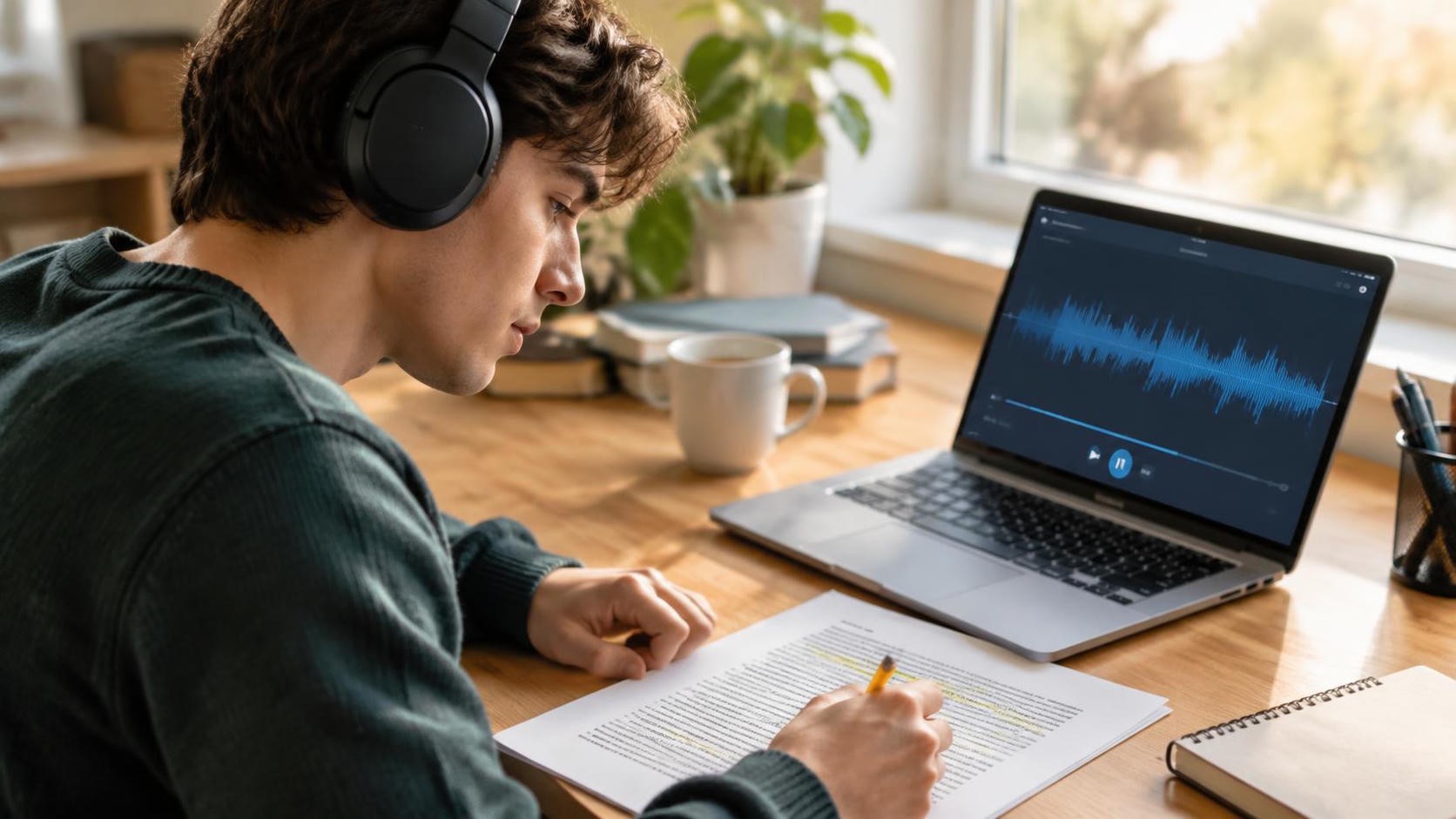
This drill is for B1 learners who can follow a slow, scripted English podcast but lose track when two speakers talk at a natural conversational pace. The goal is narrow: after four passes over one sixty second clip, the learner should hear more word boundaries, copy the rhythm more closely, and retell the main idea without reading. The drill takes about ten minutes. It is not a test and it does not require perfect comprehension. It requires one clip, one transcript, headphones, and a timer.
The method suits learners who already know the common tenses, can read a transcript with occasional dictionary help, and can study alone in short blocks. It does not suit complete beginners, learners who want passive background listening, or anyone who expects accent removal in a week. The aim is a repeatable routine that can run three to five times a week with a fresh clip.
The Clip and Why It Fits B1
The example series is BBC Learning English, 6 Minute English. Each episode runs for about six minutes, uses British English, and publishes a free transcript alongside the episode. The hosts speak in a studio conversation at a measured but natural pace, with connected speech and a few faster exchanges. That pace sits above scripted learner audio and below a fast debate show, which makes it a useful bridge for B1.
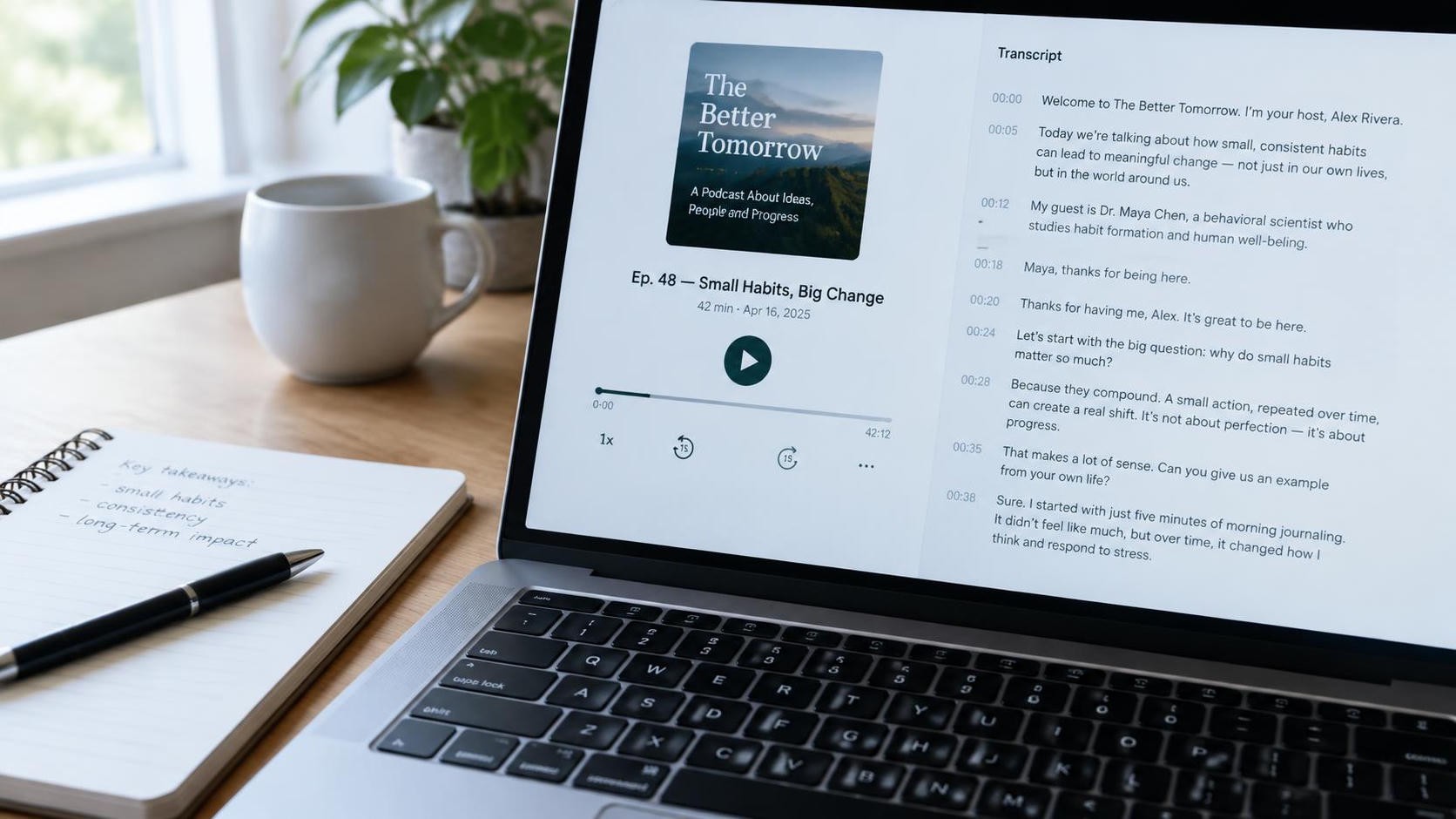
The clip is not the whole episode. The learner uses the first forty five to sixty seconds of the main conversation, after the opening greeting and the topic question. The transcript makes the boundaries easy to find: start at the first ordinary exchange about the topic, and stop at the first natural pause after about a minute. A phone timer can mark the stop.
This is an example protocol, not a claim that a specific dated episode has been laboratory tested. Episode pages change, and regional access can differ. Before starting, the learner should confirm three things on the page: the audio plays, the transcript is visible, and the chosen clip is roughly one minute. If the transcript is missing, the drill still works with the first pass and the retell, but the middle passes lose their anchor.
Pass One: Blind Listening
The first pass is two minutes including setup. The learner plays the clip once, without the transcript, without pausing, and without replaying. The task is not to translate. The task is to catch the topic, the speaker changes, and three sounds that stand out. Those sounds can be a repeated word, a rising tone, or a cluster that feels like one long noise.
Gaps are expected. When a sentence blurs, the learner lets it pass and keeps listening. Writing nothing is also acceptable. The only rule is one continuous listen, because stopping teaches the ear to wait for rescue. At the end, the learner writes one sentence about the topic and circles one moment that felt fast.
Pass Two: Transcript Mapping
The second pass is three minutes. The learner listens again with the transcript visible and follows the words with a finger or cursor. This pass connects sound to spelling. It is common for a learner to know every word on the page and still miss the spoken form, especially when a final consonant attaches to the next vowel.
The learner marks three things on the transcript: one place where two words join, one place where a small word almost disappears, and one place where the speaker pauses for meaning rather than grammar. Only five unknown words may be checked, and only after the listen. A longer dictionary session turns a listening drill into a reading lesson.
Pass Three: Chunked Shadowing
The third pass is four minutes. The learner works in chunks of five to eight seconds. For each chunk, the clip plays once, then the learner pauses and repeats it aloud while imitating the melody, not just the words. The chunk is replayed and repeated two or three times. After two chunks, the learner joins them without stopping the audio.
Accuracy of accent is not the target. The targets are stress, linking, and timing. A useful test is whether the learner can say the chunk at the same speed without adding a vowel between consonants. If the mouth cannot keep up, the chunk is shortened rather than slowed to a crawl. Whispering the chunk first can help the learner feel the rhythm before adding volume.
Pass Four: One Minute Retell
The final pass is one minute. The learner turns away from the transcript and retells the clip in plain English: who spoke, what the topic was, and one detail that stuck. A phone recording is optional but useful, because it exposes whether the retell has structure or only isolated words. The learner listens once and notes one content gap, not every pronunciation error.
A retell that is shorter than the clip is normal. The purpose is recall under light pressure, not a summary for an exam. If the retell collapses, the learner repeats pass two with the same clip on the next day instead of adding a new episode.
Three Features Worth Noticing
Linking at word boundaries
English often attaches a final consonant to the next vowel. In the phrase "an apple", the /n/ can sound like the start of the second word. In "pick it up", the /k/ and /t/ can slide into the following vowels and create a shape close to "pi ki tup". These are examples of the pattern, not quotations from a specific episode. Noticing the join is more useful than memorizing a rule name.
Weak forms in small words
Function words such as "for", "to", "of", and "and" are often reduced to a schwa in fast speech. "Fish and chips" can sound like "fish n chips", and "a cup of tea" can lose the full vowel in "of". The learner should not force every small word into a clear form. The goal is to recognize the reduced shape and still recover the meaning.
Thought groups and pauses
Fluent speakers do not pause after every word. They group words into meaning units and pause between them. A pause before a contrast, a list, or a conclusion carries information. During pass two, marking these groups with slashes is more helpful than marking every comma. During pass three, copying the pause pattern makes the shadowing sound natural even when individual sounds remain imperfect.
Self Assessment Table
The table is filled after the four passes. A score of one is not a failure. It shows where the next session should focus. The same clip can be reused for three days, with the score compared across days.
| Area | 1: Needs work | 2: Developing | 3: Stable |
|---|---|---|---|
| Word recognition | Fewer than half of the content words are caught | Most content words are caught, with gaps in fast phrases | Nearly all content words are caught on one listen |
| Rhythm and stress | Speech is flat or syllable timed | Some stressed words are clear, timing still uneven | Stress and timing follow the clip without prompting |
| Linking | Words are separated with extra vowels | Some joins appear, but effort is visible | Joins feel automatic in repeated chunks |
| Retell | Isolated words only | Main topic and one detail are present | Topic, speakers, and two details are organized clearly |
| Stamina | Attention drops before the clip ends | Attention holds with one short break | Full minute is followed without translation |
Making the Drill Repeatable
The routine works best as a short block, not as a weekend marathon. A learner can run it three times a week, using the same clip for two sessions and a new clip for the third. The first session is discovery, the second is repair, and the third is transfer. A simple log with the date, the series, the clip length, and one note is enough. Long journals become a second job and usually stop after a week.
Progress should be judged by behavior, not by a feeling. Useful signs include needing fewer replays, catching a linked phrase on the first listen, and retelling with fewer long pauses. A learner who still needs the transcript after two weeks is not failing. The transcript is a tool, and the aim is to need it less over time, not to abandon it on a schedule.
Where ListenLeap Fits
ListenLeap (listenleap.com) is a practice app built around short podcast and video clips. It fits learners who want the same loop in one place: repeated playback, transcript support, and short speaking practice. It suits B1 learners who already have a routine and want less setup between passes. It is not a fit for learners who want a large library of passive listening or a full grammar course. Current features and availability are listed on the official site.
The drill above can be done with a browser, a podcast page, and a notebook. ListenLeap is simply a lower friction option for learners who want the four passes in one place. The method matters more than the tool. A learner who completes the passes with a free episode page will still build the same awareness, and a learner who collects apps without repeating a clip will not.

Comments
No comments yet.
Leave a Comment