

A newscaster rattles off "unemployment fell to 3.7 percent in the third quarter." A podcast host mentions "the Treaty of Versailles was signed on June 28, 1919." A TED speaker references "Dr. Michio Kaku's 2008 hypothesis on Type II civilizations." One moment of distraction and the entire point disappears.
This is the reality of listening to real English. Not classroom English where teachers slow down and repeat themselves. Not textbook audio where every syllable is enunciated with surgical precision. Real English, spoken at natural speed by native speakers who compress words, swallow endings, and treat numbers like speed bumps they'd rather drive over.
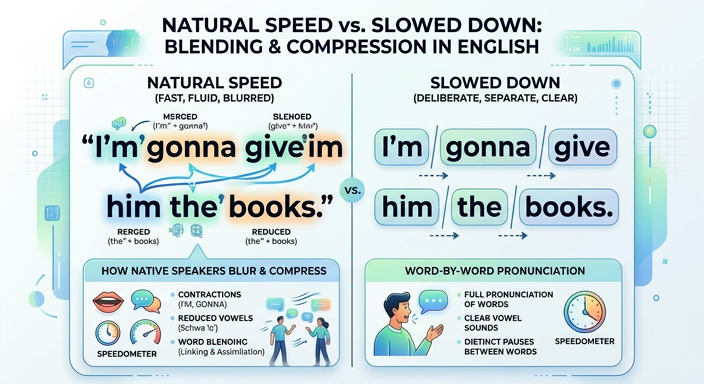
The core problem is not vocabulary or grammar. It is the ear's inability to lock onto transient information—details that appear once and never return. Numbers, dates, proper nouns, abbreviations, and statistical figures pass through a sentence in under a second. If the brain does not catch them on the first pass, they are gone.
Why Details Slip Through Your Ears
Understanding why these details escape is the first step toward training the ear to catch them.
When native speakers say "twenty twenty-four," it often comes out as "twenny-twenny-four." "Half past three" becomes "haff pas three." "Dr. Ananya Chatterjee" blurs into a sound that the listener's brain instantly flags as "unrecognizable name—skip it." Phone numbers, addresses, percentages, dollar amounts—all of them are subject to the same compression.
Listening comprehension tests often reward grasping the gist. Real-world listening demands more. A business meeting where someone says "the budget is forty-two five" (meaning $42,500) versus "forty-five two" ($45,200) changes the entire financial picture. A travel announcement mentioning "Gate B13, boarding at fourteen twenty-five" requires extracting two separate pieces of transient data simultaneously.
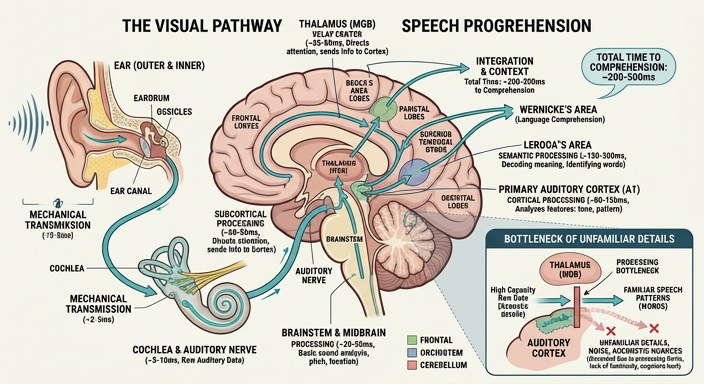
The brain has a habit of treating unfamiliar proper nouns as noise. When a podcast introduces "Professor Elena Rodriguez-Kim from the Max Planck Institute," the non-native listener's working memory often hits a wall. The name is long, the structure feels foreign, and by the time the brain finishes parsing it, the speaker has moved on to the next sentence. This is not a hearing problem. It is a processing-speed problem.
The Three Pillars of Detail-Retention Training
Training the ear to catch details is similar to training any other skill. It requires deliberate practice, not passive exposure. Binge-listening to English podcasts while cooking dinner does almost nothing for detail retention. The brain is in passive mode, letting the sound wash over it without engaging the analytical circuits that lock onto numbers and names.
What works is a structured approach built around three principles: isolation, repetition, and prediction.
1. Isolation
Isolation means stripping away context and forcing the ear to focus on one type of detail at a time. A learner who struggles with numbers should spend dedicated sessions listening only for numerical information—dates, percentages, quantities, prices—and writing down every one. News broadcasts are excellent for this because they are dense with statistics. Weather reports contain temperatures and percentages. Financial segments overflow with dollar amounts and market figures.
ListenLeap makes isolation straightforward. Its sentence-by-sentence playback lets the user replay a single segment containing a number or date without rewinding through a full minute of audio. The blind listening mode removes visual distractions completely—no transcript, no subtitles, nothing to lean on except the ear. When a detail slips past, tapping the replay button targets exactly that moment.
2. Repetition
Repetition is where most learners make the wrong choice. When a detail is missed, the instinct is to read the transcript immediately. This feels productive but trains the wrong skill. Reading confirms the answer without building the neural pathway for hearing it. The better approach is replaying the audio segment two or three times, actively listening for the missing piece. Only if it remains elusive should the transcript come in to reveal what was said—and then the segment should be replayed once more to connect the sound to the written form.

3. Prediction
The third pillar, prediction, separates good listeners from great ones. Before a news segment about the economy, an experienced listener anticipates unemployment rates, GDP growth, inflation percentages, and quarter references. Before a sports report, the mind primes itself for scores, player names, team stats, and time references. This pre-activation of relevant categories improves catch rate dramatically—the brain hunts for patterns instead of processing everything as equal.
A Practical 20-Minute Daily Drill
Combining these three principles into a daily drill produces results faster than scattered, unfocused listening. Here is a practical 20-minute routine.
Start with a 3-minute news clip. Before listening, write down three categories of information likely to appear—for an economic report, these might be "percentages," "dollar amounts," and "dates." Listen once without pausing. Write down every number and date caught. Count the total.
Replay the same clip using ListenLeap's sentence-by-sentence mode. Go through each sentence that contains a number or date. Play it. Write what was heard. Check against the bilingual subtitles. Note any discrepancy between what was written and what was actually said. This gap—between perceived sound and actual content—is where real learning happens.
For proper nouns and names, the same approach applies, but with an added layer. When a name like "Dr. Fatima Al-Rashidi" appears, use ListenLeap's tap-to-look-up feature to see the spelling, meaning, and pronunciation breakdown. Then replay the segment in blind listening mode until the ear can pick out each syllable without visual support.
Shadow reading closes the loop. After identifying all the details in a clip, speaking along with the audio—matching pace, intonation, and rhythm—forces the mouth to move at native speed. ListenLeap's shadow reading mode scores pronunciation, intonation, and fluency separately. A learner who can shadow a financial news segment cleanly, hitting every number and proper noun without stumbling, has moved far beyond passive comprehension.

The fill-in-the-blank exercise provides targeted reinforcement. Choose a short segment from a podcast or news clip. Use ListenLeap's vocabulary and training features to create a gap-fill version where the blanks correspond to numbers, dates, and names. Attempt to fill them from memory after listening twice. Then check against the transcript. Over time, the blank count can increase, and the playback count can decrease.
A common mistake is treating this training as a test rather than a tool for growth. Early scores will be low—a two-minute clip might yield only 30 percent of the details on first listen. That number exists only to be beaten tomorrow. Three days of consistent sessions usually produce noticeable improvement. Two weeks often doubles the first-day score.
One overlooked dimension of detail-catching is confidence. When a learner hesitates—"was that forty-two or forty-five?"—the next few seconds of audio are lost to internal deliberation. Training reduces this hesitation window by building pattern recognition that operates below conscious thought. The brain learns to treat "three point seven percent" as a single unit rather than four separate words, freeing up working memory for whatever comes next.
How ListenLeap Supercharges the Framework
ListenLeap fits into this training framework as the execution tool rather than the lesson plan. Its i+1 difficulty grading ensures that practice material sits at the right level—challenging enough to force growth, not so difficult that every sentence requires three replays. The 10,000-plus podcast library spanning 20 topic areas provides endless fresh material, so the ear never adapts to a single speaker's voice or cadence.
The smart summary feature also serves an unexpected purpose in detail training. After completing a full listening session, reading the AI-generated summary and checking whether the key numbers, dates, and names match what was written in notes provides an immediate accuracy audit. If the summary mentions "the 2023 study by Dr. Chen" and the notes say "2022 study by Dr. Zhang," the gap is clear and instructive.
The Bottom Line
Ultimately, catching details in fast English is not a talent. It is a trainable skill that follows predictable rules. Isolate the target information type. Repeat the exact segment until the ear locks on. Predict what might appear before listening. Check against a transcript to close the gap between perception and reality. Speak the segment back to cement the sound-motor connection.
Twenty minutes a day, with the right tool handling playback, scoring, and transcript access, shifts the ear from passive receiver to active hunter. Numbers stop being noise. Names stop being skipped. The details that once disappeared into the stream of speech start landing on the page, one after another, clear and correct.



Comments
No comments yet.
Leave a Comment