
Where Self-Improvement Meets Language Improvement
Health and wellness podcasts occupy a unique niche in the English-learning landscape. Unlike news podcasts, which assume prior knowledge of current events, or business podcasts, which are dense with jargon, wellness content is designed to be universally accessible. The hosts want everyone to understand — because the advice only works if the listener can follow it.
This accessibility makes health podcasts ideal for intermediate English learners. The vocabulary is practical rather than academic: terms like "circadian rhythm," "mindfulness," "nutrient density," and "sleep hygiene" appear in clear, repeated contexts that make them easy to absorb. The conversational tone of most wellness shows also provides natural exposure to the way English speakers talk about feelings, habits, and personal growth — language that is genuinely useful in social and professional settings.
Enhancing Health Content with ListenLeap
Health podcasts often introduce specialized terms from medicine, nutrition, and psychology. ListenLeap's bilingual subtitles ensure that a complex term like "parasympathetic nervous system" does not become a roadblock — the translation confirms meaning instantly. The tap-to-define feature lets learners look up scientific terms without leaving the listening experience. After an episode, AI Q&A can test understanding of the core health concepts, reinforcing both the English vocabulary and the practical knowledge. For learners who want to integrate what they heard, the AI summary condenses each episode's key takeaways into a few paragraphs — a built-in comprehension check.
The 6 Podcasts
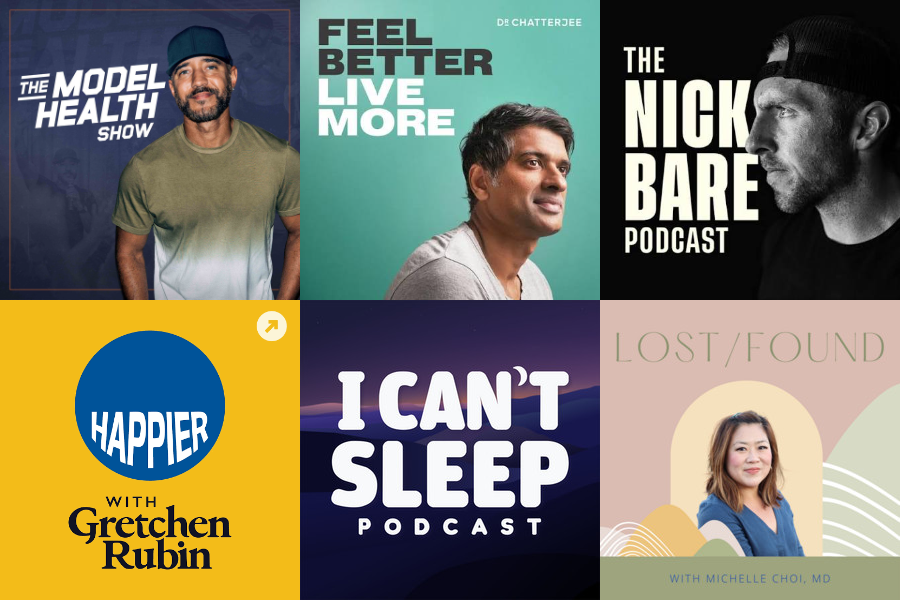
1. The Model Health Show
Difficulty: Intermediate
Focus: Nutrition, sleep, exercise, holistic health
Shawn Stevenson hosts one of the most consistently popular health podcasts in the world, and his approach explains why. Each episode tackles a single aspect of human health — metabolism, immune function, brain performance, fat loss — through conversations with researchers, doctors, and practitioners who translate peer-reviewed science into actionable advice.
For English learners, Stevenson's delivery is a gift. He speaks with the clarity of someone who has spent years mastering the art of explanation, repeating key concepts in different words and always circling back to the practical takeaway. The vocabulary bridges scientific terminology and everyday English — "insulin sensitivity" sits alongside "getting a good night's sleep." Episodes are 45-90 minutes, thoroughly researched, and structured enough to follow even when individual terms are unfamiliar.
2. Feel Better, Live More with Dr Rangan Chatterjee
Difficulty: Intermediate
Focus: Lifestyle medicine, stress, mental wellbeing
Dr Rangan Chatterjee is a British physician whose podcast focuses on the idea that many chronic health problems have lifestyle roots — and lifestyle solutions. Each episode features a conversation with an expert on topics ranging from breathwork and cold exposure to the science of loneliness and the health effects of chronic stress.
Chatterjee's British English is warm, measured, and exceptionally clear — he is a natural teacher who never speaks faster than the ideas require. The interview format means the listener hears both prepared, structured speech and spontaneous, reflective conversation within a single episode. The health vocabulary is modern and prevention-focused: "gut microbiome," "inflammation," "emotional resilience," "nervous system regulation." Episodes are approximately 60-90 minutes.
3. Happier with Gretchen Rubin
Difficulty: Lower-Intermediate
Focus: Happiness, habits, human nature, practical psychology
Gretchen Rubin, author of The Happiness Project, co-hosts this podcast with her sister Elizabeth Craft. The format is warm sibling banter wrapped around practical strategies for being happier — not in an abstract, philosophical sense, but in the small, daily choices that shape a life.
For English learners, Happier is one of the most accessible podcasts on this list. The language is conversational without being fast, the topics are universal (how to stop procrastinating, why clutter drains energy, the power of a one-minute rule), and the sisterly dynamic means the English sounds like two people actually talking, not like a scripted broadcast. Episodes are 25-35 minutes and released weekly.
4. The Nick Bare Podcast
Difficulty: Intermediate
Focus: Fitness, nutrition, business mindset, high performance
Nick Bare is a hybrid athlete and the founder of Bare Performance Nutrition, and his podcast blends three worlds: physical training, nutritional science, and entrepreneurial mindset. Each episode is part workout motivation, part business strategy session, and part personal development deep dive.
The English is direct, energetic, and distinctly American. Bare speaks with the cadence of a coach — short sentences, clear directives, plenty of repetition — which makes his content easier to follow than the average interview podcast. The vocabulary spans fitness ("hypertrophy," "endurance," "recovery window"), nutrition ("macros," "supplementation"), and business ("scaling," "brand building"). Episodes are 45-90 minutes.
5. Get Sleepy
Difficulty: Lower-Intermediate
Focus: Sleep, relaxation, bedtime stories, meditation
Get Sleepy is the number one sleep podcast for a reason: it does exactly what it promises, using soothing narration, ambient soundscapes, and gentle storytelling to guide listeners toward sleep. Each episode is a calm, slow-spoken journey designed to quiet the mind.
For English learners, Get Sleepy serves an unusual but valuable purpose. The narrators speak at a deliberately slow pace with soft, clear pronunciation — making it one of the easiest English listening experiences available. It is not for active study, but for passive absorption: falling asleep to English narration trains the brain to associate the language with relaxation rather than stress, which over time reduces the anxiety that many learners feel when encountering English in high-pressure situations. Episodes are 30-60 minutes and should be listened to at bedtime.
6. Michelle Choi
Difficulty: Intermediate
Focus: Root-cause medicine, holistic health, lifestyle change
Dr Michelle Choi is a former internal medicine physician who left conventional practice to explore a different approach to health — one that looks for root causes rather than just treating symptoms. Her podcast covers functional medicine, nutrition, mental health, and the lifestyle changes that produce lasting wellness.
The English is professional but personal — Choi shares her own health journey alongside expert interviews, creating a blend of medical vocabulary ("autoimmune," "hormonal imbalance," "gut health") and conversational reflection. Her clear, articulate American English is easy to follow, and the health concepts are always explained before being discussed in depth. Episodes are 30-50 minutes.
How to Use Health Podcasts for English Learning
Health content is ideal for habit-stacking: pairing English listening with an existing health routine. Listen to The Model Health Show during a morning walk, Happier during meal prep, and Get Sleepy as part of a wind-down routine. The consistency of a health routine reinforces the consistency of English practice — and vice versa.
After each episode, write down one health insight and one new English expression. The health insight reinforces the content; the expression reinforces the language. Over a month, this practice builds both a healthier lifestyle and a richer English vocabulary — two forms of self-improvement that feed each other.



Comments
No comments yet.
Leave a Comment