
Why Food Podcasts Are Perfect for English Learners
Everyone eats. That universal truth makes food an ideal topic for language learning. You already have a framework of knowledge — you know what bread is, you understand the concept of a recipe, you have opinions about what tastes good. When you listen to a food podcast in English, you are not starting from zero. You are building new vocabulary onto existing understanding, which is the most efficient way to learn.
Food podcasts also cover surprisingly broad linguistic territory. An episode about sourdough might teach you fermentation science terms. An episode about the history of chili peppers might take you through colonial trade routes and agricultural vocabulary. An episode about a chef's childhood might fill your ears with sensory language — descriptions of taste, smell, texture, and memory. Across a week of listening, your English absorbs vocabulary from science, history, culture, and emotion — all wrapped in the comfortable context of food.
Enhancing the Experience with ListenLeap
Food podcasts are rich with specialized vocabulary — ingredients, techniques, cultural references — that can trip up even advanced listeners. ListenLeap transforms this challenge. Bilingual subtitles let you see both the English term and its translation simultaneously, so when a host mentions "proofing dough" or "umami," you do not lose the thread. The tap-to-define feature gives instant definitions of culinary terms. After listening, AI Q&A can quiz you on the episode's content — not just "what did they cook," but "why did the technique work," building deeper comprehension. For learners who want to go further, the shadowing feature lets you practice the rhythm and pronunciation of hosts describing food — surprisingly useful training for sounding natural in English conversation.
The 5 Podcasts
1. Proof
Difficulty: Intermediate
Focus: Food history, culture, and science
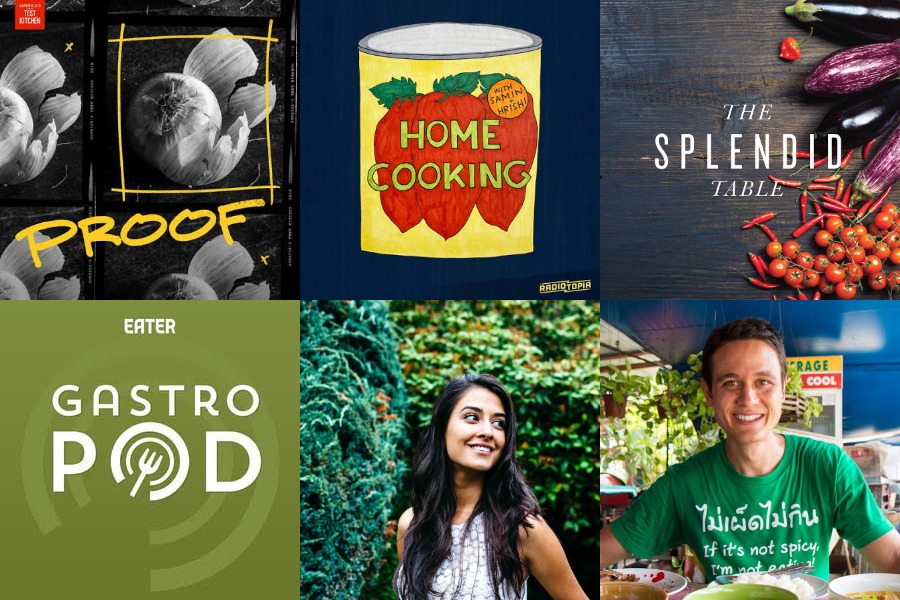
Produced by America's Test Kitchen, Proof is not a recipe show. It is an investigative podcast that uses food as a lens to explore history, psychology, science, and culture. Episodes have tackled questions like: Why did a single brand of soy sauce become a global phenomenon? What happened when a small town's only grocery store burned down? How did a spilled bag of flour lead to a major food safety discovery?
For English learners, Proof is valuable for its production quality and narrative structure. Each episode is a self-contained story with a clear arc — setup, investigation, revelation — which makes it easy to follow even when individual words are unfamiliar. The hosts speak in polished American English, and the investigative format means key information is presented multiple times from different angles. The diversity of topics means you will encounter vocabulary ranging from agricultural terms to business jargon to sensory descriptions — a broader linguistic workout than most "English learning" content provides.
2. Home Cooking
Difficulty: Intermediate
Focus: Cooking at home, kitchen creativity, food philosophy
Hosted by Samin Nosrat, author of the bestselling Salt, Fat, Acid, Heat, and Hrishikesh Hirway, creator of the podcast Song Exploder, Home Cooking was born during the pandemic and became an instant hit. The premise is simple: two friends helping people figure out what to cook with whatever they have. The execution is warm, funny, and full of practical wisdom.
For English learners, the conversational chemistry between Samin and Hrishikesh is the show's greatest asset. You hear two highly articulate people thinking out loud, interrupting each other, laughing, and circling back to earlier points — in other words, you hear English as it is actually spoken between friends, not as it is scripted for broadcast. Samin's descriptions of food are a masterclass in sensory English vocabulary — "bright," "earthy," "unctuous," "toasty" — words that bring English to life in ways that textbook adjectives never do. Episodes are approximately 45-60 minutes.
3. The Splendid Table
Difficulty: Intermediate
Focus: Food culture, chef interviews, culinary storytelling
Produced by American Public Media and distributed by NPR, The Splendid Table has been a cornerstone of food media for over thirty years. Host Francis Lam guides listeners through conversations with chefs, food writers, home cooks, and cultural commentators, exploring not just what we eat but why we eat it — and what our food says about who we are.
This long-running show is a rich source of American English in its most polished conversational form. Francis Lam is a skilled interviewer who draws stories out of his guests rather than just extracting information, and the show's broad scope means you hear discussions of immigration, identity, climate change, and family tradition — all through the lens of food. The vocabulary is sophisticated but accessible, and the interview format provides natural repetition of key concepts as guests and host build on each other's ideas. Episodes are 50 minutes, released weekly.
4. Gastropod
Difficulty: Upper-Intermediate
Focus: Food through the lens of science and history
Gastropod looks at food through the twin lenses of science and history, with hosts Cynthia Graber and Nicola Twilley tackling questions like: Why did the banana become the world's most popular fruit? What does sound have to do with how food tastes? How did the invention of the refrigerator change human civilization?
The show's research depth makes it ideal for learners who enjoy intellectual content. Each episode is thoroughly reported, with interviews from scientists, historians, and industry experts — meaning you hear a range of English accents and speaking styles within a single episode. The vocabulary is the most advanced on this list, with terms from microbiology, economics, anthropology, and food science appearing naturally in context. For upper-intermediate learners ready for a challenge, Gastropod is an excellent bridge from "learner content" to authentic, expert-level English.
5. Pick Up Limes
Difficulty: Lower-Intermediate to Intermediate
Focus: Plant-based cooking, nutrition, mindful living
Created by Canadian dietitian Sadia Badiei, Pick Up Limes combines practical plant-based recipes with thoughtful discussions about nutrition, wellness, and intentional living. The tone is calm, encouraging, and deeply personal — Sadia shares her own journey and struggles with an honesty that makes the content feel like advice from a trusted friend rather than a lecture from an expert.
For English learners, Pick Up Limes offers a gentle but effective listening experience. Sadia speaks in clear, measured Canadian English, and her explanations of nutrition concepts are designed for a general audience — she defines terms like "macronutrient" and "antioxidant" rather than assuming prior knowledge. The food vocabulary is practical and everyday: you will learn the English names for ingredients, cooking techniques, and kitchen tools that are genuinely useful in daily life. Episodes are typically 20-35 minutes, making them easy to fit into a routine.
6. Mark Wiens
Difficulty: Lower-Intermediate
Focus: Global street food, food travel, cultural exploration
Mark Wiens is one of the most recognizable faces in food travel media, known for his enthusiastic explorations of street food and local specialties across the world. His video podcast extends that format into audio, capturing the sounds, stories, and cultural context of food from bustling night markets in Bangkok to hidden kitchens in Mexico City.
For English learners, Mark Wiens offers several advantages. His English is clear, energetic, and spoken at a measured pace — he is a natural narrator who describes food with vivid, accessible vocabulary. You will hear words like "aromatic," "savory," "tender," and "fragrant" repeatedly, building sensory English vocabulary through natural repetition. More importantly, he frequently interacts with local food vendors and chefs from non-English-speaking countries, meaning you hear a wide range of English accents and communication styles — invaluable preparation for using English as a global lingua franca. Episodes vary in length but are typically digestible segments that work well for casual listening.
How to Get the Most from Food Podcasts
Food content engages all the senses, and your learning approach should too. Try this:
Listen while cooking: Pick a recipe from the episode or simply listen while preparing your own meal. The physical act of cooking while absorbing English content creates a multisensory learning experience — you associate new words with smells, textures, and actions, which deepens retention.
Cook from an English recipe: After listening to Home Cooking or Pick Up Limes, find a recipe in English and cook from it. Reading and following instructions in English bridges the gap between passive listening and active language use.
Describe your food in English: After each episode, take 30 seconds to describe what you just ate — out loud, in English. Use the sensory vocabulary you heard in the episode. "The soup was earthy and warm, with a slight bitterness from the greens." This small daily practice builds the descriptive vocabulary that distinguishes advanced speakers from intermediate ones.
Progress through the difficulty levels: Start with Pick Up Limes or Home Cooking for accessible, conversational English. Move to Proof and The Splendid Table for richer vocabulary and more complex narratives. Graduate to Gastropod when you are ready for academic-level English through the comfortable lens of food.


Comments
No comments yet.
Leave a Comment