
The Listener Who Couldn't Decide
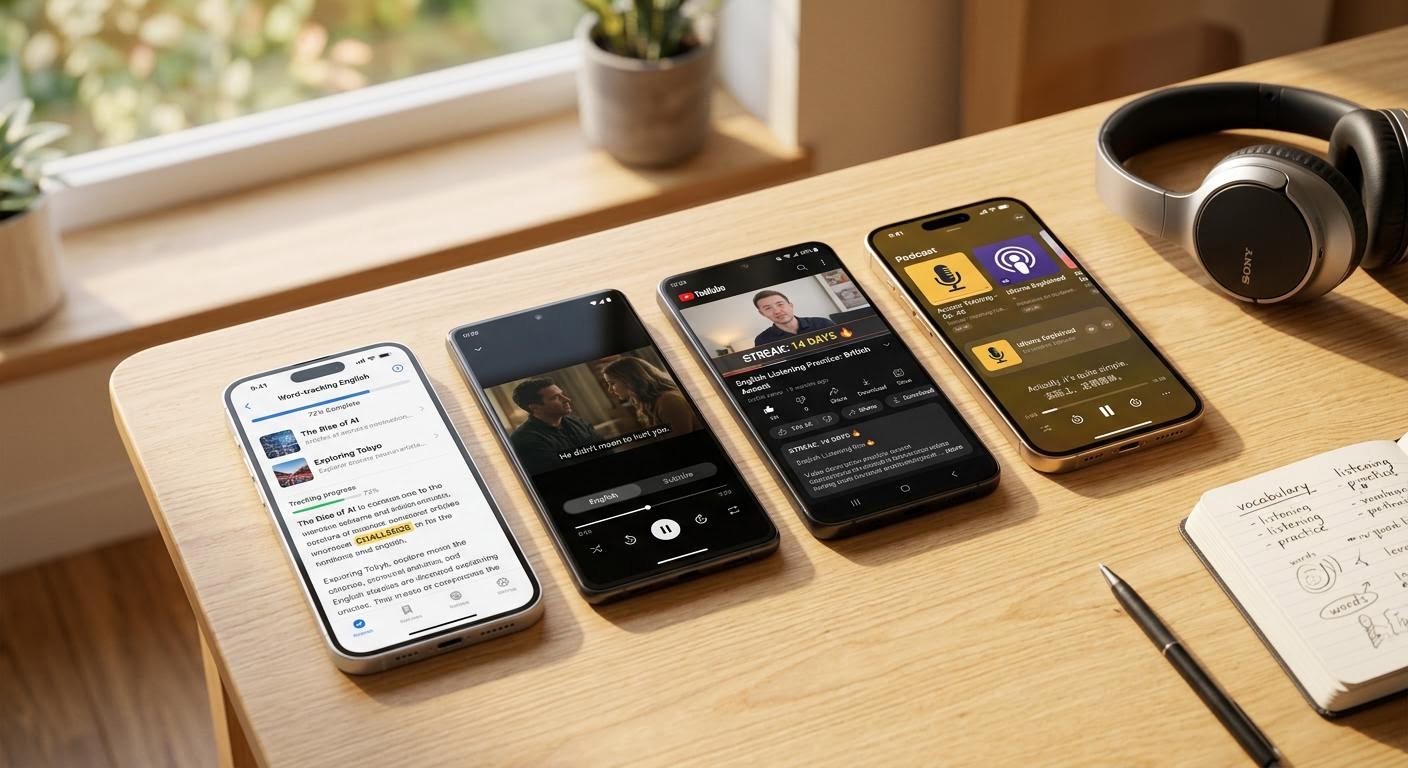
Daniel had been "learning English" for two years — downloading apps, watching videos, and quitting every month. The problem was never motivation. It was that every app he tried seemed to build a different skill, and none of them told him what to do next. One evening he had four apps open on his phone at the same time: LingQ, EWA, RedKiwi, and ListenLeap. Four interfaces, four philosophies, four different versions of the same promise: this time, your listening will actually improve.

That scene is common in 2026. The app market has matured past "one app for everything" — the best tools now specialize, and each specialization is genuinely useful. LingQ, EWA, and RedKiwi each represent a different school of listening practice, and all three deserve credit for how well they execute their chosen path. This guide walks through what each one does best and shows where ListenLeap fits, so learners can match the tool to their own habit.
Four Apps, Four Ways to Learn
LingQ is the input purist. Running since 2002, it is built on the idea of comprehensible input: read and listen to content you enjoy, look up words as you go, and let vocabulary accumulate naturally. Its 40+ language library and import-everything flexibility make it a favorite among self-directed learners and polyglots.
EWA is the entertainment ecosystem. With 60 million+ downloads, it turns movie clips, graded books, flashcards, grammar bites, and an AI chatbot into one colorful package — the "learn through movies and books" philosophy applied at scale.
RedKiwi is the daily video trainer. Developed in Korea with a polished, game-like design, it takes fresh YouTube clips and wraps each one in bilingual subtitles, fill-in-the-blank drills, dictation, and shadowing exercises — a short, focused listening workout that updates every day.
ListenLeap is the podcast-based learning system. It combines a curated library of 10,000+ real podcasts — BBC, TED, NPR, across 20+ topic areas — with i+1 difficulty grading, bilingual subtitles, vocabulary tools, and scored speaking practice, plus the ability to import personal audio.
The Content Question: Fresh, Deep, or Curated
Where learning material comes from shapes the whole experience, and here each app takes a different route.
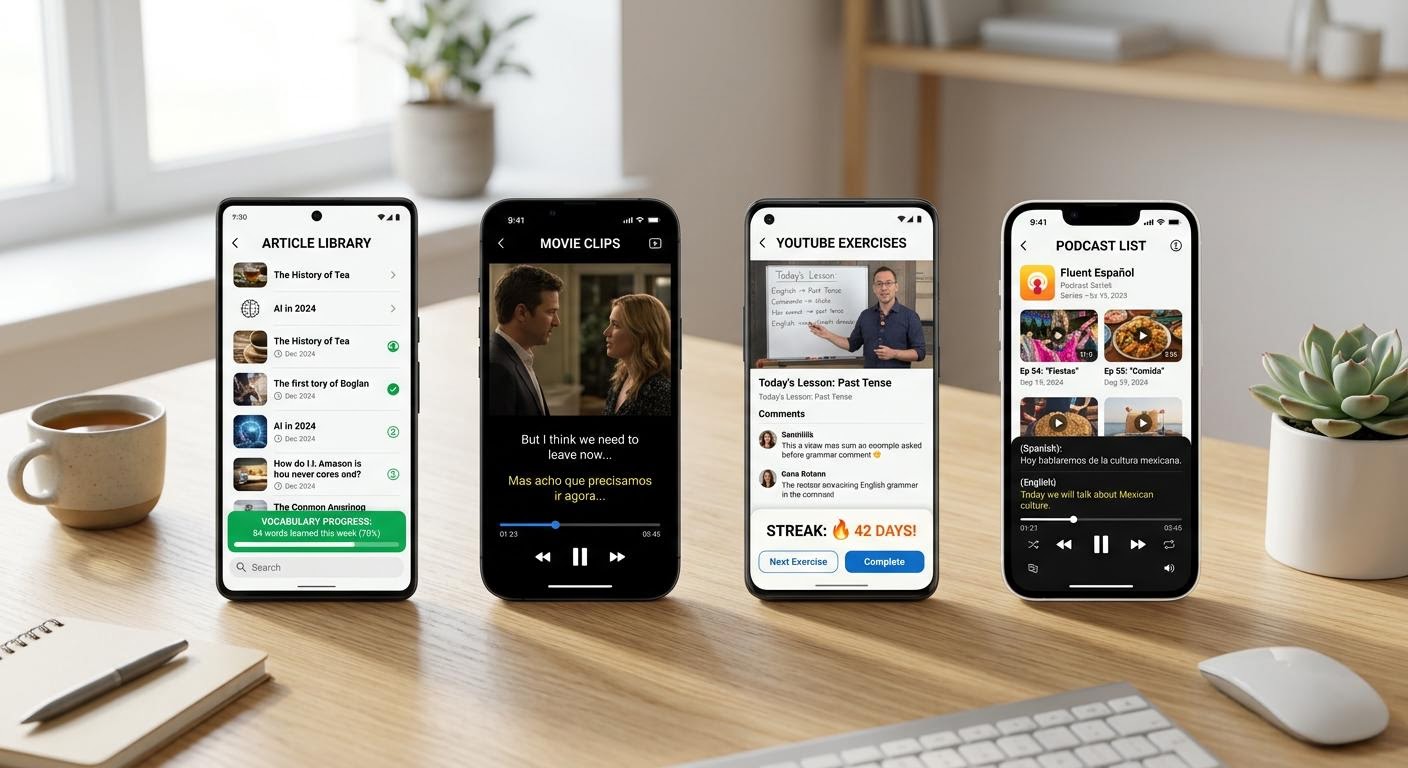
LingQ offers unmatched breadth and ownership. Users can import articles, blog posts, PDFs, YouTube videos, or podcasts and turn them into interactive lessons in seconds. Its preloaded library spans 40+ languages, and community-created lessons keep the shelves stocked. For learners who already know exactly what they want to study, this is the most flexible library in the category.
EWA brings Hollywood into the classroom. Its 10,000+ movie and TV clips cover everyday conversation that textbooks rarely touch, while 1,000+ graded audiobooks give readers a complete reading journey from starter to advanced. Few apps can offer both a movie clip and a full book in the same session.
RedKiwi keeps content fresh by design. Every day it adds new clips from popular YouTube channels — news, vlogs, talks, entertainment — so the feed never goes stale. Bilingual subtitles in 10+ languages bridge the gap instantly, and three difficulty levels help learners stay in a comfortable zone.
ListenLeap covers discovery and personal choice. Its in-app library holds 10,000+ curated podcasts organized into 20+ topic areas — from BBC news to TED talks to NPR science — so a learner who does not know what to study next can browse by interest and level. The self-import feature also accepts personal audio files, matching the bring-your-own flexibility that self-directed learners love.
The Practice Loop: What Happens After You Press Play
Listening alone rarely moves the needle — the practice around it does. Each app built a different loop.
LingQ's signature loop is word tracking. Tap any word to create a LingQ, save it, mark it known or learning, and watch the known-word counter climb. The visible progress bar turns an abstract goal into a concrete number.
EWA's loop is variety. Flashcards with images and example sentences reinforce vocabulary through spaced repetition, grammar lessons add structure in five-minute chunks, and the AI chatbot offers conversational practice — all wrapped in streaks and daily reminders that keep learners coming back.
RedKiwi's loop is precision. Every clip comes with a pool of 50,000+ exercises: fill-in-the-blank listening, multiple-choice comprehension, sentence-by-sentence dictation with instant correction, and shadowing for pronunciation. The combination trains the ear at a granular level many apps skip.
ListenLeap's loop is a guided sequence. A level test places each learner on the i+1 difficulty ladder, then bilingual subtitles (Simplified Chinese, Traditional Chinese, Korean, Japanese), tap-to-look-up vocabulary, phrase-level breakdowns with full-sentence explanations, AI Q&A, and smart summaries turn any episode into a structured lesson. Blind-listening mode strips subtitles away for pure ear training, and fill-in-the-blank drills check retention — the same episode can be studied three different ways.
Speaking and Progress: Two Things That Keep Learners Going
Listening apps live or die by whether they push learners to speak — and by whether progress is visible. EWA's dubbing mode lets users voice movie lines and get scored; RedKiwi's shadowing feature encourages imitation of native clips; LingQ keeps its focus on input, which suits readers who prefer volume over output.
ListenLeap treats speaking as a first-class feature. Its shadow reading mode scores pronunciation, intonation, and fluency separately, so learners see exactly which dimension to work on — not just "good" or "bad," but where the voice actually breaks down. The same podcast episode becomes a speaking workout: listen, look up, then speak along and receive three distinct scores. That level of granular feedback is rare among podcast learning tools.
Motivation is a feature too, and each app engineered it differently. LingQ's known-word counter gives numbers; EWA's streaks and daily challenges add game energy; RedKiwi's achievements and check-in system make practice feel like progress. ListenLeap builds progress into the content itself — because every episode is graded to the learner's level, the difficulty curve is visible as episodes get gradually harder while skills grow. Vocabulary notebook, personal notes, offline caching, and PDF export mean the learning record travels with the user across iOS, Android, and Web.
Why ListenLeap Works as a System
The four apps are not rivals in the same lane — they are four answers to four different questions, and ListenLeap answers the most complete one: how does a full English listening routine work in one place?
Start with the source. A learner opens ListenLeap and finds 10,000+ real podcasts — BBC, TED, NPR — organized across 20+ topic areas, so there is always something worth pressing play on. A quick level test then matches the content to the learner's actual ability with i+1 grading: hard enough to stretch, easy enough to follow. That single step removes the classic failure mode of podcast learning, where beginners drown in native-speed audio and give up.
Around that core sit the tools that turn listening into acquisition. Bilingual subtitles in four languages (Simplified Chinese, Traditional Chinese, Korean, Japanese) catch learners mid-flow; tapping any word or phrase pulls up a definition, a phrase breakdown, and a full-sentence explanation; AI Q&A lets learners ask follow-up questions about the episode itself; smart summaries condense long episodes into reviewable notes. For pure ear training, blind-listening mode hides the subtitles entirely, and fill-in-the-blank drills turn passive listening into active recall.
Then comes the output side. Shadow reading scores pronunciation, intonation, and fluency separately, so speaking practice is not an afterthought but a measurable daily habit. Offline caching and PDF export let the routine survive commutes without signal and study sessions without a screen. On iOS, Android, or Web, the same progress follows the learner everywhere. That is the difference between an app that improves one skill and a system that closes the whole loop from first listen to spoken output.
Choosing What Fits You
No app here is a wrong answer — each one wins in its own lane:
Self-directed readers who love importing their own content will find LingQ's flexibility and word-tracking hard to beat.
Learners who want entertainment and variety — movies, books, games — will enjoy EWA's all-in-one ecosystem.
Short-session learners who want a daily, structured listening drill will get real value from RedKiwi's YouTube clip workouts.
Learners who want a complete, podcast-driven system — level-matched content, subtitles, vocabulary depth, and scored speaking — will find the full loop in ListenLeap.
Getting Started
Daniel's conclusion after a month: he kept LingQ for reading his favorite tech articles, and built his daily English routine around ListenLeap — a BBC episode at his level every morning, blind listening on the commute, and a scored shadow reading session before bed. Different tools for different muscles is a healthy way to learn. For anyone who wants real podcasts, real progress tracking, and speaking feedback in one place, ListenLeap is a strong place to start — and its free Web version makes the first episode one click away.



Comments
No comments yet.
Leave a Comment