
Why Business Podcasts Are a Professional English Learner's Best Friend
There is a specific kind of English that textbooks do not teach: the language of deal-making, fundraising, market analysis, and entrepreneurial storytelling. It is the difference between "I want to start a business" and "I am targeting a underserved market with a scalable go-to-market strategy." Both sentences mean roughly the same thing, but only one sounds like someone who belongs in the room.
Business and finance podcasts immerse learners in this professional register naturally. They are not teaching English — they are teaching business, and the English comes along for the ride. After weeks of daily listening, phrases like "product-market fit," "runway," "valuation multiple," and "asymmetric upside" stop sounding like jargon and start sounding like vocabulary.
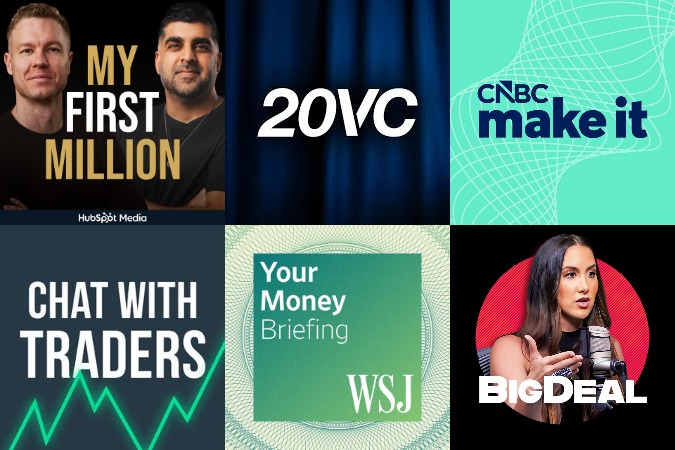
The six podcasts below span the full spectrum of business English: startup pitch conversations, Wall Street market analysis, personal finance advice, and deep-dive interviews with the people who built the companies that shape the economy.
Listening to Business Content on ListenLeap
Business English is dense with terminology that moves fast. Miss one key phrase in a pitch discussion and the entire logic of the argument can unravel. ListenLeap's bilingual subtitles keep the learner oriented through rapid-fire business dialogue. The tap-to-define feature lets users instantly look up financial terms without pausing. After an episode, AI Q&A tests whether the learner grasped the core arguments and financial logic. For learners who need to use business English professionally, the shadowing feature with pronunciation and fluency scoring provides targeted practice for sounding natural in meetings and presentations.
The 6 Podcasts
1. My First Million
Difficulty: Intermediate
Focus: Startup ideas, business models, entrepreneurial thinking
Hosted by Sam Parr and Shaan Puri, My First Million is a podcast built around a simple, addictive premise: every episode, the hosts brainstorm business ideas they would start if they were beginning from scratch. The conversation is fast, funny, and full of the informal business English that entrepreneurs actually use — not textbook case studies, but real talk about market gaps, customer acquisition, and revenue potential.
For English learners, the show's value is in its conversational authenticity. Sam and Shaan interrupt each other, talk over each other, and switch from serious analysis to jokes in the same breath — exactly the rhythm of real startup conversations. The vocabulary is practical business English: "niche," "subscription model," "customer lifetime value," "virality." Episodes run 45-60 minutes.
2. 20VC with Harry Stebbings
Difficulty: Upper-Intermediate
Focus: Venture capital, startup fundraising, tech industry
Harry Stebbings has built one of the most influential venture capital podcasts in the world by doing one thing exceptionally well: getting the world's top investors to explain how they think. Each 20-minute episode packs a dense conversation about fundraising strategy, market timing, and what VCs actually look for in founders.
For English learners aiming at the tech and startup world, 20VC is essential listening. The vocabulary is venture capital's greatest hits — "seed round," "term sheet," "dilution," "exit strategy" — and the format forces guests to be concise, which means high information density in manageable doses. Stebbings speaks in clear British English, and his guests represent a global range of accents, providing valuable exposure to international business English.
3. CNBC Make It
Difficulty: Intermediate
Focus: Personal finance, career success, entrepreneurship
CNBC Make It is the accessible, storytelling-driven arm of CNBC's business journalism. It covers the human side of money — how people built wealth, career pivots that paid off, financial mistakes and lessons learned — in segments that are designed for a broad audience rather than finance professionals.
For English learners, CNBC Make It hits a sweet spot: business and finance vocabulary delivered through narrative rather than lecture. Stories about someone who paid off six figures of debt or built a side hustle into a full-time income naturally introduce terms like "passive income," "compound interest," "diversification," and "financial independence" in context. The language is clear, the pace is moderate, and the episodes are typically 15-25 minutes.
4. Chat With Traders
Difficulty: Upper-Intermediate
Focus: Stock trading, market strategy, risk management
Chat With Traders goes deep into the minds of professional traders — the people who move markets for a living. Each episode is a long-form interview exploring a trader's specific strategy, their biggest wins and worst losses, and the psychological discipline required to manage risk at scale.
The English on this show is specialized and fast. Learners will encounter market vocabulary — "volatility," "liquidity," "short position," "hedge" — in the context of real trading stories. The interview format means guests speak in their natural voices, with hesitations, tangents, and moments of intensity that make the language feel genuinely alive rather than scripted. Episodes run 60-90 minutes and are best suited for upper-intermediate learners with an existing interest in markets.
5. WSJ Your Money Briefing
Difficulty: Intermediate
Length: 5-10 minutes
Frequency: Daily
The Wall Street Journal's daily personal finance briefing is the shortest, most efficient entry on this list. Each episode covers one money topic — a change in mortgage rates, a new tax rule, a shift in the job market — in a tight, focused format designed for morning listening.
For English learners, the brevity is the killer feature. A 7-minute episode can be listened to twice on a single commute: once for comprehension, once with ListenLeap's subtitles to catch financial terminology. The vocabulary is practical money English — the kind used in bank meetings, salary negotiations, and personal budgeting — rather than the abstract finance jargon of investment banks. Daily episodes build a compounding vocabulary effect: after a month, terms like "APR," "deductible," and "index fund" become second nature.
6. BigDeal by Codie Sanchez
Difficulty: Intermediate
Focus: Small business acquisition, entrepreneurship, wealth building
Codie Sanchez built her platform around a contrarian message: you do not need to start a business from scratch — you can buy an existing one. Her podcast explores the practical mechanics of acquiring small businesses, turning them profitable, and building wealth through ownership rather than income.
The English is direct, motivational, and refreshingly free of corporate jargon. Sanchez speaks in clear American English with the cadence of someone who has spent years explaining complex ideas to beginners — which is exactly what makes the show accessible for English learners. The vocabulary centers on practical business operations: "cash flow," "leverage," "negotiation," "owner financing." Episodes are 25-40 minutes and self-contained.
How to Approach Business Podcasts as a Learner
Business content rewards a structured approach. Start with the shortest, most accessible shows — WSJ Your Money Briefing and CNBC Make It — to build a foundation of financial English vocabulary. Move to My First Million for conversational startup English. Graduate to 20VC and Chat With Traders when ready for dense, expert-level business dialogue.
For each episode, identify three new business terms and write them in a sentence about your own work or financial situation. The gap between recognizing a term and using it is where professional English fluency is built.



Comments
No comments yet.
Leave a Comment