
Level, Goal, and the Problem This Fixes
Level: B1 (CEFR intermediate). Goal: a 12-minute session, repeated daily on one 75-second clip, ending with a 45-second spoken summary.
The short answer: an edited transcript is still usable for shadowing, but only as a map, never as a script. Take one verified episode, cut a 75-second block, choose six content words that survive editing, allow up to 10 percent drift between audio and page, then shadow the block in three layers and retell it.
This suits B1 and B1+ learners who can follow slow, clear English but lose the thread when two people talk at natural speed, overlap and pad sentences with small words. It does not suit complete beginners, who need slower audio and much shorter chunks, and it is not a grammar course. The reward is a drill with a countable score, so progress stops depending on mood.
The Source: One Episode, Checked
The episode: BBC Learning English, 6 Minute English, episode 261105, titled Could vaccines cure cancer?, published 5 November 2026.
- Length: about six minutes, the standard slot for the series.
- Speakers: Georgie and Phil, both British, studio recording, natural conversational pace with interruptions and fillers.
- Level: the BBC lists the series as intermediate, which maps roughly to B1 and B2.
- Transcript: a free worksheet and transcript PDF are linked from the episode page, and an interactive quiz sits beside them.
One detail matters more than the rest: the transcript states that it is not a word for word transcript. The published text is an edited version of the recording. Some fillers are kept, some exchanges are merged, and the grammar is occasionally tidied. That is normal practice, and it is exactly why learners who shadow while reading line by line fall behind and blame their ears.
The page does not print timecodes, so clip boundaries below are located by content rather than by clock time. Two blocks work well:
- Clip A, quiz section. From the opening question about vaccinations to the three quiz options. Around 60 seconds of speech, slow, repetitive, and easy to predict. Best for the first week.
- Clip B, guest section. Cancer cell biologist Anne Willis answering presenter Tom Whipple, roughly the middle of the episode. Around 70 seconds, technical vocabulary, but short sentences and clear turn taking. Best once Clip A feels comfortable.
Pass 1: Blind Listen and Mark the Beat (2 minutes)
- Play the clip once with no transcript and no pausing. Aim for the general shape, not detail.
- Play it a second time and tap a finger on each stressed syllable. The hand does the counting, so the brain can stay on the melody.
- Write down at most three unclear moments. Three is a limit, not a target.
- Stop there. The purpose of this pass is rhythm, and the transcript only arrives afterwards.
Learners who skip this pass tend to read the page and call it listening. The order is the method.
Pass 2: Line Up Audio and Text, Expecting Gaps (4 minutes)
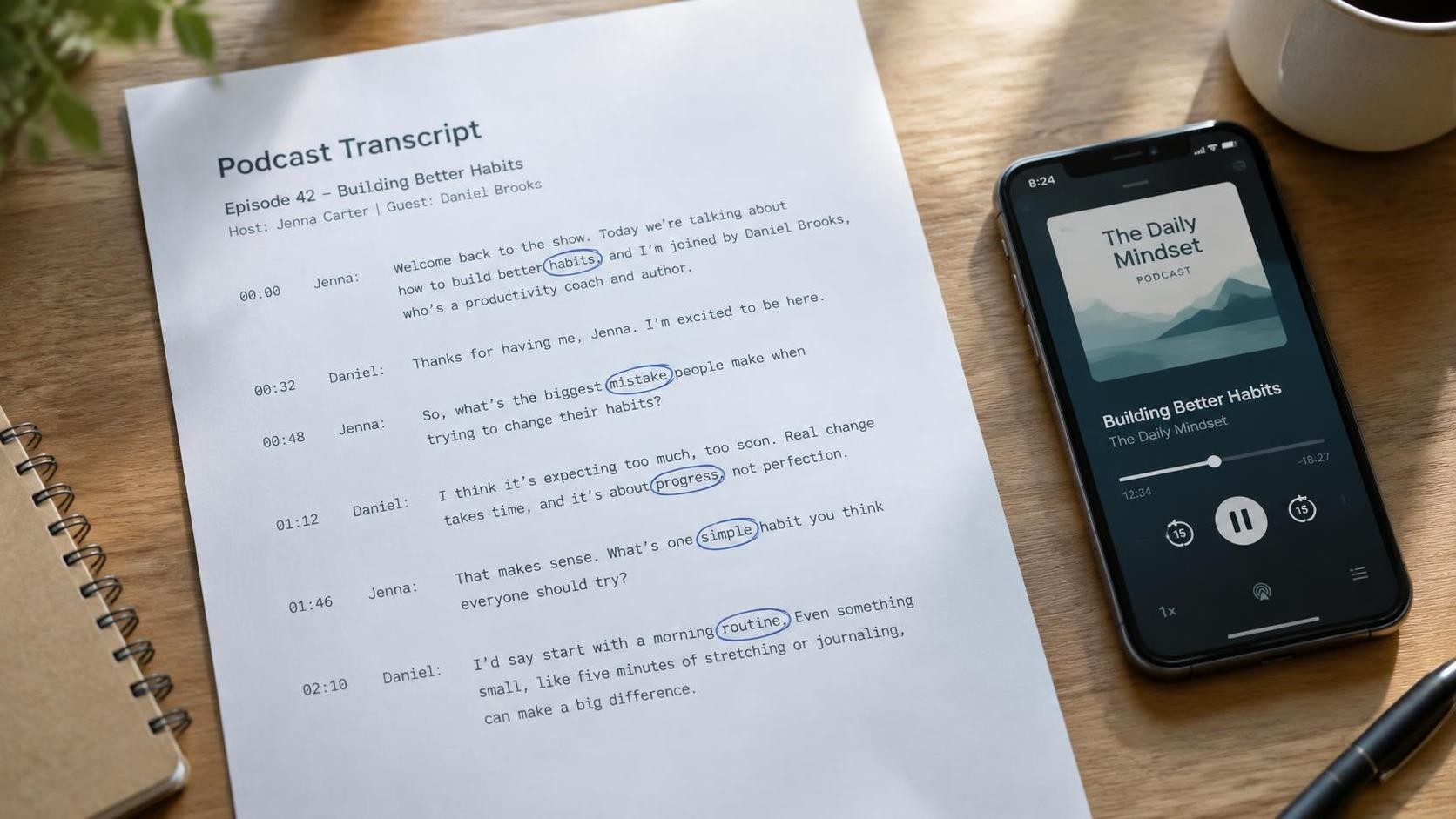
This pass treats the transcript as a rough map. Before playing, mark six anchor words, meaning words that no editor would cut: vaccine, cancer, immune, tumour, trials, promise. Those six are the fixed points to return to after any gap.
Three kinds of mismatch appear in edited transcripts:
- Dropped fillers. The audio carries small words such as well, you know and sort of that the text may trim.
- Merged turns. Two short exchanges can be collapsed into a single printed line, which hides a speaker change.
- Cleaned grammar. Spoken slips are sometimes regularised on the page, so the audio says one thing and the text another.
Four rules keep the pass moving:
- Slide, do not hunt. Keep the playhead running and let the eye catch up.
- Allow up to 10 percent drift. A 75-second clip can run a few seconds ahead of the page without any problem.
- Never restart from zero after a gap. Restarting teaches the learner to fear the next gap.
- Circle, do not translate. Mark the missing words and deal with meaning later.
A quick calibration test: play 15 seconds and count how many spoken words are missing from the page. If the count stays under five, the text is a usable map. If it climbs above five, shadow by ear and keep the transcript for vocabulary only.
Pass 3: Shadow in Three Layers (5 minutes)
Layer one, chunks
Take 8 to 12 words at a time. Pause, repeat immediately at the same speed, and do not read ahead. Accuracy matters more than volume, and three clean repetitions beat ten rushed ones.
Layer two, continuous
Shadow the whole clip with a half-second lag. Count the seconds spent in sync and write the number down. A realistic first target for B1 is 45 seconds out of 75. The number is the progress bar.
Layer three, repair
Choose the two worst lines only. Loop each one five times, then rejoin the clip at that point. Two lines per session is enough, because repair work is tiring and the drill has to survive tomorrow.
Speed rule: stay between 0.85x and 1.0x. Slower than 0.85x distorts rhythm and stress, which defeats the purpose. If 1.0x fails twice in a row, drop to Clip A rather than to a slower setting.
Pass 4: Retell and Record (1 minute)
Three prompts, answered aloud without notes:
- What the vaccine in the episode is designed to do, in three sentences.
- What false dawn means, in one sentence.
- The quiz answer plus one number. In the episode the answer is lung cancer, with an estimated 2.4 million cases worldwide in 2024, according to the World Health Organisation as cited by the programme.
Record 45 seconds, replay once, and note two fixes. Not five. Two fixes get applied tomorrow; five get forgotten.
Three Details Worth the Ears
1. Linking inside common phrases
In the clip, a long time coming runs together as one sound unit, close to along time coming, and a lot of compresses towards a lotta. Copy the linking, not the spelling. Learners who pronounce every word separately hear themselves as slower than the recording even at identical speed.
2. Weak auxiliaries
Has been, have been and would have lose most of their vowel weight, while the content words keep the beat. The line about work in this space is carried by work and space, not by the grammar around them. Shadowing the weak forms is what makes the copy sound English rather than recited.
3. Stress that carries the news
False dawn, breakthrough, priming the immune system. Each phrase has one clear peak, and the peak sits on the word that carries new information. Copying that pattern also fixes meaning: a learner who stresses false in false dawn rarely forgets what the expression means.
Self-Check Table
Score each row from 1 to 5 after the session. Total 40 points.
| Check | 1 point | 3 points | 5 points |
|---|---|---|---|
| Sync on continuous shadowing | under 20 seconds | 30 to 45 seconds | 60 seconds or more |
| Chunk accuracy | words dropped in most chunks | clean in half | clean in almost all |
| Linking | every word separated | some phrases joined | phrases joined at speed |
| Weak forms | auxiliaries fully pronounced | mixed | reduced naturally |
| Stress placement | flat delivery | correct in familiar lines | correct in new lines |
| Transcript drift | lost the place twice or more | one small loss | no loss |
| Retell | under 20 seconds | 30 seconds with pauses | 45 seconds, two target phrases |
| Focus | checked the phone | one interruption | full 12 minutes |
When the Routine Stalls
- Drift above 15 percent: shorten the clip to 40 seconds. Do not slow the audio further.
- Eyes glued to the page: cover the text with a card and reveal one line at a time.
- Episode fatigue: the series publishes weekly, so the same four passes run on a fresh episode without redesigning anything.
- No transcript at all: run passes one and three only, and use the quiz question as the comprehension check.
- Plateau after two weeks: keep the clip and change the retell prompts, which forces new language out of old audio.
Where a Tool Fits
The method works with a browser, a printed PDF and a timer, so no purchase is required. After the four passes are familiar, ListenLeap (listenleap.com), an English listening practice app built around podcasts and bilingual subtitles with AI support, can hold the same 75-second clip on a phone. A sample workflow: subtitles on during pass two, subtitles off during pass three, and one saved clip per week so the comparisons stay honest. It suits learners who want the identical clip repeated on a commute and who like a visible transcript while practising. It does not suit learners who need a grammar syllabus, exam preparation or a human speaking partner, and it does not replace the BBC worksheet, which remains the better source for the episode's own vocabulary list and quiz.


Comments
No comments yet.
Leave a Comment