

B1 learner level. Goal: shadow a natural-speed English podcast for 20 seconds without letting one missed phrase derail the next sentence. The repeatable method takes ten minutes and uses one verified episode, one short excerpt, and four deliberate passes.
The exact listening target
Use BBC Learning English, 6 Minute English, episode Are people drinking less alcohol?. The official page links to the episode MP3 and a downloadable transcript PDF. The opening 20 seconds of the linked MP3 form the practice clip: set playback from 00:00 to 00:20, so the excerpt has a clear, repeatable duration. The full item belongs to the 6 Minute English series, but the page does not state a checked runtime for the MP3, so no more precise full-episode length is claimed here.
The PDF identifies the opening speakers as Georgie and Neil and includes their initial exchange about not drinking alcohol that year. It also explicitly says that the document is not a word-for-word transcript. That matters: a transcript is a guide to meaning, not proof that every sound, hesitation, or contraction will appear exactly as written. The episode page and transcript are directly checkable at the BBC links above.
The task uses the MP3 at original speed. The page gives no words-per-minute figure, so the clip is described as ordinary BBC programme delivery rather than assigned an invented speed rating. It is useful for noticing connected speech in UK English, with named BBC Learning English presenters, while remaining too short to represent every British accent. This is a source-verified practice choice, not a claim that an independent listening test or timed speech analysis has been carried out.
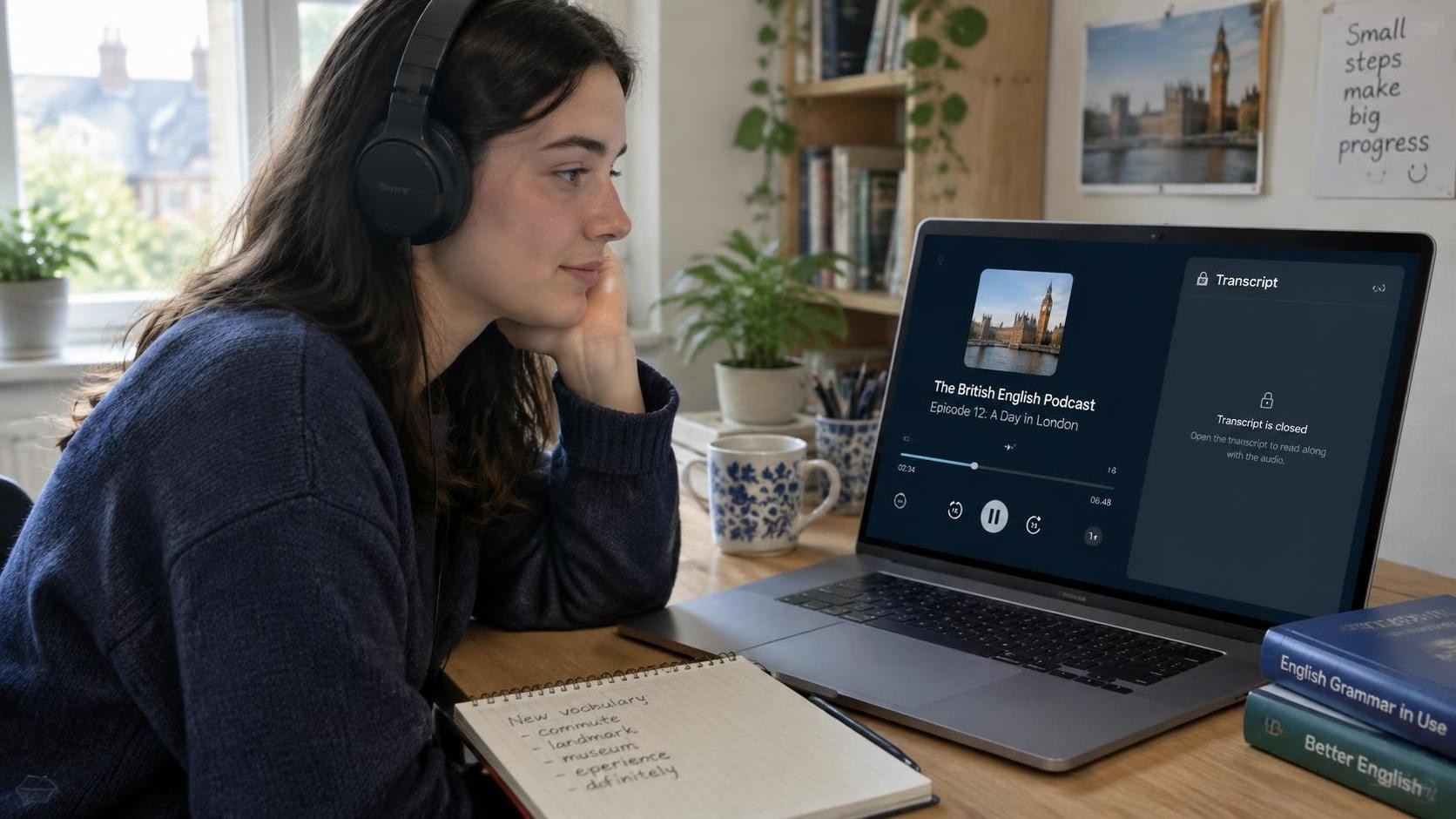
The ten-minute shadowing routine
1. First pass: blind listening, two minutes
Keep the transcript closed. Play 00:00-00:20 once without pausing. The aim is not to catch every word. Write down only a broad topic and one detail that seems clear. For this opening, a learner may notice a conversation about drinking habits; uncertainty about a phrase is expected. Listening without text first prevents the printed words from disguising which sounds were actually recognized.
On a second play, listen for phrase boundaries rather than isolated vocabulary. Notice where one speaker finishes and the other begins, and whether a short pause separates each idea. Do not stop when a word disappears. Let the recording continue to the end of the 20-second window. This is the main correction for a common shadowing failure: attention stays with the moving audio instead of becoming trapped on one missed syllable.
2. Second pass: check the transcript, three minutes
Open the BBC transcript PDF only after the blind listen. Read the opening exchange and compare its meaning with the notes from the first pass. Mark no more than three uncertain items. In this excerpt, useful text targets include the phrase want to, the expression this year, and the short reply Err, yes. These examples are present in the published transcript, but the PDF warning still applies: the wording is not guaranteed to match every audible detail.
Before replaying, identify the thought groups. A practical first division is the greeting, the longer question, a short response, and the statement about the current year. The precise pauses should follow the audio, not the punctuation on the page. If the transcript seems to conflict with the recording, trust the sound for pronunciation and retain the transcript as a meaning aid. Avoid looking up every unfamiliar word; the goal is to shadow a tiny passage, not to complete a full vocabulary lesson.
3. Third pass: shadow in short chunks, three minutes
Play the excerpt again and speak along at the original speed. Start by echoing one thought group immediately after it ends. Then repeat with the audio playing, joining the speaker slightly behind rather than trying to speak before the model. Three to six words per chunk are enough. If simultaneous speech feels too difficult, use a one-second delay and shorten the chunk instead of slowing the source.
Keep the transcript visible only as a light prompt. Look up briefly before a chunk, then move attention back to the speaker. Match the shape of the phrase: a clear stressed word, reduced connecting words, and a falling or continuing tone. Volume is not the objective. A quiet, close imitation that preserves timing is more useful than loud speech that runs ahead or flattens every syllable.
Use two cycles within the three minutes. In the first cycle, prioritize staying with the clip from start to finish. In the second, select one phrase that caused a stumble and repeat only that phrase three times, then return to the complete 20-second excerpt once. If the speaker is consistently out of reach, reduce the shadowing window to five seconds while keeping the recording at original speed. Small chunks preserve the real rhythm without requiring the learner to process an entire sentence at once.
4. Last pass: retell, two minutes
Stop the audio and close the transcript. Retell the opening exchange in two or three simple sentences without copying the printed lines. A suitable content outline is: two presenters greet each other; one mentions avoiding alcoholic drinks during the year; the other reacts with surprise. The retelling can use simpler vocabulary than the source. Its purpose is to check whether listening and speaking carried meaning, not to reproduce the original sentence word for word.
For the final minute, replay the clip once and compare the retelling with the main idea. Record one improvement for the next session, such as keeping the voice moving after an unknown word or making reduced words shorter. Keep the same excerpt for a later repeat. A second attempt on another day is more informative than adding a new episode immediately, because the learner can compare performance on an identical piece of audio.
After completing the steps, learners who want podcast and YouTube listening material with bilingual subtitles and explanations can consider ListenLeap. It may suit learners who benefit from on-screen language support while working through real media; it is not necessary for this BBC exercise and may not suit learners who prefer an audio-only routine or want to avoid screen prompts.
Three sound details to notice
1. The reduced phrase want to
In connected speech, want to can be compressed, and the final sounds may join the next word rather than remain in two carefully separated dictionary forms. Listen for a compact phrase inside the question, not a pause between every written word. The exact reduction depends on the speaker and delivery, so the goal is recognition and imitation of the recording, not forcing a single pronunciation onto it.
2. The transition in this year
The final sound of this meets the opening sound of year. In fluent speech, the boundary can feel smooth and the two words may seem to run together. Keep the final consonant audible, then move directly into the next word without inserting an extra vowel or a long pause. This is a useful place to compare the transcript with the sound while remembering that the written PDF is not a verbatim record.
3. The reduction in do you
The opening question contains do you before hear. In relaxed speech, those words can blend, and do you may sound closer to /dʒə/ than two carefully separated syllables. Listen for the transition, then repeat at the original pace. The printed transcript helps locate the words, but the MP3 decides whether this speaker uses a strong or reduced form. Avoid adding an extra pause between the question words.
Self-assessment and next repeat
Rate each item after the retelling. A low score is useful information: it points to the next small adjustment instead of serving as a judgment of general English ability. Use the same 20-second window next time and change only one practice variable, such as chunk size or attention to weak forms.
| Check | Self-rating |
|---|---|
| The broad topic was identified before opening the transcript. | 0 not yet, 1 partly, 2 clearly |
| The second listen revealed a phrase that was missed the first time. | 0 not yet, 1 partly, 2 clearly |
| The voice continued after an unfamiliar or unclear sound. | 0 not yet, 1 partly, 2 clearly |
| Shadowing stayed close to the original timing for one thought group. | 0 not yet, 1 partly, 2 clearly |
| A short retelling kept the main idea without reading the transcript. | 0 not yet, 1 partly, 2 clearly |
Interpret the result as a practice record, not a test score. If the first two checks are difficult, use the same clip and make the blind listen more focused on speaker changes. If shadowing falls behind, shorten the spoken chunk to a phrase of a few words. If the retelling loses the main idea, revisit the transcript once and then close it again before speaking. A repeatable loop is more important than an ambitious clip length.
The episode offers more material than this drill needs. Keep the task narrow: one 20-second excerpt, one transcript check, one focused shadow, and one retelling. That limited scope makes the exercise easy to repeat on a busy day and makes progress easier to notice. Once the opening becomes comfortable, select the next short segment from the same episode and repeat the same four passes.


Comments
No comments yet.
Leave a Comment