

A B1 learner does not need a new podcast every day. One verified episode, one short excerpt, and a fixed ten-minute routine are enough to build a repeatable shadowing habit. This guide uses BBC Learning English's 6 Minute English episode 261029, "Is aircon the answer to a heating world?", published on 29 October 2026. The full audio runs 6 minutes 20 seconds, the two presenters speak British English at a natural studio pace, and an official transcript is available on the episode page. The plan is for B1 learners who can follow the main idea of a short news-style conversation but lose some words when the speech becomes fast. It turns a 75-second opening excerpt into a complete blind listen, transcript check, shadowing, and retell session, with a self-assessment table for daily use.
The guide is built from the published audio, transcript, and episode page. It is a practice plan, not a claim that the episode has been tested in a classroom.
Quick answer: one episode, one 75-second excerpt
Use the first 75 seconds of the episode, from the first greeting to the point where the presenters introduce the topic of air conditioning and a warming world. The excerpt is short enough to repeat in one sitting and complete enough to stand alone as a listening task.
| Item | Detail |
|---|---|
| Podcast | BBC Learning English, 6 Minute English |
| Episode | 261029, "Is aircon the answer to a heating world?" |
| Published | 29 October 2026 |
| Full length | 6 minutes 20 seconds |
| Main accent | British English, two presenters in a studio, with guest interview clips later |
| Speed | Natural conversational pace, with no slow version |
| Transcript | Official transcript on the episode page, marked as not word-for-word |
| Extra material | A free worksheet PDF is linked on the same page |
| Target excerpt | The opening 75 seconds, ending at the topic introduction |
| Level | B1, with transcript support |
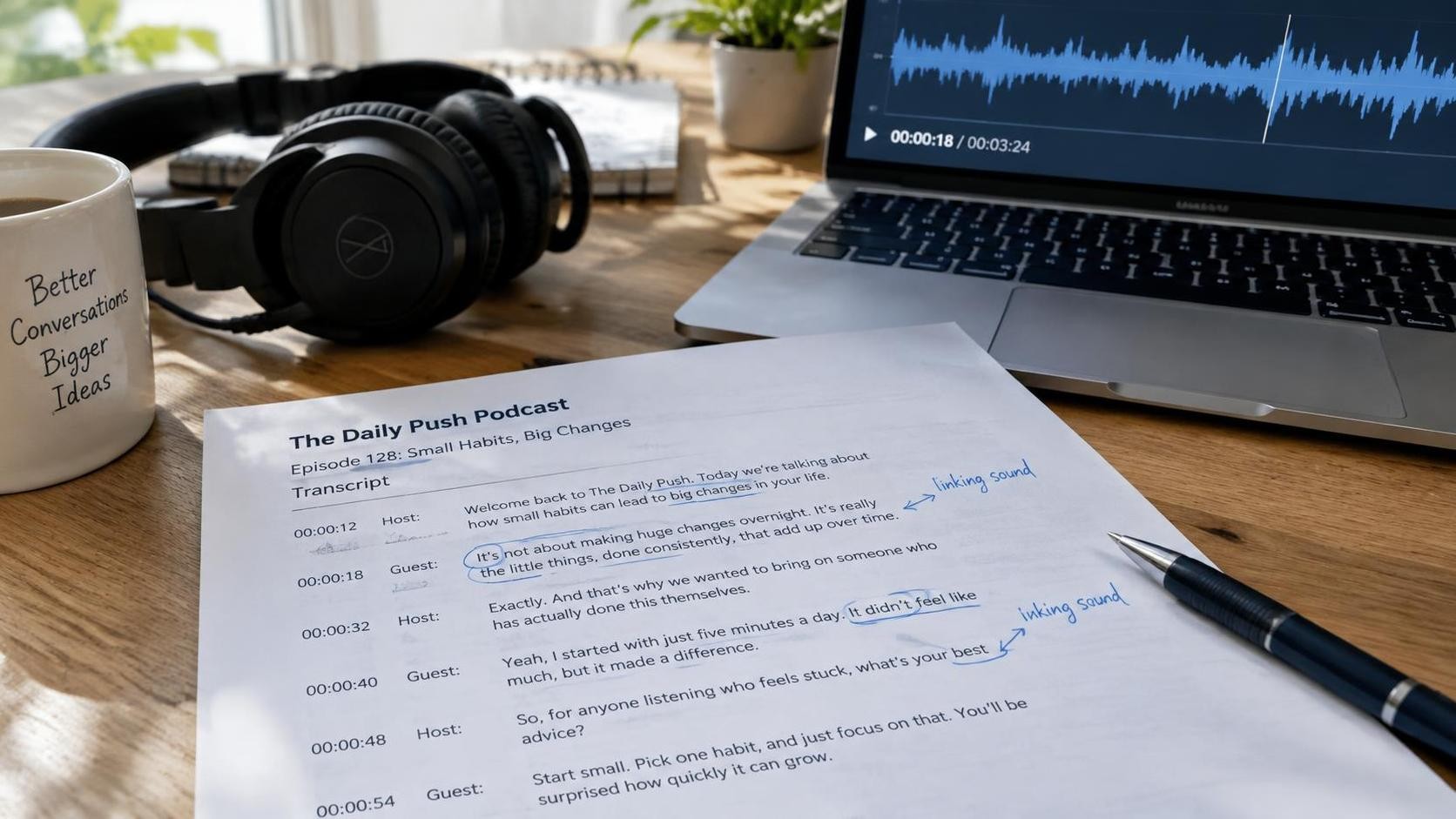
The transcript is described by the publisher as "not a word-for-word transcript". Small fillers and edits may differ from the audio. That does not weaken the exercise. The transcript still shows the order of ideas, the main vocabulary, and most of the sentence boundaries. A learner should use it as a map, not as a script for perfect imitation.
Why the opening excerpt fits B1
The opening works for B1 because it has four useful features.
- The turns are short. The two presenters greet each other, ask about air conditioning at home, and state the topic in a few lines.
- The vocabulary is concrete. Words such as summer, heat, fans, house, and air conditioning can be understood from context.
- The structure is clear. A greeting leads to a personal example, then to a wider question, then to the topic of the episode.
- The excerpt has a natural stop. It ends when the presenters introduce the subject, so the learner is not left in the middle of an argument.
The full episode also contains a guest interview with longer sentences and denser vocabulary. That section is useful later, but it is too heavy for the first ten-minute loop. The opening gives a B1 learner a fair chance to hear the rhythm of the programme before meeting the harder material.
The 10-minute loop
The loop has four stages: blind listen, transcript check, shadowing, and retell. Set a timer and keep the stages in this order. The order matters because each stage prepares the next one.
Minutes 0 to 2: blind listen
Play the 75-second excerpt without the transcript, without subtitles, and without a dictionary. Do not pause on the first play. The goal is the main idea, not every word. After the first play, write two facts and one question in English. A suitable note set might say: the episode is about cooling homes, the presenters discuss a hot summer, and one question is whether air conditioning is the best answer.
Play the excerpt a second time and allow two pauses. Add one more detail to the notes. Keep the transcript closed. If a word is unknown, mark its position by the speaker's turn, not by rewinding again and again.
Minutes 2 to 4: transcript check
Open the official transcript. Read the excerpt once in silence, then play the audio while following the text with a finger or cursor. Underline only three items: one useful phrase, one place where words join, and one sentence pattern worth copying.
Do not stop for every unknown word. The purpose of this stage is to connect printed words to the stream of sound. Two useful places to mark are "air conditioning" and "what was it originally used for". Both contain the kind of joining that makes fast English sound like one long word.
Because the transcript is lightly edited, a small difference between the written text and the audio is normal. The learner should note the difference and keep moving.
Minutes 4 to 8: shadowing
Shadowing means speaking with the audio, not waiting for the sentence to end and then repeating it. The voice stays close to the presenter's voice, like a shadow. Start at 0.85x if the full speed feels chaotic, but return to 1.0x by the fifth day.
Round one, with the transcript: play one sentence and speak along with the next play. Keep the voice low and relaxed. Copy the rhythm first, then the sounds.
Round two, without the transcript: close the text and keep one finger near the pause button, but try not to use it. Follow the melody of the sentence. If a phrase is lost, rejoin at the next clear word instead of stopping.
Round three, recorded: record 30 seconds on a phone. Do not judge the accent. Judge timing, linking, and whether the final words of each thought are audible. A recording makes the difference between a vague sense of having said the words and the sound of the words actually coming out easy to hear.
Minutes 8 to 10: retell
Close the transcript and the audio. Retell the excerpt in 45 to 60 seconds. Use a simple frame: the topic, two details, and one comment. Record the retell. Then answer three questions. Was the main idea clear? Were two details included? Did the retell use any phrase from the episode? Write one target for the next session.
The full loop takes ten minutes. The short length is a feature, not a compromise. A routine that happens every day teaches more than a ninety-minute session that happens once.
Three sound features to notice
The excerpt contains several common features of connected speech. Three are enough for one week. They are listening cues for this recording, not rules for every accent.
1. Linking /r/ in "air conditioning"
British English is non-rhotic, so the /r/ at the end of "air" is not pronounced on its own. When the next word begins with a vowel sound, however, a linking /r/ can appear. In "air conditioning", the phrase can sound like "air-r-conditioning". The same link appears in "air conditioning units".
Practice the phrase slowly, then at normal speed. Do not add /r/ after every word. The link only happens when the next word starts with a vowel sound.
The phrase "ten new air conditioning units" also contains a useful consonant link. The final /n/ of "ten" and the first /n/ of "new" merge into one longer /n/. The learner should hear one smooth unit, not two separate words.
2. Weak forms in "what was it originally used for"
In this question, "was", "it", and "for" are grammar words. They are usually weaker than "what", "originally", and "used". "Was it" can sound close to /wəzɪt/, and "for" can sound like /fə/ at the end of the question.
Practice by clapping on the content words: WHAT, originally, USED. Then say the whole question with the smaller words light and quick. This exercise trains the ear to stop expecting every word to have equal weight. It also helps the mouth move at a more natural speed.
3. Unreleased /t/ in "didn't" and "couldn't"
In "didn't always" and "couldn't sleep", the final /t/ of the negative auxiliary is often unreleased or dropped before the next consonant. The negative meaning is carried by the nasal sound and the vowel, not by a loud /t/. A learner who listens for a strong /t/ may miss the negation entirely.
Practice the pairs "didn't always", "couldn't sleep", and "wouldn't stop". Keep the tongue in position for /t/ but do not release a puff of air. Then use each pair in a short sentence about the episode. The aim is recognition and smooth timing, not a theatrical accent.
Four expressions worth keeping
The episode offers several expressions that are useful beyond the topic of air conditioning. Four are enough for one week.
| Expression | Meaning in the episode | Useful pattern |
|---|---|---|
| cope with | deal with a difficult situation | cope with heat |
| a vicious cycle | a fix that makes the original problem worse | break a vicious cycle |
| passive cooling | cooling a building without using much energy | use passive cooling first |
| shading | blocking sunlight with trees, curtains, or blinds | add shading to a room |
These expressions should be practised in the retell, not learned as a list. A learner can use "cope with heat" in the first sentence, "passive cooling" in the second detail, and "a vicious cycle" in the comment. That is enough for one session.
Self-assessment table
Use a 1 to 5 scale after the retell. A total of 15 or more means the excerpt is ready to be retired and a new one can be started. A lower score is not a failure. It shows which stage needs more time tomorrow.
| Skill | 1 point | 3 points | 5 points |
|---|---|---|---|
| Blind gist | No main idea | Main idea and one detail | Main idea, two details, and one prediction |
| Transcript match | Many sentences do not match | Most sentences match | Notices reductions and linking |
| Shadowing sync | Stops often | Keeps up in short chunks | Keeps rhythm for 30 seconds |
| Retell | Under 15 seconds | 30 seconds with two details | 45 seconds with clear structure |
| Target sounds | Does not notice them | Correct in slow speech | Correct at normal speed |
The table should be filled in immediately after the session. Memory of the recording fades quickly, and a score written five hours later is less useful.
A four-week progression
The same loop can grow without adding much time.
- Week one: the same 75-second excerpt at 0.9x, five sessions.
- Week two: the same excerpt at 1.0x, plus the next 30 seconds after the transcript check.
- Week three: a new 90-second excerpt from the same episode, with the guest section added only after the transcript check.
- Week four: a new 6 Minute English episode, using the same four stages and the same self-assessment table.
The progression is deliberately slow. A new episode every day feels productive, but it hides whether the learner can actually keep up. Repetition makes the improvement visible.
A phone option for the same loop
For learners who want to run this loop on a phone, ListenLeap (listenleap.com) pairs podcasts and YouTube videos with bilingual subtitles and AI explanations. It suits learners who need a quick meaning check inside the same player and who want the transcript close to the audio. It is not necessary for learners who already have a podcast app with looping and a separate transcript, and it does not replace the speaking and retelling steps above.
Common mistakes that waste the ten minutes
- Using the transcript during the first listen. This turns a listening task into a reading task.
- Pausing after every sentence during shadowing. That is repetition, not shadowing.
- Changing episodes every day. The same excerpt for five days gives a clearer measure.
- Staying at 0.8x for a month. Slow audio is a bridge, not the destination.
- Retelling in Chinese first. The retell should force English retrieval.
- Chasing every unknown word. Three items per session are enough.
What success looks like
After five days, a B1 learner should be able to hear the main idea of the opening without the transcript, follow the printed text without losing the place, shadow the first 30 seconds with only small gaps, and retell the excerpt in about 45 seconds. The accent does not need to become British. The goal is a steadier rhythm, better recognition of joined speech, and the confidence to keep speaking when one word is missed.
A good podcast for shadowing is not the most famous one. It is the one that can be revisited for a week without becoming boring. This episode earns that role because the opening is short, the transcript is available, and the topic gives the learner something to say at the end.



Comments
No comments yet.
Leave a Comment