
The short answer
BBC Learning English's 6 Minute English is the practical pick for a B1 learner who wants a podcast with a transcript for shadowing. Each episode runs about six minutes, is hosted by two presenters in clear British English, and comes with a transcript on the episode page next to the audio. The series gives a learner a complete stretch of connected speech, long enough to hear linking and weak forms, short enough to repeat in one sitting. The routine below takes 12 minutes and uses one 45 to 60 second clip. It suits B1 learners who follow slow, clear speech but lose words when sounds merge. It does not suit complete beginners, who need slower audio and shorter clips first.
Why this podcast fits shadowing at B1
Shadowing needs three conditions: a fixed piece of audio, a text to check, and a length that allows repetition. 6 Minute English meets all three. The programme is built for learners, so the hosts speak in complete sentences, explain topic vocabulary inside the conversation, and keep each episode to about six minutes. The transcript is published on the same page, usually as a web version and as a PDF download. The structure is predictable: an opening question, a short discussion, the answer, and a vocabulary recap. That shape makes it easy to find a clean 60 second block with two speakers.
The limitation matters too. This is graded learner audio, not unscripted conversation. The pace is controlled and the vocabulary is selected. A learner who only shadows 6 Minute English will sound clear but may struggle with a fast interview. Treat the series as a bridge. The routine below builds accuracy on controlled audio, then the learner moves to natural speed once the habit is stable.
Preparation before the clock starts
Five items are enough: one episode, the audio file, the transcript, a notebook, and a phone recorder. Choose a recent episode on a topic the learner already knows something about, because background knowledge frees attention for sound. Open the episode page, download the audio, and save the transcript. Find a segment of 45 to 60 seconds that starts after the opening question and contains both hosts. Mark the start and end times. Read nothing before the first listen.
If the download link is missing, the web transcript can be copied into a plain text file. Keep the layout simple, with one paragraph per speaker, so the eyes can move quickly during the second pass.
The 12 minute session
Minutes 0 to 2: blind listen
Play the whole episode once, without the transcript, without pausing, without replaying. The task is narrow: catch the topic, the opening question, and three words that vanish in connected speech. Write the three words down as guesses, even if they look wrong. This pass trains tolerance for gaps. A learner who understands 60 percent and keeps listening is doing the right work. Stopping to replay every unclear phrase turns listening into decoding and breaks the rhythm.
Minutes 2 to 4: transcript pass on the clip
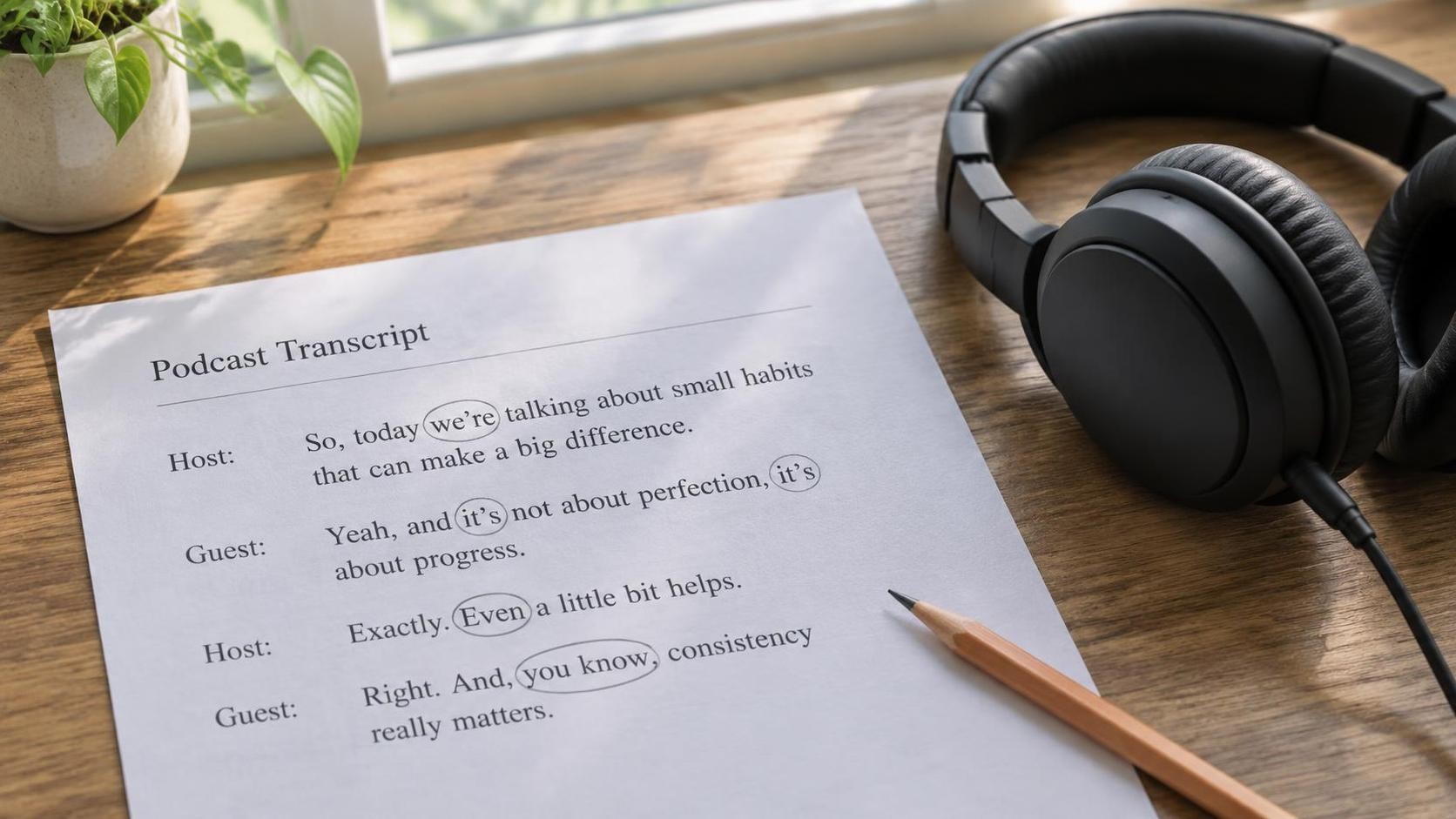
Play only the chosen clip twice while reading along. Circle every place where the written form and the heard form do not match. Most circles will land on small words: of, to, and, for, him, her. Look up no more than five words, and write the meaning in the margin, not in a separate list. The goal is not full comprehension of the episode. The goal is to connect spelling to sound in one short stretch.
Minutes 4 to 9: three shadowing passes
Pass one, together. Play the clip and speak at the same time as the hosts, matching rhythm rather than every consonant. Repeat the clip twice. The voice will feel crowded at first. That is normal, because the learner is learning to occupy the same timing as the model.
Pass two, with a lag. Speak one or two words behind the audio, like an echo. Repeat twice. The lag forces the ear to hold a phrase in memory while the mouth produces the previous one. This is the pass that changes listening most.
Pass three, solo. Mute the audio and perform the clip from memory, at the same speed, with the same stress. Record it on the phone. One take is enough. Five repetitions of a 45 to 60 second clip fits inside five minutes.
Minutes 9 to 12: retell and compare
Record a 60 to 90 second summary of the episode in plain English, using three expressions heard in the clip. Then listen to the recording once, without judging the accent. Compare the summary with the transcript for meaning: which facts were lost, which were added, which were wrong. Choose two fixes for the next session, one about sound and one about content. Stop there. The session is finished.
Three sound features to copy
1. Weak forms in function words
Small words lose their full vowel when they are not stressed. The word of becomes /əv/, to becomes /tə/, and becomes /ən/, for becomes /fə/. The content words keep their weight. In the phrase a cup of tea, the sound runs closer to a cuppa tea than to separate words. A learner who pronounces every small word fully will sound slower than the model and will mishear the model at natural speed. During pass two, hum the rhythm and let the small words collapse.
2. Linking across word boundaries
English joins words inside a phrase. A final consonant moves onto a following vowel, so turn it off sounds like tur ni toff. Two identical consonants merge into one long sound, so best time keeps a single held /t/. A final vowel can grow a glide, so go on picks up a small /w/. These joins are not sloppy speech. They are the normal shape of the language. Mark three links in the transcript with a curved line, then copy them in pass three.
3. Elision and contraction
Sounds disappear in fast speech. The /t/ in next day is often dropped, so the phrase sounds like nex day. The /h/ in tell him disappears, giving tellim. The sequence don't you blends into /dəʊntʃə/. British English also drops the final /r/ unless a vowel follows, so car ends in a vowel sound, while car alarm grows a linking /r/. None of these need to be produced perfectly. They need to be recognized, because they explain why familiar words become invisible in listening.
Expressions worth reusing for the retell
Three patterns appear often in learner podcasts and are easy to reuse. The first is be into something, as in the example sentence: the host is into old films. The second is end up doing something, as in the example: the guest ended up walking home. The third is the more, the more, as in the example: the more a learner repeats a clip, the more the sounds separate. A retell that uses two of these patterns is doing more work than a retell that lists facts.
Self assessment table
| Check | 1 point | 2 points | 3 points |
|---|---|---|---|
| Rhythm | Words are separate and even | Some phrases run together | Most phrases match the model's timing |
| Weak forms | Every small word is full | A few small words reduce | Small words collapse without effort |
| Linking | Words stop at boundaries | Some links appear | Links appear in the marked places |
| Retell | Under 30 seconds or read from notes | 60 seconds with pauses | 60 to 90 seconds, clear order, three target expressions |
| Recording | No recording made | Recorded but not reviewed | Recorded and reviewed once with two fixes |
Common mistakes
- Shadowing the whole six minutes. A learner who repeats the full episode spends most of the time catching up and none of it refining sound.
- Reading the transcript first. The first pass must be blind, or the ear never learns to tolerate uncertainty.
- Raising the speed to 1.5x. Fast playback trains fast decoding, not natural rhythm. Keep the original speed.
- Chasing a British accent. The aim is intelligibility and rhythm, not a new identity.
- Skipping the recording. Without a recording, the learner cannot hear the gap between intention and output.
- Changing the episode every day. One clip repeated for three days beats three clips heard once.
Where an app fits
ListenLeap (listenleap.com) is an app for learning English with podcasts and videos. In this routine it serves one purpose: keeping the chosen episode and the repeated clip in one place, so the learner does not switch between a browser, a PDF and a music player during the five minute shadowing block. It suits learners who already have a method and want less friction between sessions. It does not suit a learner who needs a full course, grammar explanations or a study plan, because the routine above supplies the method and the app only holds the material. One product mention is enough; the practice does the work.
Where to go next
After five or six weeks, the same session can run on natural speed audio with a published transcript. The clip shortens to 30 seconds, the repetitions stay at five, and the retell stays at 90 seconds. The self assessment table does not change. A learner who scores 2 or 3 on rhythm and linking with 6 Minute English is ready for that step. A learner who still scores 1 on weak forms should repeat the controlled audio for another two weeks, because speed hides the problem instead of fixing it.
The point
Shadowing is not a talent. It is a repeated comparison between a model and a recording. A short clip, a transcript, repeated passes and one honest review do more than an hour of passive listening. 6 Minute English supplies a reliable model at B1, and the 12 minute session supplies the repetition. The rest is calendar discipline.



Comments
No comments yet.
Leave a Comment