

The distinction between active and passive listening is one of the most discussed—and most misunderstood—topics in English learning. Spend ten minutes scanning language forums and someone will inevitably argue that passive listening is useless, while another person swears they learned English entirely by having podcasts running in the background. Both positions miss the point: these two modes are not rivals. They serve different purposes, and when used strategically together, they accelerate progress in ways neither can achieve alone.
What Active Listening Actually Demands
Active listening is not simply "paying attention." It is a structured, deliberate practice where the learner treats every second of audio as material to be processed, deconstructed, and internalized.
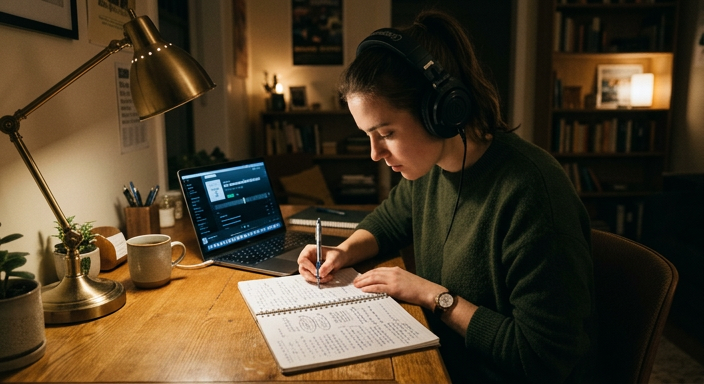
A proper active listening session follows a predictable pattern. The learner selects a short segment—90 seconds to three minutes of a podcast or video—and works through it in layers. The first pass is comprehension: what is the speaker saying? Without subtitles, without pausing, just absorbing the gist. The second pass is detail work. Sentence by sentence, sometimes phrase by phrase, the learner replays each chunk. Here is where real learning happens. A word sounds unclear—play it again. A phrase runs together in a way the ear cannot separate—slow it down. A grammar structure passes by without full understanding—pause and examine it.
This kind of deep work is what turns listening from passive reception into active skill-building. It is also mentally demanding. Most people cannot sustain genuine active listening for more than 20 to 30 minutes before their focus degrades. That is not a failure—it is the nature of deep cognitive work, and the most effective learners plan their sessions accordingly.
What Passive Listening Gets Right—and Wrong
Passive listening gets dismissed because people misunderstand what it is supposed to do. Passive listening does not teach new words. It does not clarify grammar. What it does—when used correctly—is build a massive reservoir of exposure that trains the brain to process English sounds at natural speed.
The human auditory system adapts to the patterns it encounters most frequently. A learner who only hears English during structured study sessions—maybe three or four hours per week—is giving their brain very little data to work with. Someone who adds an hour of passive listening during their commute, while cooking, or while exercising is effectively tripling or quadrupling their weekly exposure. Over months, the difference in sound recognition, rhythm intuition, and processing speed is significant.
The mistake learners make is treating passive listening as a replacement for focused study. Playing a BBC podcast in the background while writing code will not magically teach prepositions. But it will, without any conscious effort, reinforce the natural cadence of English speech, familiarize the ear with common collocations, and gradually close the gap between "I know this word on paper" and "I recognized it instantly when I heard it."

When Each Mode Fails
Both modes have one condition under which they produce zero results: mindless execution.
Active listening becomes unproductive when the learner treats it as a checkbox exercise—transcribing sentences without thinking about why a speaker chose that word or that intonation, replaying audio without forming hypotheses about what they missed. The act of listening is not the work. The thinking about what was heard is the work.
Passive listening fails when the content is incomprehensible noise. Background exposure only helps when the learner can follow at least the general thread. Playing a fast-paced debate about monetary policy to a beginner is not exposure—it is static. The sweet spot for passive listening is material the learner could understand with moderate effort if they were paying full attention. Slightly easier than active listening material. The brain needs hooks to latch onto—familiar words, recognizable topics—otherwise it tunes out completely.
The Combination That Works
The most efficient listening improvement happens when active and passive listening are deliberately paired, not just alternated at random. The pattern looks something like this:
Step one: Choose one podcast episode or video segment—roughly 10 to 20 minutes—as the anchor content for the week. This becomes the active listening material. Work through it in detail: transcribe the challenging sections, look up unfamiliar phrases, shadow the speaker's intonation. In an app like ListenLeap, this process is streamlined: the learner can tap any word in the transcript to see its definition and hear its pronunciation in both British and American accents, replay individual sentences with one touch, and use the shadowing mode to practice mimicking the speaker's delivery. The app scores pronunciation, intonation, and fluency separately, so the learner knows exactly what to improve on the next attempt.
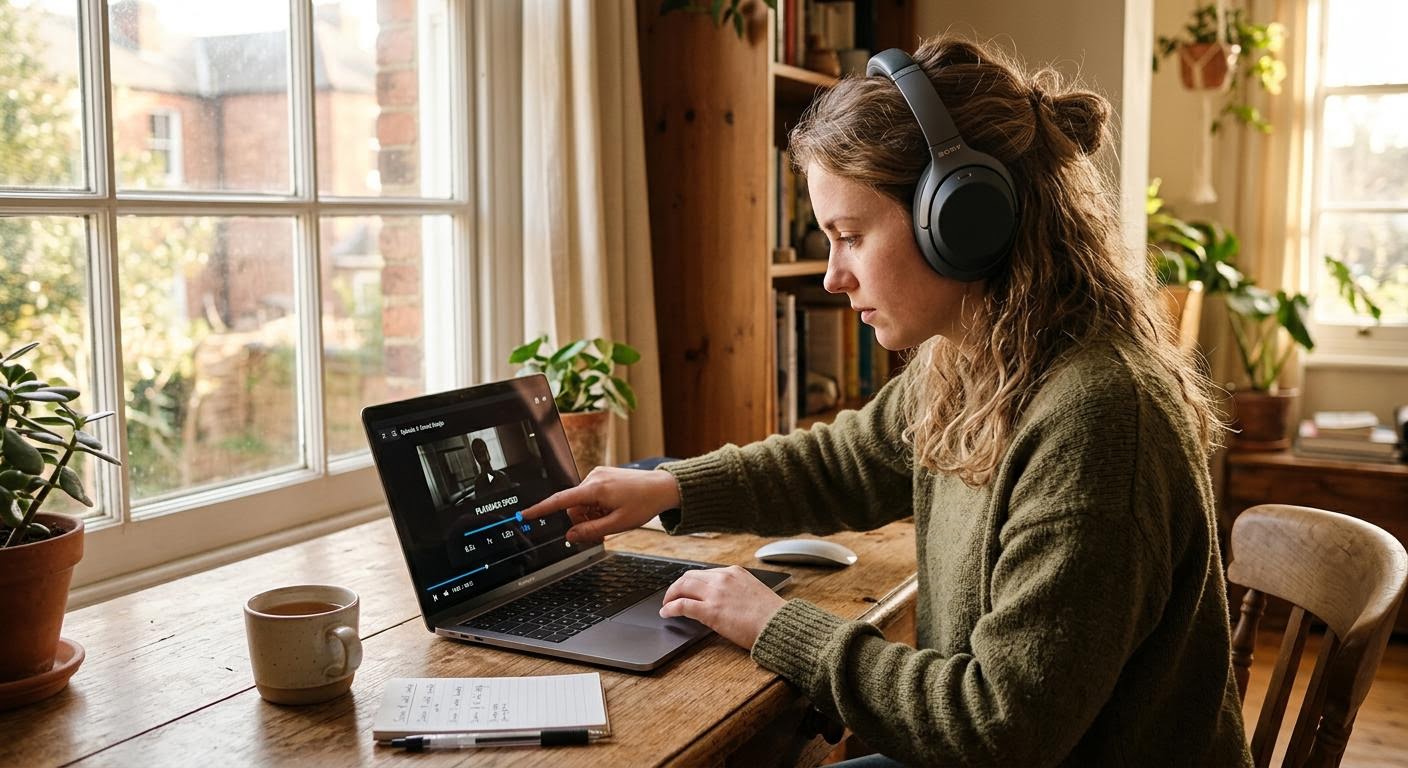
Step two: After the deep work session, listen to the same episode again during downtime—walking, folding laundry, commuting. Because every word has already been processed consciously, the passive replay locks in the connections. The brain no longer has to decode unfamiliar sounds; it can simply absorb and reinforce. This is where passive listening transforms from background noise into a genuine learning multiplier.
Step three: Expand outward. Once the anchor episode is internalized, add related but unseen content to the passive listening rotation—other episodes from the same series, discussions on similar topics, or conversations featuring the same speakers. The ear is now primed for that specific vocabulary domain and accent pattern, making the new material easier to follow without active study.

Why Learners Plateau Without Both
Learners who only do active listening eventually hit a wall. They can understand their study material just fine, but real-world conversations—with their unpredictable vocabulary, variable speeds, and lack of do-over buttons—still feel overwhelming. Active listening alone builds depth of understanding but not breadth of exposure.
Learners who only do passive listening develop a different problem. They get comfortable with the rhythm of English and can follow general topics, but their comprehension stays shallow. They cannot catch precise meaning, cannot reproduce what they hear, and struggle when the topic shifts to something unfamiliar.
The combination solves both. Active sessions build precision and expand vocabulary. Passive hours build automaticity and processing speed. Together, they close the loop between "I understood that in study mode" and "I understood that in real time, without thinking."
Making It Practical
A workable weekly framework does not need to be rigid. Three to four active sessions of 20 to 30 minutes each, paired with daily passive exposure during existing routines, is enough to see measurable progress within a month. The key is the pairing—the passive material should overlap with the active material as much as possible. A learner who studies a TED talk on climate science in active mode and then passively listens to climate-related podcast episodes throughout the week will make faster gains than someone who studies one topic and passively consumes an unrelated one.
Tools that support both modes remove the friction. ListenLeap's downloadable content and offline mode mean the learner's study material is always available for a passive replay during a subway ride without an internet connection. The blind listening mode—where the transcript is hidden on the first pass—forces the same active engagement that deliberate practice demands, while the instant tap-to-reveal function makes the transition to detail work seamless. The phrase breakdown and full-sentence explanation features help with the deconstruction work during active sessions, and the smart summary captures key expressions and useful phrases for quick review before the passive replay session.
Listening improvement is not about finding more hours in the day. It is about making the hours already available work harder. Active listening turns a small number of focused minutes into genuine skill acquisition. Passive listening turns the dead hours of daily routine into reinforcement and automation. Neither is sufficient alone. Together, they are the fastest path from "I can understand textbook English" to "I understand English the way it is actually spoken."


Comments
No comments yet.
Leave a Comment