

Nobody ever said "I can't stop listening to this vocabulary list." But people binge entire seasons of a podcast in a single weekend without even noticing the hours passing. That's the power of a good story — it hijacks your attention so completely that the language becomes invisible. You stop translating in your head. You stop worrying about grammar. You're just there, in the story.
For English learners, storytelling podcasts are something close to a cheat code. The narration is naturally paced, the vocabulary is contextual, and the emotional stakes keep you hooked — which means you're getting hours of authentic input without it ever feeling like study. The six shows below span true crime, personal memoir, investigative journalism, and language-learner content, but they share one thing: once you press play, you won't want to stop.
Why Storytelling Hits Different on ListenLeap
A good story on a regular podcast app is still just audio. If you miss a key word or a character's name flies by too fast, you either pause and Google it — killing the narrative momentum — or you let it go and hope context fills the gap later.
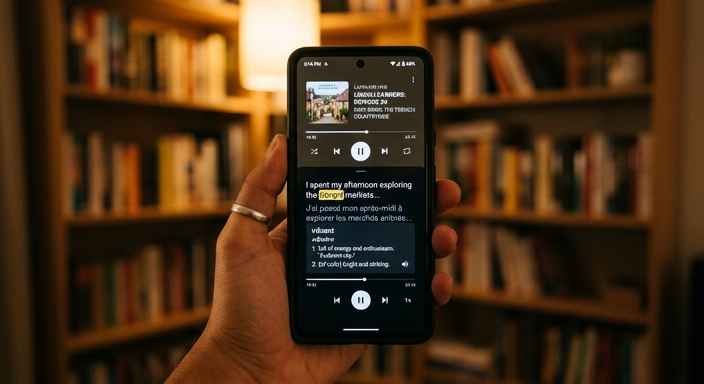
ListenLeap solves this by layering comprehension tools directly onto the listening experience. Tap any word mid-story and you get the definition, pronunciation in both British and American accents, common collocations, and example sentences — without leaving the player or losing your place in the narrative.
The bilingual subtitle system runs in real time, displaying English transcripts alongside translations in Simplified Chinese, Traditional Chinese, Japanese, or Korean. When a storyteller uses an idiom like "the elephant in the room" or "a shot in the dark," seeing the side-by-side translation reveals the meaning instantly.
ListenLeap also pre-loads an AI episode summary before you start — key plot points, notable quotes, and useful expressions — so you can skim the context first. For storytelling podcasts where missing one detail can unravel the whole thread, this is the difference between following along and getting left behind.
The app's i+1 difficulty matching means you're not guessing whether a podcast is at your level. And once you've finished listening, the shadow reading feature lets you practice delivering those same narrative sentences — scoring your pronunciation, intonation, and fluency separately so you can sound as natural as the storytellers themselves.
6 Storytelling Podcasts Worth Every Minute
1. This American Life
Difficulty: Intermediate to Advanced
Theme: Real-life stories built around a weekly theme
This American Life is the grandparent of narrative podcasting — the show that proved audio storytelling could be a cultural force. Hosted by Ira Glass for over 30 years, each episode picks one theme — fear, breakups, summer camp, money — and tells three or four true stories that orbit around it. Some are funny, some are devastating, and almost all of them contain a moment where you realize the story is about something bigger than what it first appeared to be.
With more than 800 episodes and a weekly audience of over 1.7 million listeners across 500 stations, the archive is essentially bottomless. The production is meticulous — music, pacing, and Glass's distinctive narrative voice all work together to pull you through stories that might, on paper, seem ordinary. That's the magic. On paper, a story about a school bus driver doesn't sound like much. In an episode of This American Life, it becomes unforgettable.
On ListenLeap: Because each episode contains multiple stories with different speakers and accents, the bilingual subtitle feature is especially useful here. You can track the narrative arc across different segments without losing the thread. Tap any unfamiliar term — Glass has a habit of using precise, literary vocabulary — and get the definition immediately.
2. Modern Love
Difficulty: Intermediate
Theme: True personal essays about love, relationships, and connection
Modern Love began as a weekly column in The New York Times — real people submitting deeply personal essays about their romantic lives, their marriages, their heartbreaks, and the moments that changed everything. Over 20 years, the column has grown into a podcast, a television series, and three books. Hosted by Anna Martin, each episode features an author or celebrity guest reading a selected essay aloud, followed by a conversation that unpacks what the story reveals about human connection.
What makes Modern Love particularly useful for English learners is the range of writing voices. One week you'll hear a poet's lyrical prose about a chance encounter on a train; the next, a software engineer's blunt, funny account of dating during a pandemic. Every essay is emotionally grounded — the stakes are always clear, which means you don't need cultural context to follow along. You need to understand how someone feels. And feelings translate.
On ListenLeap: The emotional vocabulary in Modern Love — longing, vulnerability, resentment, tenderness — is sophisticated but concrete. Tap any feeling-word for a full breakdown. The AI summary before each episode tells you who the essay is about and what the emotional arc is, so you can start listening already oriented.
3. StoryCorps
Difficulty: Beginner to Intermediate
Theme: Intimate, unscripted conversations between two people
StoryCorps is unlike any other podcast on this list because there is no host and no script. Each episode is simply a recording of two people who know each other — a father and daughter, two old friends, a husband and wife — sitting down and having an honest conversation about what matters most to them. The nonprofit project, distributed by NPR, has been collecting these conversations since 2003 with a simple mission: to honor and celebrate the lives of everyday Americans by listening to their stories.
Episodes are short — typically 3 to 5 minutes — and the language is natural, conversational English at its most genuine. You'll hear regional accents, emotional pauses, laughter through tears. This is not broadcast English polished for the microphone. This is how people actually talk when nobody's watching. For learners, that rawness is invaluable. You learn not just words but rhythm — the way sentences trail off, the way people interrupt themselves, the way emotion reshapes delivery.
On ListenLeap: Because StoryCorps episodes are bite-sized, they're ideal for shadow reading practice. Listen once with subtitles, then repeat each line with ListenLeap's scoring system until your delivery matches the speaker's natural cadence. The word-lookup tool is also helpful for catching regional slang and informal expressions you won't find in textbooks.
4. Serial
Difficulty: Upper-Intermediate to Advanced
Theme: Deep investigative journalism, one story per season
Serial changed podcasting. When it launched in 2014 as a spinoff of This American Life, it proved that an audio documentary series could become a cultural phenomenon. Each season follows one real story across multiple episodes — Season 1 investigated a Maryland murder case, Season 3 embedded inside a Cleveland courthouse, and subsequent seasons have tackled everything from a military prison scandal to the story of a Guantánamo detainee.
Host Sarah Koenig's style is what makes Serial work as an English-learning tool. She narrates like she's thinking out loud — she asks questions, she circles back, she admits when she's confused. That narrative transparency means the listener is always oriented. You're not being told a finished story. You're being walked through the process of figuring it out. The vocabulary is journalistic — interviews, evidence, testimony, cross-examination — but never gratuitously complex. The challenge comes from density, not obscurity.
On ListenLeap: Serial is a podcast where missing a single sentence can cost you crucial information about the case. The bilingual subtitle side-by-side view keeps you locked in. Use the AI summary after each episode to confirm you understood the key developments — then dive into the next one with the full context loaded.
5. Easy Stories in English
Difficulty: Beginner to Intermediate (4 levels available)
Theme: Original and adapted stories designed specifically for language learners
This is the one podcast on this list built from the ground up for English learners — and it's a gem. Host Ariel Goodbody, an author and language teacher, writes and narrates original stories calibrated to specific levels: Beginner, Pre-Intermediate, Intermediate, and Advanced. Every two weeks, a new story drops — fairy tales retold, original fiction, personal essays — each one introduced with clear explanations of difficult vocabulary.
Goodbody's narration is energetic, clear, and deliberately paced without sounding unnatural. Before each story begins, they explain the key words and phrases you'll encounter, then weave them into the narrative so you encounter them in context. The stories themselves are genuinely engaging — not the sanitized, watered-down "learner content" that treats you like a child. There are clever twists, emotional moments, and characters you actually care about.
On ListenLeap: Easy Stories in English is ideally suited for ListenLeap's i+1 difficulty engine. Start by assessing your level, then let the app match you to the right story tier. The word-lookup tool is less critical here since vocabulary is pre-explained, but the shadow reading feature transforms the stories into pronunciation practice. Read a paragraph aloud, get scored on three dimensions, and repeat until your delivery matches Goodbody's.
6. Criminal
Difficulty: Intermediate to Advanced
Theme: True crime stories told with empathy, nuance, and masterful pacing
True crime is the most popular podcast genre on the planet — and also the one where quality varies most wildly. Criminal, hosted by Phoebe Judge since 2014, stands apart. It doesn't chase gore or sensationalism. Instead, it explores the edges of crime and justice: a minister who secretly helped women access safe abortions before Roe v. Wade, a decades-long tree-poaching investigation, the logistics of exhuming a body for forensic evidence.
Judge's voice is the instrument here — calm, measured, precise — and her interviewing style is a lesson in conversational English. She adapts to each guest, giving space to some and gently prompting others, never confrontational but never afraid to ask hard questions. The production is minimalist. There's no wall of background music or dramatic sound effects. It's just a story, well told, with respect for both the subject and the listener.
On ListenLeap: Legal and forensic vocabulary — indictment, statute of limitations, exhumation, chain of custody — appears frequently on Criminal. The tap-to-define feature turns every episode into a vocabulary lesson without breaking the narrative flow. And because Judge's delivery is so measured, Criminal episodes are excellent material for shadow reading at intermediate levels and above.
How to Start Listening Today
If you're new to storytelling podcasts, don't overthink it. Pick the show that matches your level and your mood — that's the one you'll actually stick with.
For beginners, start with StoryCorps (3- to 5-minute episodes, natural conversational English) or Easy Stories in English (level-calibrated stories with pre-taught vocabulary). For intermediate learners, Modern Love hits the sweet spot — emotionally engaging, clear narrative arcs, episodes around 25 to 30 minutes. Advanced learners can dive into This American Life, Serial, or Criminal — all three demand sustained attention but reward it with language that sticks.
The most common mistake learners make with storytelling podcasts is treating them like textbooks — pausing every 30 seconds to Google a word, interrupting the narrative, and draining the enjoyment. Instead, use ListenLeap's built-in tools: tap words as you go without stopping the audio, glance at the bilingual subtitles when you lose the thread, and check the AI summary afterward to confirm you caught the main points. The goal is immersion first, precision second.
The Bottom Line
Storytelling is the oldest language-learning platform in human history. Before textbooks, before classrooms, before writing itself, people learned language by listening to stories. The tools have changed — now it's wireless earbuds and a smartphone app instead of a campfire — but the mechanism hasn't. Narrative is the most efficient vehicle for language input because it engages you emotionally. And emotion is what makes things memorable.
These six podcasts won't just improve your English. They'll make you forget you're practicing at all. That's the real test of good learning material: when the only reason you stop listening is because the episode ended.



Comments
No comments yet.
Leave a Comment