
Science and technology shape nearly every conversation worth having today — from AI breakthroughs and space exploration to the neuroscience behind everyday habits. For English learners, this creates a unique opportunity: the chance to build advanced vocabulary in fields that genuinely matter while staying informed about the world's most exciting developments.
But finding the right podcast is harder than it sounds. Too technical, and you spend more time looking up jargon than actually listening. Too casual, and you miss out on the precise terminology that makes scientific English so valuable. Too fast, and you feel like you are drowning in syllables.
The six podcasts below strike the right balance. They cover real science and real technology — nothing watered down — but the hosts know how to make complex ideas accessible. Some are solo shows with measured pacing. Others are fast-moving conversations between experts. All of them reward repeated listening, which is exactly what language learners need.
ListenLeap was built for exactly this kind of content. The app's i+1 difficulty grading system places each episode at the right level for the listener, so a neuroscience talk from Huberman Lab and a news-driven AI discussion from Hard Fork each land in the sweet spot between comfort and challenge. Bilingual subtitles in simplified Chinese, traditional Chinese, Korean, and Japanese mean that when a term like "neuroplasticity" or "large language model" appears, one tap brings the translation. Blind listening mode strips away the text entirely for focused ear training, and the shadowing tool scores pronunciation, intonation, and fluency on every attempt. For learners who want to go deeper, the AI Q&A function can explain any concept from an episode in plain English — or in the learner's native language — turning a 30-minute podcast into a full study session.
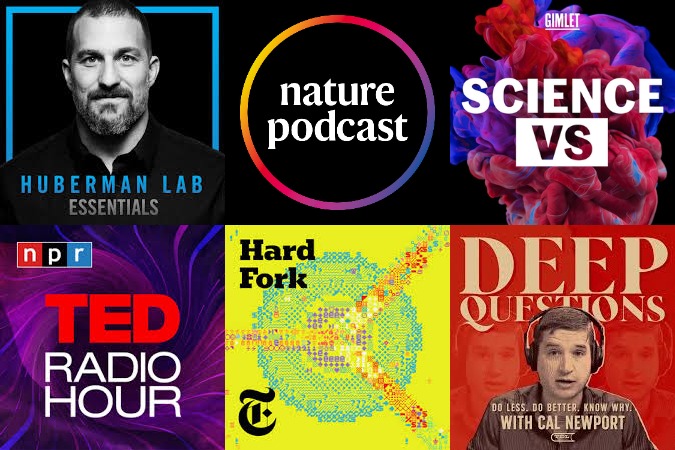
Here are the six science and technology podcasts that deserve a spot in every English learner's queue.
1. TED Radio Hour
Difficulty: Intermediate to Advanced
Hosted by Manoush Zomorodi and produced by NPR, TED Radio Hour weaves together multiple TED talks around a single big idea each episode. Topics span technology, psychology, design, and the future of work — episodes have covered artificial intelligence ethics, the science of decision-making, and how the internet rewires human attention.
What makes this show special for English learners is the format. Each episode stitches together short, self-contained segments from different speakers, each lasting five to ten minutes. That means listeners encounter multiple accents, speaking styles, and vocabulary registers within a single hour. Manoush Zomorodi's narration bridges the segments with clear, well-paced NPR English — the kind that feels professional without ever sounding stiff.
On ListenLeap, TED Radio Hour shines as a study tool. The segmented structure means learners can tackle one speaker's segment at a time, using the AI summary to confirm comprehension before moving on. The bilingual subtitles help catch the cultural references and idiomatic phrases that TED speakers love to weave into their talks, and the vocabulary notebook lets learners save domain-specific terms from each episode — "algorithmic bias" from a tech episode, "cognitive load" from a psychology one — for later review.
2. Hard Fork
Difficulty: Advanced
Kevin Roose and Casey Newton, both technology journalists at The New York Times, host this weekly show about the intersection of technology, business, and culture. The conversation moves fast — these are two reporters who spend their days covering Silicon Valley, and they talk like it. Episodes dissect the latest AI product launches, debate the implications of new research papers, and occasionally bring on guests from companies like OpenAI, Google DeepMind, and Anthropic.
Hard Fork is demanding listening. Roose and Newton use industry shorthand, crack jokes that rely on tech-culture literacy, and sometimes talk over each other in moments of genuine debate. But for advanced English learners aiming to work in tech or simply follow the AI conversation in its native language, there is no better training ground. The vocabulary is precisely the kind that populates English-language tech media — "guardrails," "alignment," "compute," "fine-tuning," "scaling laws" — and hearing these terms used in natural, unscripted discussion builds a deeper understanding than any flashcard ever could.
ListenLeap's tap-to-lookup feature handles the heavy lifting when technical terms fly by. The phrase-level explanation tool breaks down longer expressions like "we are in the middle of an inference cost collapse," unpacking each component so the sentence makes sense as a whole. And because Hard Fork is conversational, the shadowing tool is especially useful for learners who want to practice the rhythm of natural English debate — the way Roose and Newton interrupt, agree, and push back in real time.
3. Deep Questions with Cal Newport
Difficulty: Intermediate to Advanced
Cal Newport is a computer science professor at Georgetown University and the author of bestsellers like "Deep Work" and "Digital Minimalism." His podcast explores a deceptively simple question: how do people stay focused and do meaningful work in an age of constant digital distraction?
What distinguishes this show from other productivity podcasts is the intellectual rigor Newport brings to every episode. He does not offer life hacks. He builds arguments from first principles, drawing on cognitive science, philosophy, and his own research in distributed algorithms. The solo episodes, where Newport answers listener questions about career decisions, study habits, and technology habits, are particularly useful for English learners — they follow a single voice at a measured pace, with clear transitions between ideas and plenty of repetition of key concepts.
On ListenLeap, Deep Questions works well for structured study. The question-and-answer format means each listener query forms a natural break point, so a learner can listen to one segment, check comprehension with the AI summary, note down relevant vocabulary, and then continue. Newport's academic vocabulary — words like "deliberate practice," "attention residue," and "cognitive switching cost" — builds a valuable register of English that applies far beyond technology topics.
4. Huberman Lab
Difficulty: Advanced
Dr. Andrew Huberman is a professor of neurobiology and ophthalmology at Stanford School of Medicine, and his podcast is regularly ranked the number one health podcast in the world. Episodes run long — often two to four hours — and dive deep into topics like sleep science, dopamine regulation, cold exposure, strength training, and neuroplasticity.
Huberman Lab is not easy listening. Huberman speaks at a natural pace and uses precise scientific terminology throughout: "dopaminergic pathways," "sympathetic nervous system activation," "retinal ganglion cells." But his style is also remarkably structured. Each episode opens with a clear roadmap of what will be covered, proceeds through numbered segments, and closes with a recap of key takeaways. That scaffolding is a gift for English learners — it means listeners always know where they are in the argument and what vocabulary to expect next.
ListenLeap turns Huberman Lab's marathon episodes into manageable study blocks. The app's progress tracking lets learners chip away at an episode across multiple sessions without losing their place. The blind listening mode is especially effective here — Huberman's clear enunciation and logical structure make his episodes ideal for training the ear without visual support. When a term like "circadian entrainment" stops a listener cold, the phrase explanation breaks it into parts, and the vocabulary notebook saves it for spaced repetition review.
5. Nature Podcast
Difficulty: Advanced
Produced by the editors of Nature, one of the world's most prestigious scientific journals, this weekly show covers the latest research across every scientific discipline. Hosts Benjamin Thompson, Nick Petrić Howe, and Shamini Bundell interview the scientists behind newly published papers and discuss what the findings mean in plain terms.
Each episode runs about 25 to 30 minutes and typically covers two to three studies, with a shorter news roundup segment. The hosts ask the clarifying questions a curious non-specialist would ask — "What does this actually tell us that we did not know before?" and "How did the researchers figure this out?" — which means the listener gets to hear scientific concepts explained twice: once by the host in everyday language, and once by the researcher in more technical terms.
On ListenLeap, the Nature Podcast serves as a bridge between general English and academic English. The research segments introduce formal scientific vocabulary — "longitudinal study," "statistically significant," "peer-reviewed" — while the host-researcher dialogue demonstrates how to discuss complex findings conversationally. The fill-in-the-blank exercise mode, built from episode transcripts, reinforces this academic vocabulary through active recall, and the PDF export lets learners build a personal archive of science-focused study materials.
6. Science Vs
Difficulty: Intermediate to Advanced
Originally launched by ABC Australia and later acquired by Gimlet Media and Spotify, Science Vs takes on trending topics and popular claims — everything from 5G safety to intermittent fasting to the science of attraction — and pits them against the actual scientific evidence. Host Wendy Zukerman brings an infectious energy to each episode, interviewing researchers, digging into study methodologies, and arriving at conclusions that are often surprising.
What makes Science Vs uniquely useful for English learners is its commitment to explanatory clarity. When a study says one thing and a headline says another, Zukerman walks through exactly where the disconnect happened. That process — translating between scientific language and everyday English — models exactly what language learners need to do themselves. The episodes run around 30 to 40 minutes, the pacing is brisk but not rushed, and the sound design (Gimlet's signature style) keeps the listening experience engaging throughout.
ListenLeap's AI Q&A feature pairs naturally with Science Vs episodes. After listening, a learner can ask the AI to explain the study designs mentioned in the episode, clarify the difference between correlation and causation in the context of that specific topic, or generate vocabulary lists organized by theme. The smart summary function captures the episode's evidence hierarchy — what the science actually says versus what popular culture claims — which makes review sessions far more efficient than re-listening from scratch.
If someone is new to science and technology podcasts in English, the smartest approach is to start with TED Radio Hour or Science Vs. These two shows prioritize accessibility without dumbing anything down — meaning a learner with a solid B1 foundation can follow along and gradually absorb the vocabulary of scientific reasoning. Deep Questions with Cal Newport sits at a similar level and adds a layer of academic vocabulary useful across disciplines.
From there, Nature Podcast introduces the register of formal scientific communication, while Hard Fork and Huberman Lab push the ceiling — the former with speed and cultural density, the latter with depth and technical precision. Rotating between shows keeps the content fresh and prevents the ear from settling into one speaker's rhythm, which is critical for building genuine listening fluency.
The key is consistency over intensity. Fifteen minutes a day with a podcast at the right difficulty level, supported by ListenLeap's tools for vocabulary capture and comprehension checking, will produce far more progress than a two-hour binge session once a week. The podcasts are not going anywhere — the science and the language will both still be there tomorrow.
Science and technology podcasts do something that traditional English learning materials rarely achieve: they make learners forget they are studying. When a Huberman Lab episode explains how morning sunlight sets the brain's internal clock, or when Hard Fork debates whether the latest AI model represents genuine progress or clever marketing, the language stops feeling like an obstacle and starts feeling like a window. That shift — from "I need to understand these words" to "I need to know what happens next" — is where real language acquisition happens. All six of these shows can get a learner there.



Comments
No comments yet.
Leave a Comment