
History is not a fast subject. It does not move in 30-second clips or demand split-second reactions. It unfolds, deliberately, through narratives that connect cause and effect across decades and centuries. That deliberate pace — the way a good history podcast lingers on context before rushing to judgment — makes the genre uniquely suited for English learners who want to build listening stamina and academic vocabulary without feeling overwhelmed.
History podcasts also deliver something that most English-learning materials cannot: genuine content stakes. When a host describes how the Roman Republic collapsed, or how the Cuban Missile Crisis brought the world to the brink of nuclear war, the listener wants to know what happens next. That motivation — the desire to understand the story, not just decode the language — transforms passive listening into active learning. The vocabulary of diplomacy, warfare, social change, and political power settles into memory because it arrived attached to a narrative, not a flashcard.
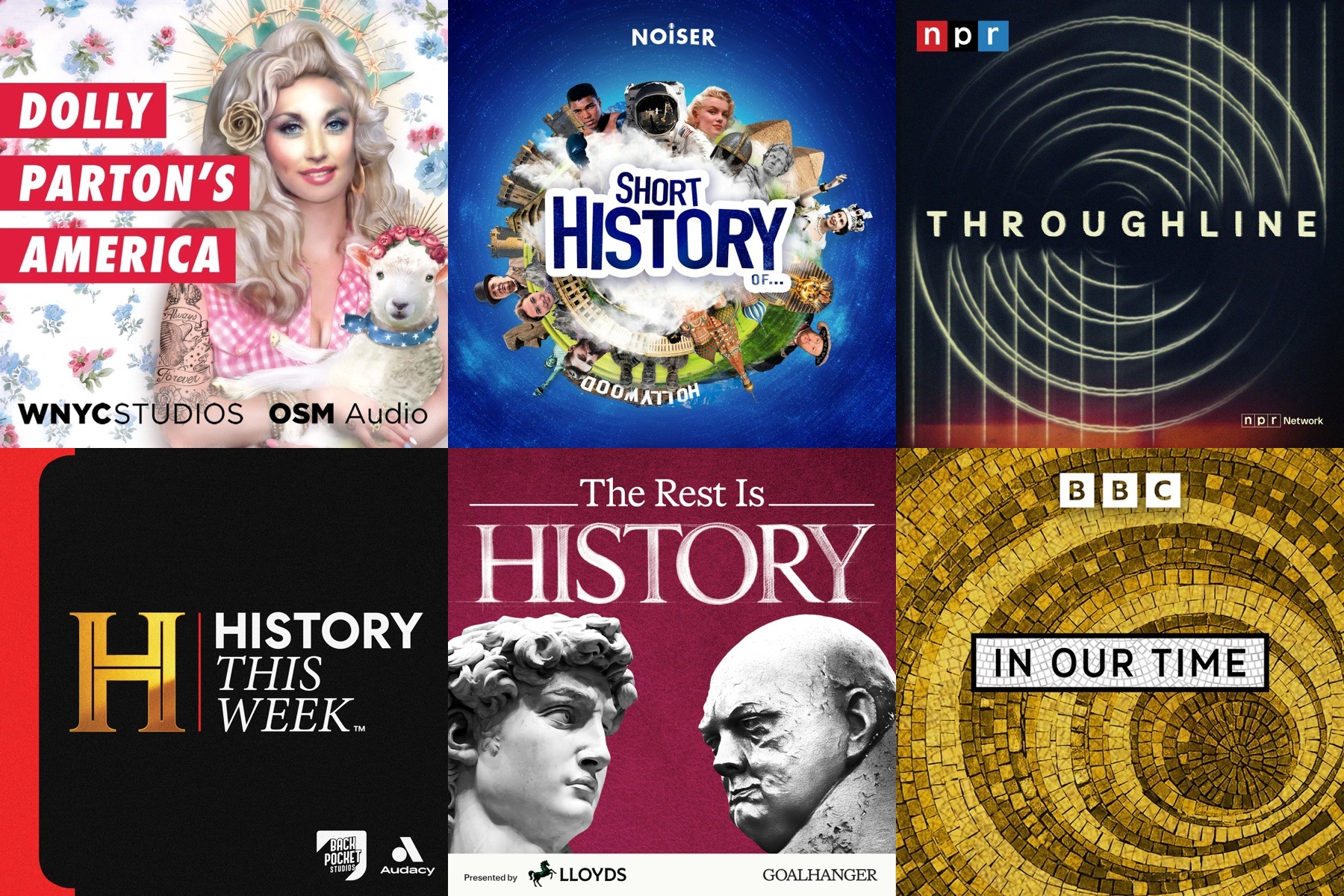
The six podcasts below span different eras, formats, and difficulty levels, but all share one quality: they treat history as a story worth telling, and they tell it in clear, well-paced English.
ListenLeap was designed for exactly this kind of content. History podcasts are dense with proper nouns, specialized terms, and references that fly past in seconds. ListenLeap's tap-to-lookup feature catches those moments instantly — tap any word in the bilingual subtitle and see the translation in simplified Chinese, traditional Chinese, Korean, or Japanese. The phrase-level explanation tool unpacks longer expressions like "balance of power" or "constitutional monarchy" component by component. Blind listening mode strips the subtitles away entirely for focused ear training, and the shadowing tool scores pronunciation, intonation, and fluency on every attempt. After listening, the AI Q&A can explain historical context from any episode in plain English or the learner's own language, and the smart summary condenses a 45-minute episode into a review that takes two minutes to read.
Here are six history podcasts that belong in every English learner's rotation.
1. Throughline
Difficulty: Intermediate to Advanced | NPR | American English
Produced by NPR and hosted by Peabody Award-winning journalist Rund Abdelfatah, Throughline operates like a time machine. Each episode takes a question from the present — a political conflict, a cultural tension, a technological shift — and traces its roots backward through history to answer the question, "How did we get here?" Recent episodes have explored the hundred-year story of Route 66, the complex legacy of global trade routes, and how ancient political philosophies still shape modern governance.
What makes Throughline exceptional for English learners is the production quality. Abdelfatah narrates at a measured, broadcast-standard pace, and every episode layers expert interviews, archival recordings, and original sound design into a cohesive narrative. Listeners hear multiple voices and accents within a single episode, which trains the ear for real-world English diversity. On ListenLeap, the clear segment breaks within each episode create natural pause points for comprehension checks. A learner can listen to a 12-minute segment, review the AI-generated summary to confirm understanding, save the key historical terms — "manifest destiny," "collective memory," "colonial administration" — to the vocabulary notebook, and then continue.
2. In Our Time
Difficulty: Advanced | BBC Radio 4 | British English
Few podcasts have the intellectual lineage of In Our Time. Hosted by Melvyn Bragg and produced by BBC Radio 4 since 1998, each episode brings together three academic experts — historians, philosophers, scientists — to discuss a single topic for approximately 45 minutes. The show is unapologetically intellectual. Bragg does not simplify or translate the academics' language for a general audience; he challenges them to be clear, and they meet him there.
For advanced English learners, In Our Time is a masterclass in academic discussion. The vocabulary is university-level: episodes on the Roman Empire bring terms like "client kingdom" and "praetorian guard," while episodes on philosophy introduce words like "epistemology" and "teleology." The conversational dynamic — three experts and one moderator — models the rhythm of English-language seminar discussions: the way speakers build on each other's points, offer respectful disagreement, and circle back to clarify earlier statements. On ListenLeap, the phrase-level explanation tool is essential here. Complex academic expressions get broken into their parts so the learner understands both the vocabulary and the syntax that holds it together.
3. The Rest Is History
Difficulty: Intermediate to Advanced | Goalhanger | British English
If In Our Time is the seminar, The Rest Is History is the after-seminar pub conversation — equally informed, far more irreverent. Hosted by historians Tom Holland and Dominic Sandbrook, this Goalhanger-produced podcast covers everything from the Fall of the Roman Empire to the Cold War, from medieval witch trials to the rise of football as a global sport. The tone is conversational, witty, and occasionally laugh-out-loud funny, but the historical rigor is real: both hosts are published authors with deep academic backgrounds.
The Rest Is History works well for upper-intermediate and advanced learners because it sounds like real conversation between smart people who genuinely enjoy each other's company. Holland and Sandbrook interrupt each other, crack jokes that rely on shared cultural knowledge, and occasionally go off on tangents that turn out to be the most interesting part of the episode. For English learners, this is gold — it is the English of opinion, debate, and camaraderie, not the English of prepared scripts. On ListenLeap, the shadowing tool helps learners practice the rhythm of this kind of conversation, and the fill-in-the-blank exercises built from episode transcripts reinforce the informal vocabulary that textbooks rarely teach.
4. HISTORY This Week
Difficulty: Intermediate | The HISTORY Channel | American English
The HISTORY Channel's official weekly podcast does exactly what the title promises: each episode takes a single week in history and zooms in on the most consequential event that happened during those seven days, whether or not it made the textbooks. Episodes run around 25 to 30 minutes and follow a tight narrative structure — setup, conflict, resolution — that makes them easy to follow even for intermediate learners.
HISTORY This Week is the most accessible entry point on this list. The host speaks clearly at a moderate pace, the episodes are short enough to listen to twice in one sitting, and the storytelling prioritizes human drama over academic analysis. Episodes cover moments like the first successful heart transplant, the day women gained the right to vote in America, and the night the Berlin Wall began to fall — events that carry enough inherent tension to keep a listener engaged regardless of language level. On ListenLeap, the 25-minute format fits naturally into the commute or a lunch break. Blind listening mode works well here because the narrative structure is intuitive enough to follow without text support.
5. Short History Of...
Difficulty: Intermediate | Noiser | British English
Produced by Noiser and hosted by John Hopkins, Short History Of... dedicates each episode to a single historical event, figure, or era — the Cuban Missile Crisis, the Vikings, the French Revolution, Cleopatra. Episodes run about 45 to 60 minutes and are built as audio documentaries: narration, expert commentary, and immersive sound design combine to create a listening experience that feels closer to a film than a lecture.
The formula suits English learners well. Each episode opens with the central question or conflict, proceeds through a chronological narrative, and closes with a reflection on the event's lasting significance. The repetition of key names, dates, and concepts throughout the episode reinforces vocabulary naturally — by the end of a 50-minute episode on the Roman Empire, a learner will have heard "legion," "senate," and "emperor" at least a dozen times each in different contexts. On ListenLeap, the PDF export feature lets learners save the transcript and their notes as a single document for offline study, and the smart summary captures the episode's narrative arc for efficient review.
6. Dolly Parton's America
Difficulty: Intermediate to Advanced | WNYC Studios / OSM Audio | American English
Dolly Parton's America is not a survey of centuries. It is a nine-episode deep dive into a single subject: the life, music, and extraordinary cultural influence of country legend Dolly Parton. What begins as an exploration of a beloved musician becomes, over nine hours, a meditation on American identity — class, gender, faith, politics, and the question of how one woman from rural Tennessee became one of the few figures almost everyone in a deeply divided country can agree on.
This podcast works well for English learners for reasons that have nothing to do with academic vocabulary. The English here is the English of storytelling — personal, emotional, full of Southern idioms and musical references and the kind of phrases that reveal as much about American culture as they do about the language itself. The production is cinematic, the pace is unhurried, and the emotional arc of the series gives listeners a reason to keep coming back. On ListenLeap, the bilingual subtitles help decode the Southern expressions and cultural references that might otherwise puzzle a learner, and the AI Q&A can explain the historical context — the Great Depression in Appalachia, the Nashville studio system, the feminist debates of the 1970s — that shapes every episode.
If someone is new to history podcasts in English, the best approach is to start with HISTORY This Week or Short History Of... Both shows prioritize narrative clarity, keep episodes under an hour, and assume no prior historical knowledge — meaning an intermediate learner can follow the story without constantly reaching for the pause button.
From there, Throughline bridges the gap between narrative history and analytical history, introducing the kind of cause-and-effect reasoning that builds critical thinking alongside language skills. The Rest Is History adds conversational speed and cultural density, while In Our Time raises the ceiling to university-level academic discourse. Dolly Parton's America offers something different — a deep-dive series format that rewards binge-listening and builds emotional connection alongside language acquisition.
The most reliable strategy is rotation. Listening to the same host, same accent, same pace every day trains the ear for one specific pattern. Rotating between shows — NPR one day, BBC the next, a conversation-driven show on Wednesday — forces the brain to adapt, which is where real listening fluency develops. Fifteen minutes a day across a mix of these six podcasts, supported by ListenLeap's tools for vocabulary capture and comprehension checking, builds more progress than a two-hour session with a single show.
History podcasts do something that few language learning materials manage: they make the learner forget the language is there. When Throughline traces the roots of a modern political crisis back to a decision made in a palace three centuries ago, or when The Rest Is History turns the collapse of an empire into a story as gripping as any thriller, the English stops being the point. The story becomes the point. And that is exactly when the language takes root.




Comments
No comments yet.
Leave a Comment