
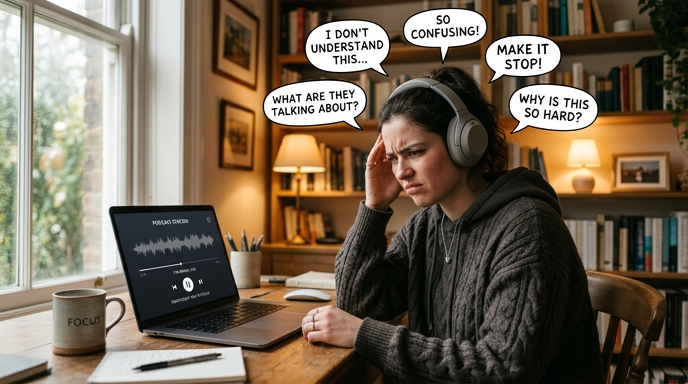
You have been listening to English podcasts every day for six months. You can follow BBC Global News without pausing. You laugh at comedy bits on Conan O'Brien's podcast. You understand TED talks about quantum physics well enough to summarize the main points.
Then someone asks you a simple question in English. And your mind goes blank.
The words are there. You know them. You just heard them on a podcast 20 minutes ago. But they will not come out of your mouth. Your brain searches, finds nothing, and offers you a broken sentence that sounds nothing like what you wanted to say.
If this sounds familiar, you are not alone. Welcome to the most common and most misunderstood problem in English learning.
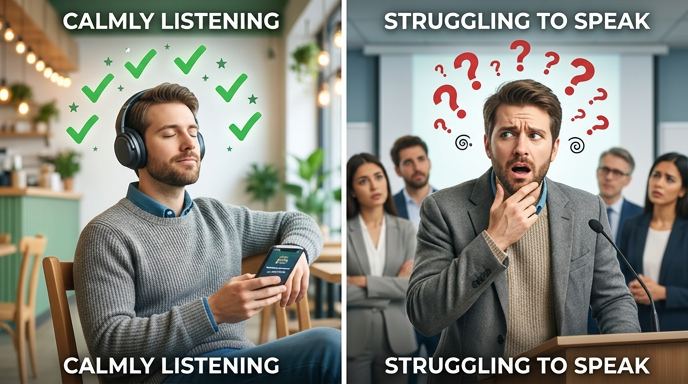
The Listening Trap: Why Podcast-Only Learning Falls Short
Podcasts are powerful tools. They expose learners to natural speech patterns, diverse accents, real vocabulary, and authentic pacing. Many learners assume that more listening equals better speaking. If they can just absorb enough input, the output will come naturally.
That assumption has led millions of learners down a dead-end path.
The data from 2026 tells a clear story. Across major language learning platforms and app analytics, learners who spend more than 70 percent of their study time on passive input—listening, watching, reading—show far slower speaking improvement than those who split their time evenly between input and output. The pattern is so consistent that many platforms now warn users when their passive-to-active ratio tips too far.
The reason is rooted in how the brain processes language. Listening comprehension and speaking production use two different neural systems. Comprehension is recognition: the brain matches incoming sounds to stored patterns. Production is retrieval: the brain must locate the right word, assemble it with correct grammar, and coordinate the muscles of the mouth and throat—all in real time.
Recognition is fast and automatic after enough exposure. Retrieval is slow and effortful without dedicated practice.
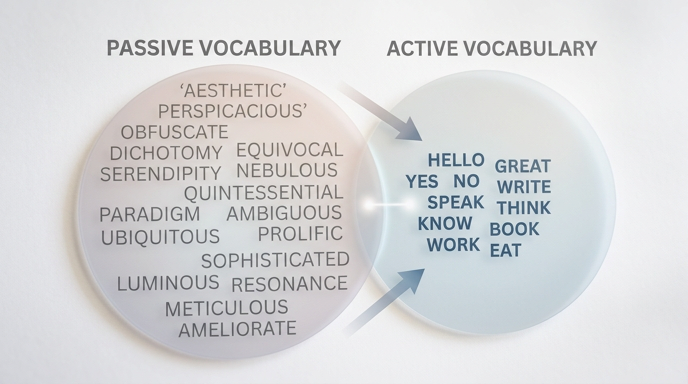
A learner who spends 300 hours listening to podcasts has built an excellent recognition system. But without the same investment in retrieval practice, the production side remains underdeveloped. The words are stored in the brain's passive vocabulary—words the learner can understand when heard—but they have not been transferred to the active vocabulary—words the learner can use freely when speaking.
This gap between passive and active vocabulary is the single biggest barrier to speaking fluency. And it only grows wider the more time a learner spends on listening alone.
Why 2026 Looks Different from 2020
The pandemic years pushed millions of learners toward self-study with digital tools. Podcast consumption among English learners hit record highs. But the corresponding leap in speaking ability never materialized.
By 2026, learner behavior analytics reveal a clear correction. The learners making the fastest progress are not the ones listening to the most podcasts. They are the ones who use listening as a foundation—then immediately follow it with production work.
The formula that works looks like this: Listen → Process → Repeat → Produce.
Listen to a three-minute clip. Pause. Process the language—what words were used, how sentences were structured. Repeat the phrases aloud. Then produce your own version of the same idea.
This cycle turns passive recognition into active retrieval. Each repetition strengthens the neural pathways needed for spontaneous speaking.
How to Bridge the Gap: From Recognition to Retrieval
The fix is not to stop listening to podcasts. The fix is to change what happens after you listen.
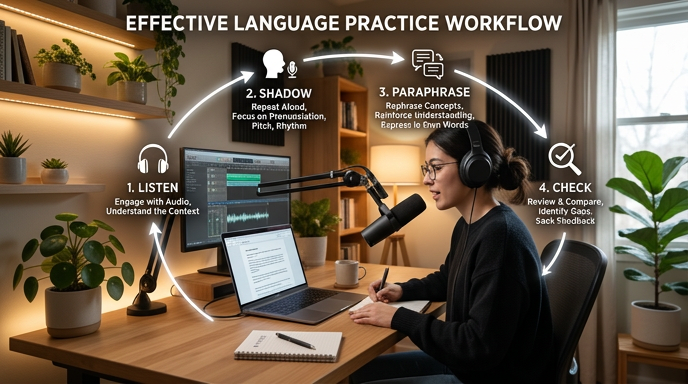
Here is a practical framework that works across all proficiency levels:
Step 1: Shorten the listening window. Instead of listening to a 30-minute podcast in one sitting, break it into 3-minute segments. Short bursts allow the brain to focus on language detail rather than content flow.
Step 2: Shadow every segment. Immediately after hearing a 3-minute clip, repeat the speaker's words aloud with the same intonation and pacing. This trains the mouth muscles and connects listening patterns to speaking patterns.
Step 3: Paraphrase without the script. Close the player and say the same idea in your own words. This forces the brain to retrieve vocabulary and construct sentences from scratch—the exact skill needed in real conversations.
Step 4: Check your accuracy. Record yourself and compare your version to the original. Identify what changed: Did you simplify the grammar? Did you use a weaker verb? Did you miss a connector that would have made the sentence flow better?
Each repetition of this cycle moves one more word from passive storage to active use.
ListenLeap: Where Passive Input Becomes Active Output
This is exactly where ListenLeap enters the picture. The platform was built on the understanding that listening alone is not enough—learners need a structured bridge from comprehension to production.
The magic lies in tools that force active retrieval. After listening to any clip from ListenLeap's library of 10,000+ podcasts across BBC, TED, and NPR, users can jump straight into targeted output exercises. The fill-in-the-blank trainer strips key words from transcripts and challenges the brain to retrieve them from context. The shadowing tool records a learner's voice alongside the original speaker and scores pronunciation, intonation, and fluency in three separate dimensions—turning passive listening into active muscle training.
The AI answer feature takes this further. Instead of passively consuming content, learners respond to AI-generated questions about the clip they just heard. They must retrieve vocabulary, construct sentences, and organize thoughts—all in real time. This mirrors the demands of actual conversation far better than listening alone ever could.
Every feature is designed around one principle: understanding must be followed by production. The bilingual subtitles (available in simplified Chinese, traditional Chinese, Korean, and Japanese) help learners catch the details during input. But it is the output tools—shadowing, fill-in-the-blank, AI answer, and the smart summary exercise—that move language from the passive shelf into active use.
A 30-Day Plan to Fix the Gap
Here is a realistic schedule for anyone stuck in the understanding-without-speaking trap:
Week 1: Break the podcast habit. Reduce daily listening from 30 minutes to 15 minutes. Spend the other 15 minutes shadowing the first 3-minute segment. Do not move on until you can shadow it at near-native speed.
Week 2: Add paraphrasing. After shadowing, close your eyes and say the same idea in your own words. If you cannot, re-listen and try again. The struggle is the learning.
Week 3: Record and compare. Shadow, paraphrase, then record both. Listen back. Identify three language gaps in your version and practice those specific areas.
Week 4: Go reactive. Use the AI answer feature on ListenLeap after every listening session. Answer questions about what you heard. If you stumble, re-listen to the part that contains the language you needed.
By the end of 30 days, the words you understood passively will start appearing in your speech without effort.
The Real Story
The 2026 data confirms what language specialists have observed for decades: speaking is not a byproduct of listening. It is a separate skill that requires separate practice.
Listening to English podcasts is a fantastic way to build comprehension. But comprehension is only half the journey. The other half—production—requires deliberate, structured, and consistent output practice. No amount of passive input can substitute for the moment when a learner must open their mouth and speak.
The good news is that the gap is fixable. The brain already has the words. They just need to be moved from the passive shelf to the active toolbox. With the right tools and the right routine, that transition happens faster than most learners expect.
Stop waiting for speaking to come naturally. It will not. Build the bridge yourself.



Comments
No comments yet.
Leave a Comment